Automotive MarketGovernment Support Propels Chinese Auto Sales to Record Heights
From
Henrik Bork | Translated by AI
3 min Reading Time
China reports 21 million vehicles sold in eight months—a 12 percent increase. Electric vehicles are booming thanks to subsidies, and exports are also rising rapidly.
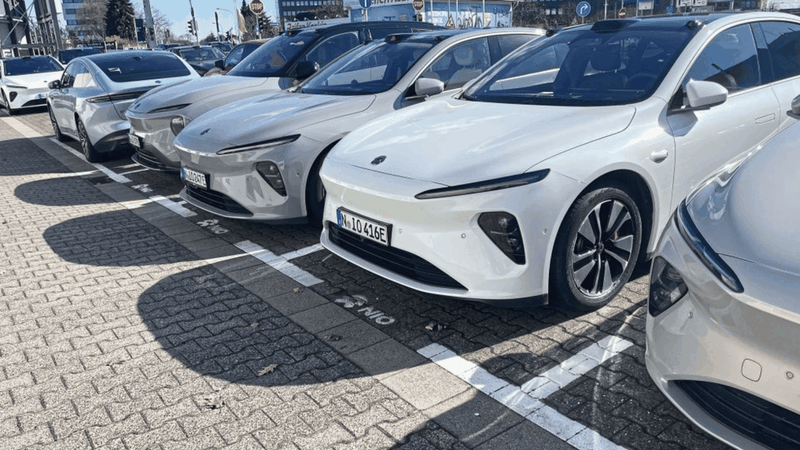
Supported by a strong domestic market, Chinese brands like Nio are seeking breakthroughs in many global markets.
(Image: Grimm – VCG)
China's automotive market is on a record-setting path. In the first eight months of 2025, over 21 million vehicles were sold, marking an increase of more than twelve percent compared to the same period last year. This means that the milestone of 20 million units sold has been surpassed for the first time before the end of the year. Nearly 2.9 million vehicles were sold in August alone, reflecting a robust increase of 16 percent compared to the same month last year.
Industry observers attribute the current sales boom to a wave of new models, particularly in the field of electromobility, which is sparking buyer interest, as well as new government incentives. Additionally, electricity prices, which are already several times lower than in Germany, are decreasing in China. It is becoming increasingly affordable to drive electrically, leading more drivers to make the switch.
Government Promotes Electric Vehicle Purchases
As the central government is not satisfied with consumption and GDP growth, it has also revived a series of economic stimulus measures for car buyers. "The growth of the automotive market has primarily been driven by the government's consumption-boosting measures," says Cui Dongshu, Secretary-General of the Chinese Passenger Car Association (CPCA). "In particular, a nationwide trade-in program for vehicle exchanges provided a significant boost in the first half of 2025."
At the beginning of the year, Beijing reintroduced an incentive program, where buyers of a new electric vehicle are rewarded for trading in their old combustion vehicle. This initiative proves to be very popular, leading to a noticeable increase in sales, especially in the first half of 2025.
Market for Internal Combustion Engine Models Grows
A large-scale model offensive from manufacturers is also contributing to the increase in sales. Additionally, the government's campaign against excessive price competition within the industry is helping. The market is not only growing, but prices are also gradually stabilizing, as heard in industry circles.
Even vehicles with internal combustion engines are currently experiencing gains. In August, sales of conventional cars rose by 13 percent compared to the previous year. This marked the third consecutive monthly increase.
Alternative Drives as Growth Drivers
However, it is primarily the boom in so-called New Energy Vehicles (NEVs) that is driving the automotive industry in the People's Republic. NEVs mainly refer to battery electric cars and hybrids. From January to August, nearly ten million vehicles were sold in this segment, reflecting an increase of nearly 37 percent compared to the same period last year.
Vehicles with alternative drives accounted for over 45 percent of the total new car market since the beginning of the year. In August, the NEV share was just under 50 percent of total sales. "The market has clearly recognized the momentum of electric vehicles, and consumer enthusiasm for them remains high," says Cui. Particularly, micro and compact electric cars have seen significant sales recently, contributing substantially to the growth, according to the association spokesperson.
China's Automotive Industry Expands Export Business
China's vehicle exports have also surged. From January to August, 4.3 million vehicles were exported, representing an increase of 13.7 percent compared to the same period last year. Here too, electric cars and plug-in hybrids are making up an increasingly larger share. Approximately 1.5 million of all exported vehicles were NEVs, which corresponds to an 87 percent increase year-on-year.
While exports of conventional cars have slightly declined, the foreign business of Chinese NEV manufacturers is booming. Foremost among them, BYD has significantly increased its export figures. The manufacturer exported over 630,000 vehicles by the end of August, marking a 130 percent increase compared to the previous year. Chery also exported significantly more during this period, reaching nearly 800,000 vehicles, which is about ten percent more than in the same period last year.
China: Over 30 Million Vehicles as a Target
Industry observers are optimistic about the figures for the entire year of 2025. They predict that by the end of the year, significantly more than 30 million vehicles will be sold in total. The manufacturer association CAAM itself forecasts nearly 33 million vehicles, including over 16 million NEVs (New Energy Vehicles). The Chinese government has set similar targets. In a action plan from the Ministry of Industry and Information Technology (MIIT), sales of around 32 million vehicles by the end of 2025 are projected.
Date: 08.12.2025
Naturally, we always handle your personal data responsibly. Any personal data we receive from you is processed in accordance with applicable data protection legislation. For detailed information please see our privacy policy.
Consent to the use of data for promotional purposes
I hereby consent to Vogel Communications Group GmbH & Co. KG, Max-Planck-Str. 7-9, 97082 Würzburg including any affiliated companies according to §§ 15 et seq. AktG (hereafter: Vogel Communications Group) using my e-mail address to send editorial newsletters. A list of all affiliated companies can be found here
Newsletter content may include all products and services of any companies mentioned above, including for example specialist journals and books, events and fairs as well as event-related products and services, print and digital media offers and services such as additional (editorial) newsletters, raffles, lead campaigns, market research both online and offline, specialist webportals and e-learning offers. In case my personal telephone number has also been collected, it may be used for offers of aforementioned products, for services of the companies mentioned above, and market research purposes.
Additionally, my consent also includes the processing of my email address and telephone number for data matching for marketing purposes with select advertising partners such as LinkedIn, Google, and Meta. For this, Vogel Communications Group may transmit said data in hashed form to the advertising partners who then use said data to determine whether I am also a member of the mentioned advertising partner portals. Vogel Communications Group uses this feature for the purposes of re-targeting (up-selling, cross-selling, and customer loyalty), generating so-called look-alike audiences for acquisition of new customers, and as basis for exclusion for on-going advertising campaigns. Further information can be found in section “data matching for marketing purposes”.
In case I access protected data on Internet portals of Vogel Communications Group including any affiliated companies according to §§ 15 et seq. AktG, I need to provide further data in order to register for the access to such content. In return for this free access to editorial content, my data may be used in accordance with this consent for the purposes stated here. This does not apply to data matching for marketing purposes.
Right of revocation
I understand that I can revoke my consent at will. My revocation does not change the lawfulness of data processing that was conducted based on my consent leading up to my revocation. One option to declare my revocation is to use the contact form found at https://contact.vogel.de. In case I no longer wish to receive certain newsletters, I have subscribed to, I can also click on the unsubscribe link included at the end of a newsletter. Further information regarding my right of revocation and the implementation of it as well as the consequences of my revocation can be found in the data protection declaration, section editorial newsletter.
However, market observers warn that sustained success requires stable framework conditions. The ongoing fierce price competition, occasional fluctuations in government subsidies, and the international trade environment remain critical hurdles for the further development of the Chinese automotive industry.



:quality(80)/p7i.vogel.de/wcms/a0/47/a04725ef9bd09fb6c9341a1bea1b5d93/0130443083v1.jpeg "Here, a type of plastic pallet is produced by thermoforming (vacuum forming or deep drawing) at the corresponding division of New England Plastics in the USA. This division, which specializes in so-called liners, is now part of Ringmetall ... (Image:New England Plastics)")
:quality(80)/p7i.vogel.de/wcms/e3/42/e342b3c593ea92d56604d3be969e9c9a/0130437231v1.jpeg "Daimler Truck will be building even more trucks at its Czech plant in Cheb in the future. This is because it is now being expanded for strategic cost-saving reasons ... (Image:Daimler Truck)")
:quality(80)/p7i.vogel.de/wcms/23/99/23992bf2dcdc432c9b7209c34a4a7c48/0129733089v1.jpeg "Stork relies on the modular Neoswiss turning system from Iscar to shorten the set-up times for its sliding headstock lathes and work more productively. (Image:Iscar)")
:quality(80)/p7i.vogel.de/wcms/7d/e2/7de2923434b2f1a78ba5482d8d335269/0113143253v1.jpeg "In our China Market Insider we regularly provide you with relevant information directly from China. (Image:© Eisenhans - stock.adobe.com)")
:quality(80)/p7i.vogel.de/wcms/b7/36/b736dfebc16c42d6901d0d0e1f390493/3d-druck-20factory-20--20ki-20generiert-1920x1079v1.png "(Source: AI-generated)")
:quality(80)/p7i.vogel.de/wcms/79/b2/79b21aad663f4a7bd4472afc1c1afc62/0130433994v1.jpeg "Mission Joyride: The free-flying robot (shown here in the rendering) will relieve the ISS crew of logistics tasks from 2027 with its two mechanical arms. (Image:Icarus Robotics)")
:quality(80)/p7i.vogel.de/wcms/6b/45/6b4546fa6ebf305c3660326909363f32/0130437089v1.jpeg "Industrial AI in action: Rockwell Automation presents practical solutions for self-controlling production systems at the Hannover Messe. (Image:Rainer Jensen, Deutsche Messe)")
:quality(80)/p7i.vogel.de/wcms/78/e9/78e9188c25a8a94e67c34c9bf8ffe495/visual-agile-20robots-20and-20google-20deepmind-20partner-20to-20bring-20intelligence-20to-20robotics-2500x1406v1v1.jpeg "Together, the partners are developing adaptable, intelligent robots for a wide range of applications (Image:Agile Robots SE)")
:quality(80)/p7i.vogel.de/wcms/59/a2/59a2b11f0aa1b700eff02addd5de8703/adobestock-1788280853--c2-a9-20satria-20-e2-80-93-20stock-adobe-com-5081x2860v1v1.jpeg "Quantum computers require extreme cooling to temperatures close to absolute zero in order to keep qubits stable. (Image:satria - stock.adobe.com)")
:quality(80)/p7i.vogel.de/wcms/62/5f/625f41e87ebfef156a98c8e6393e32fd/0130211654v1.jpeg "Axial flux motors have some advantages over radial flux motor—but their production is currently still expensive. (Image:RWTH Aachen University)")
:quality(80)/p7i.vogel.de/wcms/f6/ae/f6aec4f6241b36ed5e3a990ac9176b42/0130429460v1.jpeg "Verne, Pony.ai and Uber want to launch a robotaxi service in Europe. (Image:Verne)")
:quality(80)/p7i.vogel.de/wcms/d7/88/d788699f2974708a332baa4e7a62fa9e/0130438967v1.jpeg "Skoda is withdrawing from China. The brand has produced well over three million vehicles there. (Image:Skoda car)")
:quality(80)/p7i.vogel.de/wcms/b0/43/b043b86899837532aad62d63368a917a/0130371361v1.jpeg "Skoda leaves the chinese market.
(Image:Skoda)")
:quality(80)/p7i.vogel.de/wcms/c3/c4/c3c4ce270b083eeac55654148611f064/0130237945v1.jpeg "China is not giving up on hydrogen, but is intensifying its efforts. (Image:freely licensed from Pixabay)")
:quality(80)/p7i.vogel.de/wcms/ee/09/ee09acbd6dc896df25affaa9e871e6e5/0130440053v1.jpeg "IMS chip module for simple system integration into an ion mobility spectrometer. (Image:Fraunhofer IPMS)")
:quality(80)/p7i.vogel.de/wcms/10/6c/106cd22de5f68a0f74639d654827228c/0130345302v1.jpeg "Made in India: According to the India Electronics and Semiconductor Association (IESA), the country should be able to produce between 75 and 80 million chips by the beginning of 2027, once the plants currently under construction become operational. (Image:Pixabay (Montage: Sebastian Gerstl))")
:quality(80)/p7i.vogel.de/wcms/a5/ed/a5ed6fda029d362732a293d6b19d74c4/0130444216v1.jpeg "Thirteen executives from the Chinese chip industry have drawn up a plan to achieve an 80% self-sufficiency rate for semiconductors by 2030. (Image:Maxim_Kazmin - stock.adobe.com)")
:quality(80)/p7i.vogel.de/wcms/31/a6/31a646018b34d8e0a44bfc8bf17837f6/0130361632v1.jpeg "For many companies, PFAS are considered indispensable in electronics production. (Image:freely licensed)")
:quality(80)/p7i.vogel.de/wcms/33/be/33be0659e7949b9459d12230d26bbc14/byd-haendlertagung-de-5-20-281-29-3240x1822v1v1.jpeg "The photo was taken at the BYD dealer conference in Germany. Globally, the manufacturer has significantly expanded its sales network and thereby been able to substantially increase its sales. (Image:BYD)")
:quality(80)/p7i.vogel.de/wcms/cd/ff/cdff8e0ba245e820c96c1cb8782a5c18/leapmotor-br-c3-bcssel-2026-4096x2302v1v1.jpeg "Japanese and Korean manufacturers once came to Europe. Now a wave of new brands from China is following (pictured: Leapmotor). (Image:Wehner - VCG)")