China's government is launching a new pilot program and issuing licenses for automated driving on public roads. Initially for Level 3 functions, but the goal is autonomous driving.
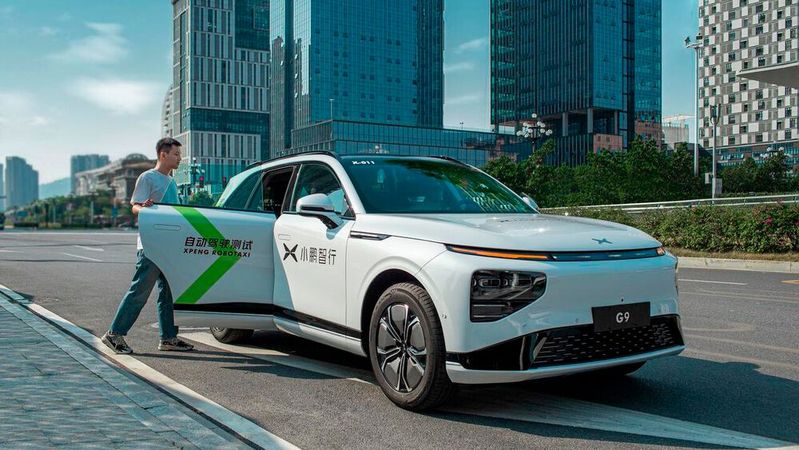
China's government is promoting the technology for automated driving. It is intended to benefit domestic car manufacturers, like Xpeng.
(Image: Xpeng)
The Chinese government wants to promote autonomous driving and is expanding its funding programs to this end. This is supposed to make domestic car manufacturers more competitive internationally, report state-controlled media such as the Global Times in Beijing. Since the beginning of this month, the central government has been implementing a plan to this effect that was already published in November of the previous year. This will significantly expand road tests across the country.
As of June 4, nine companies have received new licenses to start level 3 automated driving. All nine are Chinese manufacturers, including the car manufacturers BYD and SAIC, which have just been hit with punitive tariffs by the EU Commission. "Level 3" is the third highest level according to the Chinese classification of assistance systems and automated driving functions. This ranges from level 1 (simple driving assistance) to level 5 (completely driverless). At level 3, also known as "conditional driving automation", vehicles are allowed to drive without a driver under certain conditions, as long as a human can intervene in case of an emergency situation.
Seven metropolises involved
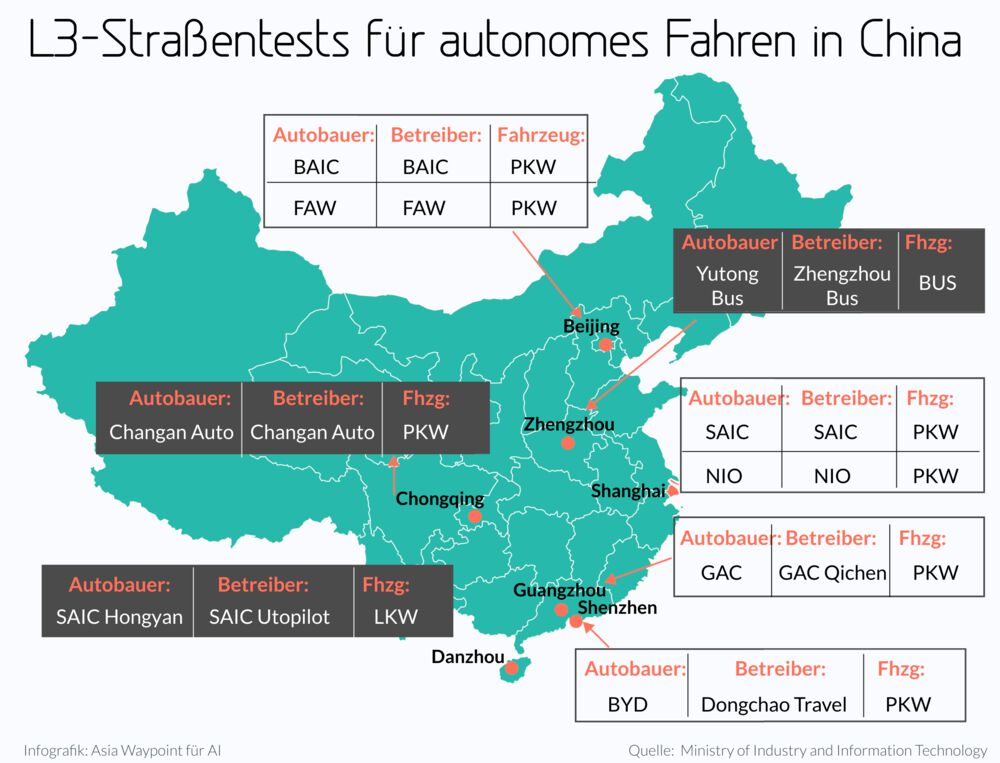
The pilot program will begin simultaneously in seven Chinese metropolises, including Beijing, Shanghai, and Guangzhou. This is the first concrete implementation of the "Notice on Conducting the Pilot Program for Intelligent Connected Vehicle Access and Road Traffic" plan from November 2023. With this, China is significantly ahead in terms of permission for road tests for driverless driving. Elsewhere, including in the U.S. and Japan, authorities have recently become more cautious following accidents.
General Motors' "Cruise" robotaxi service suspended its service last fall after one of its cars collided with a pedestrian in San Francisco. The pedestrian had been hit by a "normal" car and had been pushed into the path of the robotaxi. The regulatory authorities in California then suspended the relevant license for the car manufacturer. GM has since begun limited tests in Phoenix and Arizona, as recently reported by the New York Times.
The Japanese government has suspended tests for driverless golf carts after one of them ran into the pedals of a parked bicycle. No one was injured in the incident. The tests with the golf carts were able to resume in March of this year.
Overtaking Western competitors
The FSD (Full Self-Driving) from Tesla is a level 2 driving system. Drivers must be attentive and keep their hands on the wheel. Elon Musk had recently visited Beijing to promote the approval of FSD in China again.
The new pilot program now allows the participating Chinese companies to conduct road tests that go beyond anything approved worldwide in terms of territorial expansion and potential risk. This allows automated driving on many public roads at a level more advanced than Tesla's FSD system.
The Ministry of Industry in Beijing wrote in its announcement that this should pave the way for the "further commercialization of advanced autonomous driving technologies". China's communist leadership hopes that the expanded road tests will help its domestic industry to take over international technological leadership in automated driving.
Overtake in technological change
"Experts say this latest measure will strengthen the competitiveness of the Chinese New Energy Vehicles sector," writes the nationalistic Beijing-based newspaper Global Times. By "New Energy Vehicles" or NEV, they mean vehicles with alternative drives, especially electric cars and hybrids.
Beijing sees the rapid commercialization of new technologies as an opportunity to economically compete better with established industrial nations such as Germany, Japan, or the USA. The idea is to proverbially "overtake them in the curve," with the curve referring to the disruption caused by new technologies, say Chinese interlocutors. The Chinese Society of Automotive Engineers has predicted that by 2030, 20 percent of all vehicles sold in China will be completely autonomous (level 5). An additional 70 percent will be equipped with relatively advanced assistance systems.
Buses and trucks without drivers too
The nine manufacturers that have been confirmed for the pilot program are:
BAIC Blue Park
BYD
Changan Auto
China FAW Group
GAC
Nio
SAIC
SAIC Hongyan and
Yutong Bus
The list indicates that soon not only cars but also buses and trucks will be on the roads of the seven cities without drivers. Over the past few years, the Chinese government has already distributed a large number of test licenses to various manufacturers, including foreign OEMs in China, which are severely limited in terms of both time and location. A total of 6,800 such test licenses had been granted by April of this year, reports the Global Times.
Date: 08.12.2025
Naturally, we always handle your personal data responsibly. Any personal data we receive from you is processed in accordance with applicable data protection legislation. For detailed information please see our privacy policy.
Consent to the use of data for promotional purposes
I hereby consent to Vogel Communications Group GmbH & Co. KG, Max-Planck-Str. 7-9, 97082 Würzburg including any affiliated companies according to §§ 15 et seq. AktG (hereafter: Vogel Communications Group) using my e-mail address to send editorial newsletters. A list of all affiliated companies can be found here
Newsletter content may include all products and services of any companies mentioned above, including for example specialist journals and books, events and fairs as well as event-related products and services, print and digital media offers and services such as additional (editorial) newsletters, raffles, lead campaigns, market research both online and offline, specialist webportals and e-learning offers. In case my personal telephone number has also been collected, it may be used for offers of aforementioned products, for services of the companies mentioned above, and market research purposes.
Additionally, my consent also includes the processing of my email address and telephone number for data matching for marketing purposes with select advertising partners such as LinkedIn, Google, and Meta. For this, Vogel Communications Group may transmit said data in hashed form to the advertising partners who then use said data to determine whether I am also a member of the mentioned advertising partner portals. Vogel Communications Group uses this feature for the purposes of re-targeting (up-selling, cross-selling, and customer loyalty), generating so-called look-alike audiences for acquisition of new customers, and as basis for exclusion for on-going advertising campaigns. Further information can be found in section “data matching for marketing purposes”.
In case I access protected data on Internet portals of Vogel Communications Group including any affiliated companies according to §§ 15 et seq. AktG, I need to provide further data in order to register for the access to such content. In return for this free access to editorial content, my data may be used in accordance with this consent for the purposes stated here. This does not apply to data matching for marketing purposes.
Right of revocation
I understand that I can revoke my consent at will. My revocation does not change the lawfulness of data processing that was conducted based on my consent leading up to my revocation. One option to declare my revocation is to use the contact form found at https://contact.vogel.de. In case I no longer wish to receive certain newsletters, I have subscribed to, I can also click on the unsubscribe link included at the end of a newsletter. Further information regarding my right of revocation and the implementation of it as well as the consequences of my revocation can be found in the data protection declaration, section editorial newsletter.
Tests with Level 3 driving systems are permitted in these locations in China. Autobauer = Car Manufacturer Betreiber = Operator Fahrzeug (Fhzg) = Vehicle PKW = Passenger car LKW = Truck
(Image:Vogel Communications Group)
On roads totaling 29,000 kilometers (approx. 18,000 miles) throughout China, limited tests have already been allowed. The manufacturers have so far been able to gather experiences on 88 million test kilometers (approx. 55 million miles), according to the report. The new pilot program further expands this experimental spirit. The Chinese authorities do place a lot of importance on the safety of other road users. As the next step in the pilot program, the nine companies must "develop detailed plans for product access tests and safety assessments," reports the Chinese automotive portal Gasgoo. Also, the manufacturers and operators of the tests are liable for accidents.
Goal is to strengthen domestic providers
Nevertheless, the pilot program means that the participating Chinese companies have come a significant step closer to the commercialization of autonomous driving. Participation is the first step towards market approval. This increases the progress of Chinese car manufacturers compared to international OEMs like BMW, Mercedes-Benz, and Tesla. These have received isolated test licenses for level 3 tests in China but have not been involved in the pilot program spanning a total of five stages. At the end of which, production licenses for the construction and sale of advanced autonomous driving systems in China will stand.
The users of the autonomous vehicles participating in the pilot program include mobility providers, some of which Chinese automakers have stakes in, such as in the case of the "Shanghai SAIC Intelligent Technology Service," where SAIC holds shares. There are companies controlled by local governments in China, like the "Zhengzhou City Public Transportation Group" that collaborates closely with bus manufacturer Yutong. But private Chinese automakers like "Shanghai NIO Automobile" have also been included in the program.
What is currently happening in the field of autonomous driving in China is repeating the pattern seen in the development of e-mobility. While initially American or German companies develop the fundamentals, Chinese companies are intended to take leading positions in commercialization. In China, they are willing to implement this plan to the end. The pilot program now started shows this industry-friendly approach again. Accidents and press reports about them cannot derail the authorities' cooperation with local manufacturers and their long-term development plans.



:quality(80)/p7i.vogel.de/wcms/45/e4/45e497fad5299ffbb7278c1636a261ba/0129304667v1.jpeg "Screw head forming with heat: The heads of the blanks are heated to over 1,000 °C in the induction stage. (Image:Aachen mechanical engineering)")
:quality(80)/p7i.vogel.de/wcms/bc/df/bcdfa690253179f44dfa43986e35e3d4/0129302450v1.jpeg "The VSC 400 DDS retrofit machine from EMAG at EWS Weigele with tool shuttle for external tool preparation - the basis for reliable hard machining of gears. (Image:Emag Systems)")
:quality(80)/p7i.vogel.de/wcms/f7/85/f785e961fa2a55ecf4380e1a204c79e3/0129432203v1.jpeg "This is the new Artis 300, which completes the Artis range as the third variant. It stands for TIG DC welding up to 300 amps and is designed as an XT variant for all common voltage levels worldwide. (Image:Fronius)")
:quality(80)/p7i.vogel.de/wcms/28/7c/287ccc5ac565d6e6041bebb1e3e073f0/0113143253v1.jpeg "In our China Market Insider, we regularly provide you with relevant information directly from China. (Image:© Eisenhans - stock.adobe.com)")
:quality(80)/p7i.vogel.de/wcms/99/2e/992e57a54c4ddeaafc113de8e56f2b73/0129501004v1.jpeg "Sereact's AI-based control system can process new and unknown items without prior data collection. (Image:Sereact)")
:quality(80)/p7i.vogel.de/wcms/97/3a/973acc83133c28605f855d750523142e/0129492013v1.jpeg "During the opening, Agile One symbolically pressed the start button. (Image:Deutsche Telekom AG / Cindy Albrecht)")
:quality(80)/p7i.vogel.de/wcms/dd/4e/dd4e6ce73e0e700dcc0f0584813ef47f/0128875162v1.jpeg "Thanks to their high precision, robustness and integration capability, Micro-Epsilon's measurement technology solutions are not only suitable for new systems, but also ideal for retrofit applications. (Image:Micro-Epsilon Messtechnik GmbH & Co. KG)")
:quality(80)/p7i.vogel.de/wcms/17/61/1761a0165c23fe007d0a8e62d2a23121/0129467133v1.jpeg "The partnership between Dassault Systèmes and Nvidia aims to make the industry more effective with the help of AI and digital twins. (Picture: ©DC Studio - stock.adobe.com)")
:quality(80)/p7i.vogel.de/wcms/f8/2d/f82d45c2610205e2c0c188968022890d/more-liftoff-power-first-ariane-6-with-four-boosters-launched-4781x2691v1v1.jpeg "The Ariane 6 can be modularly adapted to any mission—either with two or four boosters and a variable payload fairing length. (Image:ESA-M. Pedoussaut)")
:quality(80)/p7i.vogel.de/wcms/9b/e7/9be7c2ceb897aa2bf1ab4eb2198b8b96/roboter-20hand1-1240x698v1v1.jpeg "What if you could 3D print a soft robot with predictable shape-shifting capabilities already built in? (Image:Picture: Harvard University)")
:quality(80)/p7i.vogel.de/wcms/a7/34/a73475e9638e032c32288f53006abab7/newsimage417867-2665x1500v1v1.jpeg "Combination of a model from a scanning electron microscope image (left) with a section of the underlying crystal structure of a studied MXene with precisely controlled surface terminations. (Image:B. Schröder/HZDR)")
:quality(80)/p7i.vogel.de/wcms/d2/1a/d21a9b3e1333f306ffd6421e84f9e3d0/semiconductor-20image-20courtesy-20of-20gelest-3000x1688v1.jpeg "In a new collaboration, IBM will test the performance of Gelest precursor materials for dry resist EUV lithography, generating results that aim to guide Gelest on materials research and speed innovation toward smaller devices. (Source: Gelest)")
:quality(80)/p7i.vogel.de/wcms/ad/72/ad72626a52c9a9332591f457e5afabca/0129497458v1.jpeg "BMW's new Board Member for Development Joachim Post in the new iX3 model. (Image:BMW)")
:quality(80)/p7i.vogel.de/wcms/12/ce/12ce3b8d4062d9e433419e9ada594c34/adobestock-1669527454-marewa-4096x2304v1v1.jpeg "Symbol image (Image:Marewa - stock.adobe.com)")
:quality(80)/p7i.vogel.de/wcms/e8/1f/e81f2bd61d820a0cf982dd3831f273dd/0129511298v1.jpeg "In China, certain functions in new cars will once again be directly accessible via haptic input—without a screen. (Image:BYD)")
:quality(80)/p7i.vogel.de/wcms/0b/02/0b02abc1524e267ae66ad0609ce08b20/0129482073v1.jpeg "The Haval Jolion Pro competes in the compact SUV segment. (Image:GWM)")
:quality(80)/p7i.vogel.de/wcms/68/ec/68ec268edc51a26c4e6e2de7187e8e4f/0129456364v1.jpeg "The storage facilities are being built at three locations in Lithuania. (Image:Nidec Conversion)")
:quality(80)/p7i.vogel.de/wcms/a0/36/a03679debcdda99158f4eaa0d6fbe43d/0129505643v1.jpeg "Arduino App Lab: The current release 0.4.0 brings a number of helpful new features. (Image:Arduino)")
:quality(80)/p7i.vogel.de/wcms/36/c8/36c8b329076027abf5def92031e3028e/0129508876v1.jpeg "Microsoft German headquarters in Munich: As part of the Munich Security Conference, 15 international companies along the entire electronics value chain have formed a tech alliance for digital sovereignty and common trust standards under the leadership of Microsoft and Ericsson. (Image:Microsoft)")
:quality(80)/p7i.vogel.de/wcms/d5/6e/d56e97cb8afab17e93794c1cca214228/0129419457v1.jpeg "China is investing heavily in its domestic semiconductor ecosystem. If you want to be part of it, you should know in advance where which cluster is located and which technology it is driving forward. (Image:Dall-E / AI-generated)")
:fill(fff,0)/images.vogel.de/vogelonline/companyimg/76800/76895/65.jpg "FAULHABER_120mm.jpg ()")
:fill(fff,0)/p7i.vogel.de/companies/67/eb/67eba621ef6ea/logo2.png "logo2 (Wuxi InfiMotion)")
:quality(80)/p7i.vogel.de/wcms/12/eb/12ebb1d6c038f81562ae3935a727d706/0118993211v1.jpeg "New functions for the cockpit and infotainment are to be validated and released within a few days in the future. (Image:William; AI-generated - stock.adobe.com)")
:quality(80)/p7i.vogel.de/wcms/ff/c1/ffc1457ec58153ed7cbec2db2b18325f/d-20changan-deepal-s07-4032x2266v1v1.jpeg "Logo of the Chinese car brand Changan. The manufacturer is one of only two in China to have received a license for level 3 assistance systems. (Image:Wehner/VCG)")
:quality(80)/p7i.vogel.de/wcms/9c/3d/9c3ddf65659ef41eddcbc0cbcc02c926/0127543708v1.jpeg "After electric driving, autonomous and connected driving is being introduced very quickly in China. And they aim to achieve global success with it. (Image:Microchip)")