China has replaced Germany as the world's leading exporter of machine tools. This was recently announced by the German Machine Tool Builders' Association (VDW) at its annual press conference.
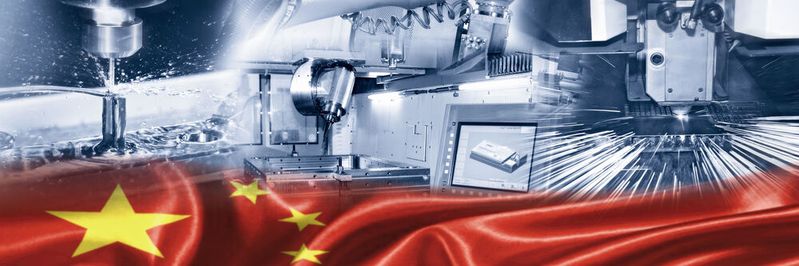
In our China Market Insider, we regularly provide you with relevant information directly from China.
This means that Germany has lost its global leadership role in another industry, after the title of world export champion in mechanical engineering had to be handed over from Germany to China in 2021.
With a 21.6% share of global exports, China is now ahead of Germany with 16.7%. Japan follows in third place with 14.2 percent.
When it comes to the production of machine tools, China has long been in the lead. Last year, 36.9 percent of all machine tools produced worldwide were manufactured in China, followed by Germany with 11.7 percent and Japan with 9.7 percent.
"We are very concerned about the competition from China," said Franz-Xaver Bernhard, Chairman of the VDW. He emphasized the "massive" increase in Chinese exports by 18 percent within one year, which had arrived "as expected" due to the "government strategy" in Beijing.
China was able to significantly expand its exports to the ASEAN region, as well as to Brazil, the Middle East and North Africa. China's exports of machine tools to some European countries, including Germany, Poland and Italy, also continued to rise in 2025, reported the VDW Chairman, although overall imports there had "tended to decline" in recent years.
"Not good news," Bernhard said, as can be read in his association's press release. However, unlike other industry associations, which are also discussing the growing competitive pressure from China, the VDW Chairman did not place the sole blame for the change of guard at the top on China.
He only mentioned China at the press conference after he had previously addressed the home-made problems of the German economy. "High costs, a lack of planning security and the absence of economic reforms to strengthen Germany as a production location" had slowed down German companies' investments in machine tools in the previous year.
However, the German economic downturn coincides with two developments in China, which together are strengthening the competitive position of Chinese machine tool manufacturers against German competitors:
The first of these is a gradual but significant improvement in the quality of Chinese machine tools. The second development is that the Chinese domestic economy is not doing particularly well at the moment, which is why many companies are being forced to make greater efforts in exports.
As far as the gradual "upgrading" of Chinese machine tool manufacturers is concerned, their progress in CNC machines, a particularly lucrative export hit for German industry to date, is particularly striking.
The reasons for this are, on the one hand, high investment in the research and development of such machines in the People's Republic and, on the other, the growing demand in the domestic market resulting from the rapid growth of high-tech segments of the Chinese economy such as e-mobility, the "low-altitude economy" (drones, air cabs) and aerospace.
Under increasing pressure from Washington and the EU Commission in Brussels with boycotts and trade barriers, China has greatly accelerated its efforts towards "local substitution" in all key areas in recent years.
So as soon as there are CNC machines that have been produced domestically, are roughly comparable in terms of quality and are often even cheaper, Chinese manufacturers are under increasing pressure to buy machine tools "made in China".
One concrete example of the positive cycle of booming domestic demand and growth in the Chinese machine tool industry is all the high-strength sheet steel that is needed to reduce the weight of electric cars.
Sheet metal like this has to be cut with lasers. The latest generation of "intelligent 3D five-axis laser cutting machines" from Wuhan Huagong Laser Engineering Co. has made significant gains in terms of speed and precision and is now enjoying strong demand in China, but also increasingly abroad, as Deng Jiake, the company's managing director, said in an interview with the Chinese business newspaper "Jingji Ribao".
New demand for vertical and horizontal CNC machining centers has arisen at manufacturer Kede CNC due to the increase in Chinese production of large UAV fuselage structures. UAV stands for "Unmanned Aerial Vehicle".
Date: 08.12.2025
Naturally, we always handle your personal data responsibly. Any personal data we receive from you is processed in accordance with applicable data protection legislation. For detailed information please see our privacy policy.
Consent to the use of data for promotional purposes
I hereby consent to Vogel Communications Group GmbH & Co. KG, Max-Planck-Str. 7-9, 97082 Würzburg including any affiliated companies according to §§ 15 et seq. AktG (hereafter: Vogel Communications Group) using my e-mail address to send editorial newsletters. A list of all affiliated companies can be found here
Newsletter content may include all products and services of any companies mentioned above, including for example specialist journals and books, events and fairs as well as event-related products and services, print and digital media offers and services such as additional (editorial) newsletters, raffles, lead campaigns, market research both online and offline, specialist webportals and e-learning offers. In case my personal telephone number has also been collected, it may be used for offers of aforementioned products, for services of the companies mentioned above, and market research purposes.
Additionally, my consent also includes the processing of my email address and telephone number for data matching for marketing purposes with select advertising partners such as LinkedIn, Google, and Meta. For this, Vogel Communications Group may transmit said data in hashed form to the advertising partners who then use said data to determine whether I am also a member of the mentioned advertising partner portals. Vogel Communications Group uses this feature for the purposes of re-targeting (up-selling, cross-selling, and customer loyalty), generating so-called look-alike audiences for acquisition of new customers, and as basis for exclusion for on-going advertising campaigns. Further information can be found in section “data matching for marketing purposes”.
In case I access protected data on Internet portals of Vogel Communications Group including any affiliated companies according to §§ 15 et seq. AktG, I need to provide further data in order to register for the access to such content. In return for this free access to editorial content, my data may be used in accordance with this consent for the purposes stated here. This does not apply to data matching for marketing purposes.
Right of revocation
I understand that I can revoke my consent at will. My revocation does not change the lawfulness of data processing that was conducted based on my consent leading up to my revocation. One option to declare my revocation is to use the contact form found at https://contact.vogel.de. In case I no longer wish to receive certain newsletters, I have subscribed to, I can also click on the unsubscribe link included at the end of a newsletter. Further information regarding my right of revocation and the implementation of it as well as the consequences of my revocation can be found in the data protection declaration, section editorial newsletter.
While Chinese association spokespeople and trade media have also taken note of China taking the title of world export champion, no one has been overly jubilant. Instead, several spokespeople emphasized that China still had a lot of catching up to do in many areas.
Despite its growing export share, the product mix of the Chinese machine tool industry remains strongly focused on the "mid-range", while there is still a gap in the high-end segment compared to advanced economies such as Germany, according to Chinese commentators.
Despite the not-so-good news on export trends, this represents a great opportunity for German manufacturers of machine tools and instruments for their production.
Possible strategies for German companies to benefit from China's technological race to catch up in all areas are investments for more "local" production in China and more partnerships with Chinese manufacturers.
A growing number of German and European manufacturers are investing in China. For example, the Swiss-German Liebherr Group (Bulle in the Swiss canton of Freiburg as well as Biberach and Kirchdorf an der Iller, Germany) opened another production facility in Yongchuan near Chongqing in September last year.
Blum Novotest GmbH from Grünkraut near Ravensburg (Germany), which manufactures measuring and testing technology for machine tools, opened a new "China Technology Center" last spring, thus deepening its involvement in the Chinese market after twenty years.
German machine tools are still at the heart of the German manufacturing industry and continue to be increasingly in demand in China due to their precision and durability. However, local presence in China is increasingly becoming an absolute necessity rather than an option.
"Local for local is becoming increasingly important", according to the VDW press release quoted above. Foreign production, especially by larger machine tool manufacturers, is accounting for an increasingly large share of the total production of machine tools "made in Germany", reports the VDW.
45% of this foreign production takes place in Europe, 32% in China and 20% in the USA. This "compensates for falling exports to important markets and stabilizes the overall result of the companies", writes the industry association.
"Companies that can take advantage of this have a better chance of participating more strongly in local market growth despite existing trade barriers and also of realizing cost advantages," says VDW Chairman Bernhard.
Henrik Bork is Managing Director at Asia Waypoint, a consulting agency based in Beijing that specializes in China. "China Market Insider" is a joint project of the Vogel Communications Group, Würzburg, and Jigong Vogel Media Advertising in Beijing.



:quality(80)/p7i.vogel.de/wcms/a0/47/a04725ef9bd09fb6c9341a1bea1b5d93/0130443083v1.jpeg "Here, a type of plastic pallet is produced by thermoforming (vacuum forming or deep drawing) at the corresponding division of New England Plastics in the USA. This division, which specializes in so-called liners, is now part of Ringmetall ... (Image:New England Plastics)")
:quality(80)/p7i.vogel.de/wcms/23/99/23992bf2dcdc432c9b7209c34a4a7c48/0129733089v1.jpeg "Stork relies on the modular Neoswiss turning system from Iscar to shorten the set-up times for its sliding headstock lathes and work more productively. (Image:Iscar)")
:quality(80)/p7i.vogel.de/wcms/7d/e2/7de2923434b2f1a78ba5482d8d335269/0113143253v1.jpeg "In our China Market Insider we regularly provide you with relevant information directly from China. (Image:© Eisenhans - stock.adobe.com)")
:quality(80)/p7i.vogel.de/wcms/9d/2b/9d2b802f800e5caf17b2831e74228cd3/screenshot-202026-03-03-20103822-609x343v1v1.png "Visual comparison: on the left, a clean, burr-free cut edge; on the right, typical burr formation with oxidation discoloration. This illustrates how strongly parameter control and gas management influence the quality of the result. (CO₂ laser, oxygen cutting gas, sheet thickness approx. 15 mm). (Image:Picture: Rime)")
:quality(80)/p7i.vogel.de/wcms/b7/36/b736dfebc16c42d6901d0d0e1f390493/3d-druck-20factory-20--20ki-20generiert-1920x1079v1.png "(Source: AI-generated)")
:quality(80)/p7i.vogel.de/wcms/79/b2/79b21aad663f4a7bd4472afc1c1afc62/0130433994v1.jpeg "Mission Joyride: The free-flying robot (shown here in the rendering) will relieve the ISS crew of logistics tasks from 2027 with its two mechanical arms. (Image:Icarus Robotics)")
:quality(80)/p7i.vogel.de/wcms/6b/45/6b4546fa6ebf305c3660326909363f32/0130437089v1.jpeg "Industrial AI in action: Rockwell Automation presents practical solutions for self-controlling production systems at the Hannover Messe. (Image:Rainer Jensen, Deutsche Messe)")
:quality(80)/p7i.vogel.de/wcms/78/e9/78e9188c25a8a94e67c34c9bf8ffe495/visual-agile-20robots-20and-20google-20deepmind-20partner-20to-20bring-20intelligence-20to-20robotics-2500x1406v1v1.jpeg "Together, the partners are developing adaptable, intelligent robots for a wide range of applications (Image:Agile Robots SE)")
:quality(80)/p7i.vogel.de/wcms/59/a2/59a2b11f0aa1b700eff02addd5de8703/adobestock-1788280853--c2-a9-20satria-20-e2-80-93-20stock-adobe-com-5081x2860v1v1.jpeg "Quantum computers require extreme cooling to temperatures close to absolute zero in order to keep qubits stable. (Image:satria - stock.adobe.com)")
:quality(80)/p7i.vogel.de/wcms/49/38/493876a248943456b7e4a6db6edfc454/0130230765v1.jpeg "Safe and reliable in aircraft construction: light-curing adhesive bond combined with universal fastening elements. (Source: Delo)")
:quality(80)/p7i.vogel.de/wcms/b5/c7/b5c749d16c8a2e789c1469c2c8c1c387/0130452780v1.jpeg "Volvo Trucks completes road tests with its new hydrogen-powered trucks. (Image:Volvo Trucks)")
:quality(80)/p7i.vogel.de/wcms/ba/69/ba6975f417a85147084f38dc2cd209e2/0130451386v1.jpeg "Together with Nvidia, Hyundai wants to develop an architecture that will be used for level 4 robotaxis (image) as well as for level 2 customer vehicles. (Image:Hyundai)")
:quality(80)/p7i.vogel.de/wcms/93/4d/934de334b47abaa526c78cba1417d7af/0130343495v1.jpeg "The new SU7 is available in three price categories, \"Standard\", \"Pro\" and \"Max\" (Image:Xiaomi)")
:quality(80)/p7i.vogel.de/wcms/df/a0/dfa048434bb94f1b7d030e346b25b3ae/0130373541v1.jpeg "From August, BMW will be producing the i3 at its main plant in Munich - which the car manufacturer has extensively rebuilt for this purpose. (Image:Rainer Haeckl)")
:quality(80)/p7i.vogel.de/wcms/ee/09/ee09acbd6dc896df25affaa9e871e6e5/0130440053v1.jpeg "IMS chip module for simple system integration into an ion mobility spectrometer. (Image:Fraunhofer IPMS)")
:quality(80)/p7i.vogel.de/wcms/10/6c/106cd22de5f68a0f74639d654827228c/0130345302v1.jpeg "Made in India: According to the India Electronics and Semiconductor Association (IESA), the country should be able to produce between 75 and 80 million chips by the beginning of 2027, once the plants currently under construction become operational. (Image:Pixabay (Montage: Sebastian Gerstl))")
:quality(80)/p7i.vogel.de/wcms/a5/ed/a5ed6fda029d362732a293d6b19d74c4/0130444216v1.jpeg "Thirteen executives from the Chinese chip industry have drawn up a plan to achieve an 80% self-sufficiency rate for semiconductors by 2030. (Image:Maxim_Kazmin - stock.adobe.com)")
:quality(80)/p7i.vogel.de/wcms/31/a6/31a646018b34d8e0a44bfc8bf17837f6/0130361632v1.jpeg "For many companies, PFAS are considered indispensable in electronics production. (Image:freely licensed)")
:fill(fff,0)/images.vogel.de/vogelonline/companyimg/76800/76895/65.jpg "FAULHABER_120mm.jpg ()")
:fill(fff,0)/p7i.vogel.de/companies/69/88/69882c428938e/tmts2026-ticec-banner-en-2000px.png "tmts2026-ticec-banner-en-2000px (https://www.tmts.tw/en)")
:quality(80):fill(efefef,0)/p7i.vogel.de/wcms/67/ad/67adf4a647532/elatec-wp-machine-authentication.png "Elatec WP Machine Authentication")
:quality(80)/p7i.vogel.de/wcms/29/32/2932e09edb99e230b75112f6cdead7c3/0113143253v1.jpeg "In our China Market Insider, we regularly provide you with relevant information directly from China. (Image:© Eisenhans - stock.adobe.com)")
:quality(80)/p7i.vogel.de/wcms/b0/7e/b07e60b6b479a80b647f0c619545985d/0113143253v1.jpeg "In our China Market Insider, we regularly provide you with relevant information directly from China. (Image:© Eisenhans - stock.adobe.com)")