From the Vehicle to the CloudChina: Connected Driving is an Expensive Vision
From
Henrik Bork
Henrik Bork * | Translated by AI
4 min Reading Time
About a month after the start of large pilot projects for connected driving in China, the problems with the project are becoming apparent. While the government promotes the technology and invests heavily, car manufacturers have so far shown little enthusiasm. The high initial costs deter many companies, several Chinese trade media report unanimously.
From the vehicle to the cloud? Connected driving is an expensive affair in China.
(Image: freely licensed on Pixabay)
In 20 Chinese megacities, government-funded pilot projects have been underway for a month, where cars and buses equipped with appropriate communication units communicate with sensors on the roadside and in traffic lights, and are coordinated via the cloud. However, the car companies whose cooperation is needed are currently still in the "wait and see" stage, writes the economic newspaper Jingji Guancha Bao. "At present, car companies are not very active in vehicle-road-cloud collaboration."
Navigate on Autopilot
As in Europe and the USA, it is easier for automakers to develop autonomous driving and its precursor, ADAS (Advanced Driver-Assistance Systems), within the car itself. NOA, or Navigate on Autopilot, as Tesla-like driving assistance functions are called in China, is gradually conquering city by city and is being offered in one car model after another.
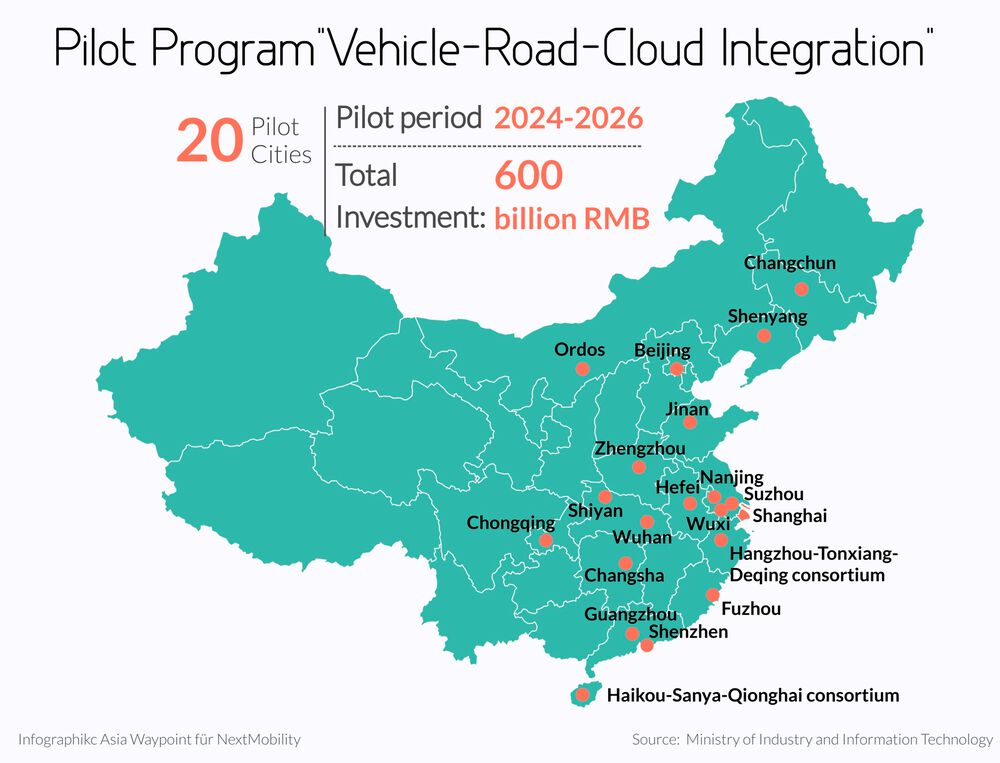
The second technological route towards autonomous driving, connected driving, is still in its early stages. Although China is already a global leader in this area, the metropolises of Beijing, Shanghai, and Chongqing, along with 17 other million-plus cities such as Shenyang, Changchun, and Nanjing, have established initial test zones.
Unfortunately, due to the overall poor state of the Chinese economy following the extreme COVID-19 measures, the escalation of the economic war with the USA, and other issues, many local governments now lack the funds for the substantial initial investments in hardware and the necessary cloud platforms.
About a month after the launch of major pilot projects for connected driving in China, the problems with the project are becoming visible.
(Image:Ministry of Industry and IT | Asia Waypoint)
High Costs
Many experts consider connected driving to be the superior and safer variant of automated driving because cars that are networked with other road users and roadside control systems are better "informed" than those relying solely on their own sensors or maps. However, this is very expensive. The economic magazine Caixin has recently calculated the costs that each individual city or municipality will incur before the vision of widespread connectivity can become a reality.
To equip a pilot project in the Yizhuang district of Beijing, covering an area of 60 km² with the necessary infrastructure, which includes 5G antennas, roadside sensors, or smart traffic lights, the city of Beijing has so far invested "more than two billion Yuan," equivalent to about 250 million Euros, reports Caixin.
Although the expansion of the zone by an additional 100 km² (38.6 square miles) is already underway, and a plan to cover all roads in Beijing is under discussion, the initial investment alone would require "ten billion yuan" (approximately €1.3 billion or $1.44 billion), according to estimates. Caixin highlights the scale of this challenge, noting that replicating Yizhuang’s advancements throughout Beijing would be a significant financial burden. "Equipping thousands of intersections across the city would demand billions more in yuan for necessary upgrades."
No business model available
For the four to eight cameras, four millimeter-wave radar devices, and one LiDAR required per intersection, the hardware alone costs about 500,000 Yuan, which is nearly 64,000 Euros (approx. 71,000 USD). Financially robust metropolises like Beijing or Shanghai might be able to afford this, but in the Chinese provinces, many local governments are already heavily indebted.
What currently motivates automakers to wait is also the lack of a realistic business model for the long-term operation of the networks. The electricity costs and fees of network operators like China Mobile and cloud providers are high. It is not yet clear how the installation of receivers in cars is supposed to pay off for automakers.
As long as the scaling beyond the twenty pilot zones progresses slowly, the technology remains unattractive for car buyers. "If one part of a city achieves autonomous driving at level L4, but another part only reaches L3 or L2, it is meaningless for the automakers," Jingji Guancha Bao quotes an expert. This cannot be explained to customers—and thus, they cannot be charged for it.
Despite these issues, the Beijing central government is still committed to its vision, which is also incorporated into the 14th Five-Year Plan of the party. Chinese planners view connected driving as another opportunity to outpace the West in emerging, new technologies from the outset, similar to e-mobility. Giving up quickly due to problems in the initial phase is not their approach.
Currently, the Chinese leadership is focusing on the twenty pilot cities and is additionally building a network of 30 "digital highways" across the country, which will lay the foundation for the infrastructure of connected driving in China. To further finance this, the issuance of special government bonds for vehicle-road-cloud integration is being experimented with.
Date: 08.12.2025
Naturally, we always handle your personal data responsibly. Any personal data we receive from you is processed in accordance with applicable data protection legislation. For detailed information please see our privacy policy.
Consent to the use of data for promotional purposes
I hereby consent to Vogel Communications Group GmbH & Co. KG, Max-Planck-Str. 7-9, 97082 Würzburg including any affiliated companies according to §§ 15 et seq. AktG (hereafter: Vogel Communications Group) using my e-mail address to send editorial newsletters. A list of all affiliated companies can be found here
Newsletter content may include all products and services of any companies mentioned above, including for example specialist journals and books, events and fairs as well as event-related products and services, print and digital media offers and services such as additional (editorial) newsletters, raffles, lead campaigns, market research both online and offline, specialist webportals and e-learning offers. In case my personal telephone number has also been collected, it may be used for offers of aforementioned products, for services of the companies mentioned above, and market research purposes.
Additionally, my consent also includes the processing of my email address and telephone number for data matching for marketing purposes with select advertising partners such as LinkedIn, Google, and Meta. For this, Vogel Communications Group may transmit said data in hashed form to the advertising partners who then use said data to determine whether I am also a member of the mentioned advertising partner portals. Vogel Communications Group uses this feature for the purposes of re-targeting (up-selling, cross-selling, and customer loyalty), generating so-called look-alike audiences for acquisition of new customers, and as basis for exclusion for on-going advertising campaigns. Further information can be found in section “data matching for marketing purposes”.
In case I access protected data on Internet portals of Vogel Communications Group including any affiliated companies according to §§ 15 et seq. AktG, I need to provide further data in order to register for the access to such content. In return for this free access to editorial content, my data may be used in accordance with this consent for the purposes stated here. This does not apply to data matching for marketing purposes.
Right of revocation
I understand that I can revoke my consent at will. My revocation does not change the lawfulness of data processing that was conducted based on my consent leading up to my revocation. One option to declare my revocation is to use the contact form found at https://contact.vogel.de. In case I no longer wish to receive certain newsletters, I have subscribed to, I can also click on the unsubscribe link included at the end of a newsletter. Further information regarding my right of revocation and the implementation of it as well as the consequences of my revocation can be found in the data protection declaration, section editorial newsletter.
*Henrik Bork is Managing Director of AsiaWaypoint, based in Beijing, PR China.



:quality(80)/p7i.vogel.de/wcms/fc/2e/fc2ead680a610e0f276d61f89c2ff7cc/0131658794v1.jpeg "The Laser-Zentrum Hannover (LZH) has developed innovative fiber optic components that can be used to boost the power of two-micrometer fiber lasers. The whole thing is based on so-called \"triple-clad\" fibers ... (Image:LZH)")
:quality(80)/p7i.vogel.de/wcms/8a/7a/8a7af51f9062e9c40116d1455e290290/0131490789v1.jpeg "With NXD tupH, Nord makes its aluminum drive solutions particularly resistant to corrosive and harsh influences. (Image:Nord Drivesystems)")
:quality(80)/p7i.vogel.de/wcms/c1/39/c139cfcb41a7214335e229a6a124c2b5/0131609956v1.jpeg "The new infrastructure allows the processing of extremely moisture-sensitive materials such as lithium metal, which are essential for future batteries with higher energy density, improved safety and lower costs. Pictured: Cutting test on lithium metal batteries. (Image:CSEM)")
:quality(80)/p7i.vogel.de/wcms/19/cb/19cb31f52892d0cad77d99b07ceb4f55/0131607455v1.jpeg "The new Pilatus delivery center at Rocky Mountain Metropolitan Airport in Broomfield, Colorado (USA). (Image:Pilatus)")
:quality(80)/p7i.vogel.de/wcms/ce/9e/ce9e57f345deb8a932eacf7b54305887/0131657178v1.jpeg "The mechanical engineering industry is facing major challenges: rising operating costs, a shortage of skilled workers, global competition and new trade barriers. The solution: energy-efficient, digitally networked and user-friendly systems. (Image:Eaton)")
:quality(80)/p7i.vogel.de/wcms/88/9d/889d38472c01136dbe6f1abbb5a888e1/0131632764v1.jpeg "Stefan Huber (Head of Research, Salzburg University of Applied Sciences) and Martin Haidacher (Innovation Manager, B&R) together with technology from B&R (Image:B&R Industrial Electronics GmbH)")
:quality(80)/p7i.vogel.de/wcms/be/b4/beb4bf1ca28a8feafc096af5ec07964a/0131594908v1.jpeg "Nord has equipped, among others, the decentralized frequency converters of the Nordac-On family with new features in the area of functional safety. (Image:Nord Drivesystems)")
:quality(80)/p7i.vogel.de/wcms/57/45/574591fe148366c863e68c0727133bf8/sereact-20pm-20cortex-202-0-20bild-204-2988x1682v1v1.jpeg "Cortex 2.0 enables robots to operate existing machines independently. (Image: Sereact)")
:quality(80)/p7i.vogel.de/wcms/82/d0/82d0bd8c5a88bba17f6e6cf6b5be1061/0131595228v1.jpeg "At the Fraunhofer Institute for Industrial Mathematics, various simulation methods are used to make battery production more productive and economical. For instance, they can predict how the insulation foam between the cells behaves—but that's not all ... (Image: Fraunhofer ITWM)")
:quality(80)/p7i.vogel.de/wcms/96/6d/966d7a9c45d729e2f3b718718831da81/0131646887v1.jpeg "This could become the future of protective work clothing! Because at DTFI in Denkendorf (Germany), together with partners, they have managed to equip it with an autonomous air conditioning system. This not only significantly increases wearing comfort during physical exertion ... (Image: DITF)")
:quality(80)/p7i.vogel.de/wcms/a2/aa/a2aa1683d3149632ec8b99244de6010c/0131643886v1.jpeg "You can't see very much, but according to FH Aachen, this is a glimpse of an entirely new way of producing carbon fibers. Because at the university, they are relying on innovative plasma technology, as explained in the article ... (Image: FH Aachen / Chr. Schopp)")
:quality(80)/p7i.vogel.de/wcms/a6/22/a62248e696413ee6cd822d5b31e2566b/0131640732v1.jpeg "Image1: Here you can see additively manufactured demonstrators made of a high-temperature superconductor material. At the Chair of Digital Additive Production at RWTH Aachen, they aim to develop more cost-effective superconductors from YBCO that are, for example, more stable than previous ones. (Image: RWTH DAP)")
:quality(80)/p7i.vogel.de/wcms/e6/58/e658886ea76d2ba540d9e0bcc8c3737f/0131653420v1.jpeg "The EPS from Knorr-Bremse will go into series production at a commercial vehicle manufacturer in the Asia-Pacific region from 2028. (Image:Knorr-Bremse)")
:quality(80)/p7i.vogel.de/wcms/bf/6e/bf6e8f8e85605acd7a812b01caad85ea/0131146816v1.jpeg "The new full hybrid drive in the VW T-Roc—the nickel-manganese-cobalt battery with 1.6 kWh is liquid-cooled and located under the rear seat bench. (Image:Volkswagen)")
:quality(80)/p7i.vogel.de/wcms/15/33/15338d99dff98733fdf2a5d57b1f373e/0131630657v1.jpeg "The SAIC subsidiary MG is building a vehicle plant in Ferrol, Spain. Pictured: the S9 model. (Image:James Arbuckle)")
:quality(80)/p7i.vogel.de/wcms/fa/b6/fab6c31b57560a4ee8c36314696ef617/0131490742v1.jpeg "The Twingo E-Tech Electric rolls off the production line in Novo mesto, Slovenia (Image:Renault)")
:quality(80)/p7i.vogel.de/wcms/18/5f/185f50b4a96889e23ff2215a24e14b61/0131645247v1.jpeg "The increasing use of AI applications is increasing the energy requirements of modern data centers and posing new challenges for power grids and energy infrastructures. (Image:Dall-E / AI-generated)")
:quality(80)/p7i.vogel.de/wcms/30/44/304461dfe0c920f14b85739fbc231b9a/0131638193v1.jpeg "Connector review:
Product highlights in summer 2026 range from outdoor connectors to terminal blocks to industrial connectors. (Image: RdM)")
:quality(80)/p7i.vogel.de/wcms/8e/44/8e44bf5fc8196c413fc1fd25814beab2/0131596875v1.jpeg "Huawei is exploring alternative ways to produce fast and advanced chips. (Image:Huawei)")
:quality(80)/p7i.vogel.de/wcms/d3/36/d33604f077c0e2b64a1c48f5770a062c/0131609721v1.jpeg "In a mesh network, several drones communicate with each other in a decentralized manner. A mobile phone mast is therefore not necessary. (Image:Fraunhofer IIS)")

:quality(80)/p7i.vogel.de/wcms/fd/76/fd762d92095ab50fd8d82d1a1f52af0d/0118937625v1.jpeg "In China, they are certain: the vehicle of the future is AI-defined. (Image:freely licensed at Pixabay)")
:quality(80)/p7i.vogel.de/wcms/cd/70/cd7019c485b4beb6cf0da564d52b9150/0119189608v1.jpeg "Tesla has received the first testing license for its FSD Autopilot in China. (Image:Tesla)")
:quality(80)/p7i.vogel.de/wcms/9c/3d/9c3ddf65659ef41eddcbc0cbcc02c926/0127543708v1.jpeg "After electric driving, autonomous and connected driving is being introduced very quickly in China. And they aim to achieve global success with it. (Image:Microchip)")
:quality(80)/p7i.vogel.de/wcms/fc/bd/fcbdbf5c6fdf969dc3e005b3ae512915/can-ai-5000x2812v1v1.jpeg "Anyone who allows themselves to be distracted in China when the assistance system is switched on is responsible. The \"Supreme People's Court\" came to this conclusion. (Image:Togg)")