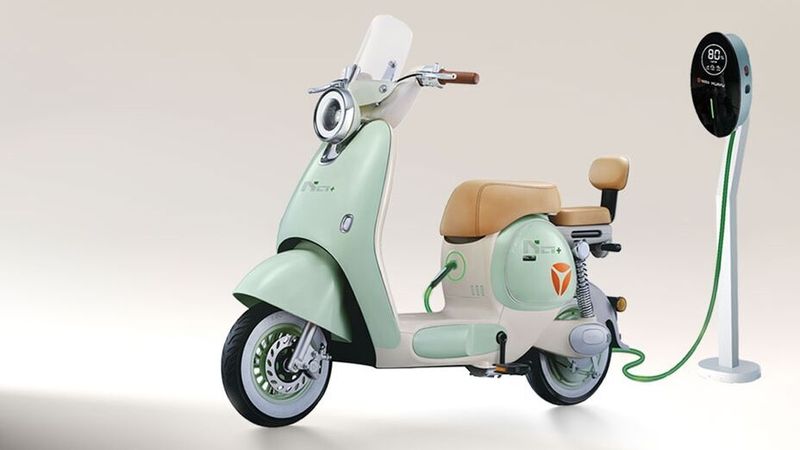
It could be e-scooters that help sodium-ion batteries achieve a breakthrough. The first serially produced Vespa-like two-wheelers with this battery technology have been on the market in China since this year.
So far, sodium-ion batteries are mainly used in electric scooters, like those from Yadea, and light electric vehicles because they have a lower energy density than lithium batteries. However, potential also exists for electric cars.
(Image: Yadea)
Sodium-ion batteries are one of several alternatives to lithium-ion batteries that major battery manufacturers are currently experimenting with. Although they offer several advantages over LFP batteries, which currently dominate the battery market, their commercialization has been slow so far. However, this may soon change. Since this year, a trend toward sodium-ion batteries (NIB) has emerged in China, which cannot yet be described as a "disruption" but could certainly influence the battery industry in the future.
Small Market Shares, But Potential
Several Chinese manufacturers of e-scooters, small electric cars, and storage batteries have started using sodium-ion batteries (NIB). Market shares in all these segments are still small. Nevertheless, battery manufacturers like CATL believe in the potential of NIB and are introducing more and more NIB products to the market.
The Chinese company Yadea, which sold 13 million e-scooters worldwide last year, has been marketing its first model with NIB since January. In the first three months of this year, "almost 1,000" units were sold, according to a company spokesperson in an interview with the BBC. More recent figures have not yet been published.
Despite the modest beginnings, this launch marks one of several milestones on the path to commercializing the technology in China, which have begun to accumulate this year. "There is a clear business case for sodium-ion batteries," explains Ulderico Ulissi of CATL Venture Capital. The investment arm of the battery manufacturer released a market research report on NIB in late October, providing a comprehensive overview of recent developments. The independence of this battery type from lithium—whose mining and processing are environmentally harmful, supply chains unreliable, and prices volatile—currently drives its "rapid commercialization," the authors write.
This certainly applies to China, which is pushing ahead with commercialization like no other country. CATL launched its first NIB in 2021. In 2023, the first small electric car with an NIB battery, the "Chery QQ Ice Cream," went into serial production. As in some other applications, it features a hybrid electric drive that incorporates both an NIB and a lithium-ion battery. Other electric vehicle manufacturers have also already launched initial models with NIBs. JMC released a small car with this technology in December 2023, and JAC introduced its "Huaxianzi" model around the same time.
Unlimited Availability
In April of this year, CATL launched its NIB battery "Naxtra". The company offers it as a 24-volt starter battery for commercial vehicles.
During this launch, company spokespersons also emphasized the significant advantage of NIBs: that sodium, present in sea salt, is virtually unlimited in availability, enabling the long-term offering of a cost-effective product as a substitute for relatively expensive lithium. "Thanks to the abundant sodium resources, we can significantly reduce dependency on scarce lithium," Gao Huan, Chief Technology Officer for passenger cars and commercial vehicles at CATL, highlighted at the time in an interview with the newspaper Lianhe Zaobao.
Earlier this month, South Korean battery manufacturer LG Chem and the Chinese oil and gas giant Sinopec, which has recently shown interest in renewable energies, agreed on a strategic partnership for the development of cathode and anode materials for NIB. In their press release, both companies praised the new battery technology: cheaper to produce in the long term, once scaling achieves the usual cost advantages (beneficial for storage batteries); better performance in cold temperatures (interesting for starter motors); and less flammable (relevant for e-scooters, several of which have recently "self-ignited" and caught fire on China's streets).
For Now, Only for E-Scooters and Small Vehicles
The slow adoption of the technology is partly due to its disadvantages compared to lithium batteries. NIBs have a lower energy density than lithium batteries. At the current state of technology, NIBs are only suitable for scooters, small electric cars, or storage batteries, which can be built larger and where overall weight is not an issue. Only with new technological breakthroughs, which cannot be ruled out, could they also become viable for hybrid engines and electric drives in larger passenger cars.
Date: 08.12.2025
Naturally, we always handle your personal data responsibly. Any personal data we receive from you is processed in accordance with applicable data protection legislation. For detailed information please see our privacy policy.
Consent to the use of data for promotional purposes
I hereby consent to Vogel Communications Group GmbH & Co. KG, Max-Planck-Str. 7-9, 97082 Würzburg including any affiliated companies according to §§ 15 et seq. AktG (hereafter: Vogel Communications Group) using my e-mail address to send editorial newsletters. A list of all affiliated companies can be found here
Newsletter content may include all products and services of any companies mentioned above, including for example specialist journals and books, events and fairs as well as event-related products and services, print and digital media offers and services such as additional (editorial) newsletters, raffles, lead campaigns, market research both online and offline, specialist webportals and e-learning offers. In case my personal telephone number has also been collected, it may be used for offers of aforementioned products, for services of the companies mentioned above, and market research purposes.
Additionally, my consent also includes the processing of my email address and telephone number for data matching for marketing purposes with select advertising partners such as LinkedIn, Google, and Meta. For this, Vogel Communications Group may transmit said data in hashed form to the advertising partners who then use said data to determine whether I am also a member of the mentioned advertising partner portals. Vogel Communications Group uses this feature for the purposes of re-targeting (up-selling, cross-selling, and customer loyalty), generating so-called look-alike audiences for acquisition of new customers, and as basis for exclusion for on-going advertising campaigns. Further information can be found in section “data matching for marketing purposes”.
In case I access protected data on Internet portals of Vogel Communications Group including any affiliated companies according to §§ 15 et seq. AktG, I need to provide further data in order to register for the access to such content. In return for this free access to editorial content, my data may be used in accordance with this consent for the purposes stated here. This does not apply to data matching for marketing purposes.
Right of revocation
I understand that I can revoke my consent at will. My revocation does not change the lawfulness of data processing that was conducted based on my consent leading up to my revocation. One option to declare my revocation is to use the contact form found at https://contact.vogel.de. In case I no longer wish to receive certain newsletters, I have subscribed to, I can also click on the unsubscribe link included at the end of a newsletter. Further information regarding my right of revocation and the implementation of it as well as the consequences of my revocation can be found in the data protection declaration, section editorial newsletter.
On the other hand, commercialization is also delayed because the price of lithium has fallen again after temporarily spiking significantly during the Covid-19 pandemic. This could happen again at any time, making NIB a very interesting addition to the portfolio of battery companies.
NIB continues to have "strong commercial potential," write CATL researchers in their report. This assessment appears credible, especially as it is supported by developments in energy storage systems, which are currently experiencing a boom due to the rapid adoption of artificial intelligence and the demand for storage capacity for renewable energy (peak shaving).
In June 2024, the "Datang-Hubei" NIB energy storage system was built and connected to the grid in Hubei Province. In May of this year, the construction of the "Baochi Energy Storage Station" in Yunnan Province was commissioned. It will have a capacity of 200 MW and integrate lithium-ion batteries and NIB.
A Nose ahead of Europe?
Nationwide, more and more energy storage systems with NIB are being planned since the Chinese government included the technology in its catalog of particularly promising future technologies. Last year alone, 27 new NIB energy storage projects with a total capacity of 180 gigawatt-hours were announced, reports Gaogong Industrial Research.
Sodium-ion batteries are also interesting for niche markets such as batteries for robots, drones, and wearables, and the first products are now gradually entering the Chinese market.
Chinese manufacturers like CATL and HiNa are not relying solely on NIBs but are also researching other "new generations" of batteries, such as solid-state batteries, while including NIBs in their product mix and further developing them. This approach is driven not only by the potentially strong market demand in the future but also by a strategic calculation. Should anyone outside China eventually come up with the idea of using NIBs to reduce dependence on Chinese lithium-ion batteries or Australian lithium mines, Chinese battery manufacturers will have already mastered, scaled, and commercialized this technology.
The global capacity of sodium-ion storage batteries is estimated to reach 500 GWh by 2033, according to a forecast by Wood Mackenzie. The report also states that approximately 90% of this capacity will likely be in China by then. For foreign competitors, it will become increasingly difficult to keep up with this level of scaling.
Conclusion: Chinese companies are currently positioning themselves strategically with significant investments in sodium-ion batteries for a potential billion-dollar market, and the necessary commercialization in large-scale production has already begun. (se)



:quality(80)/p7i.vogel.de/wcms/dd/08/dd086510d9ae7b50181f6070e4463b44/0129363730v1.jpeg "Typical application for ionizing devices: Wrapping films. (Picture: ©Adobe Stock/SMC)")
:quality(80)/p7i.vogel.de/wcms/35/57/3557c819943c53acec41a0ccba87da4f/0130049064v1.jpeg "Researchers at the Fraunhofer IWU in Chemnitz have long known that many typical sheet metal parts can be manufactured more cost-effectively using hollow embossing rollers. Now there is news to report ... (Image:Fraunhofer IWU)")
:quality(80)/p7i.vogel.de/wcms/59/02/590246e3b3f415c65edbee377c14ca77/26-06-pi-fraunhofer-iws-41450-direktplattieren-pic-01-7771x4369v1v1.jpeg "The Fraunhofer IWS has developed the new \"direct laser cladding\" process, which creates a functional layer directly on the base body by applying a strip-shaped metal to rotationally symmetrical components in a spiral and bonding it locally by laser. (Image:Christoph Wilsnack/Fraunhofer IWS)")
:quality(80)/p7i.vogel.de/wcms/73/60/73608418789b1d9c393f5e2fa974eda2/0130209906v1.jpeg "The robots of the X6 generation from b+m enable very high painting quality and are also particularly compact and easy to maintain. (Image:Beckhoff)")
:quality(80)/p7i.vogel.de/wcms/78/e9/78e9188c25a8a94e67c34c9bf8ffe495/visual-agile-20robots-20and-20google-20deepmind-20partner-20to-20bring-20intelligence-20to-20robotics-2500x1406v1v1.jpeg "Together, the partners are developing adaptable, intelligent robots for a wide range of applications (Image:Agile Robots SE)")
:quality(80)/p7i.vogel.de/wcms/e7/66/e7669ecf0260ae8fc54c214e34e4902a/0130316817v1.jpeg "Siemens and Palo Alto Networks offer tested cybersecurity solution for industrial 5G. (Image:Siemens)")
:quality(80)/p7i.vogel.de/wcms/9f/55/9f55324832c4f426958031375124d9de/siemens-20ubtech-20hmnd-1920x1079v1v1.png "Ready for the factory floor: While Ubtech is planning mass production, Siemens is already testing humanoids in real factory applications in Erlangen. (Image:Siemens)")
:quality(80)/p7i.vogel.de/wcms/11/36/113695ed260e29c8c2d9d39dc5f9d869/0130213768v1.jpeg "AI can work cheaply in China and deliver the results rapidly all over the world. (Image:Dall-E / AI-generated)")
:quality(80)/p7i.vogel.de/wcms/62/5f/625f41e87ebfef156a98c8e6393e32fd/0130211654v1.jpeg "Axial flux motors have some advantages over radial flux motor—but their production is currently still expensive. (Image:RWTH Aachen University)")
:quality(80)/p7i.vogel.de/wcms/77/9b/779b0685d010dfe45c9c2cb1cfecd467/0128886425v1.jpeg "The BlueEye is the first \"real\" hyperspectral camera for the UV range and covers the wavelength range from 220 to 380nm. (Image:Inno-spec GmbH)")
:quality(80)/p7i.vogel.de/wcms/e4/51/e451d52ce0182fb0aaa46a5774f832ef/26-04-pi-fraunhofer-iws-21160-bioslide-pic-01-4128x2321v1v1.jpeg "With the BioSlide research project, the Fraunhofer IWS is investigating how sliding systems can be designed to be more sustainable and energy-efficient. New materials can be tested in a particularly application-oriented manner on this plain bearing test stand. (Image:Fraunhofer IWS)")
![Thanks to advanced 3D printing technology, a more efficient use of resources should contribute to lower-emission aviation—this is the goal of ['skai]-lab. (Image:Oleksandr Pashchenko - stock.adobe.com / AI-generated)](https://cdn1.vogel.de/nghHNSbySccfOjG3n1qCA-FVOjQ=/288x162/smart/filters:format(jpg):quality(80)/p7i.vogel.de/wcms/62/64/626424c97a16e69f871bf216c9629c2a/adobestock-1927043193--c2-a9-20oleksandr-20pashchenko-20-e2-80-93-20stock-adobe-com-ki-generiertv1v1.jpeg "Thanks to advanced 3D printing technology, a more efficient use of resources should contribute to lower-emission aviation—this is the goal of ['skai]-lab. (Image:Oleksandr Pashchenko - stock.adobe.com / AI-generated)")
:quality(80)/p7i.vogel.de/wcms/c3/c4/c3c4ce270b083eeac55654148611f064/0130237945v1.jpeg "China is not giving up on hydrogen, but is intensifying its efforts. (Image:freely licensed from Pixabay)")
:quality(80)/p7i.vogel.de/wcms/4e/c0/4ec0bd19390b169edfa23677373dcdf1/0130260089v1.jpeg "Renewable fuels can supply European road traffic, according to a study. (Image:Aral)")
:quality(80)/p7i.vogel.de/wcms/6f/c9/6fc9050301d745cad25585c6780f8f51/0130197341v1.jpeg "Production facilities are a worthwhile target and are therefore at risk. (Image:ABB Robotics)")
:quality(80)/p7i.vogel.de/wcms/b6/62/b662adc2cec8227d8172509bbfb6ee42/25c0207-107-4961x2789v1v1.jpeg "The GLB is the second model based on Mercedes' new MMA platform. Apparently, Geely's platform is better and cheaper, which is why the two companies are negotiating a partnership. (Image:Mercedes-Benz)")
:quality(80)/p7i.vogel.de/wcms/4d/dd/4dddf438e91f394c04a095dbfd109d1c/0130236430v1.jpeg "Measurement modules: The 720301 module in combination with the SL2000 enables RMS and power calculations, among other things. (Image:Yokogawa)")
:quality(80)/p7i.vogel.de/wcms/61/fc/61fcf95f5cca15494ad18343901ae585/0130317237v1.jpeg "With the AGI CPU, Arm says it is taking a \"historic step\": With the processor aimed at AI in data centers, the company is presenting itself for the first time as a provider of its own chips, not just as a pure IP licensor. (Image:Arm)")
:quality(80)/p7i.vogel.de/wcms/82/90/8290dfe3595b6c6b33726ae8b76172c7/0130319587v1.jpeg "The concept image illustrates how the pattern of tiny protrusions and depressions created on the substrate (MgO, bottom) controls the arrangement of atoms in the superconducting material (YBCO, top). At the interface between the two layers, an electronic structure enables superconductivity to occur at higher temperatures than previously possible. (Image:Chalmers University of Technology / Riccardo Arpaia)")
:fill(fff,0)/p7i.vogel.de/companies/67/eb/67eba621ef6ea/logo2.png "logo2 (Wuxi InfiMotion)")
:quality(80)/p7i.vogel.de/wcms/fd/2d/fd2de5ac3917716aff3d127a0571af04/0129039688v1.jpeg "Experts are certain that the sodium-ion battery will make its final breakthrough in China this year, thanks in part to CATL. (Image:CATL)")
:quality(80)/p7i.vogel.de/wcms/4e/98/4e98e270d1f4b2a2854ed842296125db/0124409362v1.jpeg "In the search for the superbattery, CATL has introduced \"Naxtra,\" a sodium-ion battery. (Image:Redwood Materials)")