Researchers at Oak Ridge National Laboratory are pioneering a groundbreaking battery technology that not only stores renewable energy but also captures carbon dioxide directly from the air, offering a dual solution to two of the most pressing environmental challenges.
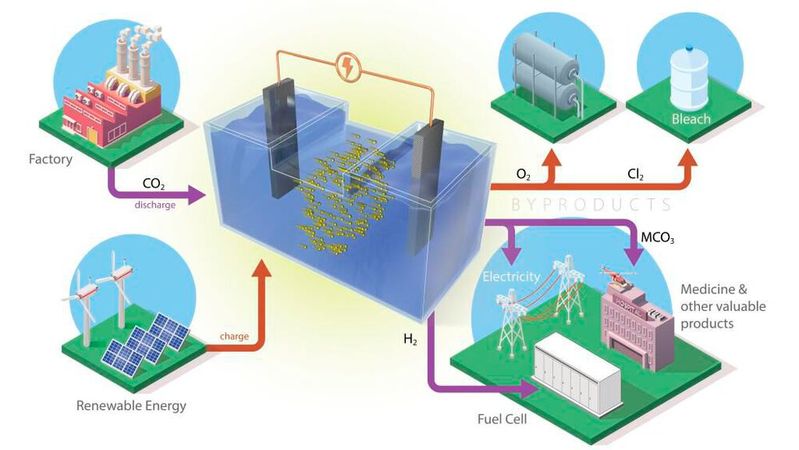
The battery developed at ORNL, which consists of two electrodes in a salt water solution, draws atmospheric carbon dioxide into its electrochemical reaction and releases only valuable by-products.
(Image: Andy Sproles/ORNL, U.S. Dept. of Energy)
Researchers at Oak Ridge National Laboratory (ORNL) are developing battery technologies to combat climate change in two ways: by increasing the use of renewable energy and by capturing carbon dioxide from the air.
This type of battery stores the renewable energy generated by solar panels or wind turbines. To use this energy when wind and sunlight are not available, an electrochemical reaction is required that captures carbon dioxide from industrial emissions and converts it into value-added products in ORNL's new battery formula.
ORNL researchers have recently developed and tested two different battery concepts that convert carbon dioxide gas (CO₂) into a solid form that can be used for other products. One of these new battery types maintained its capacity for 600 hours of operation and could store electricity for up to ten hours. The researchers also identified, investigated and overcame the main obstacle, deactivation caused by chemical deposits, which was an obstacle for the other battery concept.
"ORNL's Transformation Energy Science and Technology (TEST) initiative is exactly the kind of effort we need to combat climate change. We're excited that ORNL is investing in innovative ideas and approaches that can transform the way we think about storing energy beyond lithium-ion batteries and other conventional electrochemical energy storage systems," said Ilias Belharouak, an ORNL Corporate Fellow and leader of the initiative.
It's a fantastic scenario: using free electrons to store CO₂ and convert it into profitable products is a concept I could never have imagined ten years ago, but this is just the beginning.
Ilias Belharouak, ORNL Corporate Fellow and leader of the initiative
Stationary and open
Batteries work through electrochemical reactions in which ions are moved between two electrodes through an electrolyte. Unlike cell phone or car batteries, batteries designed to store energy on the grid do not have to function as a portable, closed system. This has enabled ORNL researchers to develop and test two types of batteries that can convert CO₂ from stationary industrial sources.
For example, the carbon dioxide produced in a power plant could be pumped through a pipe into the liquid electrolyte, creating bubbles similar to those in a carbonated soft drink. During battery operation, the gas bubbles turn into a solid powder.
How does it work?
Each component of a battery can consist of different elements or connections. This selection determines the life of the battery, how much energy it can store, how large or heavy it is and how quickly it charges or releases energy. In one of the new ORNL battery concepts, CO₂ is combined with sodium from salt water using an inexpensive iron-nickel catalyst. In the second, the gas is combined with aluminum. Each approach uses abundant materials and a liquid electrolyte in the form of salt water, sometimes mixed with other chemicals. The batteries are safer than existing technologies because their electrodes are stable in water, according to lead researcher Ruhul Amin.
Very little research has been carried out into CO₂ batteries to date. The approach tested so far is based on a reversible metal-CO₂ reaction that regenerates carbon dioxide, which continues to release greenhouse gases into the atmosphere. In addition, solid discharge products tend to clog the surface of the electrode, which impairs the performance of the battery.
However, the CO₂ batteries developed at ORNL do not release carbon dioxide. Instead, the carbonate by-product dissolves in the liquid electrolyte. The by-product either continuously enriches the liquid to improve battery performance or it can be filtered from the bottom of the container without interrupting battery operation.
The battery design can even be adapted to produce more of these by-products for use in the pharmaceutical or cement industries. The only gases released are oxygen and hydrogen, which do not contribute to climate change and can even be captured for energy or fuel production. The ORNL researchers used an almost entirely new combination of materials for these CO₂ batteries. The few similar earlier designs only worked for a short time or contained expensive metals.
Advantages, disadvantages and challenges overcome
The sodium-carbon dioxide or Na-CO₂ battery was the first to be developed and encountered a number of obstacles. For this system to work, the electrodes must be separated into wet and dry chambers with a solid ionic conductor in between. The barrier slows down the movement of the ions, which in turn slows down the operation of the battery and reduces its efficiency.
Date: 08.12.2025
Naturally, we always handle your personal data responsibly. Any personal data we receive from you is processed in accordance with applicable data protection legislation. For detailed information please see our privacy policy.
Consent to the use of data for promotional purposes
I hereby consent to Vogel Communications Group GmbH & Co. KG, Max-Planck-Str. 7-9, 97082 Würzburg including any affiliated companies according to §§ 15 et seq. AktG (hereafter: Vogel Communications Group) using my e-mail address to send editorial newsletters. A list of all affiliated companies can be found here
Newsletter content may include all products and services of any companies mentioned above, including for example specialist journals and books, events and fairs as well as event-related products and services, print and digital media offers and services such as additional (editorial) newsletters, raffles, lead campaigns, market research both online and offline, specialist webportals and e-learning offers. In case my personal telephone number has also been collected, it may be used for offers of aforementioned products, for services of the companies mentioned above, and market research purposes.
Additionally, my consent also includes the processing of my email address and telephone number for data matching for marketing purposes with select advertising partners such as LinkedIn, Google, and Meta. For this, Vogel Communications Group may transmit said data in hashed form to the advertising partners who then use said data to determine whether I am also a member of the mentioned advertising partner portals. Vogel Communications Group uses this feature for the purposes of re-targeting (up-selling, cross-selling, and customer loyalty), generating so-called look-alike audiences for acquisition of new customers, and as basis for exclusion for on-going advertising campaigns. Further information can be found in section “data matching for marketing purposes”.
In case I access protected data on Internet portals of Vogel Communications Group including any affiliated companies according to §§ 15 et seq. AktG, I need to provide further data in order to register for the access to such content. In return for this free access to editorial content, my data may be used in accordance with this consent for the purposes stated here. This does not apply to data matching for marketing purposes.
Right of revocation
I understand that I can revoke my consent at will. My revocation does not change the lawfulness of data processing that was conducted based on my consent leading up to my revocation. One option to declare my revocation is to use the contact form found at https://contact.vogel.de. In case I no longer wish to receive certain newsletters, I have subscribed to, I can also click on the unsubscribe link included at the end of a newsletter. Further information regarding my right of revocation and the implementation of it as well as the consequences of my revocation can be found in the data protection declaration, section editorial newsletter.
A major challenge for this Na-CO₂ battery is that a film forms on the electrode surface after prolonged use, which eventually leads to the battery being deactivated. Amin's research team used highly specialized microscopes and X-ray techniques to examine the battery cell at various stages of operation and then when it failed.
Studying the film formation helped the researchers to understand how to degrade it again. They were intrigued when they realized that the battery could be reactivated or prevented from deactivating by changing the charge/discharge cycle. Uneven charging and discharging pulses prevented the formation of a film on the electrode.
"We are reporting for the first time that the deactivated cell can be reactivated," says Amin. "And we have found the cause of deactivation and activation. If you charge and discharge the battery symmetrically for too long, it is dead at one stage. If you use the protocol we developed for our cell, the probability of failure is very low."
A second design for long-term storage
Next, the researchers focused on the design of the aluminum-carbon dioxide or Al-CO₂ battery. The team experimented with different electrolyte solutions and three different synthesis processes to find the best combination. The result was a battery that offers a storage capacity of more than ten hours of electricity for later use. "This is very important for long-term storage," said Amin. "This is the first Al-CO₂ battery that could run stably over a long period of time, which is the goal. Storing only a few hours of stored energy is not helpful."
The tests showed that the ORNL battery can operate for more than 600 hours without losing capacity, Amin said—far more than the only previously reported Al-CO₂ battery, which was only tested for eight hours. The icing on the cake is that this battery captures almost twice as much carbon dioxide as the Na-CO₂ battery. The system can be designed to operate in a single chamber, with both electrodes in the same liquid solution, so there is no impediment to ion movement.
The challenge for the Al-CO₂ battery is to improve its scalability, says Amin. Nevertheless, the team will continue to systematically investigate the battery's properties in order to extend the operating time and capture CO₂ more efficiently. To make the Na-CO₂ battery competitive, the team will focus on developing a very fine, dense and mechanically stable ceramic membrane to separate the battery chambers.
This research project was funded by ORNL's Laboratory Directed Research and Development (LDRD) program. The Center for Nanophase Materials Sciences, a DOE user facility at ORNL, was used for the sodium CO₂ battery research. (sb)
This article was first published on our sister website www.ElektronikPraxis.de (German language), Vogel Communications Group



:quality(80)/p7i.vogel.de/wcms/dd/08/dd086510d9ae7b50181f6070e4463b44/0129363730v1.jpeg "Typical application for ionizing devices: Wrapping films. (Picture: ©Adobe Stock/SMC)")
:quality(80)/p7i.vogel.de/wcms/35/57/3557c819943c53acec41a0ccba87da4f/0130049064v1.jpeg "Researchers at the Fraunhofer IWU in Chemnitz have long known that many typical sheet metal parts can be manufactured more cost-effectively using hollow embossing rollers. Now there is news to report ... (Image:Fraunhofer IWU)")
:quality(80)/p7i.vogel.de/wcms/59/02/590246e3b3f415c65edbee377c14ca77/26-06-pi-fraunhofer-iws-41450-direktplattieren-pic-01-7771x4369v1v1.jpeg "The Fraunhofer IWS has developed the new \"direct laser cladding\" process, which creates a functional layer directly on the base body by applying a strip-shaped metal to rotationally symmetrical components in a spiral and bonding it locally by laser. (Image:Christoph Wilsnack/Fraunhofer IWS)")
:quality(80)/p7i.vogel.de/wcms/73/60/73608418789b1d9c393f5e2fa974eda2/0130209906v1.jpeg "The robots of the X6 generation from b+m enable very high painting quality and are also particularly compact and easy to maintain. (Image:Beckhoff)")
:quality(80)/p7i.vogel.de/wcms/78/e9/78e9188c25a8a94e67c34c9bf8ffe495/visual-agile-20robots-20and-20google-20deepmind-20partner-20to-20bring-20intelligence-20to-20robotics-2500x1406v1v1.jpeg "Together, the partners are developing adaptable, intelligent robots for a wide range of applications (Image:Agile Robots SE)")
:quality(80)/p7i.vogel.de/wcms/e7/66/e7669ecf0260ae8fc54c214e34e4902a/0130316817v1.jpeg "Siemens and Palo Alto Networks offer tested cybersecurity solution for industrial 5G. (Image:Siemens)")
:quality(80)/p7i.vogel.de/wcms/9f/55/9f55324832c4f426958031375124d9de/siemens-20ubtech-20hmnd-1920x1079v1v1.png "Ready for the factory floor: While Ubtech is planning mass production, Siemens is already testing humanoids in real factory applications in Erlangen. (Image:Siemens)")
:quality(80)/p7i.vogel.de/wcms/11/36/113695ed260e29c8c2d9d39dc5f9d869/0130213768v1.jpeg "AI can work cheaply in China and deliver the results rapidly all over the world. (Image:Dall-E / AI-generated)")
:quality(80)/p7i.vogel.de/wcms/62/5f/625f41e87ebfef156a98c8e6393e32fd/0130211654v1.jpeg "Axial flux motors have some advantages over radial flux motor—but their production is currently still expensive. (Image:RWTH Aachen University)")
:quality(80)/p7i.vogel.de/wcms/77/9b/779b0685d010dfe45c9c2cb1cfecd467/0128886425v1.jpeg "The BlueEye is the first \"real\" hyperspectral camera for the UV range and covers the wavelength range from 220 to 380nm. (Image:Inno-spec GmbH)")
:quality(80)/p7i.vogel.de/wcms/e4/51/e451d52ce0182fb0aaa46a5774f832ef/26-04-pi-fraunhofer-iws-21160-bioslide-pic-01-4128x2321v1v1.jpeg "With the BioSlide research project, the Fraunhofer IWS is investigating how sliding systems can be designed to be more sustainable and energy-efficient. New materials can be tested in a particularly application-oriented manner on this plain bearing test stand. (Image:Fraunhofer IWS)")
![Thanks to advanced 3D printing technology, a more efficient use of resources should contribute to lower-emission aviation—this is the goal of ['skai]-lab. (Image:Oleksandr Pashchenko - stock.adobe.com / AI-generated)](https://cdn1.vogel.de/nghHNSbySccfOjG3n1qCA-FVOjQ=/288x162/smart/filters:format(jpg):quality(80)/p7i.vogel.de/wcms/62/64/626424c97a16e69f871bf216c9629c2a/adobestock-1927043193--c2-a9-20oleksandr-20pashchenko-20-e2-80-93-20stock-adobe-com-ki-generiertv1v1.jpeg "Thanks to advanced 3D printing technology, a more efficient use of resources should contribute to lower-emission aviation—this is the goal of ['skai]-lab. (Image:Oleksandr Pashchenko - stock.adobe.com / AI-generated)")
:quality(80)/p7i.vogel.de/wcms/c3/c4/c3c4ce270b083eeac55654148611f064/0130237945v1.jpeg "China is not giving up on hydrogen, but is intensifying its efforts. (Image:freely licensed from Pixabay)")
:quality(80)/p7i.vogel.de/wcms/4e/c0/4ec0bd19390b169edfa23677373dcdf1/0130260089v1.jpeg "Renewable fuels can supply European road traffic, according to a study. (Image:Aral)")
:quality(80)/p7i.vogel.de/wcms/6f/c9/6fc9050301d745cad25585c6780f8f51/0130197341v1.jpeg "Production facilities are a worthwhile target and are therefore at risk. (Image:ABB Robotics)")
:quality(80)/p7i.vogel.de/wcms/b6/62/b662adc2cec8227d8172509bbfb6ee42/25c0207-107-4961x2789v1v1.jpeg "The GLB is the second model based on Mercedes' new MMA platform. Apparently, Geely's platform is better and cheaper, which is why the two companies are negotiating a partnership. (Image:Mercedes-Benz)")
:quality(80)/p7i.vogel.de/wcms/4d/dd/4dddf438e91f394c04a095dbfd109d1c/0130236430v1.jpeg "Measurement modules: The 720301 module in combination with the SL2000 enables RMS and power calculations, among other things. (Image:Yokogawa)")
:quality(80)/p7i.vogel.de/wcms/61/fc/61fcf95f5cca15494ad18343901ae585/0130317237v1.jpeg "With the AGI CPU, Arm says it is taking a \"historic step\": With the processor aimed at AI in data centers, the company is presenting itself for the first time as a provider of its own chips, not just as a pure IP licensor. (Image:Arm)")
:quality(80)/p7i.vogel.de/wcms/82/90/8290dfe3595b6c6b33726ae8b76172c7/0130319587v1.jpeg "The concept image illustrates how the pattern of tiny protrusions and depressions created on the substrate (MgO, bottom) controls the arrangement of atoms in the superconducting material (YBCO, top). At the interface between the two layers, an electronic structure enables superconductivity to occur at higher temperatures than previously possible. (Image:Chalmers University of Technology / Riccardo Arpaia)")
:fill(fff,0)/p7i.vogel.de/companies/69/88/69882c428938e/tmts2026-ticec-banner-en-2000px.png "tmts2026-ticec-banner-en-2000px (https://www.tmts.tw/en)")
:fill(fff,0)/p7i.vogel.de/companies/67/eb/67eba621ef6ea/logo2.png "logo2 (Wuxi InfiMotion)")
:quality(80)/p7i.vogel.de/wcms/e2/28/e228a1f28394903c93560069fa7f5ecf/0127002762v1.jpeg "Hybrid-ion batteries could be used for the grid operation of renewable energies, where large storage systems are intended to balance the fluctuating power generation from wind and solar, several analysts write. (Image: ©Akbar - stock.adobe.com)")
:quality(80)/p7i.vogel.de/wcms/ba/d0/bad011e604599660b5b2cdd50eb44755/stefanie-arnold-152236-4500x2530v1v1.jpeg "Materials researcher Stefanie Arnold wants to make energy storage more environmentally friendly with the help of hollow carbon spheres. (Image:Saarland University)")