


:quality(80)/p7i.vogel.de/wcms/8d/ca/8dca960f81811a581332ba152fb51eea/0128759483v1.jpeg "AI will not make CNC experts obsolete in the foreseeable future but can facilitate and accelerate their work in the form of a CAM co-pilot. (Image:Siemens)")
:quality(80)/p7i.vogel.de/wcms/8b/c7/8bc7380a7e8dc5dcb9d7337383e93e46/0127912129v1.jpeg "For the second machining step, the thin-walled component is moved into the gap between the inner and outer tool. (Image:Mapal)")
:quality(80)/p7i.vogel.de/wcms/e1/b8/e1b8f2c81079d6f652a641ff0c8dcbef/0128918895v1.jpeg "Air bubbles make the flows in the gearbox visible: The left roller is actively driven by a motor (not shown), while the right roller passively rotates due to the flows. (Image:NYU (Applied Mathematics Laboratory))")
:quality(80)/p7i.vogel.de/wcms/9c/c1/9cc103887017ef58ccef3918281eb6c2/screenshot-202025-12-19-20150025-457x257v1v1.png "Various parts as produced by Kleiner in Pforzheim. (Image:Image: Kleiner)")
:quality(80)/p7i.vogel.de/wcms/2b/78/2b78c2ff6781704ed63902b59c22e195/0128897323v1.jpeg "The battery refreshers! Lithium-ion batteries for electric vehicles become unbalanced over time, causing a significant drop in performance. However, Battery X Metals knows how to restore the balance. The Canadians have now been able to prove this through tests. (Image:Power Boy)")
:quality(80)/p7i.vogel.de/wcms/2c/1f/2c1f12c11848eb8bd296de2e54726074/0128885487v1.jpeg "Matthias Lapp, CEO of the Lapp Group, sees great potential in the Taiwanese market. (Image:Lapp)")
:quality(80)/p7i.vogel.de/wcms/3d/47/3d477c7a3990157ffb8a2894ea8f6dc5/0127426206v1.jpeg "For metallic valve bodies, such as those manufactured by Gemü in the thousands, proof of structural strength is required. (Image:GEMÜ)")
:quality(80)/p7i.vogel.de/wcms/a4/d5/a4d50ff81ccd24c8247d64f12bec7fdf/0113143253v1.jpeg "In our China Market Insider, we regularly provide you with relevant information directly from China. (Image:© Eisenhans - stock.adobe.com)")
:quality(80)/p7i.vogel.de/wcms/46/5b/465bfc4297df5d51da3e8dd4db25b916/0128924879v1.jpeg "AI-based systems are restructuring traditional process flows in the interaction between design, prototyping, and manufacturing. (Image:Meviy)")
:quality(80)/p7i.vogel.de/wcms/f2/af/f2af678854664143c1d3a886cbfb7e5f/0128694427v1.jpeg "Position, angle, inclination, acceleration, vibration: Key measurements for precise productions (Image:Michael Heßhaus/abj/Midjourney)")
:quality(80)/p7i.vogel.de/wcms/77/f4/77f40a3ea0c8f9f18d72a42336e57104/0128775363v1.jpeg "Shunts with aluminum connectors are a perfect match for aluminum cables, which have long been the standard when it comes to weight reduction in mobile applications. (Image:Wickeder)")
:quality(80)/p7i.vogel.de/wcms/fa/65/fa653385df43d7b47543882ab3a89b79/0128816209v1.jpeg "Images on displays can now be touched. (Image: ©Lush Diaries - stock.adobe.com / AI-generated)")
:quality(80)/p7i.vogel.de/wcms/7f/6e/7f6e0c3d12baaf0fd6fd9301f3b3b9f7/0128909616v1.jpeg "Extended multi-ECU prototype with multi-fidelity and multi-ECU electronic simulation, integrating CarMaker from IPG Automotive and virtualization solutions from Synopsys via the SIL Kit. (Image:IPG Automotive)")
:quality(80)/p7i.vogel.de/wcms/53/0b/530b6af45fe6dfabd83e4a2d4f243e9f/0128921888v1.jpeg "Artificial intelligence has begun to conquer China's 380 million electric two-wheelers. (Image:Segway)")
:quality(80)/p7i.vogel.de/wcms/be/67/be67d69863c54f8e48c2fefaf168939b/0128749077v1.jpeg "Neura Robotics and Bosch collaborate on humanoid robots and Physical AI. In the image: the humanoid \"4NE1\". (Image:Neura Robotics)")
:quality(80)/p7i.vogel.de/wcms/58/63/5863c101435cf9c29ff718bf9bfd54a4/0128878544v1.jpeg "In all fully electric models of the BMW M Neue Klasse, two electric drive units on the front and rear axles, each with one electric motor per wheel, ensure typical BMW M driving performance. (Image: BMW AG)")
:quality(80)/p7i.vogel.de/wcms/a4/b5/a4b5d53e2b20f56fbba1b9031878eb75/0128894662v1.jpeg "The 6G mobile communication generation places high demands on test hardware. The RF measurement technology provider Anritsu is taking a new approach to test environments. (Image:freely licensed)")
:quality(80)/p7i.vogel.de/wcms/75/99/7599ac779069e5dd7d35039bdd8061c9/0128897141v1.jpeg "Nuclear power is controversial. However, at least in terms of CO2 emissions, it is not as harmful to the climate as coal or gas. (Image:freely licensed)")
:quality(80)/p7i.vogel.de/wcms/7e/c1/7ec1077a00504b919aabf27da99e93ef/0128873058v1.jpeg "Multiple structured semiconductor wafers with reflective interference colors. (Image:Dall-E / AI-generated)")
:quality(80)/p7i.vogel.de/wcms/3d/d5/3dd50e300bf8af537882d9a31d3268b8/0128891096v1.jpeg "Wolfspeed has produced a single-crystal 300-mm silicon carbide wafer. (Image:Wolfspeed)")
:fill(fff,0)/images.vogel.de/vogelonline/companyimg/76800/76895/65.jpg "FAULHABER_120mm.jpg ()")
:fill(fff,0)/p7i.vogel.de/companies/68/a4/68a47beec75ce/logo-cmyk-de.jpeg "logo-cmyk-de (https://www.datatec.eu/)")
:fill(fff,0)/p7i.vogel.de/companies/67/eb/67eba621ef6ea/logo2.png "logo2 (Wuxi InfiMotion)")
:quality(80)/p7i.vogel.de/wcms/d2/ff/d2ff74084b44049bdf850e892a0b1355/0122362274v1.jpeg "At CES 2025, Bosch focused on the eBike, among other things. The supplier aims to improve theft protection for eBike batteries. (Image:Stefanie Eckardt)")
Date: 08.12.2025
Naturally, we always handle your personal data responsibly. Any personal data we receive from you is processed in accordance with applicable data protection legislation. For detailed information please see our privacy policy.
Consent to the use of data for promotional purposes
I hereby consent to Vogel Communications Group GmbH & Co. KG, Max-Planck-Str. 7-9, 97082 Würzburg including any affiliated companies according to §§ 15 et seq. AktG (hereafter: Vogel Communications Group) using my e-mail address to send editorial newsletters. A list of all affiliated companies can be found here
Newsletter content may include all products and services of any companies mentioned above, including for example specialist journals and books, events and fairs as well as event-related products and services, print and digital media offers and services such as additional (editorial) newsletters, raffles, lead campaigns, market research both online and offline, specialist webportals and e-learning offers. In case my personal telephone number has also been collected, it may be used for offers of aforementioned products, for services of the companies mentioned above, and market research purposes.
Additionally, my consent also includes the processing of my email address and telephone number for data matching for marketing purposes with select advertising partners such as LinkedIn, Google, and Meta. For this, Vogel Communications Group may transmit said data in hashed form to the advertising partners who then use said data to determine whether I am also a member of the mentioned advertising partner portals. Vogel Communications Group uses this feature for the purposes of re-targeting (up-selling, cross-selling, and customer loyalty), generating so-called look-alike audiences for acquisition of new customers, and as basis for exclusion for on-going advertising campaigns. Further information can be found in section “data matching for marketing purposes”.
In case I access protected data on Internet portals of Vogel Communications Group including any affiliated companies according to §§ 15 et seq. AktG, I need to provide further data in order to register for the access to such content. In return for this free access to editorial content, my data may be used in accordance with this consent for the purposes stated here. This does not apply to data matching for marketing purposes.
Right of revocation
I understand that I can revoke my consent at will. My revocation does not change the lawfulness of data processing that was conducted based on my consent leading up to my revocation. One option to declare my revocation is to use the contact form found at https://contact.vogel.de. In case I no longer wish to receive certain newsletters, I have subscribed to, I can also click on the unsubscribe link included at the end of a newsletter. Further information regarding my right of revocation and the implementation of it as well as the consequences of my revocation can be found in the data protection declaration, section editorial newsletter.
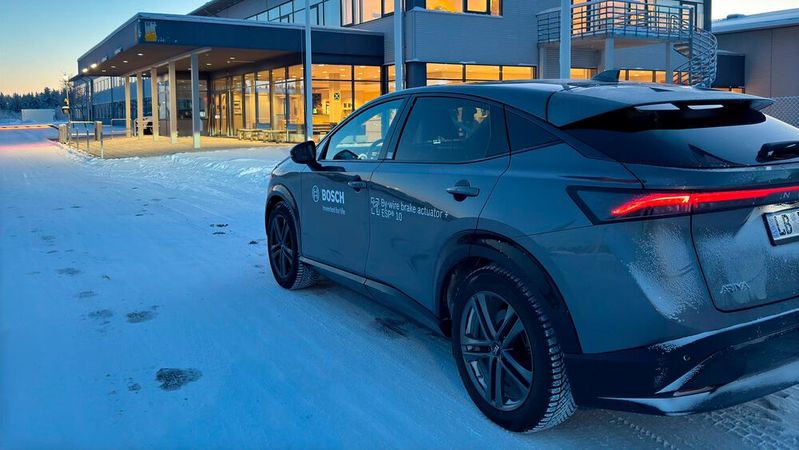
:quality(80)/p7i.vogel.de/wcms/b6/29/b6294808fd80c68fe8e153645b12be55/0128088875v1.jpeg "In brake-by-wire systems, the pedal travel is electronically transmitted to the brake actuators. (Image:Bosch)")
:quality(80)/p7i.vogel.de/wcms/e3/fb/e3fb886b4290792b18e4c7a0aa45dc26/0126604070v1.jpeg "With ZF's steer-by-wire solution, there is no longer a mechanical connection between the steering wheel and the steering gear. The technology will be standard in Mercedes-Benz vehicles starting in 2026. (Image:ZF Group)")