BMW participates in the open source project S-Core. Joachim Post, BMW Head of Development, talks about software development, expectations of suppliers— and about drive technology in the next ten years.
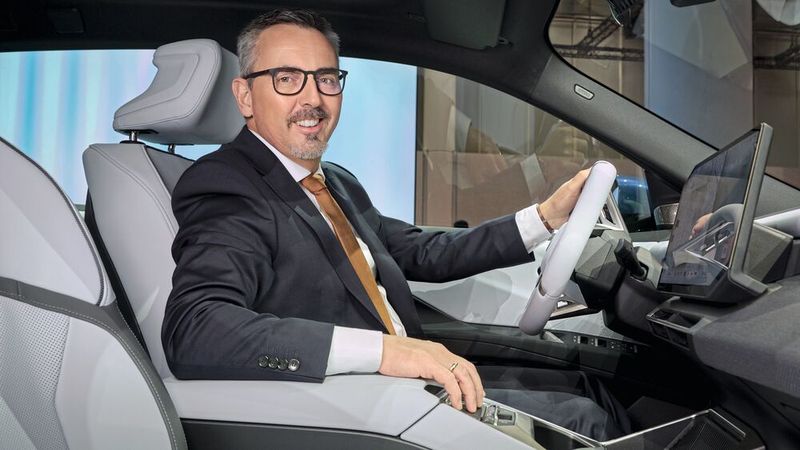
BMW's new Board Member for Development Joachim Post in the new iX3 model.
(Image: BMW)
Mr. Post, are you satisfied with the feedback and pre-orders for the iX3, the first model in the New Class?
Joachim Post: Yes, I am very satisfied. Not only the positive response overall, but also the pleasingly high number of orders received—from both private and fleet customers—is very positive. The model will only be available at dealerships in March. This means that many customers have ordered without being able to test drive the car. Naturally, we are delighted with the trust they have placed in us!
Can the pre-orders be quantified?
We cannot provide detailed figures, but the order intake is enormous. Since its unveiling at the IAA in September 2025, one in three all-electric BMWs ordered in Europe has been a BMW iX3.
The cost of developing the new platform, including software, is high for a manufacturer with around 440,000 e-cars a year. Is it worth it compared to the top global manufacturers?
If we were to develop the new zone architecture with the four central computers and the software only for selected models, it would be unaffordable. However, we are introducing these technologies in all of our future vehicles. This means that the economies of scale will apply to the entire 2.5 million vehicles that we sell each year. We have never done it before as consistently as we are introducing the new class technologies into the entire portfolio.
For example, we have 20 times more computing power on board than in the last generation. This will enable the entire future fleet to adapt future AI functions.
To reduce development costs, there is the open source project S-Core, which is supported by the German Association of the Automotive Industry (VDA). So far, most of the lines of code in the project have come from BMW. Why are you involved?
We need to start with a solid basis so that we can quickly become concrete. We have provided part of this critical mass. In the development of S-Core 1.0, we are now seeing a lot of momentum from our partners, who are also heavily involved. Why we are involved: With the software-defined vehicle, we naturally have more and more software-based functions in the car that need to be managed, updated and mastered. To do this, we need modern, powerful software platforms with which we can control the complexity, similar to what we know from software and consumer electronics.
However, in the automotive sector, these software platforms must meet much higher safety and quality standards. The development and operation of the software infrastructure is therefore growing in complexity, but at the same time must keep pace with the speed of development in the digital world. It therefore makes sense to join forces here in order to save effort, gain speed and avoid having to reinvent the wheel several times. One example: Bluetooth drivers. You really don't have to reprogram the wireless connection with the vehicle for every model. We are also hoping for greater standardization in the world of suppliers. Basically, the aim is to increase the speed of development and at the same time reduce costs and therefore the price of the vehicle.
Car prices have risen sharply in recent decades—regardless of the drive system. Buying a car is becoming more difficult for many customers. Can this trend be stopped?
The S-Core project is hopefully a building block for this. But you only have to look at what legislators are demanding for cars. Regulation plays a significant role in price increases. This ranges from emissions requirements to assistance systems.
Which drive technology will prevail in passenger cars over the next ten years?
We don't have the crystal ball to predict this. Our strategy has always been to be open to technology. That is why we design our vehicle architectures in such a way that we are able to implement the vehicle electrical system and the infotainment system independently of the drive system. The next generation of the X5, in which we are able to produce five drive types on one line, will be launched this year. This is important for us as a global player. The market in the USA is still heavily reliant on combustion engines. In China, we have a different situation, with a focus on hybrid and electric drives. Europe is in a discovery phase. We have a high proportion of electric cars in Scandinavia. In southern Europe, it is sometimes negligible.
The decision to offer the X5 with a fuel cell and hydrogen in the tank is surprising—at least in Germany—where there are only around 50 suitable filling stations. Where do you see a market for this drive system?
If you look at Korea and Japan, hydrogen plays a completely different role. There is also great interest in hydrogen in California. We want to benefit from the growth in this segment. For large vehicles such as the X5, this is a good option because batteries are heavy and cost-intensive.
Basically, however, we still have the chicken-and-egg problem with hydrogen, as we used to have with electromobility. When we launched the BMW i3, the charging infrastructure was still very patchy. For once, they have to be pioneers and offer new technology. The hydrogen economy will emerge, because the industry needs it to decarbonize—as does heavy commercial transport. Six tons (6.6 short tons) of batteries in a truck are difficult to implement from an ecological and cost perspective. In addition, dependence on raw materials from Asia is increasing. Hydrogen offers a good alternative.
Date: 08.12.2025
Naturally, we always handle your personal data responsibly. Any personal data we receive from you is processed in accordance with applicable data protection legislation. For detailed information please see our privacy policy.
Consent to the use of data for promotional purposes
I hereby consent to Vogel Communications Group GmbH & Co. KG, Max-Planck-Str. 7-9, 97082 Würzburg including any affiliated companies according to §§ 15 et seq. AktG (hereafter: Vogel Communications Group) using my e-mail address to send editorial newsletters. A list of all affiliated companies can be found here
Newsletter content may include all products and services of any companies mentioned above, including for example specialist journals and books, events and fairs as well as event-related products and services, print and digital media offers and services such as additional (editorial) newsletters, raffles, lead campaigns, market research both online and offline, specialist webportals and e-learning offers. In case my personal telephone number has also been collected, it may be used for offers of aforementioned products, for services of the companies mentioned above, and market research purposes.
Additionally, my consent also includes the processing of my email address and telephone number for data matching for marketing purposes with select advertising partners such as LinkedIn, Google, and Meta. For this, Vogel Communications Group may transmit said data in hashed form to the advertising partners who then use said data to determine whether I am also a member of the mentioned advertising partner portals. Vogel Communications Group uses this feature for the purposes of re-targeting (up-selling, cross-selling, and customer loyalty), generating so-called look-alike audiences for acquisition of new customers, and as basis for exclusion for on-going advertising campaigns. Further information can be found in section “data matching for marketing purposes”.
In case I access protected data on Internet portals of Vogel Communications Group including any affiliated companies according to §§ 15 et seq. AktG, I need to provide further data in order to register for the access to such content. In return for this free access to editorial content, my data may be used in accordance with this consent for the purposes stated here. This does not apply to data matching for marketing purposes.
Right of revocation
I understand that I can revoke my consent at will. My revocation does not change the lawfulness of data processing that was conducted based on my consent leading up to my revocation. One option to declare my revocation is to use the contact form found at https://contact.vogel.de. In case I no longer wish to receive certain newsletters, I have subscribed to, I can also click on the unsubscribe link included at the end of a newsletter. Further information regarding my right of revocation and the implementation of it as well as the consequences of my revocation can be found in the data protection declaration, section editorial newsletter.
Do you regret that BMW does not build trucks?
Not at all. We're not going to start building 40-ton (44 short tons) trucks now. But I am of course talking to my colleagues in the VDA about standardization issues. You have to make new technologies widely usable. One example is the filling station infrastructure for hydrogen: filling stations should not only be suitable for commercial vehicles, but also for passenger cars, so that you don't need two different systems.
Toyota supplies the drive technology. What is its share in the hydrogen car?
We are working closely with Toyota in the concept development phase for the next fuel cell system to standardize the core components and develop a common system for individual Toyota and BMW vehicles. Toyota will again supply its next-generation fuel cells to BMW. We will be responsible for the development and integration of the individual systems as well as safeguarding the assembly and testing processes. In addition to the fuel cell system, the hydrogen powertrain also includes the tank technology and a buffer battery. BMW is also responsible for the complete industrialization and production of the entire drive unit.
The transition to alternative drive systems is taking longer than initially expected. Are you continuing to develop combustion engines?
We are in the fortunate position of having developed our basic engines with the current modular generation of combustion engines in such a way that they can be improved for future emissions legislation and Euro 7. We have highly efficient units in our range that can be powered by 48 volts or in combination with a plug-in hybrid with low emissions and yet high performance.
With 48 volts, are you already hinting that there will always be some form of hybridization in the combustion engine in the future?
The question is, of course, whether you are looking at an entry-level or a performance model. The higher the performance of the unit, the higher the proportion of electrification will be. The use of 48-volt technology has increased, on the one hand to reduce emissions and on the other to provide comfort functions in the low-load range.
How much joy do you experience in the car when you take your hands off the steering wheel in automated mode?
I think we need to move away from black and white thinking here. Our driver assistance functions work in a symbiotic way. The driver is not patronized, but supported. They can even steer, brake or accelerate without the assistant switching off immediately. With the DCAS regulation, we are the first manufacturer to have Europe-wide approval for a level 2 hands-off system up to 130 km/h (81 mph). The costs for a genuine level 3 system are so high on the hardware side that only a small proportion of customers are prepared to spend the necessary money.
Overall, we see different dynamics for assistance systems worldwide, both in terms of regulation and acceptance. In China, we will probably see level 3 systems spreading more quickly.
Many drivers are annoyed by the bells and whistles in new cars.
The cruise control, for example, is required by law. Other drivers are the Euro NCAP requirements for awarding five stars, such as a system that determines whether there is a child in the back seat when you leave the car. There are undoubtedly many sensible requirements, but there are also some that are only relevant for a very small group of customers. And sometimes you even get the impression that you are being forced to increasingly move away from the actual needs of the customer. It is important that a customer can easily deactivate the functions that he or she does not want to use.
Dr. Joachim Post
has been a member of the Board of Management of BMW AG since January 2022. First for the Purchasing and Supplier Network division and since June 2025 for the Development division.
Post studied mechanical engineering at the Technical University of Karlsruhe (Germany) and received his doctorate in engineering from the Technical University of Munich. He joined BMW AG in 2002, initially in the functional development of motorcycle engine applications. From 2018 to 2020, he was Head of Vehicle Strategy, then Head of the BMW Midsize Product Line until 2021.



:quality(80)/p7i.vogel.de/wcms/45/e4/45e497fad5299ffbb7278c1636a261ba/0129304667v1.jpeg "Screw head forming with heat: The heads of the blanks are heated to over 1,000 °C in the induction stage. (Image:Aachen mechanical engineering)")
:quality(80)/p7i.vogel.de/wcms/bc/df/bcdfa690253179f44dfa43986e35e3d4/0129302450v1.jpeg "The VSC 400 DDS retrofit machine from EMAG at EWS Weigele with tool shuttle for external tool preparation - the basis for reliable hard machining of gears. (Image:Emag Systems)")
:quality(80)/p7i.vogel.de/wcms/f7/85/f785e961fa2a55ecf4380e1a204c79e3/0129432203v1.jpeg "This is the new Artis 300, which completes the Artis range as the third variant. It stands for TIG DC welding up to 300 amps and is designed as an XT variant for all common voltage levels worldwide. (Image:Fronius)")
:quality(80)/p7i.vogel.de/wcms/28/7c/287ccc5ac565d6e6041bebb1e3e073f0/0113143253v1.jpeg "In our China Market Insider, we regularly provide you with relevant information directly from China. (Image:© Eisenhans - stock.adobe.com)")
:quality(80)/p7i.vogel.de/wcms/99/2e/992e57a54c4ddeaafc113de8e56f2b73/0129501004v1.jpeg "Sereact's AI-based control system can process new and unknown items without prior data collection. (Image:Sereact)")
:quality(80)/p7i.vogel.de/wcms/97/3a/973acc83133c28605f855d750523142e/0129492013v1.jpeg "During the opening, Agile One symbolically pressed the start button. (Image:Deutsche Telekom AG / Cindy Albrecht)")
:quality(80)/p7i.vogel.de/wcms/dd/4e/dd4e6ce73e0e700dcc0f0584813ef47f/0128875162v1.jpeg "Thanks to their high precision, robustness and integration capability, Micro-Epsilon's measurement technology solutions are not only suitable for new systems, but also ideal for retrofit applications. (Image:Micro-Epsilon Messtechnik GmbH & Co. KG)")
:quality(80)/p7i.vogel.de/wcms/17/61/1761a0165c23fe007d0a8e62d2a23121/0129467133v1.jpeg "The partnership between Dassault Systèmes and Nvidia aims to make the industry more effective with the help of AI and digital twins. (Picture: ©DC Studio - stock.adobe.com)")
:quality(80)/p7i.vogel.de/wcms/f8/2d/f82d45c2610205e2c0c188968022890d/more-liftoff-power-first-ariane-6-with-four-boosters-launched-4781x2691v1v1.jpeg "The Ariane 6 can be modularly adapted to any mission—either with two or four boosters and a variable payload fairing length. (Image:ESA-M. Pedoussaut)")
:quality(80)/p7i.vogel.de/wcms/9b/e7/9be7c2ceb897aa2bf1ab4eb2198b8b96/roboter-20hand1-1240x698v1v1.jpeg "What if you could 3D print a soft robot with predictable shape-shifting capabilities already built in? (Image:Picture: Harvard University)")
:quality(80)/p7i.vogel.de/wcms/a7/34/a73475e9638e032c32288f53006abab7/newsimage417867-2665x1500v1v1.jpeg "Combination of a model from a scanning electron microscope image (left) with a section of the underlying crystal structure of a studied MXene with precisely controlled surface terminations. (Image:B. Schröder/HZDR)")
:quality(80)/p7i.vogel.de/wcms/d2/1a/d21a9b3e1333f306ffd6421e84f9e3d0/semiconductor-20image-20courtesy-20of-20gelest-3000x1688v1.jpeg "In a new collaboration, IBM will test the performance of Gelest precursor materials for dry resist EUV lithography, generating results that aim to guide Gelest on materials research and speed innovation toward smaller devices. (Source: Gelest)")
:quality(80)/p7i.vogel.de/wcms/ad/72/ad72626a52c9a9332591f457e5afabca/0129497458v1.jpeg "BMW's new Board Member for Development Joachim Post in the new iX3 model. (Image:BMW)")
:quality(80)/p7i.vogel.de/wcms/12/ce/12ce3b8d4062d9e433419e9ada594c34/adobestock-1669527454-marewa-4096x2304v1v1.jpeg "Symbol image (Image:Marewa - stock.adobe.com)")
:quality(80)/p7i.vogel.de/wcms/e8/1f/e81f2bd61d820a0cf982dd3831f273dd/0129511298v1.jpeg "In China, certain functions in new cars will once again be directly accessible via haptic input—without a screen. (Image:BYD)")
:quality(80)/p7i.vogel.de/wcms/0b/02/0b02abc1524e267ae66ad0609ce08b20/0129482073v1.jpeg "The Haval Jolion Pro competes in the compact SUV segment. (Image:GWM)")
:quality(80)/p7i.vogel.de/wcms/68/ec/68ec268edc51a26c4e6e2de7187e8e4f/0129456364v1.jpeg "The storage facilities are being built at three locations in Lithuania. (Image:Nidec Conversion)")
:quality(80)/p7i.vogel.de/wcms/a0/36/a03679debcdda99158f4eaa0d6fbe43d/0129505643v1.jpeg "Arduino App Lab: The current release 0.4.0 brings a number of helpful new features. (Image:Arduino)")
:quality(80)/p7i.vogel.de/wcms/36/c8/36c8b329076027abf5def92031e3028e/0129508876v1.jpeg "Microsoft German headquarters in Munich: As part of the Munich Security Conference, 15 international companies along the entire electronics value chain have formed a tech alliance for digital sovereignty and common trust standards under the leadership of Microsoft and Ericsson. (Image:Microsoft)")
:quality(80)/p7i.vogel.de/wcms/d5/6e/d56e97cb8afab17e93794c1cca214228/0129419457v1.jpeg "China is investing heavily in its domestic semiconductor ecosystem. If you want to be part of it, you should know in advance where which cluster is located and which technology it is driving forward. (Image:Dall-E / AI-generated)")
:fill(fff,0)/images.vogel.de/vogelonline/companyimg/76800/76895/65.jpg "FAULHABER_120mm.jpg ()")
:fill(fff,0)/p7i.vogel.de/companies/67/eb/67eba621ef6ea/logo2.png "logo2 (Wuxi InfiMotion)")
:quality(80):fill(efefef,0)/p7i.vogel.de/wcms/65/af/65af8b85add17/additive-manufacturing---make-or-buy.png "Additive Manufacturing - Make or Buy")
:quality(80)/p7i.vogel.de/wcms/68/0e/680e751d9f2731ebb79dcb45fd5cdf9c/0127953631v1.jpeg "Starting in 2028, BMW plans to launch a car with a fuel cell drive system. (Image:Jonas Rattel)")
:quality(80)/p7i.vogel.de/wcms/a7/94/a7940c664f0e95780f99d00c1cb1578a/0124347490v1.jpeg "Hyundai has unveiled a new generation of the Nexo hydrogen SUV. (Image:Hyundai)")