The people-mover manufacturer Holon is the Benteler Group's speedboat. Its CEO Ralf Göttel reports a strong demand for the new product, the new role of suppliers, and the philosophy of not wanting to do everything themselves.
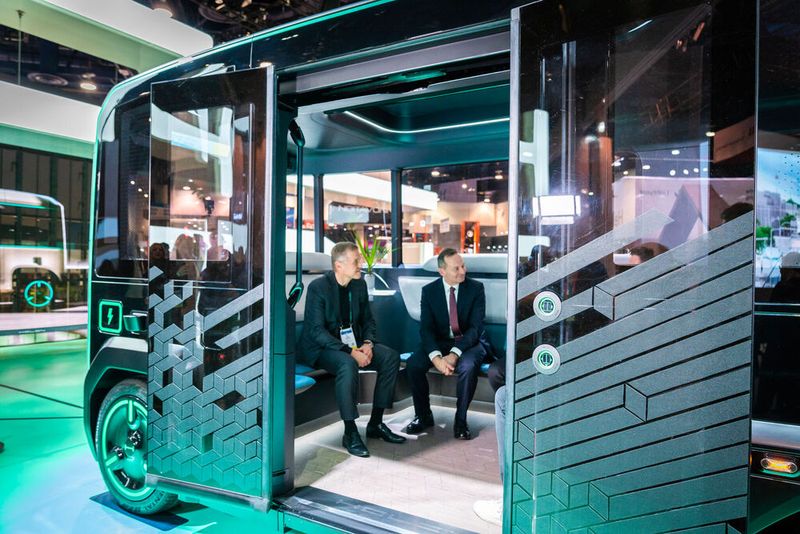
Benteler's subsidiary, Holon, successfully presented its People Mover at CES in Las Vegas.
(Image: Holon/Benteler)
Last year, you established Holon as a brand for autonomous mobility, renaming the unit Benteler EV Systems, which was spun off at the end of 2021. Can a mobility product be better positioned in the market through a name change rather than being associated with a traditional supplier name in the automotive industry?
The change of name is part of a deliberate new setting. Such new business areas can be developed faster and more effectively in a modern start-up context than in a very organized and process-oriented corporate environment. We have therefore deliberately given the new line of business more dynamism through the organization and the setting - and also express this in the branding. At the same time, Holon can always fall back on the 25,000 employees in the Benteler Group, the enormous experience, the resources. That is a real USP for us.
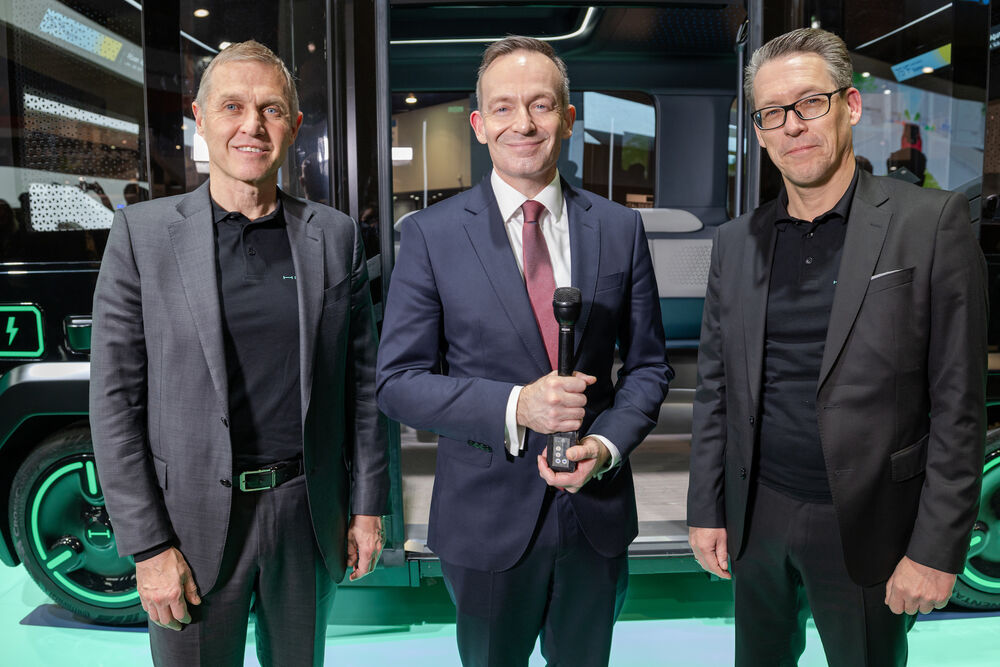
Benteler CEO Ralf Göttel (left), here with Transport Minister Volker Wissing and Holon CEO Marco Kollmeier, sees an attractive niche in the business of People Movers.
(Image:Kathryn Rapier/Holon/Benteler)
During CES, they confirmed the start of production for the People Mover from 2025 in the USA. What are the sales targets of the subsidiary, especially after receiving direct feedback from potential customers at the trade show?
We have obviously addressed a niche in which there is great demand. Over the past ten years, many companies have focused on the stacks and software associated with autonomous driving. But there is simply no suitable vehicle that offers the quality and reliability for use. The production volume that we have in our business plan for 2025 has already been sold today. We are planning for 1,000 units.
But could there be more?
If you look at the response from Las Vegas, the demand figures actually far exceed our business planning. Accordingly, they may not be feasible on this scale. For example, Hamburger Hochbahn alone wants to put 1,000 of these vehicles on the roads. And so many representatives of European cities have visited us, all of whom have the same issue: They need a reliable vehicle for public transport to get started in this segment. They all need to practice here. They don't need a 40-meter bus, but smaller vehicles with a higher frequency.
Production will start in the USA. Why only there for the time being and how attractive would other markets be?
In general, we produce at the customer's premises. In the USA, this includes our partner Beep. For European demand, we would produce in Europe and for Asian demand in Asia. We are also starting production in the USA because this is where demand is greatest - particularly from the private sector.
Another major German supplier is a direct competitor and has been pursuing the matter for a bit longer. The project has not yet seen significant economic success. What makes you confident that you will be more successful?
Please understand that I do not comment on competitors' strategies and products. We are absolutely convinced by the concept of our mover - the range, the capacity, the potential speed. In general, it is certainly a sign that traditional suppliers are now stepping up to the plate. After all, the highly committed start-ups that have been active in this field to date have not had the strength or the skills to take it straight to the streets.
You also have two identical partners or customers in Germany with Hamburger Hochbahn and in the US with Beep, just like the mentioned competitor. Will the faster one prevail here?
I have a different philosophy and strategy for such projects: I believe in the sharing economy, in partnerships to build speed and expertise. The traditional German approach is: I have to do everything myself. And our market companion seems to have high expectations of developing a lot of things in-house. At Holon, we consciously work with the best partners in the industry and, where possible, already use series components, such as the sliding door or the ramp for wheelchair users. The stack is also already in use on the market. We don't have to do everything ourselves, but see ourselves as a system integrator. This speeds up innovation and implementation.
Date: 08.12.2025
Naturally, we always handle your personal data responsibly. Any personal data we receive from you is processed in accordance with applicable data protection legislation. For detailed information please see our privacy policy.
Consent to the use of data for promotional purposes
I hereby consent to Vogel Communications Group GmbH & Co. KG, Max-Planck-Str. 7-9, 97082 Würzburg including any affiliated companies according to §§ 15 et seq. AktG (hereafter: Vogel Communications Group) using my e-mail address to send editorial newsletters. A list of all affiliated companies can be found here
Newsletter content may include all products and services of any companies mentioned above, including for example specialist journals and books, events and fairs as well as event-related products and services, print and digital media offers and services such as additional (editorial) newsletters, raffles, lead campaigns, market research both online and offline, specialist webportals and e-learning offers. In case my personal telephone number has also been collected, it may be used for offers of aforementioned products, for services of the companies mentioned above, and market research purposes.
Additionally, my consent also includes the processing of my email address and telephone number for data matching for marketing purposes with select advertising partners such as LinkedIn, Google, and Meta. For this, Vogel Communications Group may transmit said data in hashed form to the advertising partners who then use said data to determine whether I am also a member of the mentioned advertising partner portals. Vogel Communications Group uses this feature for the purposes of re-targeting (up-selling, cross-selling, and customer loyalty), generating so-called look-alike audiences for acquisition of new customers, and as basis for exclusion for on-going advertising campaigns. Further information can be found in section “data matching for marketing purposes”.
In case I access protected data on Internet portals of Vogel Communications Group including any affiliated companies according to §§ 15 et seq. AktG, I need to provide further data in order to register for the access to such content. In return for this free access to editorial content, my data may be used in accordance with this consent for the purposes stated here. This does not apply to data matching for marketing purposes.
Right of revocation
I understand that I can revoke my consent at will. My revocation does not change the lawfulness of data processing that was conducted based on my consent leading up to my revocation. One option to declare my revocation is to use the contact form found at https://contact.vogel.de. In case I no longer wish to receive certain newsletters, I have subscribed to, I can also click on the unsubscribe link included at the end of a newsletter. Further information regarding my right of revocation and the implementation of it as well as the consequences of my revocation can be found in the data protection declaration, section editorial newsletter.
In addition to passenger transport, variants for freight transportation are also being considered. Wouldn't that be the more lucrative perspective? After all, all experts expect the rollout of autonomous vehicles, especially in freight transportation, in the USA. How far along is the product development in this area?
We have had good experience with not starting too broadly. With the current focus, we are also creating a basis for other use cases. One thing we have learned about autonomous driving is that you shouldn't plan for the most difficult scenario - i.e. autonomous driving everywhere. We start with Beep with defined residential areas, geofencing routes and repeatable driving situations. Freight transport or last-mile applications are the logical next step for this concept. This is also possible thanks to the modularity of the Holon platform. Holon always runs on the same concept and the outer skin can be adapted accordingly.
How committed are you to your current partners such as Mobileye, Cognizant, etc.? Could other companies also join in for different models?
There is no exclusivity. The circle can grow. And we are aware that partnerships evolve over the years. If a great innovation comes around the corner the day after tomorrow, it would be negligent if we didn't include it. But you also have to be able to share.
If a powerful mobility service provider in Asia were to make a very good offer to acquire the "Holon" package and thus produce their own fleet cost-effectively on site, would you be swayed?
Strategically, we don't have that on our radar. Of course, I would have to discuss a special offer with our shareholders. It would be exciting if we could accelerate distribution even further with a strong partner. I don't think we would close our minds to a coherent industrial concept.



:quality(80)/p7i.vogel.de/wcms/a0/47/a04725ef9bd09fb6c9341a1bea1b5d93/0130443083v1.jpeg "Here, a type of plastic pallet is produced by thermoforming (vacuum forming or deep drawing) at the corresponding division of New England Plastics in the USA. This division, which specializes in so-called liners, is now part of Ringmetall ... (Image:New England Plastics)")
:quality(80)/p7i.vogel.de/wcms/e3/42/e342b3c593ea92d56604d3be969e9c9a/0130437231v1.jpeg "Daimler Truck will be building even more trucks at its Czech plant in Cheb in the future. This is because it is now being expanded for strategic cost-saving reasons ... (Image:Daimler Truck)")
:quality(80)/p7i.vogel.de/wcms/23/99/23992bf2dcdc432c9b7209c34a4a7c48/0129733089v1.jpeg "Stork relies on the modular Neoswiss turning system from Iscar to shorten the set-up times for its sliding headstock lathes and work more productively. (Image:Iscar)")
:quality(80)/p7i.vogel.de/wcms/7d/e2/7de2923434b2f1a78ba5482d8d335269/0113143253v1.jpeg "In our China Market Insider we regularly provide you with relevant information directly from China. (Image:© Eisenhans - stock.adobe.com)")
:quality(80)/p7i.vogel.de/wcms/b7/36/b736dfebc16c42d6901d0d0e1f390493/3d-druck-20factory-20--20ki-20generiert-1920x1079v1.png "(Source: AI-generated)")
:quality(80)/p7i.vogel.de/wcms/79/b2/79b21aad663f4a7bd4472afc1c1afc62/0130433994v1.jpeg "Mission Joyride: The free-flying robot (shown here in the rendering) will relieve the ISS crew of logistics tasks from 2027 with its two mechanical arms. (Image:Icarus Robotics)")
:quality(80)/p7i.vogel.de/wcms/6b/45/6b4546fa6ebf305c3660326909363f32/0130437089v1.jpeg "Industrial AI in action: Rockwell Automation presents practical solutions for self-controlling production systems at the Hannover Messe. (Image:Rainer Jensen, Deutsche Messe)")
:quality(80)/p7i.vogel.de/wcms/78/e9/78e9188c25a8a94e67c34c9bf8ffe495/visual-agile-20robots-20and-20google-20deepmind-20partner-20to-20bring-20intelligence-20to-20robotics-2500x1406v1v1.jpeg "Together, the partners are developing adaptable, intelligent robots for a wide range of applications (Image:Agile Robots SE)")
:quality(80)/p7i.vogel.de/wcms/59/a2/59a2b11f0aa1b700eff02addd5de8703/adobestock-1788280853--c2-a9-20satria-20-e2-80-93-20stock-adobe-com-5081x2860v1v1.jpeg "Quantum computers require extreme cooling to temperatures close to absolute zero in order to keep qubits stable. (Image:satria - stock.adobe.com)")
:quality(80)/p7i.vogel.de/wcms/62/5f/625f41e87ebfef156a98c8e6393e32fd/0130211654v1.jpeg "Axial flux motors have some advantages over radial flux motor—but their production is currently still expensive. (Image:RWTH Aachen University)")
:quality(80)/p7i.vogel.de/wcms/f6/ae/f6aec4f6241b36ed5e3a990ac9176b42/0130429460v1.jpeg "Verne, Pony.ai and Uber want to launch a robotaxi service in Europe. (Image:Verne)")
:quality(80)/p7i.vogel.de/wcms/d7/88/d788699f2974708a332baa4e7a62fa9e/0130438967v1.jpeg "Skoda is withdrawing from China. The brand has produced well over three million vehicles there. (Image:Skoda car)")
:quality(80)/p7i.vogel.de/wcms/b0/43/b043b86899837532aad62d63368a917a/0130371361v1.jpeg "Skoda leaves the chinese market.
(Image:Skoda)")
:quality(80)/p7i.vogel.de/wcms/c3/c4/c3c4ce270b083eeac55654148611f064/0130237945v1.jpeg "China is not giving up on hydrogen, but is intensifying its efforts. (Image:freely licensed from Pixabay)")
:quality(80)/p7i.vogel.de/wcms/ee/09/ee09acbd6dc896df25affaa9e871e6e5/0130440053v1.jpeg "IMS chip module for simple system integration into an ion mobility spectrometer. (Image:Fraunhofer IPMS)")
:quality(80)/p7i.vogel.de/wcms/10/6c/106cd22de5f68a0f74639d654827228c/0130345302v1.jpeg "Made in India: According to the India Electronics and Semiconductor Association (IESA), the country should be able to produce between 75 and 80 million chips by the beginning of 2027, once the plants currently under construction become operational. (Image:Pixabay (Montage: Sebastian Gerstl))")
:quality(80)/p7i.vogel.de/wcms/a5/ed/a5ed6fda029d362732a293d6b19d74c4/0130444216v1.jpeg "Thirteen executives from the Chinese chip industry have drawn up a plan to achieve an 80% self-sufficiency rate for semiconductors by 2030. (Image:Maxim_Kazmin - stock.adobe.com)")
:quality(80)/p7i.vogel.de/wcms/31/a6/31a646018b34d8e0a44bfc8bf17837f6/0130361632v1.jpeg "For many companies, PFAS are considered indispensable in electronics production. (Image:freely licensed)")
:fill(fff,0)/images.vogel.de/vogelonline/companyimg/76800/76895/65.jpg "FAULHABER_120mm.jpg ()")
:quality(80)/p7i.vogel.de/wcms/7e/b0/7eb06cbceefad121d4bbeb142ac1c620/0127436676v1.jpeg "Moia has developed a self-driving van. But instead of offering driving services, the VW subsidiary wants to sell such systems. (Image:Moia)")
:quality(80)/p7i.vogel.de/wcms/c1/ca/c1ca4004b322db66b4d7a4858ce4693b/0129153436v1.jpeg "Apollo Go in China recorded over eleven million journeys between September 2020 and mid-2025. (Image:Baidu)")