Which component is used depends on the application area. Not only precision, dynamics, or efficiency are decisive—space requirements and cost factors also play a role.
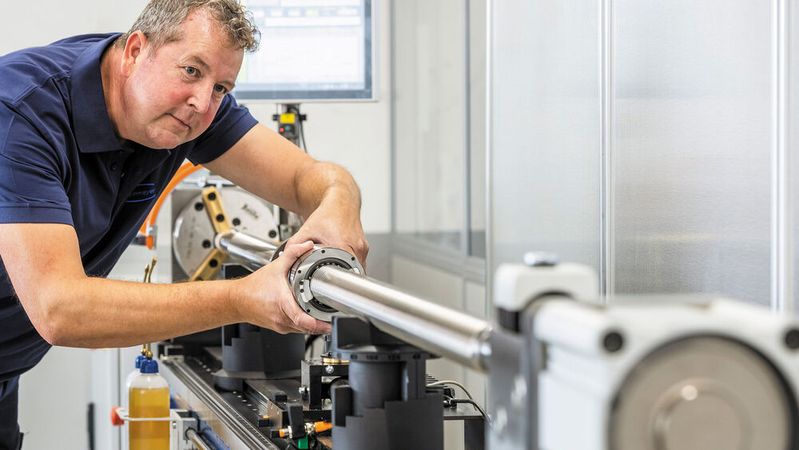
In Albstadt, preload and running characteristics are tested to ensure the highest possible quality of ball screws.
(Image: August Steinmeyer)
Whether a ball screw or a sliding screw is the better choice for an application depends on several factors. A clear case is, for example, the feed axis of a machine tool. Enormous forces are at work here. Accordingly, particularly robust, reliable and durable components should be used for driving and positioning. These must ensure not only high force transmission but also high dynamics and precision over a long service life. "In many cases, a ball screw is advantageous in a machine tool," explains Wolfgang Klöblen, Head of Development at August Steinmeyer.
Advantages of ball screws
Ball screws are central elements in linear drives for machine and apparatus construction. They ensure play-free and dynamic implementation of rotational and linear movements. The components consist of a spindle, nut, deflection, and balls. The balls circulate in a return system between the thread of the nut and that of the spindle. "Force transmission occurs—as the name suggests—via rolling balls, resulting in a particularly high efficiency and high rigidity," Klöblen continues. Furthermore, the so-called rolling friction offers additional advantages such as low wear and energy consumption, minimal heat generation, and high positioning accuracy. Further applications where a ball screw is the preferred choice include automotive steering and actuators in aviation, according to the Head of Development.
Gallery
Advantages of sliding screws
A cost-effective alternative or complement to the ball screw is the sliding screw. It covers additional application areas. While ball screws offer significantly more leeway for higher loads, they also reach their structural limits in miniature form at a certain point when it comes to use in ultra-compact spaces. That's when sliding screws come into their own.
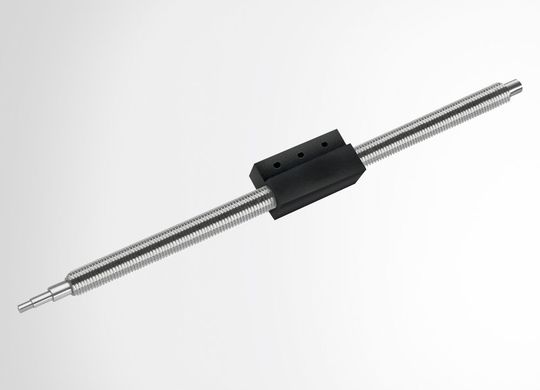
Sliding screw consisting of a stainless steel spindle with a PEEK nut
(Image: Feinmess Suhl)
Sliding screws consist of only two components: a spindle and a nut. Unlike ball screws, the nut's thread is in direct contact with the spindle through surface contact. This results in sliding friction, which also leads to more heat generation, higher wear, and increased energy consumption. "Typical applications are found in device engineering, for example when small masses need to be moved evenly and with high accuracy," explains Detlef Rode, Head of Development at the Suhl location of the Steinmeyer Group. "Therefore, sliding screws are not necessarily suitable for continuous operation, but rather for occasional movements or single adjustments—for example, when optics in devices at the ophthalmologist need to remain in a certain position—then the inherent self-locking due to their design is advantageous."
More safety through self-locking
In safety-critical applications, the self-locking feature of sliding screws is even indispensable: it can prevent the spindle from continuing to rotate in the event of a power failure. Otherwise, unwanted lowering of the load can lead to damage to the system or machine and pose a hazard to the operator. "If a drive fails, the nut of a sliding screw immediately stops and holds its position, so no additional brake is required," Rode continues. Additionally, intentionally switching off the drive when holding a position can prevent heat from entering the system and avoid distortion. Sliding screws are also very robust and can withstand short-term overloads and shocks. Furthermore, they impress with their quiet operation.
At Feinmess Suhl GmbH (a company of the Steinmeyer Group), sliding screws are produced with variable nut designs, which offer the possibility of functional integration—for example, with a linear guide. This allows for a simple pin to be used as an anti-rotation mechanism for the nut. "Through the innovative spindle-nut system, a mirror on a construction laser, for instance, can be moved without additional linear guidance," explains Rode. The reduced number of components not only allows for a more compact design of the screw drives but also of the entire assembly. "This opens up numerous design possibilities and facilitates the implementation of customer-specific geometries and innovative applications."
Comparison of ball screw and sliding screw
Compared to ball screws, sliding screws are appealing due to their manageable acquisition costs, but they also offer a lower efficiency of typically 20 percent to 40 percent, or up to 80 percent in special cases without self-locking. Through various processes, such as lapping, friction between the nut and spindle can be minimized, thereby reducing wear. Nevertheless, the high efficiency of a ball screw exceeding 90 percent remains unmatched.
Materials and lubricants
In terms of material selection, sliding screws offer the advantage that they are not dependent on hardened steel. For example, bearing metals such as brass or bronze and certain plastics can be used for the nut. "A PEEK nut, for instance, can provide a self-lubricating effect, which is particularly advantageous in vacuum, UHV, or EUV environments," explains Rode. In addition to various materials and lubrication concepts, there are also different coatings to minimize friction and wear or eliminate the need for grease, as well as components made of stainless or non-magnetic steel for particularly sensitive medical devices such as MRIs or CTs.
Date: 08.12.2025
Naturally, we always handle your personal data responsibly. Any personal data we receive from you is processed in accordance with applicable data protection legislation. For detailed information please see our privacy policy.
Consent to the use of data for promotional purposes
I hereby consent to Vogel Communications Group GmbH & Co. KG, Max-Planck-Str. 7-9, 97082 Würzburg including any affiliated companies according to §§ 15 et seq. AktG (hereafter: Vogel Communications Group) using my e-mail address to send editorial newsletters. A list of all affiliated companies can be found here
Newsletter content may include all products and services of any companies mentioned above, including for example specialist journals and books, events and fairs as well as event-related products and services, print and digital media offers and services such as additional (editorial) newsletters, raffles, lead campaigns, market research both online and offline, specialist webportals and e-learning offers. In case my personal telephone number has also been collected, it may be used for offers of aforementioned products, for services of the companies mentioned above, and market research purposes.
Additionally, my consent also includes the processing of my email address and telephone number for data matching for marketing purposes with select advertising partners such as LinkedIn, Google, and Meta. For this, Vogel Communications Group may transmit said data in hashed form to the advertising partners who then use said data to determine whether I am also a member of the mentioned advertising partner portals. Vogel Communications Group uses this feature for the purposes of re-targeting (up-selling, cross-selling, and customer loyalty), generating so-called look-alike audiences for acquisition of new customers, and as basis for exclusion for on-going advertising campaigns. Further information can be found in section “data matching for marketing purposes”.
In case I access protected data on Internet portals of Vogel Communications Group including any affiliated companies according to §§ 15 et seq. AktG, I need to provide further data in order to register for the access to such content. In return for this free access to editorial content, my data may be used in accordance with this consent for the purposes stated here. This does not apply to data matching for marketing purposes.
Right of revocation
I understand that I can revoke my consent at will. My revocation does not change the lawfulness of data processing that was conducted based on my consent leading up to my revocation. One option to declare my revocation is to use the contact form found at https://contact.vogel.de. In case I no longer wish to receive certain newsletters, I have subscribed to, I can also click on the unsubscribe link included at the end of a newsletter. Further information regarding my right of revocation and the implementation of it as well as the consequences of my revocation can be found in the data protection declaration, section editorial newsletter.
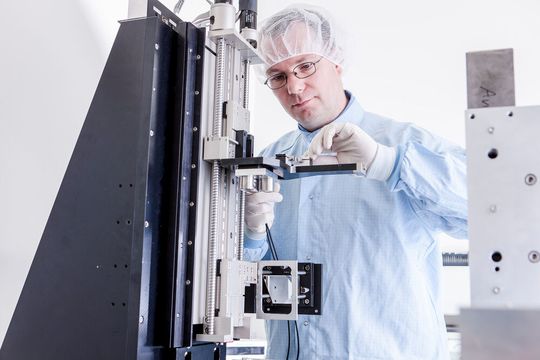
Ball screws from Albstadt are used in extreme environments, from clean rooms to space.
(Image: August Steinmeyer)
But ball screws are also offered in special versions with alternative materials such as ceramics or plastic, as well as various types of wipers, lubricants, or preservatives, to meet the requirements even in extreme environments—from clean rooms to space. (dm)



:quality(80)/p7i.vogel.de/wcms/dd/08/dd086510d9ae7b50181f6070e4463b44/0129363730v1.jpeg "Typical application for ionizing devices: Wrapping films. (Picture: ©Adobe Stock/SMC)")
:quality(80)/p7i.vogel.de/wcms/35/57/3557c819943c53acec41a0ccba87da4f/0130049064v1.jpeg "Researchers at the Fraunhofer IWU in Chemnitz have long known that many typical sheet metal parts can be manufactured more cost-effectively using hollow embossing rollers. Now there is news to report ... (Image:Fraunhofer IWU)")
:quality(80)/p7i.vogel.de/wcms/59/02/590246e3b3f415c65edbee377c14ca77/26-06-pi-fraunhofer-iws-41450-direktplattieren-pic-01-7771x4369v1v1.jpeg "The Fraunhofer IWS has developed the new \"direct laser cladding\" process, which creates a functional layer directly on the base body by applying a strip-shaped metal to rotationally symmetrical components in a spiral and bonding it locally by laser. (Image:Christoph Wilsnack/Fraunhofer IWS)")
:quality(80)/p7i.vogel.de/wcms/73/60/73608418789b1d9c393f5e2fa974eda2/0130209906v1.jpeg "The robots of the X6 generation from b+m enable very high painting quality and are also particularly compact and easy to maintain. (Image:Beckhoff)")
:quality(80)/p7i.vogel.de/wcms/78/e9/78e9188c25a8a94e67c34c9bf8ffe495/visual-agile-20robots-20and-20google-20deepmind-20partner-20to-20bring-20intelligence-20to-20robotics-2500x1406v1v1.jpeg "Together, the partners are developing adaptable, intelligent robots for a wide range of applications (Image:Agile Robots SE)")
:quality(80)/p7i.vogel.de/wcms/e7/66/e7669ecf0260ae8fc54c214e34e4902a/0130316817v1.jpeg "Siemens and Palo Alto Networks offer tested cybersecurity solution for industrial 5G. (Image:Siemens)")
:quality(80)/p7i.vogel.de/wcms/9f/55/9f55324832c4f426958031375124d9de/siemens-20ubtech-20hmnd-1920x1079v1v1.png "Ready for the factory floor: While Ubtech is planning mass production, Siemens is already testing humanoids in real factory applications in Erlangen. (Image:Siemens)")
:quality(80)/p7i.vogel.de/wcms/11/36/113695ed260e29c8c2d9d39dc5f9d869/0130213768v1.jpeg "AI can work cheaply in China and deliver the results rapidly all over the world. (Image:Dall-E / AI-generated)")
:quality(80)/p7i.vogel.de/wcms/62/5f/625f41e87ebfef156a98c8e6393e32fd/0130211654v1.jpeg "Axial flux motors have some advantages over radial flux motor—but their production is currently still expensive. (Image:RWTH Aachen University)")
:quality(80)/p7i.vogel.de/wcms/77/9b/779b0685d010dfe45c9c2cb1cfecd467/0128886425v1.jpeg "The BlueEye is the first \"real\" hyperspectral camera for the UV range and covers the wavelength range from 220 to 380nm. (Image:Inno-spec GmbH)")
:quality(80)/p7i.vogel.de/wcms/e4/51/e451d52ce0182fb0aaa46a5774f832ef/26-04-pi-fraunhofer-iws-21160-bioslide-pic-01-4128x2321v1v1.jpeg "With the BioSlide research project, the Fraunhofer IWS is investigating how sliding systems can be designed to be more sustainable and energy-efficient. New materials can be tested in a particularly application-oriented manner on this plain bearing test stand. (Image:Fraunhofer IWS)")
![Thanks to advanced 3D printing technology, a more efficient use of resources should contribute to lower-emission aviation—this is the goal of ['skai]-lab. (Image:Oleksandr Pashchenko - stock.adobe.com / AI-generated)](https://cdn1.vogel.de/nghHNSbySccfOjG3n1qCA-FVOjQ=/288x162/smart/filters:format(jpg):quality(80)/p7i.vogel.de/wcms/62/64/626424c97a16e69f871bf216c9629c2a/adobestock-1927043193--c2-a9-20oleksandr-20pashchenko-20-e2-80-93-20stock-adobe-com-ki-generiertv1v1.jpeg "Thanks to advanced 3D printing technology, a more efficient use of resources should contribute to lower-emission aviation—this is the goal of ['skai]-lab. (Image:Oleksandr Pashchenko - stock.adobe.com / AI-generated)")
:quality(80)/p7i.vogel.de/wcms/c3/c4/c3c4ce270b083eeac55654148611f064/0130237945v1.jpeg "China is not giving up on hydrogen, but is intensifying its efforts. (Image:freely licensed from Pixabay)")
:quality(80)/p7i.vogel.de/wcms/4e/c0/4ec0bd19390b169edfa23677373dcdf1/0130260089v1.jpeg "Renewable fuels can supply European road traffic, according to a study. (Image:Aral)")
:quality(80)/p7i.vogel.de/wcms/6f/c9/6fc9050301d745cad25585c6780f8f51/0130197341v1.jpeg "Production facilities are a worthwhile target and are therefore at risk. (Image:ABB Robotics)")
:quality(80)/p7i.vogel.de/wcms/b6/62/b662adc2cec8227d8172509bbfb6ee42/25c0207-107-4961x2789v1v1.jpeg "The GLB is the second model based on Mercedes' new MMA platform. Apparently, Geely's platform is better and cheaper, which is why the two companies are negotiating a partnership. (Image:Mercedes-Benz)")
:quality(80)/p7i.vogel.de/wcms/4d/dd/4dddf438e91f394c04a095dbfd109d1c/0130236430v1.jpeg "Measurement modules: The 720301 module in combination with the SL2000 enables RMS and power calculations, among other things. (Image:Yokogawa)")
:quality(80)/p7i.vogel.de/wcms/61/fc/61fcf95f5cca15494ad18343901ae585/0130317237v1.jpeg "With the AGI CPU, Arm says it is taking a \"historic step\": With the processor aimed at AI in data centers, the company is presenting itself for the first time as a provider of its own chips, not just as a pure IP licensor. (Image:Arm)")
:quality(80)/p7i.vogel.de/wcms/82/90/8290dfe3595b6c6b33726ae8b76172c7/0130319587v1.jpeg "The concept image illustrates how the pattern of tiny protrusions and depressions created on the substrate (MgO, bottom) controls the arrangement of atoms in the superconducting material (YBCO, top). At the interface between the two layers, an electronic structure enables superconductivity to occur at higher temperatures than previously possible. (Image:Chalmers University of Technology / Riccardo Arpaia)")
:fill(fff,0)/images.vogel.de/vogelonline/companyimg/76800/76895/65.jpg "FAULHABER_120mm.jpg ()")
:fill(fff,0)/p7i.vogel.de/companies/69/88/69882c428938e/tmts2026-ticec-banner-en-2000px.png "tmts2026-ticec-banner-en-2000px (https://www.tmts.tw/en)")
:fill(fff,0)/p7i.vogel.de/companies/67/eb/67eba621ef6ea/logo2.png "logo2 (Wuxi InfiMotion)")
:quality(80)/p7i.vogel.de/wcms/08/80/0880d74beae7e86024b8034e0d0f4ba9/0120826773v1.jpeg "Positioning table assembly with sliding screw spindles from Suhl(Image: Feinmess Suhl)")
:quality(80)/p7i.vogel.de/wcms/a3/33/a33352a94065d23e06109c1855dbbc0f/0120826765v1.jpeg "Ground spindle with bronze nut from Suhl(Image: Feinmess Suhl)")
:quality(80)/p7i.vogel.de/wcms/64/16/641697cd25a8935ac84767df22424302/0120826774v1.jpeg "From miniature to heavy-duty ball screws, there are numerous options available at August Steinmeyer.(Image: August Steinmeyer)")
:quality(80)/p7i.vogel.de/wcms/7d/50/7d50e37ec6567e3d4432908e47d47666/0125228081v1.jpeg "Ball screws or hydraulic cylinders? In hydraulic steel structures, both types of actuators can be used. (Image: ©fottoo - stock.adobe.com)")
:quality(80)/p7i.vogel.de/wcms/2c/bc/2cbc5709f83f8f864d0c287815e363fe/0126877505v1.jpeg "To maintain the precision of the machine tool at higher torques and speeds, heat must be dissipated from the drive train. (Image:Redex)")