Automation with virtual controllers promises considerable savings potential in terms of procurement, maintenance and operation compared to conventional control technology. But what about applications in which, for example, coordinated movements have high requirements in terms of real-time behavior?
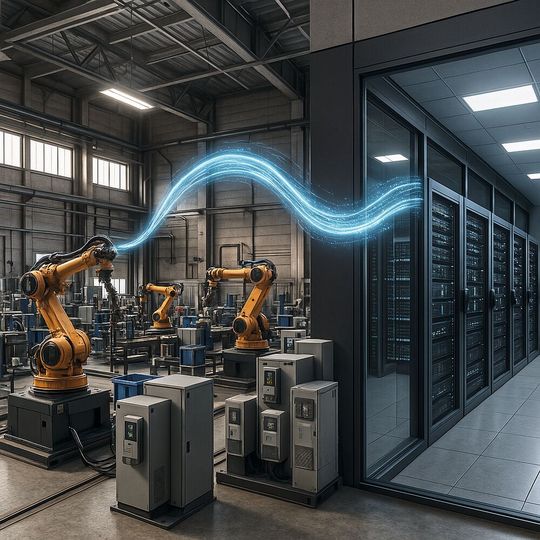
Can real-time applications for motion or robotics, for example, be operated with virtual controllers in the data center?
(Image: AI-generated)
The first applications with virtual controllers are now in productive operation: hosted on IT servers, they are replacing physical PLCs in Audi AG's production lines, for example. A major advantage of virtual controllers over hardware solutions is that they are much easier to maintain. Security updates can be rolled out much more quickly and comprehensively in order to harden production systems against targeted or random attacks. And because virtual safety controllers such as Codesys Virtual Safe Control SL are now also available with IEC 61508 certification for SIL3 applications, there are no longer any restrictions on their use.
Nevertheless, doubts remain: if virtual controllers are operated on remote industrial PCs (IPCs) close to the machine or even on remote servers in the data center, can real-time applications with high performance and jitter requirements still be implemented? Especially if coordinated movements are required, as is the case with motion controllers, CNC and robotics controllers. Can larger distances between the controller and drives or I/Os be bridged?
Gallery
Suitable servo drives with digital fieldbus interfaces are required to implement coordinated movements for motion, CNC or robotics tasks. Due to their real-time capability, CANopen and increasingly Ethercat have established themselves as bus systems. They are implemented by many manufacturers, meaning that there is a broad portfolio of compatible drives from different manufacturers to choose from. The motion solution integrated in Codesys alone offers specific drivers for CANopen and Ethercat drives from more than two dozen manufacturers as well as generic drivers for CiA402/CoE and SoE-compatible systems.
Motion, CNC And Robotics on PLC
Whereas in the past, dedicated controllers were used to control coordinated movements, the approach points of the drives and their dynamics can now also be calculated in the PLC and transmitted via fieldbus. This reduces both hardware requirements and costs. On the hardware side, a suitable CPU performance and available interfaces on the PLC are essential prerequisites for this. If the performance of the controller used is insufficient, a change to a more powerful model is necessary - with consequences that can be expensive and time-consuming. When estimating the performance requirements of an application, it should also be checked very carefully whether motion control, CNC or robotics functions are required. The selection of suitable controllers can then be filtered according to the available performance. SoftPLC or virtual controllers offer significantly more flexibility here.
Of course, the performance reserves of IPCs or servers with several CPU cores are also used up at some point if several virtual controllers are executed on them. But compared to dedicated PLCs, the reserves are many times greater and can be called up as required.
An application case: During project planning, it becomes clear that a motion controller is required in addition to the logic controller. This can now simply be "upgraded" by obtaining a license. This allows complex axis groups to be used and the associated called library blocks to be enabled. With physical devices, this is simply unthinkable in many cases—a clear advantage for virtual control systems.
There are basically two architectural approaches for motion control, which have a strong influence on the requirements for real-time communication. In the central approach described above, the trajectory is calculated in the controller, with the individual axes following this specification. This requires constant, jitter-free communication. This contrasts with the decentralized approach, in which intelligent drives or subordinate controllers implement this motion function and only receive commands from the higher-level controller. This does not require cyclical, synchronized communication.
Industrial robots in particular can therefore manage without special programming languages such as Karel, Inform or Rapid. Instead, commands are sent from the PLC to the robot controller via standard fieldbus systems such as Profinet, which ensure the desired movement. While proprietary libraries such as mxAutomation were offered for this purpose in the past, the Standard Robot Command Interface (SRCI) is currently establishing itself as a comprehensive standard with a set of 115 commands ranging from linear movements to more complex commands such as force control. In such applications, the virtual PLC can be executed remotely without any problems and send its commands via fieldbus, as the actual robot control is still carried out locally on the robot.
Date: 08.12.2025
Naturally, we always handle your personal data responsibly. Any personal data we receive from you is processed in accordance with applicable data protection legislation. For detailed information please see our privacy policy.
Consent to the use of data for promotional purposes
I hereby consent to Vogel Communications Group GmbH & Co. KG, Max-Planck-Str. 7-9, 97082 Würzburg including any affiliated companies according to §§ 15 et seq. AktG (hereafter: Vogel Communications Group) using my e-mail address to send editorial newsletters. A list of all affiliated companies can be found here
Newsletter content may include all products and services of any companies mentioned above, including for example specialist journals and books, events and fairs as well as event-related products and services, print and digital media offers and services such as additional (editorial) newsletters, raffles, lead campaigns, market research both online and offline, specialist webportals and e-learning offers. In case my personal telephone number has also been collected, it may be used for offers of aforementioned products, for services of the companies mentioned above, and market research purposes.
Additionally, my consent also includes the processing of my email address and telephone number for data matching for marketing purposes with select advertising partners such as LinkedIn, Google, and Meta. For this, Vogel Communications Group may transmit said data in hashed form to the advertising partners who then use said data to determine whether I am also a member of the mentioned advertising partner portals. Vogel Communications Group uses this feature for the purposes of re-targeting (up-selling, cross-selling, and customer loyalty), generating so-called look-alike audiences for acquisition of new customers, and as basis for exclusion for on-going advertising campaigns. Further information can be found in section “data matching for marketing purposes”.
In case I access protected data on Internet portals of Vogel Communications Group including any affiliated companies according to §§ 15 et seq. AktG, I need to provide further data in order to register for the access to such content. In return for this free access to editorial content, my data may be used in accordance with this consent for the purposes stated here. This does not apply to data matching for marketing purposes.
Right of revocation
I understand that I can revoke my consent at will. My revocation does not change the lawfulness of data processing that was conducted based on my consent leading up to my revocation. One option to declare my revocation is to use the contact form found at https://contact.vogel.de. In case I no longer wish to receive certain newsletters, I have subscribed to, I can also click on the unsubscribe link included at the end of a newsletter. Further information regarding my right of revocation and the implementation of it as well as the consequences of my revocation can be found in the data protection declaration, section editorial newsletter.
Remote Industrial Drive Systems
Whether virtual controllers are suitable for centrally calculated motion tasks is therefore primarily determined by the communication between the controller and drive. In hardware-independent systems such as Codesys, the commands and services of the protocol stack are implemented in library blocks. This means that they are abstracted from the actual hardware used. This code is implicitly translated into native machine code for the CPU of the controller used with the aid of integrated compilers in the development environment together with the PLC application. It is only noticeable in the translation time and code size that the fieldbus protocol is now also included in the compilation in addition to the self-created logic program.
To ensure that this code can also be executed cycle-consistently with the PLC application, the drive system must be configured correctly in the programming tool. Depending on the system used, this includes parameters such as network addresses, bus-specific settings and technical properties of the axes and motors used, such as gear ratios, axis types and limits and their dynamics.
Secondly, a motion task must be created in the project with the appropriate cycle time and priority so that drives and motors receive their set values "on time" and run smoothly. By definition, the cable lengths of Ethercat, for example, may have a maximum length of 330 feet. If the number of controlled drives does not exceed 10 to 20, no further measures or devices such as additional switches or amplifiers are usually required. In addition to the hard real-time properties of Ethercat, this is one reason why the system is so widespread.
Motion Communication Over Long Distances
But what if virtual controllers are operated in a nearby data center where the required cable lengths exceed the limit? Or if a large number of drives need to be controlled or other data needs to be exchanged on the bus in addition to Ethercat communication, for example for a vision system? Ethercat providers offer special hardware for this purpose, which transmits data via fiber optic cables and thus bridges large distances of up to several kilometers. This allows motion applications to be implemented with virtual controllers that are executed in a remote server room, for example. Things get complicated if older bus technologies with sensors and actuators are installed on the machine at the same time, whose data cannot be easily embedded in the motion bus. It is essential that this data is also transmitted via the fiber optic cable.
Technically, this data can be packaged in parallel to Ethercat using special protocols and sent via the fiber optic cable. If the data is embedded in integrated circuits (ASICs), this data can be transmitted simultaneously via the fiber optic cable at almost any frequency without loss. This is exactly what an approach with the working title "Robo/TSN" from the company Missing Link Electronics promises. The system was funded as part of the BMFTR projects "Octopus Verano" and "6G Integrated Communication & Sensing for Mobility", among others.
It combines data from different bus systems via FPGA and transmits them deterministically. Depending on the medium, typically fiber optics, several hundred gigabits of data can be transmitted in the nanosecond range. In a patented process, the data is tunneled in such a way that all properties and information of the original system are retained: Functionally safe protocols such as FSoE (Fail Safe over Ethercat) or Profisafe can therefore be used without any problems.
Thanks to the encapsulation, the fieldbus information can even be transmitted securely in open IT networks in accordance with IEC 62443. What is important for users of motion and PLC systems such as Codesys is that, unlike other fiber optic systems, operation and configuration do not change as a result of this type of data tunneling. In initial tests, for example, the Codesys motion application was configured exactly as before: An available Ethernet port becomes the Ethercat master together with the connected I/Os and drives—during configuration, it is not noticeable that this port is tunneled through Robo/TSN.
The Network Card Ensures that All Protocols Are Tunneled
Further parameterization and project planning does not change in comparison to use on a standard Ethernet port. What does change is the "network card": it contains the corresponding ASIC and provides Ethernet and other communication ports. Internally, it tunnels the configured data and transmits it via the connected medium. At the remote station, this data is unpacked again by a PCIe network card and made available as originally. The cards equipped with the ASIC are required both on the host computer, on which virtual controllers are operated, and in the remote control cabinet or in the machine parts in which the corresponding end devices are operated.
In the case of virtual control systems, the physical separation of the underlying computer systems and the drives required for motion control and robotics poses a challenge. However, these challenges can be solved—depending on the application and the components used by using standards such as Ethercat and SRCI. Or by using fiber optic cables as the transmission medium. Thanks to modern, integrated circuits, project planning does not change compared to local systems. This makes it clear that virtualized control technology can be used for all areas of application.



:quality(80)/p7i.vogel.de/wcms/66/08/660805a7af69a79b12c4d76fccc5b56b/0129347606v1.jpeg "Can real-time applications for motion or robotics, for example, be operated with virtual controllers in the data center? (Image:AI-generated)")
:quality(80)/p7i.vogel.de/wcms/30/d8/30d8972f1ee47667c699644237c46bd6/0129387994v1.jpeg "This is Romeo. This vertical take-off electric aircraft with hybrid drive was developed by ERC System from Ottobrunn and recently presented in Erding. It is still a drone, but Romeo is set to achieve what Volocopter and Lilium have failed to do ... (Image:ERC system)")
:quality(80)/p7i.vogel.de/wcms/aa/1e/aa1e17bc8df164e0281d77a96b84a41d/0129392569v1.jpeg "The new Gordie Howe International Bridge between Canada and the USA has become a divisive and threatening tool by Donald Trump instead of an economic connecting element ... (Image:Burnsen)")
:quality(80)/p7i.vogel.de/wcms/da/58/da58c363e5354da35941bd4b2fe56b5b/0128273113v1.jpeg "The Hirth serration of the TTD drills from Mapal ensures a very stable fit of the drill heads. This enables optimum torque transfer as well as high changeover and concentricity accuracies. (Image:Mapal)")
:quality(80)/p7i.vogel.de/wcms/d7/d9/d7d9db10c5514e5a22af1517fd962531/0128891375v1.jpeg "The new Machinery Ordinance also includes special regulations on digitalization and cyber security. The countdown is now on for companies. (Picture: ©khunkornStudio - stock.adobe.com)")
:quality(80)/p7i.vogel.de/wcms/cb/9c/cb9c788f7bd82466739e63c2403a06df/0129100353v1.jpeg "A rolling mill before modernization: downtimes, CO2 emissions and energy and maintenance costs are high. (Image:Deguma)")
:quality(80)/p7i.vogel.de/wcms/cd/fe/cdfe212a3b3206e2ff09dcdf71c11240/0129219561v1.jpeg "Extended S-series: The new Cobot models from Omron lift up to 30 kilograms and are now also protected against dust and water thanks to protection class IP65. (Image:Omron)")
:quality(80)/p7i.vogel.de/wcms/c3/6d/c36d161e7709095fd1de4cb9de27d927/0129133682v1.jpeg "Nanjing is Siemens' largest research and production center for CNC systems, drives and electric motors outside Germany. (Image:Siemens)")
:quality(80)/p7i.vogel.de/wcms/f5/c6/f5c6cefa374d48138dc702821d41c7c6/greenspeed-visual-home-1500x843v1v1.jpeg "The EU Green Speed project is laying the foundations for cleaner and more competitive production of lithium-ion batteries in Europe. (Image:greenSPEED Consortium / VIRTUAL VEHICLE)")
:quality(80)/p7i.vogel.de/wcms/ba/d0/bad011e604599660b5b2cdd50eb44755/stefanie-arnold-152236-4500x2530v1v1.jpeg "Materials researcher Stefanie Arnold wants to make energy storage more environmentally friendly with the help of hollow carbon spheres. (Image:Saarland University)")
:quality(80)/p7i.vogel.de/wcms/8f/ff/8fff835b941e411b6f988a183905309a/0129302533v1.jpeg "The Chair of AI Chip Design at the Technical University of Munich (TUM) has created the EU's first AI chip using modern 7-nanometer technology. In the picture: Chair holder Prof. Hussam Amrouch. (Image:Andreas Heddergott / TU Munich)")
:quality(80)/p7i.vogel.de/wcms/39/38/393873c2ed943bb715a6419d94049b63/geralt-entrepreneur-1340649-1280-1280x720v1v1.jpeg "Visual Components presents its forecast for production simulation in 2026. (Image:Pixabay)")
:quality(80)/p7i.vogel.de/wcms/89/e2/89e2226e826f23fb666222b66c737531/0129393966v1.jpeg "Chinese car manufacturers and suppliers want to produce small batches of brake-by-wire systems this year. (Image:Chery)")
:quality(80)/p7i.vogel.de/wcms/3b/2e/3b2efe1abd7a263adf9ef3a9b20d0392/0129406745v1.jpeg "A rectangular steering wheel? Yes, Peugeot is serious about this concept. But there is a lot of technology behind it. (Image:Peugeot)")
:quality(80)/p7i.vogel.de/wcms/21/8e/218e304ba65372854479aa52b4ccdbe5/0129271089v1.jpeg "Suppliers from Europe are currently facing a variety of challenges. Pictured: The Aumovio headquarters in Frankfurt am Main. (Image:Aumovio)")
:quality(80)/p7i.vogel.de/wcms/d2/40/d240b49c8edba464bf610f0e0b3628f0/p90629460-lowres-2250x1265v1.jpeg "(Source: BMW Group)")
:quality(80)/p7i.vogel.de/wcms/5b/38/5b385ec75bff6e84b70a02c0c939dd2b/0129331527v1.jpeg "The TSMC site of Japan Advanced Semiconductor Manufacturing in Kumamoto, Japan. While the second fab currently under construction was initially only intended for the production of semiconductors using the N6 process, the contract manufacturer is currently negotiating with the Japanese government to possibly upgrade the site to N3 after all. (Image:JASM)")
:quality(80)/p7i.vogel.de/wcms/02/49/0249ae04d53137282148ff0ef0fbcfa2/0129294209v1.jpeg "Superconductivity can reveal hidden magnetic orders by forcing it to break its own symmetries. (Image:freely licensed)")
:quality(80)/p7i.vogel.de/wcms/82/53/8253c7a38b4891e5822a06405e0124cb/0129319571v1.jpeg "The losses and penetration depth depend on the frequency. (Picture: ©studioworkstock - stock.adobe.com)")
:quality(80)/p7i.vogel.de/wcms/6f/8f/6f8ff5bf9b81829ef22736bc790cecca/0129224894v1.jpeg "View of the quantum optics laboratory at the University of Stuttgart: here, researchers are experimenting with new photon sources for quantum computing and quantum networks. (Image:Barz Group, University of Stuttgart)")
:fill(fff,0)/images.vogel.de/vogelonline/companyimg/76800/76895/65.jpg "FAULHABER_120mm.jpg ()")
:quality(80)/p7i.vogel.de/wcms/43/73/43730024e728447988685339b668b6ee/0129347302v1.jpeg "In a patented process, the data on the network card is tunneled in such a way that all properties and information of the original system are retained.(Image: Missing Link Electronics GmbH)")
:quality(80)/p7i.vogel.de/wcms/fc/c1/fcc1eae769ee3b0b28ad36459b3a99a2/0129347299v1.jpeg "In the Codesys Development System, Ethercat-connected devices can be supplied with customized code, among other things.(Image: Codesys)")
:quality(80)/p7i.vogel.de/wcms/b0/52/b05236ed41a48647301a62b3cac10ce9/0129347608v1.jpeg "Typical fieldbus protocols are combined in hardware via ASIC and sent over almost any distance in real time.(Image: Missing Link Electronics GmbH)")
:quality(80):fill(efefef,0)/p7i.vogel.de/wcms/65/f0/65f0715271f4e/dassault-wpcover-mm.png "Dassault_WPCover_MM")
:quality(80)/p7i.vogel.de/wcms/57/03/57033deb409d3609592ddcb59d86ac69/0127248634v1.jpeg "The Industrial PI from Pilz is a versatile industrial PC: suitable for automation and drive technology. The Industrial PI can be used as an IIoT gateway or soft PLC. (Image:Pilz GmbH & Co. KG)")
:quality(80)/p7i.vogel.de/wcms/6b/88/6b88d7cf5b56d2a99e2c4d199044bd18/0125366044v1.jpeg "A digital twin (on the left) allows testing, refining, and validating the PLC automation logic before deployment. In practice, this can lead to up to 70 percent time savings during commissioning. (Image:SEW-Eurodrive)")