Precise, reliable and flexible automation solutions are the key to competitiveness. Intelligent, robust and highly accurate sensors open up new possibilities—not only for new systems, but also as part of retrofit projects. Micro-Epsilon offers a large portfolio of these innovative sensor solutions that can be seamlessly integrated into automated manufacturing processes.
Thanks to their high precision, robustness and integration capability, Micro-Epsilon's measurement technology solutions are not only suitable for new systems, but also ideal for retrofit applications.
(Image: Micro-Epsilon Messtechnik GmbH & Co. KG)
The use of sensors in automated processes not only enables greater process reliability and efficiency, but also predictive maintenance and flexible production. The benefits in terms of quality, resource savings and efficiency are enormous.
The path to modern automation does not always involve a completely new investment. With targeted retrofit solutions, existing machines and systems can be retrofitted with the latest sensors and modern interface technology. The sensor solutions from Micro-Epsilon are ideal for this approach: thanks to compact designs, plug-and-play functionality and modern interfaces such as Ethercat, EthernetIP, IO-Link, Profinet or RS422, all sensors can be easily and quickly integrated into existing plants and systems. This allows production processes to be digitized without having to completely replace existing infrastructures.
Companies that use automation solutions from the sensor specialist benefit from high signal stability, a wide temperature range and a convincing price-performance ratio for OEM and series production.
Numerous Sensors for A Wide Range of Industries
The wide range of automation solutions is matched by the diversity of sensor technology options. Micro-Epsilon offers suitable solutions for almost all possible areas of application. The broad portfolio ranges from compact laser sensors, inductive sensors and probes to precise temperature sensors or complex 3D measurement technology.
The company also provides suitable sensor solutions for retrofit projects in existing production lines, which can be easily integrated thanks to their compact design, standardized interfaces and software compatibility. This means that older machines can be digitally networked and integrated into modern production systems without major conversion work. Micro-Epsilon offers in-depth expertise for highly efficient industry and application solutions, particularly for series integration in inline factory environments.
Thickness Measurement of Glass Panes
Confocal sensors from the Confocal DT series can display resolutions down to the nanometer range, operate wear-free and measure the distance and thickness of microlenses, glass or foils. This makes them ideal for use in industries such as semiconductor and glass production or electronics manufacturing. They use the principle of chromatic aberration in combination with confocal imaging to capture precise measurement data.
One advantage of confocal chromatic sensors is that they can measure precisely and accurately on a wide variety of surfaces—from weakly reflective to reflective. They are also less sensitive to vibrations and tilting. For this reason, confocal DT sensors are used in smartphone production to measure the thickness of glass panes in the manufacture of displays without contact and on one side.
2D/3D Geometry Inspection of Hairpins
Hairpin technology makes it possible to pack wires more densely and thus increase the power and torque in electric motors. During the production of the copper wires, various geometric parameters such as the cross-section of the wire, bending angle and parallelism are checked. Possible defects are also
on the component and the position of the connecting wires are monitored to ensure perfect function. 3D sensors and laser scanners are used for geometric checks. These check geometry, defects, position and positioning.
Temperature Measurement in Real Time
In the field of temperature measurement technology, Micro-Epsilon has developed the new, high-precision UC, SE and FI series thermometers. They measure temperatures from -60 to 2000 °F without contact. The compact and robust stainless steel housing with a high degree of protection ensures that the sensors measure precisely even in harsh environmental conditions and deliver high signal quality and stability. Simple mounting and integration as well as industrial interfaces with M12 standards make the sensors ideal for use in sectors such as automation or process technology. Industrial temperature measurements play an important role in the production of modern batteries for electric vehicles, energy storage systems and smartphones. During the battery foil drying process, a paste (slurry) is applied to the carrier foil via a slotted nozzle and cured in a drying oven. The non-contact infrared temperature sensors of the FI and SE series thermometers measure the temperature of the slurry in real time and enable precise control of the process.
Date: 08.12.2025
Naturally, we always handle your personal data responsibly. Any personal data we receive from you is processed in accordance with applicable data protection legislation. For detailed information please see our privacy policy.
Consent to the use of data for promotional purposes
I hereby consent to Vogel Communications Group GmbH & Co. KG, Max-Planck-Str. 7-9, 97082 Würzburg including any affiliated companies according to §§ 15 et seq. AktG (hereafter: Vogel Communications Group) using my e-mail address to send editorial newsletters. A list of all affiliated companies can be found here
Newsletter content may include all products and services of any companies mentioned above, including for example specialist journals and books, events and fairs as well as event-related products and services, print and digital media offers and services such as additional (editorial) newsletters, raffles, lead campaigns, market research both online and offline, specialist webportals and e-learning offers. In case my personal telephone number has also been collected, it may be used for offers of aforementioned products, for services of the companies mentioned above, and market research purposes.
Additionally, my consent also includes the processing of my email address and telephone number for data matching for marketing purposes with select advertising partners such as LinkedIn, Google, and Meta. For this, Vogel Communications Group may transmit said data in hashed form to the advertising partners who then use said data to determine whether I am also a member of the mentioned advertising partner portals. Vogel Communications Group uses this feature for the purposes of re-targeting (up-selling, cross-selling, and customer loyalty), generating so-called look-alike audiences for acquisition of new customers, and as basis for exclusion for on-going advertising campaigns. Further information can be found in section “data matching for marketing purposes”.
In case I access protected data on Internet portals of Vogel Communications Group including any affiliated companies according to §§ 15 et seq. AktG, I need to provide further data in order to register for the access to such content. In return for this free access to editorial content, my data may be used in accordance with this consent for the purposes stated here. This does not apply to data matching for marketing purposes.
Right of revocation
I understand that I can revoke my consent at will. My revocation does not change the lawfulness of data processing that was conducted based on my consent leading up to my revocation. One option to declare my revocation is to use the contact form found at https://contact.vogel.de. In case I no longer wish to receive certain newsletters, I have subscribed to, I can also click on the unsubscribe link included at the end of a newsletter. Further information regarding my right of revocation and the implementation of it as well as the consequences of my revocation can be found in the data protection declaration, section editorial newsletter.
Assembly of Flexible Components
The Scancontrol laser line scanners use the laser triangulation principle to capture two-dimensional profiles on a wide variety of object surfaces. In the automated assembly of flexible components such as cable harnesses, for example, special requirements must be met in terms of precision and flexibility. The Scancontrol 3010-200 laser profile scanners have proven themselves for this complex task in conjunction with robots. The sensors record the exact position and geometry of the cables in real time so that the robot can grip them securely and insert them into the connector housing with pinpoint accuracy. The measurement data is synchronized directly with the robot movement, enabling maximum process reliability and assembly accuracy. Thanks to the flexible automation solution with standard components, variants can also be efficiently implemented without mechanical adaptations.
Inline Quality Assurance
The measurement of vibrating or fast-moving objects poses a major challenge in dynamic production processes. The Optocontrol 2700 optical precision micrometer is specially designed for this requirement. With a sampling rate of 15 kHz and an extremely short exposure time of 8.5 µs, they detect diameters, gap widths or edge positions extremely reliably, even with strong object movements. An active tilt correction automatically compensates for angular errors and provides stable measured values in real time. The compact design with integrated controller reduces installation costs, while the output of measurement data via digital interfaces and a web interface enables simple integration into existing systems. The system is available in two models with measuring ranges of 0.4 in and 1.6 in, making it ideal for inline quality assurance and machine monitoring at high cycle rates.
Wide Variety of 3D Sensors
The company offers a wide variety of 3D measurement technology. With the 3D Profile Unit, for example, up to eight Scancontrol sensors can be offset in a common coordinate system to create a precise 3D image of a measurement object. This makes it possible to capture a wide variety of geometries and measure the thickness of profiles. The data is evaluated and the system parameterized in the manufacturer's 3D Inspect software.
In contrast, the high-precision 3D snapshot sensors from the Surfacecontrol series are ideal for the automated inline inspection of geometries or shapes on diffusely reflective surfaces. They work according to the principle of fringe light projection, allowing direct 3D measurement to be realized. The sensors are used for quality assurance in battery production, for example. Precise measurement of the terminals is essential here. After welding the pole terminal, shunt and bridge, the Surfacecontrol 3D 3500-80 sensor with its large measuring range of 3.1 × 2.0 in checks the coplanarity of these three components. The 3D snapshot sensor is integrated into the rotary indexing table and captures a high-resolution 3D point cloud within milliseconds, the data of which is transferred to the evaluation software via a Gigabit Ethernet interface. Thanks to the compact, inline-capable design, no additional controller is required. The sensor therefore enables fast, space-saving and cost-efficient inline inspection and makes a significant contribution to quality assurance in battery production.
Surface Inspection of Reflective Parts
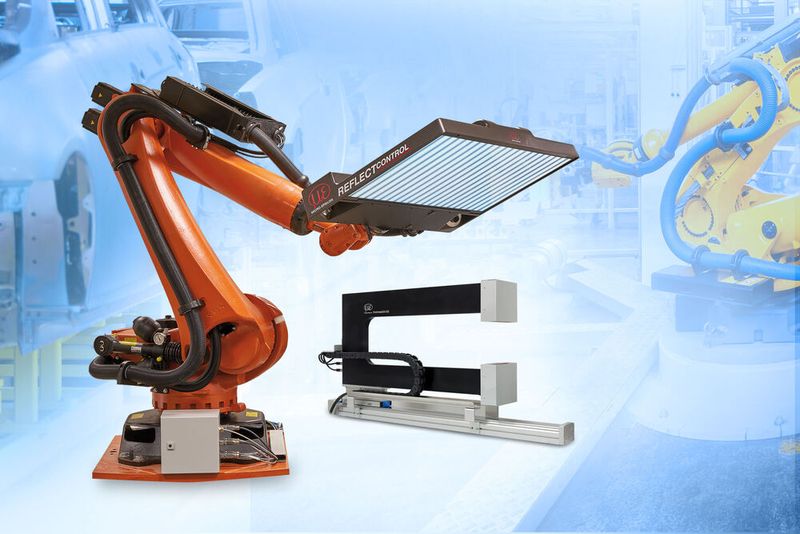
The sensors in the Reflectcontrol series, on the other hand, were developed for the surface inspection of reflective parts. The compact sensor shows a stripe pattern on its display, which is reflected across the surface of the object to be measured into the sensor's cameras. Irregularities on the surface cause deviations in the stripe pattern, which are evaluated by software. Thanks to their high-precision resolution, the sensors are used, for example, in paint defect inspection by leading car manufacturers. The vehicle is first measured and any defects found are projected back onto the vehicle surface. A defect can be localized with ± 0.1 in on the surface and is given 3D features such as height, depth and volume thanks to the unique reconstruction. Once the defect has been detected and localized, automatic processing can begin, which Micro-Epsilon implements together with partner companies. With Reflectcontrol, defects in reflective surfaces can be detected and classified almost 100 percent.
Another sensor from the field of 3D measurement technology is the Thicknessgauge 3D, a precise sensor system for two-sided profile and thickness measurement of strand and sheet material. Two opposing laser profile scanners record synchronized profile data along a linear movement, which is merged into a 3D point cloud. On this basis, the Thicknessgauge 3D calculates freely programmable target values to solve complex 2D or 3D measurement tasks. For example, the sensor system is used for precise inline 3D measurement of coating applications, film curvature and welded pouch cells in battery production.
Easy to Integrate
In the age of Industry 4.0, measurement alone is no longer enough. The decisive factor is how sensors can be seamlessly integrated into digital production systems. Micro-Epsilon's measurement technology solutions are therefore not only designed for precision, but also for intelligent integration and data-based added value. Thanks to standardized interfaces, the sensors can be integrated directly into control and management systems without additional gateways or complex adaptations—both for new systems and retrofit projects. Many sensors also support plug-and-play concepts, which enable quick commissioning and simple maintenance.
The company also offers software solutions such as sensor tools for parameterizing, visualizing and evaluating data. Comprehensive software development kits (SDKs) allow integration into in-house applications, industrial PCs or cloud platforms.
Also Ideal for Retrofit Applications
The measurement technology solutions from Micro-Epsilon make a decisive contribution to the successful automation of industrial processes. Thanks to their high precision, robustness and integration capability, they are not only suitable for new systems, but also ideal for retrofit applications. This allows production processes to be modernized efficiently without having to replace the entire infrastructure. AI-supported evaluation processes, adaptive algorithms for object recognition and advanced 3D measurement technologies also create the basis for the next level of industrial automation.



:quality(80)/p7i.vogel.de/wcms/a0/47/a04725ef9bd09fb6c9341a1bea1b5d93/0130443083v1.jpeg "Here, a type of plastic pallet is produced by thermoforming (vacuum forming or deep drawing) at the corresponding division of New England Plastics in the USA. This division, which specializes in so-called liners, is now part of Ringmetall ... (Image:New England Plastics)")
:quality(80)/p7i.vogel.de/wcms/23/99/23992bf2dcdc432c9b7209c34a4a7c48/0129733089v1.jpeg "Stork relies on the modular Neoswiss turning system from Iscar to shorten the set-up times for its sliding headstock lathes and work more productively. (Image:Iscar)")
:quality(80)/p7i.vogel.de/wcms/7d/e2/7de2923434b2f1a78ba5482d8d335269/0113143253v1.jpeg "In our China Market Insider we regularly provide you with relevant information directly from China. (Image:© Eisenhans - stock.adobe.com)")
:quality(80)/p7i.vogel.de/wcms/9d/2b/9d2b802f800e5caf17b2831e74228cd3/screenshot-202026-03-03-20103822-609x343v1v1.png "Visual comparison: on the left, a clean, burr-free cut edge; on the right, typical burr formation with oxidation discoloration. This illustrates how strongly parameter control and gas management influence the quality of the result. (CO₂ laser, oxygen cutting gas, sheet thickness approx. 15 mm). (Image:Picture: Rime)")
:quality(80)/p7i.vogel.de/wcms/b7/36/b736dfebc16c42d6901d0d0e1f390493/3d-druck-20factory-20--20ki-20generiert-1920x1079v1.png "(Source: AI-generated)")
:quality(80)/p7i.vogel.de/wcms/79/b2/79b21aad663f4a7bd4472afc1c1afc62/0130433994v1.jpeg "Mission Joyride: The free-flying robot (shown here in the rendering) will relieve the ISS crew of logistics tasks from 2027 with its two mechanical arms. (Image:Icarus Robotics)")
:quality(80)/p7i.vogel.de/wcms/6b/45/6b4546fa6ebf305c3660326909363f32/0130437089v1.jpeg "Industrial AI in action: Rockwell Automation presents practical solutions for self-controlling production systems at the Hannover Messe. (Image:Rainer Jensen, Deutsche Messe)")
:quality(80)/p7i.vogel.de/wcms/78/e9/78e9188c25a8a94e67c34c9bf8ffe495/visual-agile-20robots-20and-20google-20deepmind-20partner-20to-20bring-20intelligence-20to-20robotics-2500x1406v1v1.jpeg "Together, the partners are developing adaptable, intelligent robots for a wide range of applications (Image:Agile Robots SE)")
:quality(80)/p7i.vogel.de/wcms/59/a2/59a2b11f0aa1b700eff02addd5de8703/adobestock-1788280853--c2-a9-20satria-20-e2-80-93-20stock-adobe-com-5081x2860v1v1.jpeg "Quantum computers require extreme cooling to temperatures close to absolute zero in order to keep qubits stable. (Image:satria - stock.adobe.com)")
:quality(80)/p7i.vogel.de/wcms/49/38/493876a248943456b7e4a6db6edfc454/0130230765v1.jpeg "Safe and reliable in aircraft construction: light-curing adhesive bond combined with universal fastening elements. (Source: Delo)")
:quality(80)/p7i.vogel.de/wcms/b5/c7/b5c749d16c8a2e789c1469c2c8c1c387/0130452780v1.jpeg "Volvo Trucks completes road tests with its new hydrogen-powered trucks. (Image:Volvo Trucks)")
:quality(80)/p7i.vogel.de/wcms/ba/69/ba6975f417a85147084f38dc2cd209e2/0130451386v1.jpeg "Together with Nvidia, Hyundai wants to develop an architecture that will be used for level 4 robotaxis (image) as well as for level 2 customer vehicles. (Image:Hyundai)")
:quality(80)/p7i.vogel.de/wcms/93/4d/934de334b47abaa526c78cba1417d7af/0130343495v1.jpeg "The new SU7 is available in three price categories, \"Standard\", \"Pro\" and \"Max\" (Image:Xiaomi)")
:quality(80)/p7i.vogel.de/wcms/df/a0/dfa048434bb94f1b7d030e346b25b3ae/0130373541v1.jpeg "From August, BMW will be producing the i3 at its main plant in Munich - which the car manufacturer has extensively rebuilt for this purpose. (Image:Rainer Haeckl)")
:quality(80)/p7i.vogel.de/wcms/ee/09/ee09acbd6dc896df25affaa9e871e6e5/0130440053v1.jpeg "IMS chip module for simple system integration into an ion mobility spectrometer. (Image:Fraunhofer IPMS)")
:quality(80)/p7i.vogel.de/wcms/10/6c/106cd22de5f68a0f74639d654827228c/0130345302v1.jpeg "Made in India: According to the India Electronics and Semiconductor Association (IESA), the country should be able to produce between 75 and 80 million chips by the beginning of 2027, once the plants currently under construction become operational. (Image:Pixabay (Montage: Sebastian Gerstl))")
:quality(80)/p7i.vogel.de/wcms/a5/ed/a5ed6fda029d362732a293d6b19d74c4/0130444216v1.jpeg "Thirteen executives from the Chinese chip industry have drawn up a plan to achieve an 80% self-sufficiency rate for semiconductors by 2030. (Image:Maxim_Kazmin - stock.adobe.com)")
:quality(80)/p7i.vogel.de/wcms/31/a6/31a646018b34d8e0a44bfc8bf17837f6/0130361632v1.jpeg "For many companies, PFAS are considered indispensable in electronics production. (Image:freely licensed)")
:fill(fff,0)/images.vogel.de/vogelonline/companyimg/76800/76895/65.jpg "FAULHABER_120mm.jpg ()")
:quality(80)/p7i.vogel.de/wcms/9f/e1/9fe15f2d90f187b4c80d78cc5cc4a847/0128872685v1.jpeg "Confocal sensors from the ConfocalDT series can display resolutions down to the nanometer range. For this reason, they are predestined for measuring the thickness of glass panes.(Image: Micro-Epsilon Messtechnik GmbH & Co. KG)")
:quality(80)/p7i.vogel.de/wcms/5a/62/5a626fe5faa2acc3c3b01a3a11430de3/0128872691v1.jpeg "Hairpin technology makes it possible to pack wires more densely and thus increase the power and torque in electric motors. Quality control is carried out using laser scanners from the Scancontrol series.(Image: Micro-Epsilon Messtechnik GmbH & Co. KG)")
:quality(80)/p7i.vogel.de/wcms/ab/29/ab29e2183979578239c5a1cbf58c621d/0128872697v1.jpeg "In the field of temperature measurement technology, Micro-Epsilon has developed the new UC, SE and FI thermometer series. They measure a very high temperature range from -50 to +1100 °C precisely and without contact.(Image: Micro-Epsilon Messtechnik GmbH & Co. KG)")
:quality(80)/p7i.vogel.de/wcms/7a/37/7a377b148a4b1641527b380df955c3e4/0128873355v1.jpeg "The Scancontrol laser line scanners use the laser triangulation principle to capture two-dimensional profiles on a wide variety of object surfaces.(Image: Micro-Epsilon Messtechnik GmbH & Co. KG)")
:quality(80):fill(efefef,0)/p7i.vogel.de/wcms/69/1f/691f21f5d458e/aai-agritechnica-whitepaper-coverbild.png "AAI_Agritechnica Whitepaper_Coverbild")
:quality(80)/p7i.vogel.de/wcms/97/28/9728e560d751dd54acd8b88a82ff7330/0129610882v1.jpeg "Temperature measuring devices are essential for monitoring industrial processes and thus ensuring high product quality. (Image:Micro-Epsilon)")
:quality(80)/p7i.vogel.de/wcms/6b/13/6b13416a7bde25cee8f238a685d10677/0125363149v1.jpeg "The laser triangulation sensors are ideal for numerous applications, including factory automation, electronics manufacturing, and robotics. (Image:Micro-Epsilon Messtechnik GmbH & Co. KG)")