Medium-sized companies are currently under enormous pressure. Automation can help, but acquiring robots is expensive. Robco now offers an alternative option with a rental model.
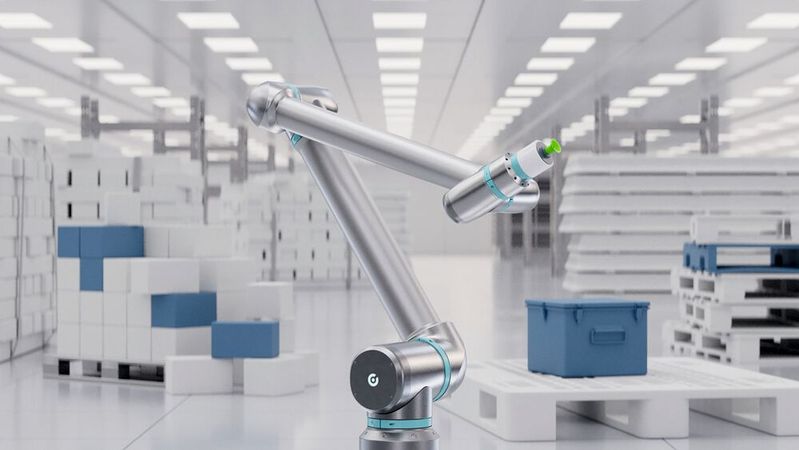
Modular robots combine the advantages of cobots and traditional industrial robots.
(Image: Robco)
In addition to the traditional acquisition of robotic systems, the German manufacturer Robco offers the rental model Robot-as-a-Service (RaaS) as a flexible solution for medium-sized companies. This model includes all necessary components for automation without requiring a high initial investment.
A key advantage of the rental model is the quick return on investment (ROI). Due to predictable rental costs and the absence of high initial investments, the rental costs pay off within the first month, providing a risk-free way to automate manufacturing processes. The model also offers high flexibility as companies can adjust the rental period to their production requirements and vary the redemption price depending on the usage horizon. Another advantage is the comprehensive offering: In addition to the robots, the rental model includes the necessary software and peripherals. Planning and commissioning are also included, allowing companies to receive a complete automation solution from a single source.
Future-proof and plannable
Over a period of six years, companies can achieve significant savings of around 787,202 US dollars. With an hourly rate of 3.67 US dollars , the use of robots enables cost-effective automation of processes, ensuring productivity. Especially in times of skilled labor shortages, the robot-assisted solution offers an efficient alternative to seamlessly continue production processes and bridge staffing gaps. Additionally, the rental model guarantees 100 percent availability of the solution throughout the rental period, providing extra security. Companies can utilize their financial resources elsewhere while benefiting from a future-proof and plannable solution supported by regular maintenance and software updates. For example, at the company DE-VAU-GE, each deployed rental robot reduces the cost per shift and pays for itself within just six months. Wodewa also uses this robot-assisted technology to save approximately 3,148.80 US dollars monthly through process automation.
What are modular robots?
Robco is particularly known for its modular robots. These differ in several ways from cobots or traditional industrial robots. Cobots (collaborative robots) offer a certain flexibility but often reach their limits with more demanding manufacturing requirements as they do not always deliver the necessary performance or speed. They also require special safety measures such as rounded grippers or collision protection mechanisms, which add additional cost and complexity. In many cases, cobots must be used in a separate area or with safety fences. In contrast, traditional industrial robots are very powerful but not very flexible and expensive to purchase. They often require extensive retrofitting to adapt to new production requirements. Their rigid structure leads to long adaptation times and high operating costs, as extensive adjustments are often necessary. Modular robots, on the other hand, combine the advantages of both worlds: They offer the flexibility and user-friendliness of cobots along with the performance and efficiency of industrial robots—and at a much lower price. Thanks to their modular design, companies can quickly respond to changing requirements without compromising on performance or safety.
The versatility of modular robots
Modular robots have versatile applications in manufacturing, particularly in palletizing, welding, assembly, machine loading and unloading, pick-and-place, and quality control. Thanks to their flexibility, they can be easily adapted to new products, manufacturing processes, or operational requirements. This allows companies to respond to market changes without being burdened by long downtimes or expensive new acquisitions. The cost efficiency of modular robots is another key advantage: instead of purchasing entirely new systems, existing robots can be reconfigured, enabling significant savings. This allows financial resources to be deployed strategically elsewhere.
The easy implementation facilitates their integration into existing production environments. Thanks to plug-and-play solutions and standardized interfaces, the systems can be installed quickly and with little effort. With a no-code approach, access is also created for employees without programming knowledge, which eases adaptation within the workforce.
Unlike traditional robotics solutions, which often rely on a fixed, predictable environment, Robvision enables robots to respond flexibly to changes in their environment.
Equipped with artificial intelligence, robots can significantly expand their range of applications. An example of this technology is Robvision, an AI-supported automation system developed by Robco. It utilizes advanced technologies like computer vision and machine learning to enable robots to work autonomously even in unstructured and dynamic environments. Unlike traditional robotic solutions, which often rely on a fixed, predictable environment, Robvision allows robots to flexibly respond to changes in their surroundings. The robots are equipped with a camera that captures images of the environment. These images are processed by AI software to recognize objects and calculate the optimal gripping position. This enables the robots to precisely pick components even in chaotic, unsorted environments, elevating their flexibility and versatility to a new level.
In addition to intelligent functions, sensors also contribute to increased efficiency. They allow seamless communication between modules, provide valuable data such as power consumption, and lay the foundation for a digital twin of the robot. This optimizes processes and enables robots to continue working seamlessly in production even when individual modules are replaced.
Date: 08.12.2025
Naturally, we always handle your personal data responsibly. Any personal data we receive from you is processed in accordance with applicable data protection legislation. For detailed information please see our privacy policy.
Consent to the use of data for promotional purposes
I hereby consent to Vogel Communications Group GmbH & Co. KG, Max-Planck-Str. 7-9, 97082 Würzburg including any affiliated companies according to §§ 15 et seq. AktG (hereafter: Vogel Communications Group) using my e-mail address to send editorial newsletters. A list of all affiliated companies can be found here
Newsletter content may include all products and services of any companies mentioned above, including for example specialist journals and books, events and fairs as well as event-related products and services, print and digital media offers and services such as additional (editorial) newsletters, raffles, lead campaigns, market research both online and offline, specialist webportals and e-learning offers. In case my personal telephone number has also been collected, it may be used for offers of aforementioned products, for services of the companies mentioned above, and market research purposes.
Additionally, my consent also includes the processing of my email address and telephone number for data matching for marketing purposes with select advertising partners such as LinkedIn, Google, and Meta. For this, Vogel Communications Group may transmit said data in hashed form to the advertising partners who then use said data to determine whether I am also a member of the mentioned advertising partner portals. Vogel Communications Group uses this feature for the purposes of re-targeting (up-selling, cross-selling, and customer loyalty), generating so-called look-alike audiences for acquisition of new customers, and as basis for exclusion for on-going advertising campaigns. Further information can be found in section “data matching for marketing purposes”.
In case I access protected data on Internet portals of Vogel Communications Group including any affiliated companies according to §§ 15 et seq. AktG, I need to provide further data in order to register for the access to such content. In return for this free access to editorial content, my data may be used in accordance with this consent for the purposes stated here. This does not apply to data matching for marketing purposes.
Right of revocation
I understand that I can revoke my consent at will. My revocation does not change the lawfulness of data processing that was conducted based on my consent leading up to my revocation. One option to declare my revocation is to use the contact form found at https://contact.vogel.de. In case I no longer wish to receive certain newsletters, I have subscribed to, I can also click on the unsubscribe link included at the end of a newsletter. Further information regarding my right of revocation and the implementation of it as well as the consequences of my revocation can be found in the data protection declaration, section editorial newsletter.
Another significant advantage of the maintenance-friendliness of modular robots is that defective parts can be easily replaced without taking the entire robot out of service. This minimizes downtime and reduces operating costs in the long term. At the same time, regular updates and upgrades offer high future security. Companies can thus be assured that their investments are protected in the long run, as the systems are always kept up to date with the latest technology. (kip)



:quality(80)/p7i.vogel.de/wcms/a0/47/a04725ef9bd09fb6c9341a1bea1b5d93/0130443083v1.jpeg "Here, a type of plastic pallet is produced by thermoforming (vacuum forming or deep drawing) at the corresponding division of New England Plastics in the USA. This division, which specializes in so-called liners, is now part of Ringmetall ... (Image:New England Plastics)")
:quality(80)/p7i.vogel.de/wcms/23/99/23992bf2dcdc432c9b7209c34a4a7c48/0129733089v1.jpeg "Stork relies on the modular Neoswiss turning system from Iscar to shorten the set-up times for its sliding headstock lathes and work more productively. (Image:Iscar)")
:quality(80)/p7i.vogel.de/wcms/7d/e2/7de2923434b2f1a78ba5482d8d335269/0113143253v1.jpeg "In our China Market Insider we regularly provide you with relevant information directly from China. (Image:© Eisenhans - stock.adobe.com)")
:quality(80)/p7i.vogel.de/wcms/9d/2b/9d2b802f800e5caf17b2831e74228cd3/screenshot-202026-03-03-20103822-609x343v1v1.png "Visual comparison: on the left, a clean, burr-free cut edge; on the right, typical burr formation with oxidation discoloration. This illustrates how strongly parameter control and gas management influence the quality of the result. (CO₂ laser, oxygen cutting gas, sheet thickness approx. 15 mm). (Image:Picture: Rime)")
:quality(80)/p7i.vogel.de/wcms/b7/36/b736dfebc16c42d6901d0d0e1f390493/3d-druck-20factory-20--20ki-20generiert-1920x1079v1.png "(Source: AI-generated)")
:quality(80)/p7i.vogel.de/wcms/79/b2/79b21aad663f4a7bd4472afc1c1afc62/0130433994v1.jpeg "Mission Joyride: The free-flying robot (shown here in the rendering) will relieve the ISS crew of logistics tasks from 2027 with its two mechanical arms. (Image:Icarus Robotics)")
:quality(80)/p7i.vogel.de/wcms/6b/45/6b4546fa6ebf305c3660326909363f32/0130437089v1.jpeg "Industrial AI in action: Rockwell Automation presents practical solutions for self-controlling production systems at the Hannover Messe. (Image:Rainer Jensen, Deutsche Messe)")
:quality(80)/p7i.vogel.de/wcms/78/e9/78e9188c25a8a94e67c34c9bf8ffe495/visual-agile-20robots-20and-20google-20deepmind-20partner-20to-20bring-20intelligence-20to-20robotics-2500x1406v1v1.jpeg "Together, the partners are developing adaptable, intelligent robots for a wide range of applications (Image:Agile Robots SE)")
:quality(80)/p7i.vogel.de/wcms/59/a2/59a2b11f0aa1b700eff02addd5de8703/adobestock-1788280853--c2-a9-20satria-20-e2-80-93-20stock-adobe-com-5081x2860v1v1.jpeg "Quantum computers require extreme cooling to temperatures close to absolute zero in order to keep qubits stable. (Image:satria - stock.adobe.com)")
:quality(80)/p7i.vogel.de/wcms/62/5f/625f41e87ebfef156a98c8e6393e32fd/0130211654v1.jpeg "Axial flux motors have some advantages over radial flux motor—but their production is currently still expensive. (Image:RWTH Aachen University)")
:quality(80)/p7i.vogel.de/wcms/e3/42/e342b3c593ea92d56604d3be969e9c9a/0130437231v1.jpeg "Daimler Truck will be building even more trucks at its Czech plant in Cheb in the future. This is because it is now being expanded for strategic cost-saving reasons ... (Image:Daimler Truck)")
:quality(80)/p7i.vogel.de/wcms/f6/ae/f6aec4f6241b36ed5e3a990ac9176b42/0130429460v1.jpeg "Verne, Pony.ai and Uber want to launch a robotaxi service in Europe. (Image:Verne)")
:quality(80)/p7i.vogel.de/wcms/d7/88/d788699f2974708a332baa4e7a62fa9e/0130438967v1.jpeg "Skoda is withdrawing from China. The brand has produced well over three million vehicles there. (Image:Skoda car)")
:quality(80)/p7i.vogel.de/wcms/b0/43/b043b86899837532aad62d63368a917a/0130371361v1.jpeg "Skoda leaves the chinese market.
(Image:Skoda)")
:quality(80)/p7i.vogel.de/wcms/ee/09/ee09acbd6dc896df25affaa9e871e6e5/0130440053v1.jpeg "IMS chip module for simple system integration into an ion mobility spectrometer. (Image:Fraunhofer IPMS)")
:quality(80)/p7i.vogel.de/wcms/10/6c/106cd22de5f68a0f74639d654827228c/0130345302v1.jpeg "Made in India: According to the India Electronics and Semiconductor Association (IESA), the country should be able to produce between 75 and 80 million chips by the beginning of 2027, once the plants currently under construction become operational. (Image:Pixabay (Montage: Sebastian Gerstl))")
:quality(80)/p7i.vogel.de/wcms/a5/ed/a5ed6fda029d362732a293d6b19d74c4/0130444216v1.jpeg "Thirteen executives from the Chinese chip industry have drawn up a plan to achieve an 80% self-sufficiency rate for semiconductors by 2030. (Image:Maxim_Kazmin - stock.adobe.com)")
:quality(80)/p7i.vogel.de/wcms/31/a6/31a646018b34d8e0a44bfc8bf17837f6/0130361632v1.jpeg "For many companies, PFAS are considered indispensable in electronics production. (Image:freely licensed)")
:fill(fff,0)/images.vogel.de/vogelonline/companyimg/76800/76895/65.jpg "FAULHABER_120mm.jpg ()")
:quality(80)/p7i.vogel.de/wcms/63/e3/63e30c347948c42342c23ef9148ec1ff/0128208922v1.jpeg "In total, more than 40 cobots from the E-series and the new generation of Universal Robots are in productive use at Junior Kühlkörper. (Image:Junior Kühlkörper)")
:quality(80)/p7i.vogel.de/wcms/19/97/1997c06eb2970b0528308f315d0c8e2b/0129538778v1.jpeg "Robots on demand: Rental robots can offer advantages for small and medium-sized companies in particular. (Image:Christopher White)")