Optimize production processes and increase efficiency—more and more companies are using artificial intelligence for this. But training is time-consuming. New methods are now paving the way for economical and accessible AI-based quality assurance.
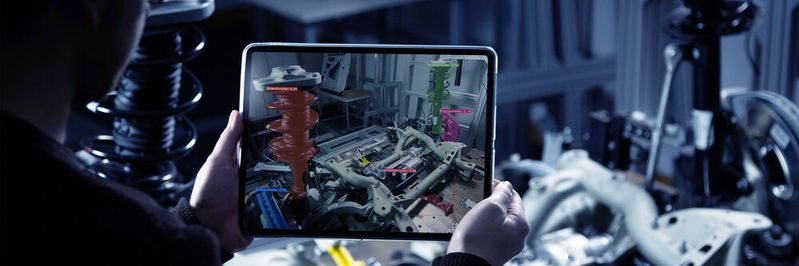
Fraunhofer IGD is working on solutions for AI-based quality assurance. The Marquis program offers visual inspection during the ongoing assembly process and can also map the associated documentation.
(Image: Fraunhofer IGD)
Generative AI is already enriching the daily lives of many people, but industrial companies face a challenge in implementing this technology: for AI training, they need not only images of flawless products (short: OK data) but also hundreds of images of defective items (short: NOK data). What is generally advantageous becomes a hurdle in this case since production should ideally generate as few defective pieces as possible. Approaches like training solely with OK data and the synthetic generation of training data based on CAD data can solve the challenge.
Generate Artificial Training Images with CAD Data
At the beginning of a manufacturing process, there are no real photos yet—neither OK nor NOK data. The Fraunhofer Institute for Computer Graphics Research IGD is researching methods to generate images of three-dimensional models from CAD data using virtual cameras from various perspectives and orientations. They then virtually apply different materials and a variety of backgrounds to the component. "This allows for the generation of numerous images and the creation of training databases within a very short time, without ever having to add real photos," explains Holger Graf, head of the Virtual and Augmented Reality department at Fraunhofer IGD.
Gallery
The inspection system has never seen the real setup and product configuration before in operation, yet it can still recognize, classify the object, and estimate its position. Additionally, this approach shortens the reconfiguration time of the inspection system for any variant. Fraunhofer IGD developed the technology specifically for assembly or construction state control in automotive and commercial vehicle manufacturing, as well as in tool manufacturing. Another example shows the application of the solution in the production of airbag igniters. Here, automated optical quality control is particularly important: The end product is highly safety-relevant and cannot be fully tested—the airbags cannot be used again after deployment.
Optimal Classification Using only OK Data
In other applications, quality inspection cannot be based on CAD data. This is because they are either not available, or the product is to be assessed not in its original state but by its appearance after a stress test. As a result, companies need to train their AI systems with real data. To avoid relying on a multitude of NOK data, Ulrich Krispel and his team from Fraunhofer Austria developed a solution that learns solely from OK data. These are qualified as "in order" in terms of production, meaning they do not need reworking or sorting out. The method thus learns a variation of normality and eventually also recognizes deviations from it. This way, the AI can also find previously unseen errors. The known problem with training AI classically using NOK data is that it cannot react appropriately when confronted with an image that falls outside the known error classes. The reason is that the AI is only trained to recognize and classify known errors.
The Fraunhofer solution is based on transfer learning, which involves pre-trained neural networks developed and published for research. These networks have already learned which areas in the image to focus on for classification. The scientists adapt the model to the application using statistical methods. "Pre-trained neural networks make it possible to keep the training effort as low as possible," explains Krispel. The researchers also identify the appropriate model for each application, aiming to produce optimal results while also making quick decisions.
In addition to the shortest possible training time, a process-capable classification time is also crucial. After all, the inspection system should not disrupt production processes but rather enable continuous and uninterrupted monitoring of product quality in real-time. This way, errors can be detected and corrected early on.
A few NOK images are sufficient for evaluating the model. The AI marks deviations from normality with colors—blue for slight deviations, red for defective areas in the image.
Supporting Manual Quality Assurance
Whether it's training exclusively with OK data or synthetic training data, AI-based quality control contributes to the overarching goal of economical production. "Our experience shows that companies are curious and want to take advantage of artificial intelligence. We assist SMEs as well as corporations in finding a solution tailored to them, as every product has its own peculiarities and each production environment has different requirements," emphasizes Holger Graf. The Fraunhofer IGD also supports interested companies in terms of imaging systems and technical equipment.
Date: 08.12.2025
Naturally, we always handle your personal data responsibly. Any personal data we receive from you is processed in accordance with applicable data protection legislation. For detailed information please see our privacy policy.
Consent to the use of data for promotional purposes
I hereby consent to Vogel Communications Group GmbH & Co. KG, Max-Planck-Str. 7-9, 97082 Würzburg including any affiliated companies according to §§ 15 et seq. AktG (hereafter: Vogel Communications Group) using my e-mail address to send editorial newsletters. A list of all affiliated companies can be found here
Newsletter content may include all products and services of any companies mentioned above, including for example specialist journals and books, events and fairs as well as event-related products and services, print and digital media offers and services such as additional (editorial) newsletters, raffles, lead campaigns, market research both online and offline, specialist webportals and e-learning offers. In case my personal telephone number has also been collected, it may be used for offers of aforementioned products, for services of the companies mentioned above, and market research purposes.
Additionally, my consent also includes the processing of my email address and telephone number for data matching for marketing purposes with select advertising partners such as LinkedIn, Google, and Meta. For this, Vogel Communications Group may transmit said data in hashed form to the advertising partners who then use said data to determine whether I am also a member of the mentioned advertising partner portals. Vogel Communications Group uses this feature for the purposes of re-targeting (up-selling, cross-selling, and customer loyalty), generating so-called look-alike audiences for acquisition of new customers, and as basis for exclusion for on-going advertising campaigns. Further information can be found in section “data matching for marketing purposes”.
In case I access protected data on Internet portals of Vogel Communications Group including any affiliated companies according to §§ 15 et seq. AktG, I need to provide further data in order to register for the access to such content. In return for this free access to editorial content, my data may be used in accordance with this consent for the purposes stated here. This does not apply to data matching for marketing purposes.
Right of revocation
I understand that I can revoke my consent at will. My revocation does not change the lawfulness of data processing that was conducted based on my consent leading up to my revocation. One option to declare my revocation is to use the contact form found at https://contact.vogel.de. In case I no longer wish to receive certain newsletters, I have subscribed to, I can also click on the unsubscribe link included at the end of a newsletter. Further information regarding my right of revocation and the implementation of it as well as the consequences of my revocation can be found in the data protection declaration, section editorial newsletter.
With the two approaches presented, the effort for users can be significantly reduced without any loss in reliability in the decision between OK and NOK. By automating quality inspections with AI, companies ultimately reduce the need for manual inspection and minimize human errors, which in turn decreases scrap and rework costs. As a supplement, AI can thus also alleviate the shortage of skilled workers in quality assurance.
*Prof. Dr.-Ing. André Stork is the automotive industry leader at Fraunhofer IGD.



:quality(80)/p7i.vogel.de/wcms/a0/47/a04725ef9bd09fb6c9341a1bea1b5d93/0130443083v1.jpeg "Here, a type of plastic pallet is produced by thermoforming (vacuum forming or deep drawing) at the corresponding division of New England Plastics in the USA. This division, which specializes in so-called liners, is now part of Ringmetall ... (Image:New England Plastics)")
:quality(80)/p7i.vogel.de/wcms/23/99/23992bf2dcdc432c9b7209c34a4a7c48/0129733089v1.jpeg "Stork relies on the modular Neoswiss turning system from Iscar to shorten the set-up times for its sliding headstock lathes and work more productively. (Image:Iscar)")
:quality(80)/p7i.vogel.de/wcms/7d/e2/7de2923434b2f1a78ba5482d8d335269/0113143253v1.jpeg "In our China Market Insider we regularly provide you with relevant information directly from China. (Image:© Eisenhans - stock.adobe.com)")
:quality(80)/p7i.vogel.de/wcms/9d/2b/9d2b802f800e5caf17b2831e74228cd3/screenshot-202026-03-03-20103822-609x343v1v1.png "Visual comparison: on the left, a clean, burr-free cut edge; on the right, typical burr formation with oxidation discoloration. This illustrates how strongly parameter control and gas management influence the quality of the result. (CO₂ laser, oxygen cutting gas, sheet thickness approx. 15 mm). (Image:Picture: Rime)")
:quality(80)/p7i.vogel.de/wcms/b7/36/b736dfebc16c42d6901d0d0e1f390493/3d-druck-20factory-20--20ki-20generiert-1920x1079v1.png "(Source: AI-generated)")
:quality(80)/p7i.vogel.de/wcms/79/b2/79b21aad663f4a7bd4472afc1c1afc62/0130433994v1.jpeg "Mission Joyride: The free-flying robot (shown here in the rendering) will relieve the ISS crew of logistics tasks from 2027 with its two mechanical arms. (Image:Icarus Robotics)")
:quality(80)/p7i.vogel.de/wcms/6b/45/6b4546fa6ebf305c3660326909363f32/0130437089v1.jpeg "Industrial AI in action: Rockwell Automation presents practical solutions for self-controlling production systems at the Hannover Messe. (Image:Rainer Jensen, Deutsche Messe)")
:quality(80)/p7i.vogel.de/wcms/78/e9/78e9188c25a8a94e67c34c9bf8ffe495/visual-agile-20robots-20and-20google-20deepmind-20partner-20to-20bring-20intelligence-20to-20robotics-2500x1406v1v1.jpeg "Together, the partners are developing adaptable, intelligent robots for a wide range of applications (Image:Agile Robots SE)")
:quality(80)/p7i.vogel.de/wcms/59/a2/59a2b11f0aa1b700eff02addd5de8703/adobestock-1788280853--c2-a9-20satria-20-e2-80-93-20stock-adobe-com-5081x2860v1v1.jpeg "Quantum computers require extreme cooling to temperatures close to absolute zero in order to keep qubits stable. (Image:satria - stock.adobe.com)")
:quality(80)/p7i.vogel.de/wcms/62/5f/625f41e87ebfef156a98c8e6393e32fd/0130211654v1.jpeg "Axial flux motors have some advantages over radial flux motor—but their production is currently still expensive. (Image:RWTH Aachen University)")
:quality(80)/p7i.vogel.de/wcms/b5/c7/b5c749d16c8a2e789c1469c2c8c1c387/0130452780v1.jpeg "Volvo Trucks completes road tests with its new hydrogen-powered trucks. (Image:Volvo Trucks)")
:quality(80)/p7i.vogel.de/wcms/ba/69/ba6975f417a85147084f38dc2cd209e2/0130451386v1.jpeg "Together with Nvidia, Hyundai wants to develop an architecture that will be used for level 4 robotaxis (image) as well as for level 2 customer vehicles. (Image:Hyundai)")
:quality(80)/p7i.vogel.de/wcms/93/4d/934de334b47abaa526c78cba1417d7af/0130343495v1.jpeg "The new SU7 is available in three price categories, \"Standard\", \"Pro\" and \"Max\" (Image:Xiaomi)")
:quality(80)/p7i.vogel.de/wcms/df/a0/dfa048434bb94f1b7d030e346b25b3ae/0130373541v1.jpeg "From August, BMW will be producing the i3 at its main plant in Munich - which the car manufacturer has extensively rebuilt for this purpose. (Image:Rainer Haeckl)")
:quality(80)/p7i.vogel.de/wcms/ee/09/ee09acbd6dc896df25affaa9e871e6e5/0130440053v1.jpeg "IMS chip module for simple system integration into an ion mobility spectrometer. (Image:Fraunhofer IPMS)")
:quality(80)/p7i.vogel.de/wcms/10/6c/106cd22de5f68a0f74639d654827228c/0130345302v1.jpeg "Made in India: According to the India Electronics and Semiconductor Association (IESA), the country should be able to produce between 75 and 80 million chips by the beginning of 2027, once the plants currently under construction become operational. (Image:Pixabay (Montage: Sebastian Gerstl))")
:quality(80)/p7i.vogel.de/wcms/a5/ed/a5ed6fda029d362732a293d6b19d74c4/0130444216v1.jpeg "Thirteen executives from the Chinese chip industry have drawn up a plan to achieve an 80% self-sufficiency rate for semiconductors by 2030. (Image:Maxim_Kazmin - stock.adobe.com)")
:quality(80)/p7i.vogel.de/wcms/31/a6/31a646018b34d8e0a44bfc8bf17837f6/0130361632v1.jpeg "For many companies, PFAS are considered indispensable in electronics production. (Image:freely licensed)")
:fill(fff,0)/images.vogel.de/vogelonline/companyimg/76800/76895/65.jpg "FAULHABER_120mm.jpg ()")
:fill(fff,0)/p7i.vogel.de/companies/69/88/69882c428938e/tmts2026-ticec-banner-en-2000px.png "tmts2026-ticec-banner-en-2000px (https://www.tmts.tw/en)")
:quality(80)/p7i.vogel.de/wcms/f3/9f/f39fb88199e6079ef37781a7840c03fa/0120496628v1.jpeg "For AI applications to gain a foothold in the manufacturing industry, their training must be made easier – for example, with synthetically generated training data.(Image: Fraunhofer IGD)")
:quality(80)/p7i.vogel.de/wcms/71/f3/71f3d9d17366a47c3f318adc7cce9841/0120496623v1.jpeg "The AR software Arrange, trained with synthetic training data, assists in sorting various stamped parts through color overlays and simultaneously performs a target-actual comparison as a contribution to quality assurance.(Image: Fraunhofer IGD)")
:quality(80)/p7i.vogel.de/wcms/7e/68/7e681d74a11c5cc0788138e3d8a10134/0120498258v1.jpeg "Fraunhofer IGD is working on solutions for AI-based quality assurance. The Marquis program offers visual inspection during the ongoing assembly process and can also map the associated documentation.(Image: Fraunhofer IGD)")
:quality(80):fill(efefef,0)/p7i.vogel.de/wcms/67/ad/67adf4a647532/elatec-wp-machine-authentication.png "Elatec WP Machine Authentication")
:quality(80)/p7i.vogel.de/wcms/d1/83/d1838c2714f74df5bd64de722f287054/0127389633v1.jpeg "Deep learning-based algorithms learn automatically based on training data. (Image:MVTec Software GmbH)")
:quality(80)/p7i.vogel.de/wcms/9f/59/9f5914e814b92138262a652418a14d7f/0125202214v1.jpeg "Machine learning is a subset of artificial intelligence that enables computer systems to learn from data and experiences and improve independently. (Image: ©WrightStudio - stock.adobe.com)")