The incorporation of AI into the manufacturing industry has long since begun. However, several hurdles still need to be overcome for the industry-wide shift towards data-driven production. The DataFactory.NRW project provides a pioneering blueprint for the factory of tomorrow.
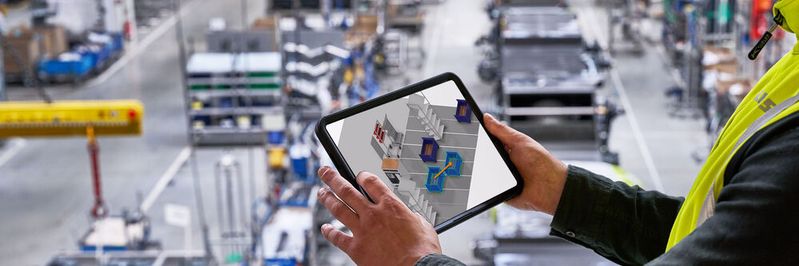
The DataFactory.NRW project is intended to serve as a blueprint for manufacturing companies in North Rhine-Westphalia and beyond.
(Image: Fraunhofer IEM / Janosch Gruschczyk)
Dimitri Schweigerdt is Project Manager Smart Factory, Global Innovation & Industry Consulting at NTT Data Business Solutions.
The increasing digitalization of production environments through Artificial Intelligence is becoming particularly important for medium-sized companies in the manufacturing industry. In the future, these companies can undergo the transformation towards a data-driven Smart Factory, in which all processes and production resources are optimized based on AI.
On the path to intelligent production, data is crucial as it forms the basis for the transformation into smart factories. Pallets effortlessly making entries and exits in the rack warehouse without human intervention at the computer, or an innovative application for guiding tractors in yard logistics, which allows storing the GPS coordinates of a parked vehicle and directly transmitting them to the SAP system, are examples of AI-supported production. Currently, the real transformation is primarily failing due to lack of networking and cooperation between companies and research institutions, as well as inadequate data strategies and information architectures for optimal use of existing potentials. Indispensable for the digital transformation of the industry is a tried and tested and reliable blueprint. This is where the project "Data Factory.NRW - Artificial Intelligence in Production" begins.
Gallery
Focus on Artificial Intelligence: DataFactory.NRW shapes the factory of the future
A consortium of nine actors from industry and science, including the Fraunhofer Institute and the SAP consulting firm NTT Data Business Solutions, are pooling their expertise to significantly advance the optimization of production using artificial intelligence. The project is considered groundbreaking and is set to provide a blueprint for manufacturing companies in North Rhine-Westphalia and beyond. The goal: The development of best practices and reference concepts for companies. The focus here is on the areas of factory planning and engineering, production and manufacturing, as well as logistics. The project aims to accelerate the development of intelligent solutions, taking into account the latest technologies for manufacturing companies. It is also set to boost networking and cooperation between companies and research institutions.
A partner in the Data Factory.NRW project is NTT Data Business Solutions, which contributes its comprehensive IT expertise and industry knowledge. In this context, NTT Data Business Solutions advises and sensitizes the user companies, for example, whether it makes sense to use SAP solutions instead of in-house developments. The solutions developed from the project are integrated into the companies' existing IT architecture. About ten experts from NTT Data Business Solutions are working on the data factory. The first prototypes – such as a worker assistance system for assembly that supports staff with 3D and augmented reality instructions – have already been completed.
Fields of action and transformation areas on the way to the Smart Factory
The transformation from traditional manufacturing to smart production requires companies to particularly consider three crucial fields of action. Firstly, the implementation of intelligent solutions in industrial production is crucial. Here, various technologies are used that use data to optimize manufacturing, such as Automated Guided Vehicles, Cyber Physical Systems, or the Industrial Internet of Things. The subsequent step is the integration of these intelligent solutions into real work environments, making them an integral part of an overarching information architecture that connects all relevant data sources and targets. A stringent organization is indispensable for the success of the endeavor. Because the introduction and synchronization of intelligent solutions must be carefully planned and controlled to ensure a smooth transformation into a Smart Factory.
The three central fields of action for the transformation from traditional manufacturing to intelligent production are applied in concrete terms in the project in four transformation areas: Data-Driven Engineering, Data-Driven Manufacturing, Data-Driven Logistics, and Data-Driven Enterprise Architecture. These transformation areas, also referred to as Transformation Areas, represent typical areas of task where manufacturing companies carry out concrete activities. As part of the Data Factory.NRW project, these activities are defined in the form of structured work packages and use cases that are progressively implemented:
Date: 08.12.2025
Naturally, we always handle your personal data responsibly. Any personal data we receive from you is processed in accordance with applicable data protection legislation. For detailed information please see our privacy policy.
Consent to the use of data for promotional purposes
I hereby consent to Vogel Communications Group GmbH & Co. KG, Max-Planck-Str. 7-9, 97082 Würzburg including any affiliated companies according to §§ 15 et seq. AktG (hereafter: Vogel Communications Group) using my e-mail address to send editorial newsletters. A list of all affiliated companies can be found here
Newsletter content may include all products and services of any companies mentioned above, including for example specialist journals and books, events and fairs as well as event-related products and services, print and digital media offers and services such as additional (editorial) newsletters, raffles, lead campaigns, market research both online and offline, specialist webportals and e-learning offers. In case my personal telephone number has also been collected, it may be used for offers of aforementioned products, for services of the companies mentioned above, and market research purposes.
Additionally, my consent also includes the processing of my email address and telephone number for data matching for marketing purposes with select advertising partners such as LinkedIn, Google, and Meta. For this, Vogel Communications Group may transmit said data in hashed form to the advertising partners who then use said data to determine whether I am also a member of the mentioned advertising partner portals. Vogel Communications Group uses this feature for the purposes of re-targeting (up-selling, cross-selling, and customer loyalty), generating so-called look-alike audiences for acquisition of new customers, and as basis for exclusion for on-going advertising campaigns. Further information can be found in section “data matching for marketing purposes”.
In case I access protected data on Internet portals of Vogel Communications Group including any affiliated companies according to §§ 15 et seq. AktG, I need to provide further data in order to register for the access to such content. In return for this free access to editorial content, my data may be used in accordance with this consent for the purposes stated here. This does not apply to data matching for marketing purposes.
Right of revocation
I understand that I can revoke my consent at will. My revocation does not change the lawfulness of data processing that was conducted based on my consent leading up to my revocation. One option to declare my revocation is to use the contact form found at https://contact.vogel.de. In case I no longer wish to receive certain newsletters, I have subscribed to, I can also click on the unsubscribe link included at the end of a newsletter. Further information regarding my right of revocation and the implementation of it as well as the consequences of my revocation can be found in the data protection declaration, section editorial newsletter.
Transformation Area 1: Data-Driven Production Engineering: This area focuses on how production data can be used to improve factory planning and optimization. Objectives include the creation of digital twins of the factory and production, the use of AI-based methods to support factory planning and optimization, and data-driven decisions for increased efficiency, quality, and flexibility of production. The development of learning factories, which can continuously adapt to changed requirements, is another aspect.
Transformation Area 2: Data-Driven Manufacturing: The focus here is on data-driven manufacturing to ensure future competitiveness. Six work packages address issues relating to human-machine interaction and the integration of data for added value and accurate predictions of machine maintenance needs. The goal is comprehensive digitization and the application of AI in various production areas, thereby effectively aligning the IT and production landscape towards data-driven processes.
Transformation Area 3: Data-Driven Logistics: The development of data-driven AI solutions for the entire logistics value chain is the focus here. From goods delivery to picking and assembly, research areas such as AI in inbound logistics, intra-company transport, provisioning, picking, and assembly are addressed. Implementation is carried out through already formulated use cases, data analysis, training of AI models, piloting, proof of concept, and integration into business processes.
Transformation Area 4: Data-Driven Enterprise Architecture: The fourth Transformation Area has the task of creating a consistent process and IT landscape for the project. By working holistically across all work packages, solutions should be developed that interlock seamlessly and form a stable IT environment. Ensuring synergy effects between different transformation areas and the integration of solutions through modeling and regular meetings for coordination is crucial.
Successes, challenges and the path to the future to the AI factory of tomorrow
With the successful start phase of Datenfabrik.NRW, it becomes clear how significant the collaboration of different expertise is in advancing pioneering future projects. The project demonstrates how ongoing digitization of production environments through AI opens up new horizons for small and medium-sized companies in the manufacturing industry. The focus here is on the next steps in the Transformation Areas. In Data-Driven Production Engineering, the development of a design guideline for digital factory layouts, the selection of methods for semi-automated standard time determination, and the validation of this standard time are pending. In the Manufacturing area, recommendations for action to minimize routine tasks are to be developed and user-friendly worker assistance systems are to be partially implemented and validated. An initial validation of the forecast in the delivery and material disposition, as well as the testing of algorithms for freight bundling, form the next steps in Data-Driven Logistics. In Data-Driven Enterprise Architecture, a fit-gap analysis is planned in perspective and a concept for the technical infrastructure for the integration of the project solutions is being developed. These next developments not only represent the continuation of a project that is already successful; they further break up the still partially existing silo thinking and thus pave the way for the AI factory of tomorrow.



:quality(80)/p7i.vogel.de/wcms/40/c5/40c5051cebdb10fdee9a283303434d9d/0129881741v1.jpeg "3D-printed tools and other components contribute to energy-saving, precise processes. (Image:Gerhard Schubert GmbH)")
:quality(80)/p7i.vogel.de/wcms/e5/fa/e5fa9fa2e3b44ee1894fdf95bbe828fe/0129904146v1.jpeg "Airports and other critical infrastructure in Europe are to be better protected against drones. (Picture: ©assetseller - stock.adobe.com)")
:quality(80)/p7i.vogel.de/wcms/ae/bd/aebda515c684825e97579175874ea6bd/0129920231v1.jpeg "Hensoldt, a sensor specialist for critical defense applications among other things, now has a strategic milestone ahead of it. The company is planning to acquire Nedinsco, an optronics company from Venlo in the Netherlands. Here's what's to come ... (Image:Hensoldt)")
:quality(80)/p7i.vogel.de/wcms/c3/6f/c36f031df46d22615d941d077d32313c/0129800025v1.jpeg "The laser-assisted process is intended to make wafer cutting significantly more productive. (Image:Trumpf)")
:quality(80)/p7i.vogel.de/wcms/e8/dc/e8dc27a8d9fba8fbd081987400bf6848/0127426198v1.jpeg "3D FEM models are detailed, large and computationally intensive. Thanks to ROM and the support of Cadfem, Wago has succeeded in setting up an e-shop for thermal simulation. (Image:WAGO)")
:quality(80)/p7i.vogel.de/wcms/9c/ac/9cac6246660e746c5a3989399ac4d250/0128561645v1.jpeg "Artificial intelligence can drive efficiency in smart factories through centralized data management and predictive maintenance. (Picture: ©Fardived - stock.adobe.com)")
:quality(80)/p7i.vogel.de/wcms/6b/e2/6be235b5ad8a442ccd9d164b0b300d8b/0129763992v1.jpeg "As early as 2020, the Zimmer Group announced that it would convert its production to be sustainably CO2-neutral. (Image:Zimmer Group)")
:quality(80)/p7i.vogel.de/wcms/d4/ba/d4bab9481e66f8570f40eb8ef2a90198/0129795613v1.jpeg "A camera inspection during removal ensures that the components are placed correctly in the KLTs. (Image:Yaskawa Europe)")
:quality(80)/p7i.vogel.de/wcms/76/81/7681b6450512b2cce1e453cd3d732543/0129479309v1.jpeg "Symbolic image: Model-based design combines virtual system models with real machines and systems in order to simulate, validate and coordinate functions, control and software early on in the development process. (Image:Dall-E / AI-generated)")
:quality(80)/p7i.vogel.de/wcms/5c/0f/5c0fee074c4b6c8e8c0993f3217c2f5a/0129773718v1.jpeg "The General Fusion demonstration reactor. (Image:General Fusion)")
:quality(80)/p7i.vogel.de/wcms/b5/5e/b55ed9355e0395ec0caf111d6af6b494/adobestock-495980372--c2-a9-20natali-mis-20-e2-80-93-20stock-adobe-com-6720x3778v1v1.jpeg "Which engineering skills will be in vogue in 2026? (Image:natali_mis - stock.adobe.com)")
:quality(80)/p7i.vogel.de/wcms/bf/a5/bfa5d882e93f159ce93e933742272b00/nord-vibn-cmyk-2196x1235v1v1.jpeg "With digital twins for virtual commissioning, Nord supports customers in ensuring that systems are available more quickly, even with complex drive systems. (Image:Nord Drivesystems)")
:quality(80)/p7i.vogel.de/wcms/e4/01/e40186c9a7d04cbecb20fab20ff79094/0129886097v1.jpeg "Skoda has inaugurated a new battery plant in Mlada Boleslav to meet rising demand, but also to reduce battery costs by 30 percent. (Image:Skoda)")
:quality(80)/p7i.vogel.de/wcms/74/7b/747b6bc4d758c5dd4b5c24a763ae493d/0129897614v1.jpeg "Huawei Intelligent Automotive Solutions has presented a lidar with a resolution of 896 lines. (Image:HIMA via ChinaEVHome)")
:quality(80)/p7i.vogel.de/wcms/ba/b7/bab7bfd052f35da3c39388508faa350e/0129851977v1.jpeg "The third generation of the Mazda CX-5 scores above all with its inner values. (Image:Mauritz - VCG)")
:quality(80)/p7i.vogel.de/wcms/81/24/8124e33f53ec73fa99374f407cc11b61/0129727992-541x304v1v1.jpeg "The development of control elements and HMI systems for commercial vehicles can lead to interactions. (Image:Preh / AI-generated)")
:quality(80)/p7i.vogel.de/wcms/8b/46/8b46730ba87a86f16d696f043cf0e3d1/0129887022v1.jpeg "Linyi Yunchuan's S2000 platform has risen to a height of two kilometers and fed the energy generated into the grid. (Image:Linyi Yunchuan)")
:quality(80)/p7i.vogel.de/wcms/92/f8/92f8bf81914500bcda78f63dab8da720/0129926751v1.jpeg "Only recently, the US government allowed high-end chips for AI such as Nvidia's H200 series (pictured) to be exported to China under certain conditions. But now the tax is being pulled back all the harder: An eDraft envisages tighter controls on the export of hardware for AI technologies worldwide. Even allies would be affected. (Image:Nvidia)")
:quality(80)/p7i.vogel.de/wcms/84/cc/84cc506003388ecffaab464677c7afa6/0129843694v1.jpeg "Launched last year, ASML's TWINSCAN XT:260 is an i-line scanner with a throughput of 270 wafers per hour. With a focus on the increased demands of AI chips, ASML wants to shift its focus away from pure front-end tools for chip production in the next ten to fifteen years with packaging and bonding technologies. (Image:ASML)")
:quality(80)/p7i.vogel.de/wcms/8f/48/8f48b0ed0d6c5c4f299b1310a7b577e9/0129830738v1.jpeg "Data centers in orbit are indeed dreams of the future, while data centers under water are already being tested. (Image:Dall-E / AI-generated)")
:fill(fff,0)/images.vogel.de/vogelonline/companyimg/76800/76895/65.jpg "FAULHABER_120mm.jpg ()")
:fill(fff,0)/p7i.vogel.de/companies/69/88/69882c428938e/tmts2026-ticec-banner-en-2000px.png "tmts2026-ticec-banner-en-2000px (https://www.tmts.tw/en)")
:fill(fff,0)/p7i.vogel.de/companies/67/eb/67eba621ef6ea/logo2.png "logo2 (Wuxi InfiMotion)")
:quality(80)/p7i.vogel.de/wcms/c5/64/c564866a8e46381d6decdc482656a2a5/0117196847.jpeg "The solutions developed in the project are integrated into the existing IT architecture of the companies.(Image: Fraunhofer IEM / Janosch Gruschczyk)")
:quality(80)/p7i.vogel.de/wcms/d1/fa/d1fa652b036d08690f690d8099177ad1/0117196851.jpeg "In the digital transformation, the initial focus is on the implementation of intelligent solutions in industrial production.(Image: Fraunhofer IEM / Janosch Gruschczyk)")
:quality(80)/p7i.vogel.de/wcms/89/c2/89c2c5b5ae0f8851a942f4e6d8a28fc6/0117196848.jpeg "The DataFactory.NRW project is intended to serve as a blueprint for manufacturing companies in North Rhine-Westphalia and beyond.(Image: Fraunhofer IEM / Janosch Gruschczyk)")
:quality(80)/p7i.vogel.de/wcms/da/ef/daefabacb3ee6c6c027ad2aa557892a8/0117197662.jpeg "The DataFactory.NRW project is intended to serve as a blueprint for manufacturing companies in North Rhine-Westphalia and beyond.(Image: Fraunhofer IEM / Janosch Gruschczyk)")
:quality(80)/p7i.vogel.de/wcms/90/85/9085f8716e1a5c459ae3b7e261df7002/0128992085v1.jpeg "Humanoid robots are entering the factory floors, fully autonomous factories organize themselves. What is still a thing of the future could shake up the industry significantly in the coming years. (Image: ©Gorodenkoff - stock.adobe.com)")
:quality(80)/p7i.vogel.de/wcms/9c/ac/9cac6246660e746c5a3989399ac4d250/0128561645v1.jpeg "Artificial intelligence can drive efficiency in smart factories through centralized data management and predictive maintenance. (Picture: ©Fardived - stock.adobe.com)")