Automating the production of shoes is not easy due to the requirements: different sizes and different types need a flexible system that can produce sports, safety or children's shoes quickly and precisely.
The global shoe machine manufacturer Desma relies on automation and has been revolutionizing shoe production—together with ABB Robotics for over 40 years.
(Image: ABB Robotics)
In the face of increasing demands for higher product quality, faster production cycles and safer working conditions, global footwear machinery manufacturer Desma is turning to automation to revolutionize footwear manufacturing. In collaboration with ABB Robotics, Desma has been developing innovative robotic solutions for shoe production for more than four decades. Over 1,700 ABB robots are now in use in the production facilities of Desma customers worldwide.
One of these customers is Strauss, a leading international manufacturer of protective workwear. At Strauss' CI Factory in Germany, Desma systems with ABB robots help to produce high-quality children's and safety shoes with a high degree of flexibility, precision and efficiency.
A Duo that Shapes the Industry
When Desma Schuhmaschinen GmbH started using robots for industrial shoe production in the 1980s, they were pioneers in the industry and ahead of their time. In 1990 alone, Desma and ABB delivered 70 robots to the industry. Today, more than 1,700 ABB robots are in use in Desma systems worldwide. For Desma's customers, the improved performance of the robots brings a number of benefits: consistently high quality, less exposure of employees to hazardous substances and more sustainable use of materials with less waste and offcuts.
Translating Innovation into Practical Solutions
Over the years, Desma and ABB Robotics have deepened their collaboration, developing solutions specifically tailored to the footwear industry. Tobias Giron works in sales at ABB Robotics and describes the collaboration as follows: "When you work together on solutions over 40 years, you get to know each other really well technically. Our robots are now an integral part of the Desma systems."
A key objective was to simplify the handling of robots to such an extent that even people without in-depth technical expertise would be able to operate them. ABB Robotics therefore developed a control system that made this possible long before the competition was working on similar projects. Desma worked closely with the ABB Robotics team for weeks to perfect the solution. Now the robots can also be operated by people without any previous technical knowledge. This means that monitoring is no longer necessary during the night shift, for example.
Flexibility And A High Degree of Precision for A Complex Product
The production of shoes—especially safety shoes—places high demands on the machines used. Although shoes are manufactured in pairs, every shoe is different: the left one is different from the right one and they have to be produced in a wide variety of sizes. Safety shoes are much more demanding to produce than sports or everyday shoes because even more materials and processing techniques are used.
Gallery
In the past, many robots lacked the sensitivity required for contour-critical tasks. As a result, their use was usually limited to pick-and-place tasks. ABB robots, however, provide the contour accuracy, force control and repeatability required for high-precision operations such as roughening and machining complex geometries.
Strauss utilizes these capabilities in the CI Factory, where Desma machines equipped with ABB robots perform a range of demanding production tasks with consistent accuracy.
Automated Shoe Production at Strauss
Strauss' CI Factory in Hesse is the brand's flagship, demonstrating modern production on 65,000 square feet of space. More than 300,000 pairs of shoes have left the production facility since it opened in 2019. Many of them are produced using an innovative direct soling process. In an integrated production process, the sole is created directly on the upper.
At the heart of this process are five ABB robots that perform the most important production tasks. Two IRB 1600 industrial robots are responsible for spraying release agent on the rotary table and roughening in the laser cell. In addition, there are two IRB 2600s that carry out handling on the rotary table and in the laser cell, as well as an IRB 2600 that lays steel soles and carries out additional roughening processes.
"The combination of the Desma system and the ABB robots enables us to produce top-quality safety shoes right here in Germany. The system is flexible, efficient and sustainabl—exactly what modern production needs today," explains Thomas Schwieder, Production Manager at Strauss.
With their solution, Desma and ABB Robotics deliver a flexibility that enables the production of a size 25 children's shoe on the left to be switched to a size 39 women's safety shoe on the right and then to a size 43 men's safety shoe in a matter of seconds. The robots carry out these processes at a speed of up to 4 inches per second and maintain tolerances of just 0.1 inches—even with small children's shoes, where precision is particularly important.
Paving the Way for Local, Sustainable Production
Automation is not only revolutionizing the production of shoes, but also opening up new opportunities for Desma customers to adapt their business models. According to Christian Decker, Managing Director of Desma Schuhmaschinen GmbH, robotics is becoming a decisive factor in bringing production closer to the consumer: "Robotics is the key to profitable production in high-wage countries such as Germany. It enables our customers to save material, costs and time while at the same time being able to react flexibly to dynamic customer requirements."
Date: 08.12.2025
Naturally, we always handle your personal data responsibly. Any personal data we receive from you is processed in accordance with applicable data protection legislation. For detailed information please see our privacy policy.
Consent to the use of data for promotional purposes
I hereby consent to Vogel Communications Group GmbH & Co. KG, Max-Planck-Str. 7-9, 97082 Würzburg including any affiliated companies according to §§ 15 et seq. AktG (hereafter: Vogel Communications Group) using my e-mail address to send editorial newsletters. A list of all affiliated companies can be found here
Newsletter content may include all products and services of any companies mentioned above, including for example specialist journals and books, events and fairs as well as event-related products and services, print and digital media offers and services such as additional (editorial) newsletters, raffles, lead campaigns, market research both online and offline, specialist webportals and e-learning offers. In case my personal telephone number has also been collected, it may be used for offers of aforementioned products, for services of the companies mentioned above, and market research purposes.
Additionally, my consent also includes the processing of my email address and telephone number for data matching for marketing purposes with select advertising partners such as LinkedIn, Google, and Meta. For this, Vogel Communications Group may transmit said data in hashed form to the advertising partners who then use said data to determine whether I am also a member of the mentioned advertising partner portals. Vogel Communications Group uses this feature for the purposes of re-targeting (up-selling, cross-selling, and customer loyalty), generating so-called look-alike audiences for acquisition of new customers, and as basis for exclusion for on-going advertising campaigns. Further information can be found in section “data matching for marketing purposes”.
In case I access protected data on Internet portals of Vogel Communications Group including any affiliated companies according to §§ 15 et seq. AktG, I need to provide further data in order to register for the access to such content. In return for this free access to editorial content, my data may be used in accordance with this consent for the purposes stated here. This does not apply to data matching for marketing purposes.
Right of revocation
I understand that I can revoke my consent at will. My revocation does not change the lawfulness of data processing that was conducted based on my consent leading up to my revocation. One option to declare my revocation is to use the contact form found at https://contact.vogel.de. In case I no longer wish to receive certain newsletters, I have subscribed to, I can also click on the unsubscribe link included at the end of a newsletter. Further information regarding my right of revocation and the implementation of it as well as the consequences of my revocation can be found in the data protection declaration, section editorial newsletter.
Robotics is the key to profitable production in high-wage countries such as Germany.
Christian Decker, Managing Director of Desma Schuhmaschinen GmbH
The use of robotics and automation is also noticeably improving working conditions. Where workers were previously exposed to toxic or irritating gases from material abrasion, adhesive spraying or paint, these tasks are now performed by enclosed robot cells. This significantly improves safety and comfort in the workplace while reducing material and energy consumption. The higher product quality also contributes to greater sustainability, as less waste is produced.



:quality(80)/p7i.vogel.de/wcms/d0/4c/d04c032c8e1e150bf33ba84def4ed9a6/0130721540v1.jpeg "Müller Precision Tools supports its customers with customized, application-specific tools. (Image: Müller)")
:quality(80)/p7i.vogel.de/wcms/f0/7a/f07aa6f8243048d3bc7156fa4fc263bb/0113143253v1.jpeg "In our China Market Insider, we regularly provide you with relevant information directly from China. (Image:© Eisenhans - stock.adobe.com)")
:quality(80)/p7i.vogel.de/wcms/c0/92/c0922365a230627bafa6a3ed7fbe15d7/0131573143v1v1.jpeg "The EU members of the European Parliament have voted by a majority in favor of the planned tariff agreement coming into effect. Trump's threats have clearly worked ... (Image: F. Schneidler)")
:quality(80)/p7i.vogel.de/wcms/81/22/8122583abe81b65e0590e99aa189b001/0131847826v1.jpeg "Rymoplast has invested in a recycling plant in Markranstädt, Saxony, near Leipzig. There, high-quality granulate is produced from plastic films. However, the thermal management of the processing systems must be optimal for this. Technotrans had the right solution ... (Image: Rymoplast)")
:quality(80)/p7i.vogel.de/wcms/bb/38/bb38b290715449fdcb977cb4a0c720be/0131850167v1.jpeg "To make manufacturing faster, more robust, and more flexible, production must be designed in a more IT-oriented manner. This also requires virtual controls. (Image: Audi AG)")
:quality(80)/p7i.vogel.de/wcms/ab/e8/abe8dd2398744832931a48d525b18acf/screenshot-202026-04-02-20163710v1.png "The interplay of horizontal and vertical grinding discs effortlessly creates a 2-mm radius with maximum efficiency. (Source: Teqram)")
:quality(80)/p7i.vogel.de/wcms/de/49/de496edc0815d63154eccc7d1341d696/0131501872v1.jpeg "Cybersecurity: is increasingly evolving from an isolated IT discipline to an integral part of industrial value creation. (Image: Designed by Freepik)")
:quality(80)/p7i.vogel.de/wcms/2f/34/2f3405b4e958de9db82d079bd8681bde/symbolbild-wahrnehmung-kiv1.jpeg "AI models often process visual information in a fragmented manner – new training approaches address this. (Source: )")
:quality(80)/p7i.vogel.de/wcms/7d/f0/7df0df2c3fc0cd9cb7fd614412361aac/henkel-20ami-20pm-20anodis-uminium-bild-201-v1.jpeg "Henkel research in action: The development of Bonderite M-AD 2000A demonstrates how targeted additives can make anodizing processes more energy-efficient, sustainable, and economical. (Source: Henkel)")
:quality(80)/p7i.vogel.de/wcms/e3/01/e3018c55021f2a0ce0745124354eb96e/6000x4000v1.jpeg "Holographic projection of a model of a human ear. (Source: Adrien Buttier/EPFL)")
:quality(80)/p7i.vogel.de/wcms/2c/65/2c65057b446b0c6fd5f59a51af9081c1/ruderer-pm-sonderfahrzeugbau-caravan-cmyk-02v1.jpeg "Modern adhesives and sealants enable stable, tight, and economical connections in special vehicle construction – from vehicle structure to interior fittings to repairs. (Source: Ruderer)")
:quality(80)/p7i.vogel.de/wcms/dc/1e/dc1e164ca1e524e7cb48de6fd6a16a1c/hytank-ifam-pi-bilder-1-ad-plasmav1.png "Non-contact atmospheric pressure plasma pretreatment of a CFRP surface. (Source: Fraunhofer IFAM)")
:quality(80)/p7i.vogel.de/wcms/5a/b6/5ab6a38b387b4f9d9f18e889588d85da/0131905522v1.jpeg "The Chinese are clever! After the EU introduced countervailing duties on electric cars, they quickly realized that plug-in hybrids, like the Sealing 6 Touring from BYD, were not affected. However, the EU Commission now wants to block these loopholes... (Image: BYD)")
:quality(80)/p7i.vogel.de/wcms/5c/46/5c4696dbe0c30e52f9cccb6b0aba1af9/b2026cw00206v1.jpeg "Oliver Blume has reaffirmed the automaker's cost-cutting strategy. (Source: Volkswagen)")
:quality(80)/p7i.vogel.de/wcms/49/d2/49d254cee8bf109b21ebe0012ab7b896/0131877440v1.jpeg "Press conference for the opening of the Schaeffler Automotive Symposium 2026 (from left): Klaus Rosenfeld, CEO of Schaeffler AG, together with Matthias Zink, Board Member Powertrain & Chassis, and Thomas Stierle, Board Member E-Mobility. (Image:Schaeffler | Daniel Karmann)")
:quality(80)/p7i.vogel.de/wcms/44/eb/44eb83edaca5dabdd56631c48cd0b19f/0131869666v1.jpeg "Stellantis, Wayve, and Uber aim to establish a cooperation for autonomous driving and have accordingly signed a memorandum of understanding. (Image: Stellantis)")
:quality(80)/p7i.vogel.de/wcms/49/db/49dbdb906050c2ee2f12aca95a309599/0131907985v1.jpeg "System-wide context integration: AI agents consolidate isolated data from ALM, PLM, and ERP systems into well-founded decision templates. (Image: PTC)")
:quality(80)/p7i.vogel.de/wcms/a8/f7/a8f769adac577406bb0c56f5b7535564/0131874725v1.jpeg "Huge success: In 1983, the Controller Area Network was born. A revolution, as it reduced wiring efforts, is fail-safe, and real-time capable. (Image: ©Elena - stock.adobe.com / AI-generated)")
:quality(80)/p7i.vogel.de/wcms/d3/37/d337fde36d300515a0d679aa55fb5432/0131894777v1.jpeg "Mixed-signal and power semiconductors: The services of the Cosmic Group support customers from the initial design phase to the end-of-line test. (Image: Cosmic Group)")
:quality(80)/p7i.vogel.de/wcms/40/77/4077a0064066bde13aa0a8e2817c8858/0131879275v1.jpeg "Bosch location in Shanghai: Due to unauthorized deliveries to Huawei, Bosch must pay a multi-million dollar fine in the USA. (Image: Bosch)")
:fill(fff,0)/images.vogel.de/vogelonline/companyimg/76800/76895/65.jpg "FAULHABER_120mm.jpg ()")
:fill(fff,0)/p7i.vogel.de/companies/69/de/69de1b7403b0d/simtos-logo.jpeg "simtos-logo (SIMTOS)")
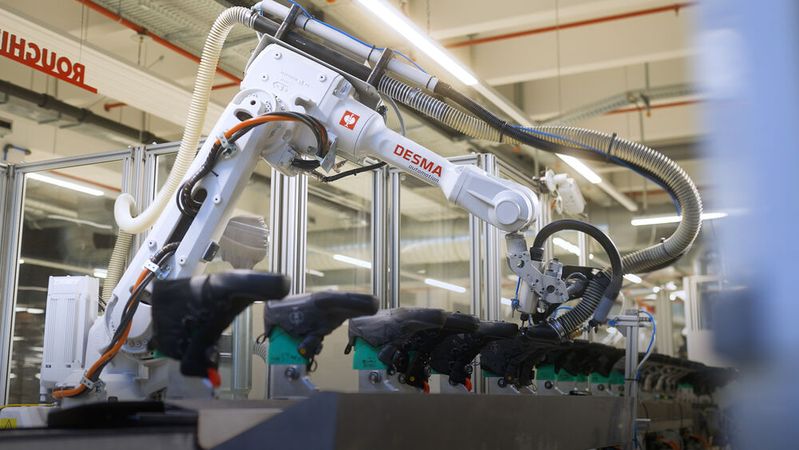
:quality(80)/p7i.vogel.de/wcms/b6/12/b612c7edd99a5d6cd3ad919afb061e06/0129206155v1.jpeg "Five ABB robots perform key processes such as roughening, release agent application and handling in the innovative direct soling process.(Image: ABB Robotics)")
:quality(80)/p7i.vogel.de/wcms/2d/69/2d69328d7058ab610aa7b9c3a585e7ae/0129206154v1.jpeg "Over 1,700 ABB robots are in use at Desma customers worldwide - including Strauss, a leading manufacturer of protective workwear.(Image: ABB Robotics)")
:quality(80)/p7i.vogel.de/wcms/74/8f/748fe3526e799ce61e57a8b8596fc7ca/0129206157v1.jpeg "Desma's robot-assisted solution enables lightning-fast changes between shoe sizes and types - at up to 100 millimetres per second with tolerances of just three millimetres.(Image: ABB Robotics)")
:quality(80)/p7i.vogel.de/wcms/c3/64/c364677c2903147872d5317815e21ec2/0129206162v1.jpeg "At Strauss' CI Factory, Desma systems with ABB robots produce high-quality children's and safety shoes - flexibly, precisely and efficiently.(Image: ABB Robotics)")
:quality(80):fill(efefef,0)/p7i.vogel.de/wcms/65/f0/65f0715271f4e/dassault-wpcover-mm.png "Dassault_WPCover_MM")
:quality(80)/p7i.vogel.de/wcms/c0/2c/c02c9d3a4a6c0de3412dc0ffbbff2e7a/0131693942v1.jpeg "Automated grinding and polishing: Thanks to simple and intuitive programming and operation, ABB’s automation cell now makes this possible even for small and medium-sized manufacturing companies. (Image:ABB)")
:quality(80)/p7i.vogel.de/wcms/76/74/76741895df02ffd13e8844aee3572155/0128805929v1.jpeg "The KMP 1500P is used in the Krone plant in Werlte to minimize forklift traffic. (Image:Kuka)")