Replacing a drill turned the entire production process upside down at Tries GmbH & Co. KG in Ehingen (Germany) on the Danube, internationally known for their hydraulic control blocks, valves, and cylinders: Switching to the "Exburrdrill" from deburring specialist Kempf not only improved the quality of the holes but also increased the tool life tenfold and saved a lot of effort in deburring.
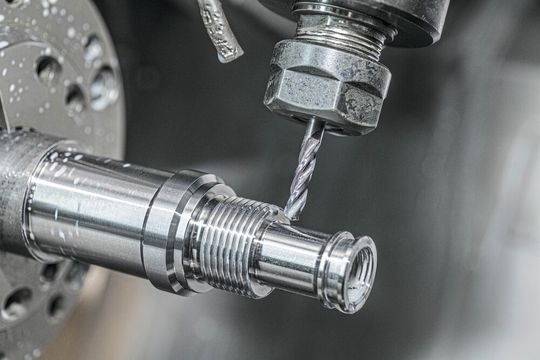
The hydraulic housing made of steel, clamped in the CNC machine. The "Exburrdrills" used with TiAlN coating (diameter 5 mm, approx. 0.2 inches, z=3) drills the four holes into the component within seconds, without the need for subsequent deburring. Thus, the workpiece comes directly from the machine, finished and already burr-free.
(Image: Kempf)
In the production of a turned part with cross holes for hydraulic blocks, which measures about 120 mm in length and with a quantity of approximately 25,000 parts per year has become a standard product at Tries, the supposedly "simple" drilling application turned out to be a real sticking point in the entire machining process.
Problem: High Burr Formations
The drills used created such high burr formations at the hole exit on the inside of the component that it was necessary to first manually deburr the parts and then have them thermally deburred by an external service provider as a second step.
Gallery
In addition, there was the relatively short tool life of the drills used and the resulting lack of or non-plannable process reliability, as the burr formation had to be continuously checked and the drills had to be replaced after varying durations of use (usually at about 2000 drillings).
Many Drilling Tests with Different Manufacturers
Overall, the production process was not satisfactory for Robert König, the head of series production, which is why a new and better solution was sought.
After several attempts with various drills from well-known manufacturers, which all failed to achieve a satisfactory result regarding the burr height at the hole exit, Tries finally became aware of the "Exburrdrill" from Kempf. The burr-minimizing drill, a development by the deburring specialist from Reichenbach-Fils (D), promises through its special geometry that no drilling caps remain attached to the component.
Application and Material-Specific Tool Solution
In addition, the "Exburrdrill," according to the manufacturer, impresses with various other advantages that can optimize machining in many areas compared to the use of standard drills. To fully exploit its performance range, the special drill from Kempf is not offered as an off-the-shelf tool but is individually manufactured for the respective customer application in a diameter range of 0.8 mm to 20 mm.
Taking into account the engagement conditions at the bore exit and the material of the component, the tool geometry of the "Exburrdrill" is parametrically designed. The individual tool manufacturing also allows for the combination of several process steps in one drilling operation.
Residual Burr Significantly Smaller
By using a step drill, for example, both the downstream deburring process and a countersinking or reaming process can be eliminated. This reduces tool change and main times on the machine. The "Exburrdrill" was principally designed to drill with minimal burr at ideally higher feed rates than standard drills, while also not leaving behind any drilling caps that always present a risk to subsequent tools. Due to the special cutting edge of the "Exburrdrill," this risk does not exist. If edge breaking on the workpiece is required, the subsequent deburring tool is significantly relieved by the minimal remaining burr. If the hole is ECM deburred, this also runs with significantly fewer disturbances, as the remaining burr is considerably smaller.
Performance of the Special Drill Surprised
At Tries, expectations for the "Exburrdrill" were kept in check due to the many unsatisfactory preliminary tests. A satisfactory performance would have been achieved if external thermal deburring could be dispensed with. Therefore, the performance of the special drill was all the more surprising.
Run on several machines, the burr formation at the bore exit was not visible or hardly measurable even after many thousands of drilled holes. In the continuous operation running since then, the performance is so good that there is essentially no inspection effort, but the drill is preemptively changed at around 20,000 parts to prevent any potential burr formation.
Bore Exits no Longer Need to be Reworked
Since the implementation of the Kempf "Exburrdrill," the hole exits no longer require reworking. The constant inspection effort and the machine downtime associated with tool changes are also things of the past. "After the first successful use of the 'Exburrdrill,' the drill is now also used in other components with a total of three different diameters," summarizes Robert König. "The drill has to perform up to eight holes per component, and even with these applications, we no longer have problems with burr formation."
Quality was the top priority when the engineering firm Manfred Tries was founded in 1964. Therefore, it did not take long before an in-house production was established and integrated alongside the development and design of hydraulic components. In 1978, the present Tries GmbH & Co. KG was founded, which now employs nearly 180 people and is internationally known for its hydraulic control blocks, valves, and cylinders, among other products.
Date: 08.12.2025
Naturally, we always handle your personal data responsibly. Any personal data we receive from you is processed in accordance with applicable data protection legislation. For detailed information please see our privacy policy.
Consent to the use of data for promotional purposes
I hereby consent to Vogel Communications Group GmbH & Co. KG, Max-Planck-Str. 7-9, 97082 Würzburg including any affiliated companies according to §§ 15 et seq. AktG (hereafter: Vogel Communications Group) using my e-mail address to send editorial newsletters. A list of all affiliated companies can be found here
Newsletter content may include all products and services of any companies mentioned above, including for example specialist journals and books, events and fairs as well as event-related products and services, print and digital media offers and services such as additional (editorial) newsletters, raffles, lead campaigns, market research both online and offline, specialist webportals and e-learning offers. In case my personal telephone number has also been collected, it may be used for offers of aforementioned products, for services of the companies mentioned above, and market research purposes.
Additionally, my consent also includes the processing of my email address and telephone number for data matching for marketing purposes with select advertising partners such as LinkedIn, Google, and Meta. For this, Vogel Communications Group may transmit said data in hashed form to the advertising partners who then use said data to determine whether I am also a member of the mentioned advertising partner portals. Vogel Communications Group uses this feature for the purposes of re-targeting (up-selling, cross-selling, and customer loyalty), generating so-called look-alike audiences for acquisition of new customers, and as basis for exclusion for on-going advertising campaigns. Further information can be found in section “data matching for marketing purposes”.
In case I access protected data on Internet portals of Vogel Communications Group including any affiliated companies according to §§ 15 et seq. AktG, I need to provide further data in order to register for the access to such content. In return for this free access to editorial content, my data may be used in accordance with this consent for the purposes stated here. This does not apply to data matching for marketing purposes.
Right of revocation
I understand that I can revoke my consent at will. My revocation does not change the lawfulness of data processing that was conducted based on my consent leading up to my revocation. One option to declare my revocation is to use the contact form found at https://contact.vogel.de. In case I no longer wish to receive certain newsletters, I have subscribed to, I can also click on the unsubscribe link included at the end of a newsletter. Further information regarding my right of revocation and the implementation of it as well as the consequences of my revocation can be found in the data protection declaration, section editorial newsletter.
The focus today, as it was back then, is on the development and design of custom special solutions, which are carried out in close collaboration with customers. As a result, Tries produces quantities ranging from a few individual pieces to several tens of thousands per year, depending on the component and requirements, primarily used in special vehicles, wheeled excavators, and cranes by various large and well-known manufacturers.



:quality(80)/p7i.vogel.de/wcms/9f/7b/9f7be35880605811e045acd3af8b571b/0129558586v1.jpeg "An example of the V210 processing machine, which, according to Voortman, supplements the laser cutting of the V353 with drilling, thread cutting and milling. (Image:Voortman)")
:quality(80)/p7i.vogel.de/wcms/b0/41/b041264d931df4347bc760fff1c7cb7b/0129439236v1.jpeg "The circular milling system proves to be a problem solver in the numerous standard variants, as well as in special shapes for some other milling processes. (Image:Horn/Sauermann)")
:quality(80)/p7i.vogel.de/wcms/33/ab/33abf15b4b5625a8904cb57c51597709/0129982307v1.jpeg "This is a new development from Fraunhofer IFAM and partners: an automated adhesive splitting system for the reliable and more productive bonding of composite parts. Here, a frame for an airplane window is measured in real time and a precise amount of adhesive is applied. (Image:Fraunhofer IFAM)")
:quality(80)/p7i.vogel.de/wcms/df/26/df26e72a2f7c890171a1059b48eef68e/0129962397v1.jpeg "The Swedish cutting tool manufacturer Sandvik Coromant now has two additional geometries for its Corodrill DE10 replaceable head drilling system, which it says will further expand the already wide range of applications - for example for cast materials ... (Image:Sandvik Coromant)")
:quality(80)/p7i.vogel.de/wcms/92/5e/925ee98ea36ad9bd574fa1cea11d0e53/0129964352v1.jpeg "The production of hardware components for humanoid robots offers great market potential. (Image:Fraunhofer IPA)")
:quality(80)/p7i.vogel.de/wcms/08/72/0872dd2dd119a54824c41e0e580e45a8/0129576591v1.jpeg "The Rose enclosure systems can be customized on request. (Image:Rose Systemtechnik GmbH)")
:quality(80)/p7i.vogel.de/wcms/73/17/7317794432521bf911711b91287cfc28/0129961259v1.jpeg "ABB Robotics and Nvidia are enabling the widespread use of physical AI in the world of robotics. This means that systems can be created virtually and with high precision and optimized much more cost-effectively. In the large image the virtual system, next to it the real robot cell ... (Image:ABB)")
:quality(80)/p7i.vogel.de/wcms/09/a2/09a2e832b1c0271d299fc130201e5717/adobestock-1767409934-4191x2360v1.jpeg "(Source: © ImageFlow - stock.adobe.com)")
:quality(80)/p7i.vogel.de/wcms/68/89/688937087188b77da95b2079399ca862/0130009534v1.jpeg "Here you can see the Dualis layout configurator in use at Montratec. (Picture: ©Gorodenkoff - stock.adobe.com)")
:quality(80)/p7i.vogel.de/wcms/9e/98/9e984afbf9c6f2bcc8963bd13465b180/26-02-pi-fraunhofer-iws-41300-ultragrain-project-closing-pic-02-1562x878v1v1.png "The process of laser wire build-up welding (DED-LB) with pulse laser-induced plasma, which contributed to the success of the Ultra Grain project, is shown at high speed. (Image:Fraunhofer IWS)")
:quality(80)/p7i.vogel.de/wcms/28/00/28008d9477bb07daa3b28ce4ac0ae907/newsimage418436-1536x864v1v1.jpeg "Researchers have produced elastic ear cartilage from human cells in the laboratory, which remains dimensionally stable in animal models. (Image:ETH Zurich)")
:quality(80)/p7i.vogel.de/wcms/1e/7d/1e7d6a316cdd7a7ba5e84d7c9a3efb80/newsimage418837-3000x1687v1v1.jpeg "Driverless shuttles can strengthen public transport, especially in rural areas. (Image:ZF Friedrichshafen)")
:quality(80)/p7i.vogel.de/wcms/c5/d2/c5d2655e427c7cbfe2f537dccfbd06e3/0129971639v1.jpeg "Volkswagen Group Charging, Elli, has connected its first electricity storage system to the grid. (Image:Elli)")
:quality(80)/p7i.vogel.de/wcms/b4/fc/b4fc9420fca6915b291eca0ae2532688/0129978040v1.jpeg "MAN has completed winter tests with nine buses. (Image:Bulent Camci)")
:quality(80)/p7i.vogel.de/wcms/a7/22/a722a06c823b5d7405eb9fb15a0b4e7d/0129931201v1.jpeg "The company offers access to its charging network, which now has more than 1,000,000 charging points across Europe, via the Elli app. (Image:Elli | Volkswagen)")
:quality(80)/p7i.vogel.de/wcms/89/5d/895dfb4fb9a90c33ddd287c7d09c9ffd/0129938355v1.jpeg "Ganfeng Lithium has developed semi-solid batteries for eVTOLs together with Geely subsidiary Aerofugia. (Image:Aerofugia)")
:quality(80)/p7i.vogel.de/wcms/c2/a8/c2a8a93f306c1475489dff074ad59731/0129967672v1.jpeg "Figure 1: Imec's logic technology roadmap showing the extension of the nanosheet era from 2nm to the A10 node with the outer-wall forksheet, before the transition to CFET for A7 and beyond. (Image:imec)")
:quality(80)/p7i.vogel.de/wcms/07/79/0779a3ba2b38d583fc9b515900be2add/0129957428v1.jpeg "If the Chinese government has its way, domestic data centers full of Nvidia hardware will be a thing of the past. (Image:Nvidia)")
:quality(80)/p7i.vogel.de/wcms/aa/4c/aa4cd2c6c10199015d47caf72eca2115/0129962687v1.jpeg "Bosch Rexroth and AMD are working together on Software-Defined Automation: ctrlX OS now also supports AMD Embedded x86 CPUs and adaptive SoCs, promising even greater hardware design flexibility, seamless scalability and a secure, modular operating system foundation. (Image:Bosch Rexroth AG)")
:quality(80)/p7i.vogel.de/wcms/7b/10/7b108d8ec7bf09cb1a20998364483525/0129923685v1.jpeg "The concept of the blade battery. (Image:BYD Europe B.V.)")
:fill(fff,0)/images.vogel.de/vogelonline/companyimg/76800/76895/65.jpg "FAULHABER_120mm.jpg ()")
:fill(fff,0)/p7i.vogel.de/companies/67/eb/67eba621ef6ea/logo2.png "logo2 (Wuxi InfiMotion)")
:quality(80)/p7i.vogel.de/wcms/0d/85/0d85a784dc20fabdea891b976fb2d122/0124723494v1.jpeg "The component on the right and the cut-open variant for investigation on the left. The complete hole is clearly visible as well as the two sawed holes on the left and right (in the left component). The hole diameter is 5 mm (approx. 0.2 inches), and the inner diameter of the main hole at this point is 14 mm (approx. 0.5 inches).(Image: Kempf)")
:quality(80)/p7i.vogel.de/wcms/63/d3/63d36cf0e1182a291ebfe47d4ecec076/0124723503v1.jpeg "For these components, the \"Exburrdrill\" is used with a total of three different diameter variants. The fourth diameter variant with 3 mm is currently still in the testing phase.(Image: Kempf)")
:quality(80)/p7i.vogel.de/wcms/0b/3c/0b3c9ca50bf3356cb38169f2ae66c523/0124723497v1.jpeg "The hydraulic housing made of steel, clamped in the CNC machine. The \"Exburrdrills\" used with TiAlN coating (diameter 5 mm, approx. 0.2 inches, z=3) drills the four holes into the component within seconds, without the need for subsequent deburring. Thus, the workpiece comes directly from the machine, finished and already burr-free.(Image: Kempf)")
:quality(80)/p7i.vogel.de/wcms/57/1d/571d0ddfaa30fbc381d011c9bd8a3ffe/0124723500v1.jpeg "The bore exit seen in the close-up on the inside of the workpiece was created after about 4000 drillings with the \"Exburrdrill.\" No visible burr is detectable.(Image: Kempf)")
:quality(80):fill(efefef,0)/p7i.vogel.de/wcms/67/ad/67adf4a647532/elatec-wp-machine-authentication.png "Elatec WP Machine Authentication")
:quality(80)/p7i.vogel.de/wcms/c0/c7/c0c72d813b322431d67710cc1011d2a3/0124421887v1.jpeg "The hydraulic housing made of steel, clamped in the CNC machine. The ExBurrDrill with TiAlN coating (diameter 5 mm, Z=3) drills the four holes in the component within a few seconds, without having to deburr them afterwards. The workpiece comes directly from the machine finished and burr-free. (Image:Kempf GmbH)")
:quality(80)/p7i.vogel.de/wcms/a7/17/a717ab2c04cbd5a936e25d990fe66b9b/0125791006v1.jpeg "The doubling of cutting edges, the use of PcBN high-performance cutting materials, and the robust clamping system result in a significant productivity increase in valve seat machining. (Image:Mapal)")