It was not in Cologne but in Berlin that the history of Ford Germany began 100 years ago. Henry Ford had his legendary Model T assembled on the Spree, before series like Taunus, Capri, and Fiesta catapulted the Ford brand to third place in the German registration ranking in Cologne. Today, however, Ford passenger cars are experiencing a crisis.
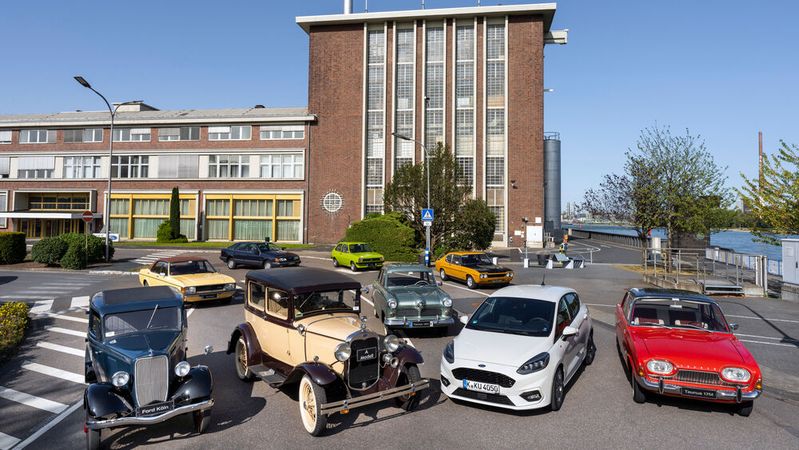
Since 1930, legendary Ford models like the Model A and the types Cologne, Taunus, Capri, Granada, and Fiesta, as well as the Scorpio, have come from Cologne.
(Image: Ford)
Short-time work and looming mass layoffs in Cologne, the Capri and Explorer electric vehicles are in low demand: Precisely on the 100th anniversary of Ford Germany's founding, bad news is dampening the celebratory mood. The name Ford, like VW and Opel, stands for the history of affordable people's cars. Founder Henry Ford fancied himself as a visionary, which is why he wanted to produce the world's first assembly line vehicle, the legendary Model T, in Germany from 1925. Ambitions he realized with an assembly plant in Berlin's Westhafen with a connection to the Spree.
A river as an inexpensive transport route was essential for Ford, and thus Cologne's mayor, Konrad Adenauer, was able to lure Henry Ford to the Rhine in 1930. According to Ford's plans, the assembly lines in Niehl were to deliver a quarter of a million cars annually—and thus three times the entire German car production of those years. Even if these numbers remained wishful thinking, Ford managed to jump to third place in German passenger car production. With popular series like Taunus and Transit, and later Escort, Capri, Granada, Fiesta, Mondeo, and Focus, as well as SUVs, Ford established itself in Germany as a mass-market brand, and the Transit even surpassed VW Bulli & Co.
Ford's greatest passenger car success: the Focus
The Ford Focus achieved the greatest success among passenger cars: by the end of the 1990s, the compact car became the best-selling car in the world. Nevertheless, the career of the Focus ends in 2025, just as the Fiesta, Mondeo, and other traditional models were previously discontinued. After 100 years, Ford is saying goodbye to the role of a full-range supplier, as the US corporation aims to make its Cologne subsidiary future-ready as an "Electric Vehicle Center." For now, however, the electric vehicles are experiencing sales problems.
Even the familiar names from combustion models like Mustang (Mach-E), Explorer, Capri, and Puma (Gen-E) change nothing for now; car buyers do not yet favor the electric Ford phalanx enough. The compact SUV Kuga remains popular along with the combustion-engine Puma, but this duo could not stop the decline of Ford to under 100,000 units and a 3.5 percent market share in Germany in 2024. It's hard to believe that they once celebrated over half a million cars built per year and an 18.5 percent market share in Cologne, first in 1965 when the West German economic miracle reached its peak, and Ford put both VW and Opel under pressure.
A remarkable development, which began with the Model T, already venerable-looking by the mid-1920s. It was in Cologne where large-scale production truly started for Ford—with a Ford named Cologne. This precursor to the 1939 streamlined Taunus showcased stylish British couture, as the Ford Cologne was ultimately nothing other than the German interpretation of the British Ford Y.
Foundation stone of the Ford Cologne plant
"The German people will make a good job of it," predicted automotive pioneer Henry Ford in 1930 at the laying of the foundation stone for the Cologne plant, and the Rhinelanders met the patriarch's expectations. When the Ford plants in Dearborn celebrated the production of the 25 millionth vehicle as the world's first manufacturer in 1937, the Cologne branch had already contributed a bit: 38,000 cars per year, from the small four-cylinder to the affordable V8, meant third place in the German brand ranking. And the Taunus in aerodesign, affectionately called "Buckel" by the public, was set to do even better, although it only really took off in 1948, after the Second World War.
By then, Henry Ford II, the founder's grandson, had already made a surprising decision: with a clear "No!" he declined the Allied victors' offer to take over the Wolfsburg VW plant. Instead, company leader Ford II focused on rebuilding his Cologne plant and developing the Taunus 12 M ("Meisterstück" (Masterpiece)) with its distinctive globe logo, as well as the slightly more powerful 15 M.
The designers of the 12 M/15 M had to adhere just as much to directives from Dearborn as the developers of the 1957 introduced Taunus 17 M (P 2) with panoramic windows and Hollywood-style tailfins. In that year, Ford Germany sold over 100,000 vehicles per year for the first time—much to Opel's chagrin. The rival from Rüsselsheim even threatened to fall behind with its mid-range model Rekord when Ford introduced the 17 M (P 3) in 1960, featuring an avant-garde "line of reason" (advertising slogan).
Date: 08.12.2025
Naturally, we always handle your personal data responsibly. Any personal data we receive from you is processed in accordance with applicable data protection legislation. For detailed information please see our privacy policy.
Consent to the use of data for promotional purposes
I hereby consent to Vogel Communications Group GmbH & Co. KG, Max-Planck-Str. 7-9, 97082 Würzburg including any affiliated companies according to §§ 15 et seq. AktG (hereafter: Vogel Communications Group) using my e-mail address to send editorial newsletters. A list of all affiliated companies can be found here
Newsletter content may include all products and services of any companies mentioned above, including for example specialist journals and books, events and fairs as well as event-related products and services, print and digital media offers and services such as additional (editorial) newsletters, raffles, lead campaigns, market research both online and offline, specialist webportals and e-learning offers. In case my personal telephone number has also been collected, it may be used for offers of aforementioned products, for services of the companies mentioned above, and market research purposes.
Additionally, my consent also includes the processing of my email address and telephone number for data matching for marketing purposes with select advertising partners such as LinkedIn, Google, and Meta. For this, Vogel Communications Group may transmit said data in hashed form to the advertising partners who then use said data to determine whether I am also a member of the mentioned advertising partner portals. Vogel Communications Group uses this feature for the purposes of re-targeting (up-selling, cross-selling, and customer loyalty), generating so-called look-alike audiences for acquisition of new customers, and as basis for exclusion for on-going advertising campaigns. Further information can be found in section “data matching for marketing purposes”.
In case I access protected data on Internet portals of Vogel Communications Group including any affiliated companies according to §§ 15 et seq. AktG, I need to provide further data in order to register for the access to such content. In return for this free access to editorial content, my data may be used in accordance with this consent for the purposes stated here. This does not apply to data matching for marketing purposes.
Right of revocation
I understand that I can revoke my consent at will. My revocation does not change the lawfulness of data processing that was conducted based on my consent leading up to my revocation. One option to declare my revocation is to use the contact form found at https://contact.vogel.de. In case I no longer wish to receive certain newsletters, I have subscribed to, I can also click on the unsubscribe link included at the end of a newsletter. Further information regarding my right of revocation and the implementation of it as well as the consequences of my revocation can be found in the data protection declaration, section editorial newsletter.
Suddenly, the Rhenish "masterpieces" were at the forefront, and the Taunus 12 M, launched in 1962, was the first to introduce the combination of front-wheel drive and a V4 engine to the lower mid-range segment. Originally designed as the Ford Cardinal for the US market, this V4 Taunus shook up all of Europe, typically Ford also as a popular "Turnier" wagon. The robust V4 engine even powered models from Saab and Matra. The next step in mid-range class brought shine and size with the affordable V6 in the 20 M, aligning with the "prosperity for all" motto of the mid-1960s federal chancellor Ludwig Erhard, at the end of the economic miracle.
Fiesta as the most modern small car in 1976
Now Ford became the "a lot of car for the money" brand, celebrated with affordable luxury in a stately form with the Granada from 1972 to 1984. The Capri became a mega-seller among family-friendly sports coupes, with neither the Opel Manta nor the VW Scirocco able to keep up. In contrast, the compact Escort (1968-2000) remained an eternal third in the contest with the VW Golf and Opel Kadett/Astra. It was only the Focus that could temporarily take the lead globally. Added to this was the Fiesta, introduced in 1976 as the world's most modern small car and a unique piece of art that sits atop the Cologne City Museum. The streamlined Sierra (from 1982) and Scorpio (from 1985) initially dared successful avant-garde, inspiring new design and vehicle concepts like the small car Ka (from 1996) with its New Edge Design or the large Ford S-Max (from 2006). Even competitors like the Renault Espace later adapted its crossover concept. Not to forget the mid-sized family and company car models like the Ford Mondeo (from 1993) or Kuga (from 2013)—Ford seemed to know how to succeed in Germany and Europe.
Flops were still part of the story, especially when it came to American ideas. This includes the Scorpio from 1995 with its round American-style forms, the sprawling Windstar van (1998), or the Probe coupe imported from the USA (1993). The name Explorer—today adorning the first all-electric SUV built in Cologne—has since the 1990s been associated with a large SUV that found its niche between New York and Los Angeles but gained little traction here. Nevertheless, in Cologne, they want to drive into the all-electric future with American "adventure spirit," as exemplified by the Mustang Mach-E since 2021. At least the new Capri references the name of its 1.9 million-times sold European predecessor, and as an SUV coupe, it tries to capture the hearts of families as it once did.



:quality(80)/p7i.vogel.de/wcms/81/c6/81c6f01476cd66350d1a6467efede21d/screenshot-202026-01-28-20174921-783x440v1v1.png "Vacuum-brazed probes. (Image:iew inductive heating systems)")
:quality(80)/p7i.vogel.de/wcms/40/c5/40c5051cebdb10fdee9a283303434d9d/0129881741v1.jpeg "3D-printed tools and other components contribute to energy-saving, precise processes. (Image:Gerhard Schubert GmbH)")
:quality(80)/p7i.vogel.de/wcms/ae/bd/aebda515c684825e97579175874ea6bd/0129920231v1.jpeg "Hensoldt, a sensor specialist for critical defense applications among other things, now has a strategic milestone ahead of it. The company is planning to acquire Nedinsco, an optronics company from Venlo in the Netherlands. Here's what's to come ... (Image:Hensoldt)")
:quality(80)/p7i.vogel.de/wcms/c3/6f/c36f031df46d22615d941d077d32313c/0129800025v1.jpeg "The laser-assisted process is intended to make wafer cutting significantly more productive. (Image:Trumpf)")
:quality(80)/p7i.vogel.de/wcms/73/17/7317794432521bf911711b91287cfc28/0129961259v1.jpeg "ABB Robotics and Nvidia are enabling the widespread use of physical AI in the world of robotics. This means that systems can be created virtually and with high precision and optimized much more cost-effectively. In the large image the virtual system, next to it the real robot cell ... (Image:ABB)")
:quality(80)/p7i.vogel.de/wcms/09/a2/09a2e832b1c0271d299fc130201e5717/adobestock-1767409934-4191x2360v1.jpeg "(Source: © ImageFlow - stock.adobe.com)")
:quality(80)/p7i.vogel.de/wcms/3e/1c/3e1c58be6be95c1f511fc6fd6812cf20/0129887455v1.jpeg "The picture shows an aerial view of the existing site, supplemented by a visualization of the Smart Factory. The new production facility is to be built on the current parking lot. (Image:Siemens AG)")
:quality(80)/p7i.vogel.de/wcms/ee/2e/ee2ed86ee6920e691aaab10cc7d2dec6/0128979319v1.jpeg "Humanoid robots can support people without adapting the environment. (Picture: ©Gorodenkoff - stock.adobe.com)")
:quality(80)/p7i.vogel.de/wcms/28/00/28008d9477bb07daa3b28ce4ac0ae907/newsimage418436-1536x864v1v1.jpeg "Researchers have produced elastic ear cartilage from human cells in the laboratory, which remains dimensionally stable in animal models. (Image:ETH Zurich)")
:quality(80)/p7i.vogel.de/wcms/1e/7d/1e7d6a316cdd7a7ba5e84d7c9a3efb80/newsimage418837-3000x1687v1v1.jpeg "Driverless shuttles can strengthen public transport, especially in rural areas. (Image:ZF Friedrichshafen)")
:quality(80)/p7i.vogel.de/wcms/85/e8/85e89606edeeec55feac9ab5617e2440/newsimage418885-3500x1969v1v1.jpeg "Flexible: The solid electrolyte based on silicone is expandable and thus compensates for the cavities that form in solid-state batteries during charging and discharging. (Image:Empa)")
:quality(80)/p7i.vogel.de/wcms/e8/dc/e8dc27a8d9fba8fbd081987400bf6848/0127426198v1.jpeg "3D FEM models are detailed, large and computationally intensive. Thanks to ROM and the support of Cadfem, Wago has succeeded in setting up an e-shop for thermal simulation. (Image:WAGO)")
:quality(80)/p7i.vogel.de/wcms/a7/22/a722a06c823b5d7405eb9fb15a0b4e7d/0129931201v1.jpeg "The company offers access to its charging network, which now has more than 1,000,000 charging points across Europe, via the Elli app. (Image:Elli | Volkswagen)")
:quality(80)/p7i.vogel.de/wcms/89/5d/895dfb4fb9a90c33ddd287c7d09c9ffd/0129938355v1.jpeg "Ganfeng Lithium has developed semi-solid batteries for eVTOLs together with Geely subsidiary Aerofugia. (Image:Aerofugia)")
:quality(80)/p7i.vogel.de/wcms/7c/b5/7cb53f75b7254936bca07deea6df4ed7/0129926273v1.jpeg "Windrose and Hubjekt cooperate on Plug&Charge authentication. (Image:Wind rose)")
:quality(80)/p7i.vogel.de/wcms/09/5a/095a3ffb6f8fa4c4ccdd40e99ad4eb57/0129947820v1.jpeg "The developers at Irlbacher prevent the glass surface from falling below the dew point with 3D printing in the form of filigree conductor tracks on flat glass. (Image:Irlbacher)")
:quality(80)/p7i.vogel.de/wcms/64/97/6497d264fcf62cf4325443498b3826f3/0129930890v1.jpeg "Switching without mechanical contacts (Image:Endrich)")
:quality(80)/p7i.vogel.de/wcms/f3/c0/f3c0040f2b655e91b80158029c65b0cc/0127314142v1.jpeg "Nexperia's assembly and testing fab in Guangdong, China. (Image:Nexperia)")
:quality(80)/p7i.vogel.de/wcms/eb/06/eb069fcd5423295876bad3277dbea0bf/0129955418v1.jpeg "The Iran war and the supply chains: Electronic components are currently hardly affected by bottlenecks. (Image:Markus Kammermann)")
:quality(80)/p7i.vogel.de/wcms/ee/75/ee7566bf98b05455703bb7521fcb98a4/0129937679v1.jpeg "The search for new semiconductor materials is progressing. (Image:Dall-E / AI-generated)")
:fill(fff,0)/p7i.vogel.de/companies/67/eb/67eba621ef6ea/logo2.png "logo2 (Wuxi InfiMotion)")
:quality(80)/p7i.vogel.de/wcms/ac/a7/aca7954806286a4662219e7fdf3fc6eb/0122483561v1.jpeg "Mustang fully electric—The Ford Mach-E initiated the electrification offensive in the Cologne model lineup in 2021.(Image: Ford)")
:quality(80)/p7i.vogel.de/wcms/59/53/5953f84c4e021d663f2bb24fab70aa2d/0122483396v1.jpeg "Small car icon—In 1976, Ford introduced the bestseller Fiesta, but unlike VW and Opel, Ford has forgone small cars since 2023.(Image: Ford)")
:quality(80)/p7i.vogel.de/wcms/c7/56/c75683f81943846203d859ae7b9ad5ae/0122483358v1.jpeg "Economic miracle glamour—The Ford Taunus 17 M competed against the Opel Rekord from 1957.(Image: Ford)")
:quality(80)/p7i.vogel.de/wcms/15/29/1529afadfec959e140920fa9a3747f7a/0122483374v1.jpeg "Failed in the USA, successful in Europe—Taunus 12 M with front-wheel drive, emerged in 1962 from the US type Cardinal.(Image: Ford)")
:quality(80)/p7i.vogel.de/wcms/bb/55/bb558471688ba22f36718bceb7fc56e4/0125164959v1.jpeg "Ford hopes, among other things, for greater market success from the e-SUV variant of the Capri. To ensure that as much expertise as possible is in their own hands, the Cologne team is now assembling the batteries for the vehicle themselves. (Image:Ford)")
:quality(80)/p7i.vogel.de/wcms/fc/21/fc215fef341cba0242ff4840a2f969de/0124694244v1.jpeg "In the USA, models like the Ford F-150 are popular. Here is the extreme Raptor variant. (Image:Ford)")