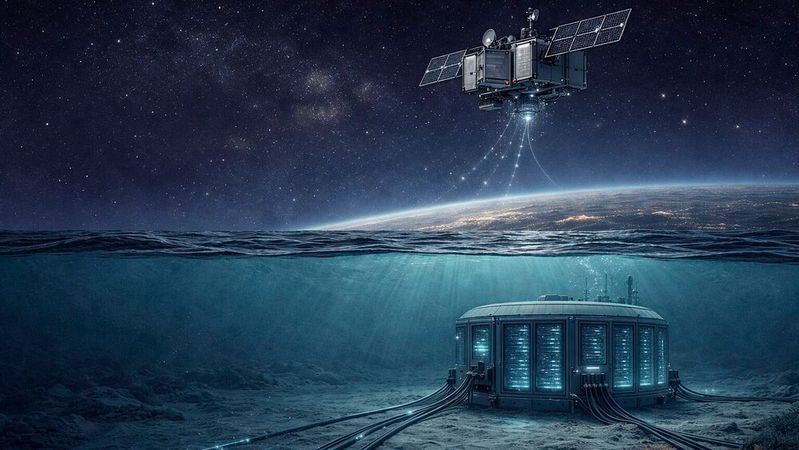
The idea of establishing data centers in Earth orbit is not new, nor is it currently economically viable. Tech celebrities are dreaming of AI from space, but there is other uncharted territory to be discovered: the sea.
Data centers in orbit are indeed dreams of the future, while data centers under water are already being tested.
(Image: Dall-E / AI-generated)
The increasing energy requirements of data centers, particularly due to AI workloads, have led to ever more radical infrastructure ideas in recent years. There is talk of locations in cool regions, then again of locations in areas where the weather is largely stable, such as deserts. Then there is talk of data centers near renewable energy sources—or near decommissioned nuclear reactors that could be put back into operation.
A vision that is as fascinating as it is controversial regularly crops up in conversations and brainstorms: data centers in space. The idea behind it seems plausible at first. There is almost unlimited solar energy available in orbit. There are no space problems like on Earth. Well, that's easy to believe if you don't necessarily want to deal with space debris.
And yes, the waste heat could theoretically be released into space. Well ... it's not that easy because of the vacuum. Anyway, let's stick to the green playground for now. At the same time, data could be processed directly where it is generated—for example on earth observation satellites. These are all valid ideas that are already being implemented.
Calculating in Space
However, when it comes to shooting data from Earth into orbit in order to process it there and send it back again, this is precisely where criticism comes in, including from analyst firm Gartner. In a recent analysis, the experts came to the conclusion that orbital data centers will not serve terrestrial requirements in the foreseeable future and that companies would be better off focusing their investments on infrastructure on Earth.
The reasoning is less visionary than physical and economic. Transportation costs dominate every calculation, as IT hardware, energy supply, cooling and structure must first be brought into orbit. Even if launch costs fall sharply, mass and volume remain decisive cost drivers. Added to this are extreme environmental conditions such as radiation, vacuum and temperature cycles, which require specially hardened components and further increase costs. Our space fan Hendrik Härter has already explained the challenges that electronics would have to face when Jeff Bezos shared his vision of AI data centers in space at Italy Tech Week 2025.
First the Construction, Then the Maintenance
Another key issue is maintenance. While servers in terrestrial data centers can be continuously replaced, any repair in orbit would require complex missions or sophisticated robotics. Without maintenance, systems would quickly contribute to additional space debris; a problem that is already being critically discussed today due to its dangerous nature.
At the same time, data transmission also remains a limiting factor, as large volumes of data would have to be reliably transmitted between earth and orbit. Against this backdrop, the idea of transferring a relevant proportion of global cloud capacities into space currently makes neither economic nor practical sense. Even the often cited advantage of cooling is put into perspective on closer inspection, as heat in a vacuum can only be dissipated via radiation, which requires large radiator surfaces and additional mass.
There is also an aspect that is often overlooked in visionary discussions: space problems cannot really be solved by orbital computing. Data centers require enormous infrastructure—energy conversion, communication systems, structural modules—which also take up space and resources. The physical location merely shifts from the earth's surface to orbit, without the fundamental scaling issues disappearing.
Why Look Up ... And Not Down?
On the other hand, a concept that also seems unusual but is physically much more favorable is much closer to practical implementation: data centers in the sea. Underwater data centers use the high heat capacity and stable temperatures of seawater for cooling, which can significantly reduce one of the biggest energy consumers of traditional data centers. At the same time, many large conurbations are located close to the coast, so that latency times remain low and existing fiber optic infrastructure can be used.
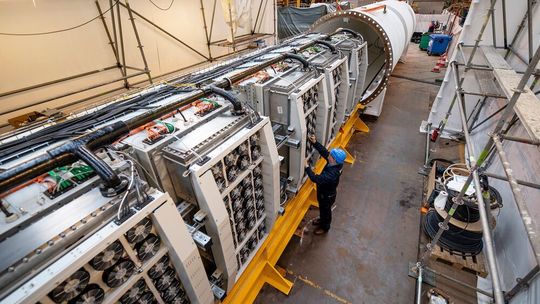
855 servers were accommodated in the Project Natick racks. Six of these failed during the 25-month term—a failure rate of 0.7 percent. The failure rate of the control group (135 servers) on land was just under 6 percent
(Image: Microsoft)
Projects that have already been carried out show that this approach is not just theoretical. Microsoft tested a sealed data center module on the seabed off the Scottish coast for several years with "Project Natick". Among other things, the results indicated higher hardware reliability, which was attributed to the stable environment and the sealed design. Underwater data centers have also been tested or announced in China, including in connection with offshore energy projects. Such concepts enable direct coupling to renewable energy sources such as offshore wind power, which opens up additional efficiency potential.
Date: 08.12.2025
Naturally, we always handle your personal data responsibly. Any personal data we receive from you is processed in accordance with applicable data protection legislation. For detailed information please see our privacy policy.
Consent to the use of data for promotional purposes
I hereby consent to Vogel Communications Group GmbH & Co. KG, Max-Planck-Str. 7-9, 97082 Würzburg including any affiliated companies according to §§ 15 et seq. AktG (hereafter: Vogel Communications Group) using my e-mail address to send editorial newsletters. A list of all affiliated companies can be found here
Newsletter content may include all products and services of any companies mentioned above, including for example specialist journals and books, events and fairs as well as event-related products and services, print and digital media offers and services such as additional (editorial) newsletters, raffles, lead campaigns, market research both online and offline, specialist webportals and e-learning offers. In case my personal telephone number has also been collected, it may be used for offers of aforementioned products, for services of the companies mentioned above, and market research purposes.
Additionally, my consent also includes the processing of my email address and telephone number for data matching for marketing purposes with select advertising partners such as LinkedIn, Google, and Meta. For this, Vogel Communications Group may transmit said data in hashed form to the advertising partners who then use said data to determine whether I am also a member of the mentioned advertising partner portals. Vogel Communications Group uses this feature for the purposes of re-targeting (up-selling, cross-selling, and customer loyalty), generating so-called look-alike audiences for acquisition of new customers, and as basis for exclusion for on-going advertising campaigns. Further information can be found in section “data matching for marketing purposes”.
In case I access protected data on Internet portals of Vogel Communications Group including any affiliated companies according to §§ 15 et seq. AktG, I need to provide further data in order to register for the access to such content. In return for this free access to editorial content, my data may be used in accordance with this consent for the purposes stated here. This does not apply to data matching for marketing purposes.
Right of revocation
I understand that I can revoke my consent at will. My revocation does not change the lawfulness of data processing that was conducted based on my consent leading up to my revocation. One option to declare my revocation is to use the contact form found at https://contact.vogel.de. In case I no longer wish to receive certain newsletters, I have subscribed to, I can also click on the unsubscribe link included at the end of a newsletter. Further information regarding my right of revocation and the implementation of it as well as the consequences of my revocation can be found in the data protection declaration, section editorial newsletter.
The Other Side of the Coin
Of course, underwater data centers are not without their challenges. Maintenance work is understandably more complex than on land. Material durability in salt water must be guaranteed in the long term. At the same time, ecological effects must be assessed. However, these disadvantages are considerably reduced compared to orbit. If maintenance in space is considered a solvable problem in many visions, then this applies all the more to systems that are located a few hundred meters below the surface of the sea and can be reached with existing offshore technology.
Perhaps the future of data centers does not lie above our heads, but under the surface of the water. While data centers in space currently remain primarily a long-term vision with special niche applications, underwater data centers could become a realistic addition to existing infrastructure much sooner. They address specific problems such as cooling, energy efficiency and space availability without having to overcome the fundamental physical and economic hurdles of space travel.
Whether we will actually need the data center boom at the end of the day, in the next 5, 10, 15, 50 years, or whether ways can be found by then to significantly reduce AI's hunger for energy and space, is of course another matter. (sb)



:quality(80)/p7i.vogel.de/wcms/ef/1e/ef1e248f58a3697ec1384f6849762d5a/0129842086v1.jpeg "Bodo will soon be hitting it off smart! Signing the memorandum of understanding in Las Vegas: Steffen Haack, Member of the Board of Bosch Rexroth, and Yoshimoto Matsuda, Managing Director of Precision Machinery & Robot Company, Kawasaki Heavy Industries. Here's what it's all about ... (Image:Bosch Rexroth)")
:quality(80)/p7i.vogel.de/wcms/f9/7d/f97deef8fde21c8630d76411b18a20a7/0129803665v1.jpeg "Skoda has invested well over 220 million US dollars in the high-tech battery plant that has now opened in Mlada Boleslav. It has now started its work, which is highly automated ... (Image:Skoda)")
:quality(80)/p7i.vogel.de/wcms/f5/61/f561ad7c72ed41fd7a67ad9c481cb15d/0129799343v1.jpeg "Engine-generator units (MGU) from Steyr Motors are at work in the Leopard 2 main battle tank and the Leguan bridge vehicle (pictured). An extended contract is now to secure at least 500 more systems of this type for the Bundeswehr ... (Image:German Armed Forces)")
:quality(80)/p7i.vogel.de/wcms/6c/b5/6cb5ce2155433f6e73b16399adc4c561/0113143253v1.jpeg "In our China Market Insider we regularly provide you with relevant information directly from China. (Image:© Eisenhans - stock.adobe.com)")
:quality(80)/p7i.vogel.de/wcms/9c/ac/9cac6246660e746c5a3989399ac4d250/0128561645v1.jpeg "Artificial intelligence can drive efficiency in smart factories through centralized data management and predictive maintenance. (Picture: ©Fardived - stock.adobe.com)")
:quality(80)/p7i.vogel.de/wcms/6b/e2/6be235b5ad8a442ccd9d164b0b300d8b/0129763992v1.jpeg "As early as 2020, the Zimmer Group announced that it would convert its production to be sustainably CO2-neutral. (Image:Zimmer Group)")
:quality(80)/p7i.vogel.de/wcms/d4/ba/d4bab9481e66f8570f40eb8ef2a90198/0129795613v1.jpeg "A camera inspection during removal ensures that the components are placed correctly in the KLTs. (Image:Yaskawa Europe)")
:quality(80)/p7i.vogel.de/wcms/cb/56/cb56e42b01638b618e8d1b9b38f32faa/0129810132v1.jpeg "From summer 2026, \"AEON\" will support people at the BMW plant in Leipzig. (Image:diephotodesigner.de/BMW)")
:quality(80)/p7i.vogel.de/wcms/b5/5e/b55ed9355e0395ec0caf111d6af6b494/adobestock-495980372--c2-a9-20natali-mis-20-e2-80-93-20stock-adobe-com-6720x3778v1v1.jpeg "Which engineering skills will be in vogue in 2026? (Image:natali_mis - stock.adobe.com)")
:quality(80)/p7i.vogel.de/wcms/bf/a5/bfa5d882e93f159ce93e933742272b00/nord-vibn-cmyk-2196x1235v1v1.jpeg "With digital twins for virtual commissioning, Nord supports customers in ensuring that systems are available more quickly, even with complex drive systems. (Image:Nord Drivesystems)")
:quality(80)/p7i.vogel.de/wcms/f5/7e/f57ef535ee35e7b3b7ff15a8a63cef10/eds-keyvisual-8000x4496v1.jpeg "(Source: European Defence Supply)")
:quality(80)/p7i.vogel.de/wcms/af/a3/afa312176d956068af20491957eef642/newsimage418262-3100x1745v1v1.jpeg "The autonomous shuttle of the Aula AI project during a demonstration of sensor data with artificial fog. (Image:University of Magdeburg)")
:quality(80)/p7i.vogel.de/wcms/40/b3/40b38efc9eae25e69d644512a2dc4b7c/0129806862v1.jpeg "This is one of the new MDA power clamping nuts from Jakob Antriebstechnik from various angles. It is described as particularly durable and powerful. Here are a few specific data ... (Image:Jakob Drive Technology)")
:quality(80)/p7i.vogel.de/wcms/29/3a/293a6a8483f59bc2fa65a7e1a4d9a703/0129822140v1.jpeg "The Fraunhofer IDMT, Mercedes-Benz and Burmester have developed the 3D audio technology \"Audiofields\". (Image:Thomas Günnel - Automotive Industry)")
:quality(80)/p7i.vogel.de/wcms/cb/23/cb23acd8e9de969d52522692b62b1892/0129680605v1.jpeg "The Z22198 is an extremely compact, three-axis IEPE acceleration sensor for measuring oscillations (vibrations) and shocks in demanding applications. With an edge length of just 0.24 inches and a weight of 0.03 ounces, it is ideal for lightweight structures and confined spaces. (Image:Copyright 2020 ScROGERS,All Rights Reserved)")
:quality(80)/p7i.vogel.de/wcms/c4/40/c44043c61f9dd99b80ccca398c284018/0129795093v1.jpeg "Subaru manufactures the E-Outback at its Yajima plant, marking the first time it has produced an electric vehicle in-house. (Image:Subaru)")
:quality(80)/p7i.vogel.de/wcms/8f/48/8f48b0ed0d6c5c4f299b1310a7b577e9/0129830738v1.jpeg "Data centers in orbit are indeed dreams of the future, while data centers under water are already being tested. (Image:Dall-E / AI-generated)")
:quality(80)/p7i.vogel.de/wcms/36/ec/36ec46b311c3fb2cf9759ba4843047c5/0129831604v1.jpeg "Keysight and Ericsson enable validation of pre-6G interoperability with real network infrastructure and devices. (Image:Keysight)")
:quality(80)/p7i.vogel.de/wcms/c5/7a/c57ab05221defbbcaf6bddc346d21464/0129752421v1.jpeg "(Image:concept electronic GmbH)")
:quality(80)/p7i.vogel.de/wcms/12/e4/12e428b994a4f83779ce72d333964fcf/wth1pi1740-01-2048x1152v1v1.jpeg "Würth Elektronik has developed a customized transformer for the intelligent Motion Mate orthosis from Powered Orthotics, which was presented at DLD. (Image:Philipp Guelland for DLD Hubert Burda Media)")
:fill(fff,0)/p7i.vogel.de/companies/69/88/69882c428938e/tmts2026-ticec-banner-en-2000px.png "tmts2026-ticec-banner-en-2000px (https://www.tmts.tw/en)")
:fill(fff,0)/p7i.vogel.de/companies/67/eb/67eba621ef6ea/logo2.png "logo2 (Wuxi InfiMotion)")
:quality(80):fill(efefef,0)/p7i.vogel.de/wcms/65/a6/65a678f1a2373/etmm-artificial-intelligence.png "ETMM Artificial Intelligence")
:quality(80)/p7i.vogel.de/wcms/58/f2/58f220c93ab6a5fc7c8374849430a444/0128247466v1.jpeg "Space satellites: \"Setting up and providing NTN has never been so easy.\" (Image:AI-generated)")
:quality(80)/p7i.vogel.de/wcms/04/52/045296a1e0e4c04bae8a7a6f02487c66/0124864728v1.jpeg "Drivetrain Analyzer Cloud, a powerful solution from the Siemens Xcelerator portfolio, helps companies significantly reduce the energy consumption of their drive systems through energy-based maintenance. (Image:Siemens)")