Early validation, fewer prototypes, better traceability of specifications and new requirements due to the Cyber Resilience Act and Machinery Ordinance: model-based design is increasingly becoming a relevant methodology for medium-sized industrial companies.
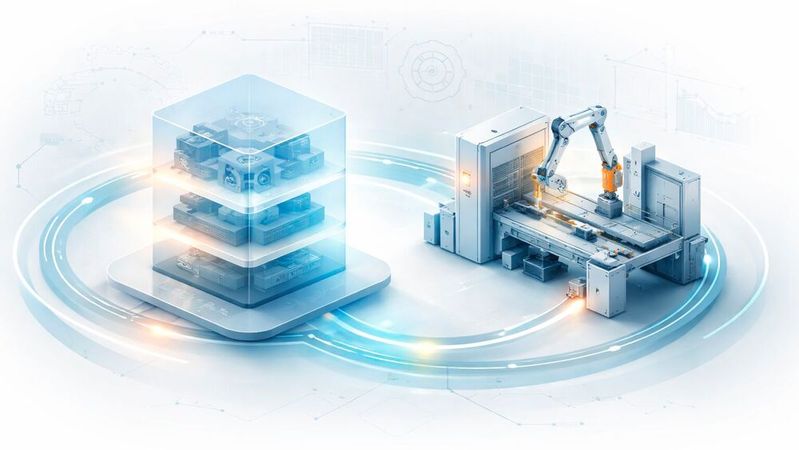
Symbolic image: Model-based design combines virtual system models with real machines and systems in order to simulate, validate and coordinate functions, control and software early on in the development process.
(Image: Dall-E / AI-generated)
Design for Manufacturing and Design for Testing are becoming increasingly important development principles to ensure that a product is not only developed functionally, but can also be manufactured stably, economically and reproducibly and tested reliably. While DfM helps to avoid manufacturing risks such as tight tolerances, unstable process windows or assembly-critical designs at an early stage, DfT ensures that errors can be detected and contained during testing and later operation.
Model-based design is a methodical approach that allows DfM and DfT requirements to be mapped and checked in the system context at an early stage. The model-based description of mechanics, electrics, software and control allows manufacturing variations, tolerances, signal noise or test and error scenarios to be simulated and evaluated as early as the design phase.
Rareș Curatu is Industrial Automation & Machinery, EMEA Industry Manager at Mathworks.
(Image: Mathworks)
In an interview with Rareș Curatu, we talked about the specific benefits that model-based design offers small and medium-sized companies today. Curatu is Industrial Automation & Machinery, EMEA Industry Manager at Mathworks and answered our inquisitive questions at SPS 2025. He explains where typical entry hurdles lie and why the effort pays off, especially for complex machines and systems. He also talks about the necessary organizational change, the importance of reusability and simulation in the overall mechatronic system as well as the influence of new regulatory requirements and future developments such as AI and CI/CD in industrial development.
ELEKTRONIKPRAXIS: Where do you see the benefits of model-based design for small and medium-sized companies? Are there any hurdles to getting started?
Rareș Curatu: We work with many companies—some are very large, others rather small. The German SME sector, which is often relatively large compared to other European countries, is an important customer base for us. At the same time, we also have many smaller customers. Many of these companies have very similar issues, regardless of whether they are large or small.
From your point of view, what are the most important advantages of model-based design in the development process?
Model-based design helps engineers to gain more confidence in their development. This is because validation can take place very early on in the development process. The earlier simulations are carried out, the earlier problems can be identified. This reduces risks, because the earlier errors are found, the less time and effort is needed later to rectify them—or worse still: after a project has already been delivered or a machine has already been put into operation.
Another important aspect is design space exploration. Variants can be simulated and evaluated in a very targeted manner, for example when placing or dimensioning actuators or sensors. This reduces the number of physical prototypes and leads to a better design sooner.
Another point that is currently becoming increasingly important is feasibility and compliance. With regard to the upcoming Cyber Resilience Act and the new Machinery Regulation, model-based design helps to link and track requirements with implementation and tests. And last but not least, models themselves are a valuable asset—for reuse and for collaboration.
Because models capture information and facilitate the exchange between different development phases and disciplines?
Exactly. When models are used as a central means of describing the system, communication between engineers from different departments becomes much easier—even if they have different working methods or expectations. And if the data is available in a structured form, it can also be reused and adapted in other projects.
Many of our customers develop machines and systems, and no two lines are exactly the same, especially when it comes to larger production systems. The components are similar, but placed or dimensioned differently. These differences justify the reuse of the intellectual property and the subsequent configuration and validation for the respective customer.
Do you also see the limits of model-based design today?
Yes, in my opinion, one of the biggest limitations is the necessary mindset change. Many traditional industrial companies are heavily focused on mechanics and electrics. Software has become much more important in recent years, but not all organizations are prepared for this internal transformation. This cultural and methodological change is often a challenge because not everyone knows what to expect.
Another challenge is choosing the right project. Very simple projects can often be implemented without simulation. In such cases, Model-Based Design shows its added value less clearly. The approach really comes into its own with more complex projects. The greater the complexity, the greater the benefit.
Do smaller companies recognize for themselves at what point model-based design becomes useful? Or do some simply try it out, even though they may not need it?
This depends less on the size of the company and more on the complexity of the project. Even small teams with just a few engineers very quickly reach their limits with complex products and then feel the need for simulation. Model-based design also makes it possible to simulate individual components as well as complete machines or systems. Many customers come to us with the desire to become more efficient, reduce errors or improve the performance of their machines.
How mature is the methodology today?
Model-based design is already well established in areas such as automotive and aerospace. In industrial automation, the picture is more mixed. There are very advanced users, but also many companies that are just getting started. I have seen some very impressive applications—and at the same time, I have almost daily conversations with companies that first want to understand why they need this approach in the first place and what economic benefits it brings.
Are there examples where development has been accelerated or errors significantly reduced?
One example comes from an Austrian manufacturer of injection molding machines. Model-based design has significantly reduced the development time for quality control algorithms. Simulation helps to better understand the system and code generation is used as a common source for design and implementation. The result is faster development cycles and more robust systems.
Is the number of reliable reference projects growing?
Simulation in itself is nothing new. Mechanical, electrical or CAD simulation has been around for many years. What is new is the increasing linking of these simulations in the overall mechatronic system. New users are constantly being added, while experienced companies are further professionalizing their processes and expanding their model-based design methodology. The market is very competitive, and model-based design helps to ensure product quality.
What concerns do companies have most frequently?
One of the first questions—especially from management—is: How do we see the return on investment? Other questions are: Does Model-Based Design really reduce risks—or does it introduce new ones? Do we have to start from scratch? Can we continue to use our existing intellectual property?
We generally recommend a step-by-step approach. There is a risk in using tools without defining clear objectives and a clear use case. Companies are often very enthusiastic at first because initial successes are quickly visible. It is important to understand that model-based design is not a push-button tool, but requires a structural change in the development process. The effort is shifted forward—to simulation, testing and validation.
How do you see things developing over the next five years?
Important trends include AI, agile development processes and CI/CD pipelines. Model-based design is increasingly being integrated into modern software workflows. We see AI both as part of the development process, for example in the form of co-pilots, and as part of the solution, for example for reinforcement learning in control systems or for virtual sensors.
Model-based design makes it possible to simulate the interaction of the plant, control system and AI in the overall system and then generate code for different target platforms—from cloud systems to microcontrollers.
How do European companies compare internationally?
Europe is a leader in the field of industrial automation and mechanical engineering. Many European companies are already using model-based design very successfully. However, the market is changing. Regulatory requirements such as the Cyber Resilience Act or the new Machinery Directive are challenging, but will help to further increase the level of quality in the long term.
(sb)
Future-Proof Authentication with Universal RFID Readers
Naturally, we always handle your personal data responsibly. Any personal data we receive from you is processed in accordance with applicable data protection legislation. For detailed information please see our privacy policy.
Consent to the use of data for promotional purposes
I hereby consent to Vogel Communications Group GmbH & Co. KG, Max-Planck-Str. 7-9, 97082 Würzburg including any affiliated companies according to §§ 15 et seq. AktG (hereafter: Vogel Communications Group) using my e-mail address to send editorial newsletters. A list of all affiliated companies can be found here
Newsletter content may include all products and services of any companies mentioned above, including for example specialist journals and books, events and fairs as well as event-related products and services, print and digital media offers and services such as additional (editorial) newsletters, raffles, lead campaigns, market research both online and offline, specialist webportals and e-learning offers. In case my personal telephone number has also been collected, it may be used for offers of aforementioned products, for services of the companies mentioned above, and market research purposes.
Additionally, my consent also includes the processing of my email address and telephone number for data matching for marketing purposes with select advertising partners such as LinkedIn, Google, and Meta. For this, Vogel Communications Group may transmit said data in hashed form to the advertising partners who then use said data to determine whether I am also a member of the mentioned advertising partner portals. Vogel Communications Group uses this feature for the purposes of re-targeting (up-selling, cross-selling, and customer loyalty), generating so-called look-alike audiences for acquisition of new customers, and as basis for exclusion for on-going advertising campaigns. Further information can be found in section “data matching for marketing purposes”.
In case I access protected data on Internet portals of Vogel Communications Group including any affiliated companies according to §§ 15 et seq. AktG, I need to provide further data in order to register for the access to such content. In return for this free access to editorial content, my data may be used in accordance with this consent for the purposes stated here. This does not apply to data matching for marketing purposes.
Right of revocation
I understand that I can revoke my consent at will. My revocation does not change the lawfulness of data processing that was conducted based on my consent leading up to my revocation. One option to declare my revocation is to use the contact form found at https://contact.vogel.de. In case I no longer wish to receive certain newsletters, I have subscribed to, I can also click on the unsubscribe link included at the end of a newsletter. Further information regarding my right of revocation and the implementation of it as well as the consequences of my revocation can be found in the data protection declaration, section editorial newsletter.



:quality(80)/p7i.vogel.de/wcms/f9/7d/f97deef8fde21c8630d76411b18a20a7/0129803665v1.jpeg "Skoda has invested well over 220 million US dollars in the high-tech battery plant that has now opened in Mlada Boleslav. It has now started its work, which is highly automated ... (Image:Skoda)")
:quality(80)/p7i.vogel.de/wcms/f5/61/f561ad7c72ed41fd7a67ad9c481cb15d/0129799343v1.jpeg "Engine-generator units (MGU) from Steyr Motors are at work in the Leopard 2 main battle tank and the Leguan bridge vehicle (pictured). An extended contract is now to secure at least 500 more systems of this type for the Bundeswehr ... (Image:German Armed Forces)")
:quality(80)/p7i.vogel.de/wcms/6c/b5/6cb5ce2155433f6e73b16399adc4c561/0113143253v1.jpeg "In our China Market Insider we regularly provide you with relevant information directly from China. (Image:© Eisenhans - stock.adobe.com)")
:quality(80)/p7i.vogel.de/wcms/7f/fd/7ffd32863352c40f562f4245e4766e61/0129745849v1.jpeg "After US President Donald Trump once again resorted to his favorite weapon, tariffs, concerns rose in the EU that the so-called tariff deal could become invalid. But it looks as if the sea remains relatively calm ... (Image:F. Schneidler)")
:quality(80)/p7i.vogel.de/wcms/9c/ac/9cac6246660e746c5a3989399ac4d250/0128561645v1.jpeg "Artificial intelligence can drive efficiency in smart factories through centralized data management and predictive maintenance. (Picture: ©Fardived - stock.adobe.com)")
:quality(80)/p7i.vogel.de/wcms/6b/e2/6be235b5ad8a442ccd9d164b0b300d8b/0129763992v1.jpeg "As early as 2020, the Zimmer Group announced that it would convert its production to be sustainably CO2-neutral. (Image:Zimmer Group)")
:quality(80)/p7i.vogel.de/wcms/d4/ba/d4bab9481e66f8570f40eb8ef2a90198/0129795613v1.jpeg "A camera inspection during removal ensures that the components are placed correctly in the KLTs. (Image:Yaskawa Europe)")
:quality(80)/p7i.vogel.de/wcms/cb/56/cb56e42b01638b618e8d1b9b38f32faa/0129810132v1.jpeg "From summer 2026, \"AEON\" will support people at the BMW plant in Leipzig. (Image:diephotodesigner.de/BMW)")
:quality(80)/p7i.vogel.de/wcms/b5/5e/b55ed9355e0395ec0caf111d6af6b494/adobestock-495980372--c2-a9-20natali-mis-20-e2-80-93-20stock-adobe-com-6720x3778v1v1.jpeg "Which engineering skills will be in vogue in 2026? (Image:natali_mis - stock.adobe.com)")
:quality(80)/p7i.vogel.de/wcms/bf/a5/bfa5d882e93f159ce93e933742272b00/nord-vibn-cmyk-2196x1235v1v1.jpeg "With digital twins for virtual commissioning, Nord supports customers in ensuring that systems are available more quickly, even with complex drive systems. (Image:Nord Drivesystems)")
:quality(80)/p7i.vogel.de/wcms/f5/7e/f57ef535ee35e7b3b7ff15a8a63cef10/eds-keyvisual-8000x4496v1.jpeg "(Source: European Defence Supply)")
:quality(80)/p7i.vogel.de/wcms/af/a3/afa312176d956068af20491957eef642/newsimage418262-3100x1745v1v1.jpeg "The autonomous shuttle of the Aula AI project during a demonstration of sensor data with artificial fog. (Image:University of Magdeburg)")
:quality(80)/p7i.vogel.de/wcms/40/b3/40b38efc9eae25e69d644512a2dc4b7c/0129806862v1.jpeg "This is one of the new MDA power clamping nuts from Jakob Antriebstechnik from various angles. It is described as particularly durable and powerful. Here are a few specific data ... (Image:Jakob Drive Technology)")
:quality(80)/p7i.vogel.de/wcms/29/3a/293a6a8483f59bc2fa65a7e1a4d9a703/0129822140v1.jpeg "The Fraunhofer IDMT, Mercedes-Benz and Burmester have developed the 3D audio technology \"Audiofields\". (Image:Thomas Günnel - Automotive Industry)")
:quality(80)/p7i.vogel.de/wcms/cb/23/cb23acd8e9de969d52522692b62b1892/0129680605v1.jpeg "The Z22198 is an extremely compact, three-axis IEPE acceleration sensor for measuring oscillations (vibrations) and shocks in demanding applications. With an edge length of just 0.24 inches and a weight of 0.03 ounces, it is ideal for lightweight structures and confined spaces. (Image:Copyright 2020 ScROGERS,All Rights Reserved)")
:quality(80)/p7i.vogel.de/wcms/c4/40/c44043c61f9dd99b80ccca398c284018/0129795093v1.jpeg "Subaru manufactures the E-Outback at its Yajima plant, marking the first time it has produced an electric vehicle in-house. (Image:Subaru)")
:quality(80)/p7i.vogel.de/wcms/8f/48/8f48b0ed0d6c5c4f299b1310a7b577e9/0129830738v1.jpeg "Data centers in orbit are indeed dreams of the future, while data centers under water are already being tested. (Image:Dall-E / AI-generated)")
:quality(80)/p7i.vogel.de/wcms/36/ec/36ec46b311c3fb2cf9759ba4843047c5/0129831604v1.jpeg "Keysight and Ericsson enable validation of pre-6G interoperability with real network infrastructure and devices. (Image:Keysight)")
:quality(80)/p7i.vogel.de/wcms/c5/7a/c57ab05221defbbcaf6bddc346d21464/0129752421v1.jpeg "(Image:concept electronic GmbH)")
:quality(80)/p7i.vogel.de/wcms/12/e4/12e428b994a4f83779ce72d333964fcf/wth1pi1740-01-2048x1152v1v1.jpeg "Würth Elektronik has developed a customized transformer for the intelligent Motion Mate orthosis from Powered Orthotics, which was presented at DLD. (Image:Philipp Guelland for DLD Hubert Burda Media)")
:fill(fff,0)/p7i.vogel.de/companies/67/eb/67eba621ef6ea/logo2.png "logo2 (Wuxi InfiMotion)")

:quality(80):fill(efefef,0)/p7i.vogel.de/wcms/67/ae/67ae0b9ac31f8/elatec-wp-universal-reader.png "Elatec WP Universal Reader")
:quality(80)/p7i.vogel.de/wcms/26/59/265958ddfec669ba075bb02b73a49688/0127467050v1.jpeg "With model-based design, more efficiency in production. (Image:Mathworks)")
:quality(80)/p7i.vogel.de/wcms/27/af/27afc72d9caef86492e7758dad727df1/0127294033v1.jpeg "Today's product development process requires a shared system understanding, clear interfaces, and good collaboration across all disciplines. Systems engineering delivers that. (Image: ©J.G Studio - stock.adobe.com)")