In connection technology, six trends are currently clearly emerging: direct current technology, digitization, Single Pair Ethernet, miniaturization, EMC compatibility, and sustainability. Read why this is so here.
Direct current is supposed to make an important contribution to the success of the energy transition and to increase sustainability.
(Image: Lapp)
1. Trend: Direct current technology
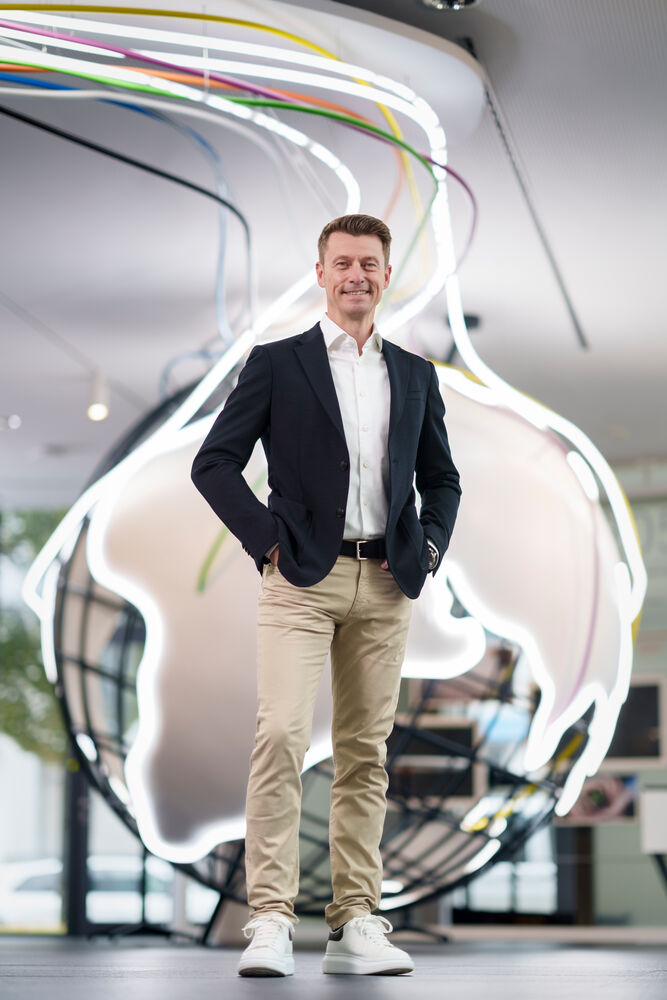
Hubertus Breier, board member for technology and innovation at Lapp, presents six trends in connection technology.
(Image:Lapp)
Experts have determined that the use of DC networks significantly reduces energy consumption in existing facilities by avoiding conversion stages. The need for copper for the three-/four-wire DC cables and AC-DC converter devices is also reduced. Therefore, DC will make a significant contribution to the success of the energy transition and to more sustainability. DC networks in factories also contribute to a lower peak power at the supply connection in the direction of the network and relieve here. The connection technology provider Lapp is therefore developing cables and lines for low-voltage direct current networks for industrial applications and has a broad portfolio of connection solutions for industrial DC networks. Lapp has been one of the founding members of the Open Direct Current Alliance (ODCA) since fall 2022. This is an alliance of companies, research institutions and the ZVEI with the aim of paving the way for DC technology from research to industrial practice. In addition, Lapp networks worldwide with other DC initiatives, for example in Austria, the Netherlands and France as well as in the USA.
In the subject of direct current, Lapp leads by example and shows what the first steps might look like: The cooperation between Lapp and the Fraunhofer IPA led to the development of a scalable DC network concept for a production site expansion in France. This increases efficiency and enables the integration of PV systems for sustainable network concepts. This pioneering concept work supports the transformation of factory power supply towards direct current and promotes efficiency and sustainability.
2. Trend: Digitization
The greed for data is ever increasing. One hundred eighty-one zettabytes, or to put it more vividly, the number 181 followed by 21 zeros - that's the forecast for the global amount of digital data generated for the year 2025. How can this gigantic amount of data be transmitted stably and quickly? Copper cables alone cannot handle this. The solution: light, more precisely optical fibers. Therefore, a future-proof communication infrastructure in the factory with fiber optic cables is indispensable. As of today, there are already implementations like Fibre-to-the-Curb, where the fiber optic connection is practically laid to the distribution box in front of the residential building or factory. Fibre-to-the-Machine is the next logical step to network the highly networked machines in the factory with sufficient data transmission performance. Lapp already has a wide range of fiber optic cables and connectors for almost every industry and application. New to the portfolio are the field-assembled Epic Data FFC-LC connectors and Epic Data FFC-SC connectors for GOF optical fibers. They simplify the creation of a pluggable fiber optic connection and offer a high degree of flexibility.
3. Trend: Single Pair Ethernet
Despite the enormous hunger for data, copper-based data transmission remains the dominant solution in the industry. Lapp has been a member of the SPE Industrial Partner Network e.V. since 2019. The association of well-known companies is a central information and exchange platform for Single Pair Ethernet (SPE) and together helps the technology to break through. Simply translated, it is about connecting the field level, for example sensors or actuators, to the cloud via the Ethernet protocol. Existing fieldbus systems are to be replaced by the more modern protocol, paving the way for the Industrial Internet of Things (IIoT). To meet the demands of the market, Lapp is expanding its portfolio with SPE solutions. The Etherline T1 FD is suitable for continuous use in the drag chain. For demanding applications in the process industry, Ethernet Advanced Physical Layer (Ethernet APL) has been developed, which is partially based on SPE. The technology enables secure data transmission to the field level in potentially explosive environments. This is ensured by the type of ignition protection 'Intrinsic Safety'. Ethernet APL also covers long distances up to 1,000 meters.
4. Trend: Miniaturization
The trend towards miniaturization continues in many areas of industry. Applications are becoming more compact, installation spaces are getting smaller, and a growing number of data and power connections need to be accommodated in a very small space. The Epic Power M12 connectors were developed in response to these market requirements and implemented consistently. The applications for the Epic Power M12L and M12K connectors are diverse. They are suitable, for example, for collaborative human-robot solutions, known as cobots, that work together with humans in manufacturing or in the warehouse. The technical properties of the connectors were already simulated using virtual models during development.
Date: 08.12.2025
Naturally, we always handle your personal data responsibly. Any personal data we receive from you is processed in accordance with applicable data protection legislation. For detailed information please see our privacy policy.
Consent to the use of data for promotional purposes
I hereby consent to Vogel Communications Group GmbH & Co. KG, Max-Planck-Str. 7-9, 97082 Würzburg including any affiliated companies according to §§ 15 et seq. AktG (hereafter: Vogel Communications Group) using my e-mail address to send editorial newsletters. A list of all affiliated companies can be found here
Newsletter content may include all products and services of any companies mentioned above, including for example specialist journals and books, events and fairs as well as event-related products and services, print and digital media offers and services such as additional (editorial) newsletters, raffles, lead campaigns, market research both online and offline, specialist webportals and e-learning offers. In case my personal telephone number has also been collected, it may be used for offers of aforementioned products, for services of the companies mentioned above, and market research purposes.
Additionally, my consent also includes the processing of my email address and telephone number for data matching for marketing purposes with select advertising partners such as LinkedIn, Google, and Meta. For this, Vogel Communications Group may transmit said data in hashed form to the advertising partners who then use said data to determine whether I am also a member of the mentioned advertising partner portals. Vogel Communications Group uses this feature for the purposes of re-targeting (up-selling, cross-selling, and customer loyalty), generating so-called look-alike audiences for acquisition of new customers, and as basis for exclusion for on-going advertising campaigns. Further information can be found in section “data matching for marketing purposes”.
In case I access protected data on Internet portals of Vogel Communications Group including any affiliated companies according to §§ 15 et seq. AktG, I need to provide further data in order to register for the access to such content. In return for this free access to editorial content, my data may be used in accordance with this consent for the purposes stated here. This does not apply to data matching for marketing purposes.
Right of revocation
I understand that I can revoke my consent at will. My revocation does not change the lawfulness of data processing that was conducted based on my consent leading up to my revocation. One option to declare my revocation is to use the contact form found at https://contact.vogel.de. In case I no longer wish to receive certain newsletters, I have subscribed to, I can also click on the unsubscribe link included at the end of a newsletter. Further information regarding my right of revocation and the implementation of it as well as the consequences of my revocation can be found in the data protection declaration, section editorial newsletter.
5. Trend: EMC compatibility
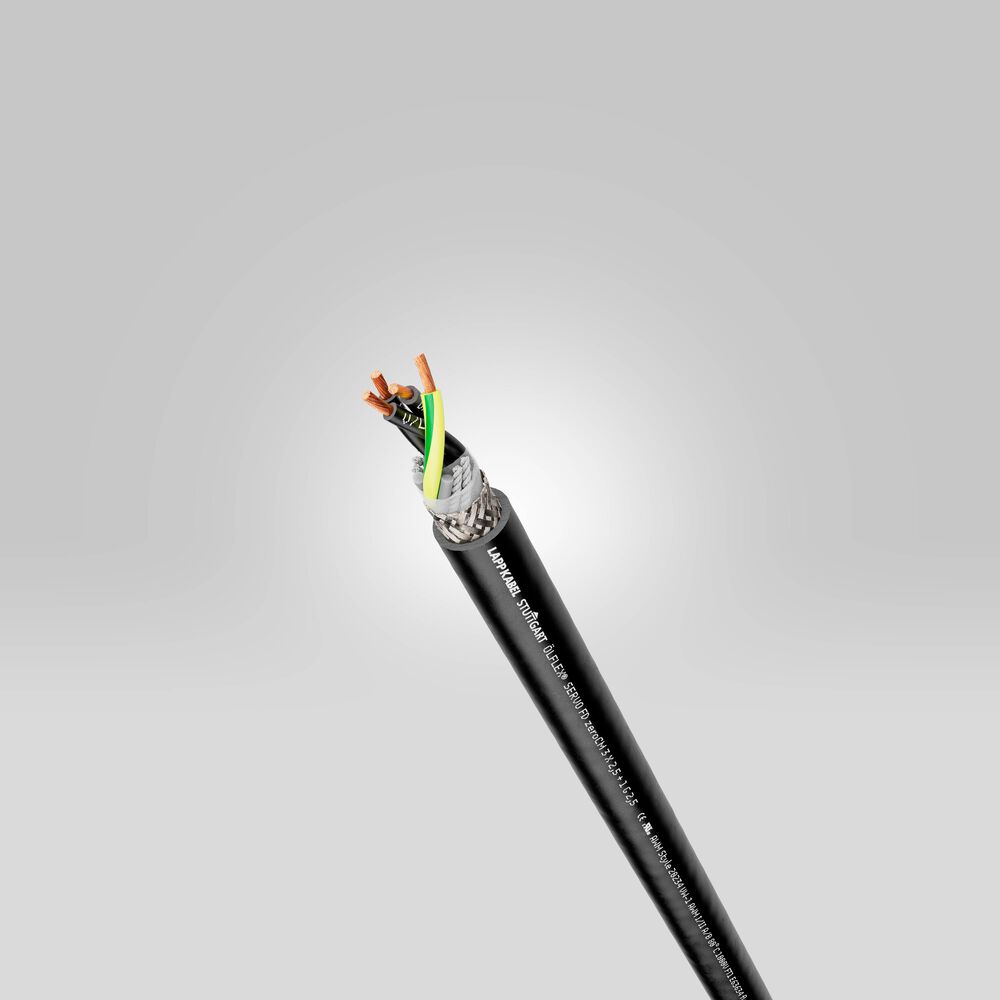
The motor line Ölflex FD Servo ZeroCM has been optimized for leakage current by a special stranding process and makes an important contribution to EMC optimization of frequency-controlled drive systems.
(Image:Lapp)
With the increasing networking of machines and systems in the Smart Factory, the topic of electromagnetic compatibility (EMC) is becoming increasingly important. Especially in industrial plants where frequency converter-controlled motors are used, there can be more frequent undesired currents on the equipotential bonding conductors (PA) or protective earth conductors (PE). These unwanted currents can affect neighboring data lines and their data quality in transmission, falsely trigger fault protection switches, or even lead to increased rusting effects in building structures. A new cable design from Lapp reliably reduces leakage currents and makes a crucial contribution to improved EMC in machines and systems. The motor cable Ölflex FD Servo ZeroCM has been optimized for leakage current through a special silver-plating process and makes an important contribution to EMC optimization of frequency-controlled drive systems.
6. Trend: Sustainability
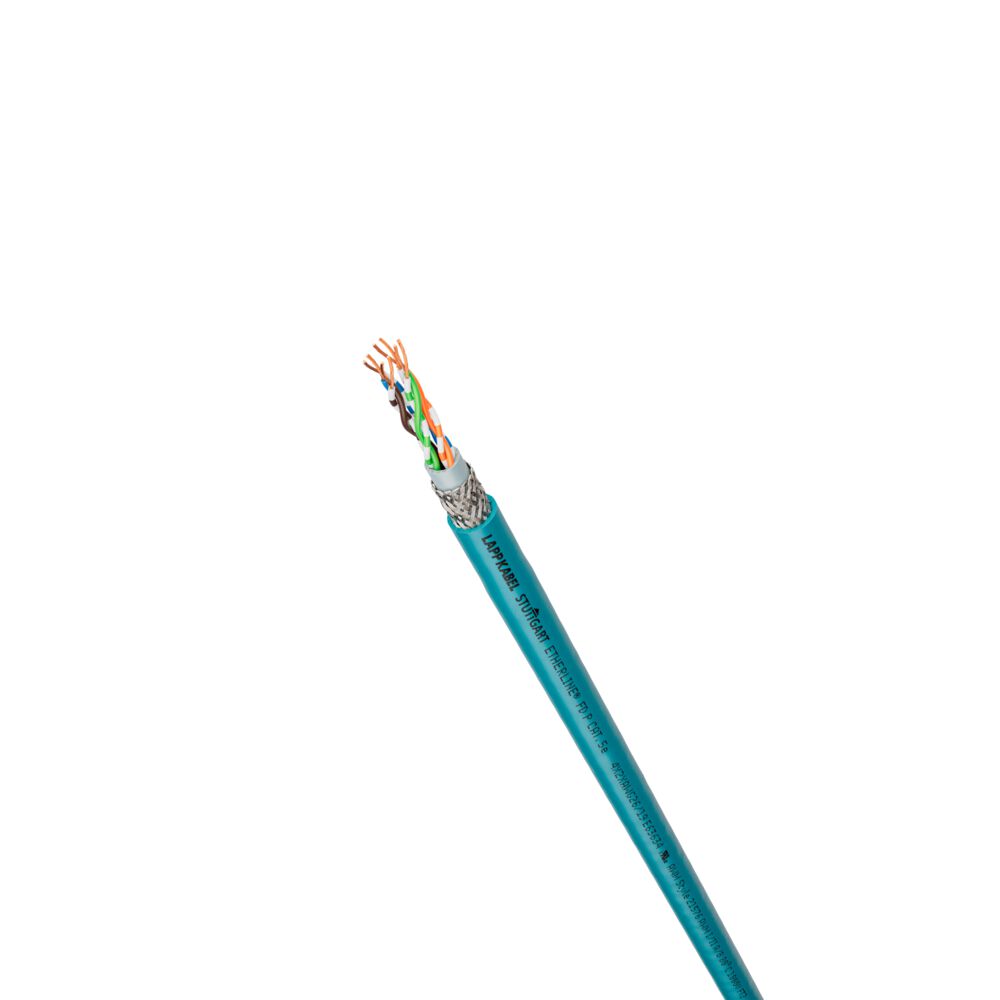
The Etherline FD P Cat. 5e is a cable with a sheath made from partially bio-based TPU sheath material.
(Image:Lapp)
More and more users are asking for environmentally friendly and energy-efficient connection solutions. With the Etherline FD P Cat. 5e, Lapp already has a line with a jacket made of a partially bio-based TPU jacket material in its range. This is now followed by the Ölflex Classic FD 810, the prototype of a cable with a sustainable PVC jacket. Lapp is also investigating initial approaches to the use of recycled material, both in the production cycle and the use of cable scrap. In addition to product-related sustainability approaches, the transparency and documentation of the Product Carbon Footprint is important, as is the accounting of Scope 1 and 2.



:quality(80)/p7i.vogel.de/wcms/60/eb/60ebe43de41f833157b476b2e1641811/0130090160v1.jpeg "The Surface Control Automotive measuring system from Micro-Epsilon automatically detects dents, scratches and other surface defects on body shells. (Image:Micro-Epsilon)")
:quality(80)/p7i.vogel.de/wcms/26/8a/268aba929d72bd089234bd512aab9b08/0130487474v1.jpeg "The works meeting at Volkswagen is over! Here is a brief overview of the most important aspects ... (Image:VW)")
:quality(80)/p7i.vogel.de/wcms/50/63/5063e5b91e7897c13b882440c7f106d4/0128575929v1.jpeg "How is Edge AI changing the industry? Local data processing meets distributed intelligence to promote sustainability and efficiency. (Picture: ©tippapatt - stock.adobe.com)")
:quality(80)/p7i.vogel.de/wcms/a0/47/a04725ef9bd09fb6c9341a1bea1b5d93/0130443083v1.jpeg "Here, a type of plastic pallet is produced by thermoforming (vacuum forming or deep drawing) at the corresponding division of New England Plastics in the USA. This division, which specializes in so-called liners, is now part of Ringmetall ... (Image:New England Plastics)")
:quality(80)/p7i.vogel.de/wcms/29/d8/29d83fa92093c7f247429e060be46c7b/0130378625v1.jpeg "Secures and monitors circuits directly in the field: Turck's IP67 TBIF fuse with IO-Link (Image:Turck GmbH)")
:quality(80)/p7i.vogel.de/wcms/d3/3d/d33d26b35aa1e64f5c41d19d22c5c5dc/0130496518v1.jpeg "(Image:Speedbot)")
:quality(80)/p7i.vogel.de/wcms/f0/ca/f0caaaa9fc2347a5221760a94f92e831/0129880873v1.jpeg "Human-machine collaboration takes on a new quality. This is because the automation task is formulated in natural language and the AI takes over its implementation directly in the project. This allows users to implement Codesys projects more quickly. (Image:Codesys)")
:quality(80)/p7i.vogel.de/wcms/b7/36/b736dfebc16c42d6901d0d0e1f390493/3d-druck-20factory-20--20ki-20generiert-1920x1079v1.png "(Source: AI-generated)")
:quality(80)/p7i.vogel.de/wcms/79/b2/79b21aad663f4a7bd4472afc1c1afc62/0130433994v1.jpeg "Mission Joyride: The free-flying robot (shown here in the rendering) will relieve the ISS crew of logistics tasks from 2027 with its two mechanical arms. (Image:Icarus Robotics)")
:quality(80)/p7i.vogel.de/wcms/59/a2/59a2b11f0aa1b700eff02addd5de8703/adobestock-1788280853--c2-a9-20satria-20-e2-80-93-20stock-adobe-com-5081x2860v1v1.jpeg "Quantum computers require extreme cooling to temperatures close to absolute zero in order to keep qubits stable. (Image:satria - stock.adobe.com)")
:quality(80)/p7i.vogel.de/wcms/49/38/493876a248943456b7e4a6db6edfc454/0130230765v1.jpeg "Safe and reliable in aircraft construction: light-curing adhesive bond combined with universal fastening elements. (Source: Delo)")
:quality(80)/p7i.vogel.de/wcms/26/e1/26e1c8d1f56a588b078196508a069155/0130500702v1.jpeg "Hyundai plans a large truck for North America (Image:Hyundai)")
:quality(80)/p7i.vogel.de/wcms/61/eb/61eb2c9fe2ec3295593bd63ebc610f59/0130504331v1.jpeg "Headquarters of the Chinese truck start-up Zeron. (Image:Jiangsu 01 Automobile Technology/Screen shot)")
:quality(80)/p7i.vogel.de/wcms/c2/57/c257d627beec10e94252cde72830adf6/0130472803v1.jpeg "With the Twingo E-Tech, Renault is now launching a purely electrically powered new edition of the Twingo small car (Image:Renault)")
:quality(80)/p7i.vogel.de/wcms/c1/43/c143c24b62e51b848b2586b52bcd20e2/0130468443v1.jpeg "Jörg Burzer, Head of Development at Mercedes Benz Group AG (Image:Mercedes)")
:quality(80)/p7i.vogel.de/wcms/89/f2/89f2b2de703956abfb30ea456d77a463/0130471595v1.jpeg "The joint venture between TDK and Nippon Chemical Industrial focuses on the development of ceramic materials for electronic components. (Image:TDK Corporation)")
:quality(80)/p7i.vogel.de/wcms/e4/a0/e4a0da27805e96aa8976f04add4b3bec/0130458429v1.jpeg "Fit for extreme conditions: This illustration shows a photonic chip whose components have been bonded with high stability using the new connection technology. (Image:NIST)")
:quality(80)/p7i.vogel.de/wcms/9b/84/9b845ee38e4fb3c8ea07d1735d9e36fd/0130451629v1.jpeg "The windshield as a projection screen: a high-precision and low-latency system architecture is required for implementation. This requires the seamless integration of different technologies. (Image:Harman)")
:quality(80)/p7i.vogel.de/wcms/86/e0/86e09ea9c278d112c55b995b843abfee/0130494578v1.jpeg "PV system on the roof of the Elbfabrik, a Fraunhofer IFF research factory. A sensor system can detect faults in large-scale PV systems at an early stage. (Image:Fraunhofer IFF/Anne Bornkessel)")
:fill(fff,0)/images.vogel.de/vogelonline/companyimg/76800/76895/65.jpg "FAULHABER_120mm.jpg ()")
:quality(80)/p7i.vogel.de/wcms/4e/85/4e858d1ecec06dab411fa4e31501d5a8/0127057552v1.jpeg "Lapp offers Single Pair Ethernet cables for fixed and flexible applications, as well as long distances, along with specially designed cables for Ethernet-APL. (Image:LAPP)")
:quality(80)/p7i.vogel.de/wcms/5d/92/5d926034862159e54ada6078a642985b/0125078752v1.jpeg "Use case robot: Single Pair Ethernet offers new solution approaches in many application areas for successful digitalization. (Image:Phoenix Contact)")