Documenting war crimes, supporting vaccinations, measuring snow depths, and tracking climate change—satellite Earth observations offer immense potential. Researchers at ETH Zurich (Switzerland) are leveraging this technology.
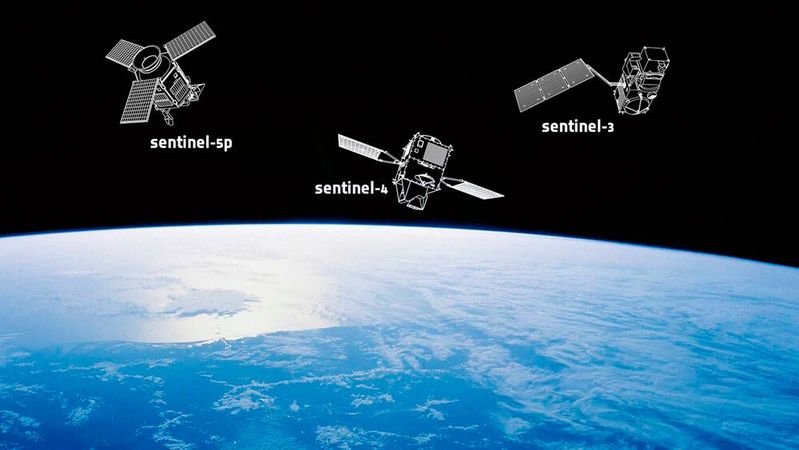
ESA's Sentinel satellites are public earth observation satellites that are also used by ETH researchers.
(Image: ESA)
Satellites of the European Space Agency (ESA) send radar beams to Earth from an altitude of 700 kilometers. These are scattered back and provide images of the Earth's surface even when the sky is overcast. Konrad Schindler and his team are particularly interested in the radar images of Ukraine. "The satellites fly over the country every few days, providing a kind of slow-motion video," explains the head of the Institute of Geodesy and Photogrammetry at ETH Zurich. "The signal changes when intact houses turn into a field of rubble." This is because the radar beams are reflected more strongly on smooth surfaces than on rough ones.
However, humans would be overwhelmed by the task of analyzing the freely accessible flood of images. This task is performed by an automatic monitoring system based on artificial intelligence (AI). "This means that the computer system is left to statistically recognize typical patterns in the data," explains Schindler. For this machine learning, the AI system is trained with sample images in which you are sure to see a destroyed building that was previously still intact.
This reference data was provided by the UN Satellite Center (UNOSAT). Experts there painstakingly identify such building damage by hand using high-resolution images from commercial providers in order to document war crimes such as the bombing of civilian facilities. "Our monitoring system is by no means a substitute for these experts," says Schindler. "But because it can cover large areas, it gives them important clues as to where they should take a closer look."
Cards for aid organization
The mapping of war damage is one of two projects that the ETH researchers carried out in collaboration with the International Committee of the Red Cross (ICRC). "The second project was about the seemingly very simple question: where are the people?" says Schindler. If the ICRC is planning a vaccination campaign or a relief operation following a natural disaster, it needs data on population density, which is often lacking in less developed countries. This gap is filled by the population maps that Schindler's group creates using satellite data.
The ETH researchers use satellite observations in combination with machine learning for a wide range of areas. In collaboration with the Swiss start-up ExoLabs, they have developed a system that measures snow depth faster and more precisely than was previously possible. Satellite images and digital elevation maps provided the first estimates of snow cover in Switzerland. From comparisons with precise data collected by an airplane and measuring stations on the ground, the system learned to improve the estimate based on the satellite images. It now provides daily updated snow depth maps, which are due to be launched on the market soon.
A global map of tree heights is already freely available, which is primarily used for ecological purposes and is also based on satellite data. "From space, you can't see where a tree begins and ends, but the reflected signal still contains a surprising amount of information, especially in the infrared range, where vegetation is particularly active," explains Schindler. A computer program learned how these local illumination patterns relate to tree height from examples provided by a laser scanner on board the International Space Station (ISS). Depending on whether the laser pulses are reflected by the treetops or the ground, their transit time shifts minimally. The height of the vegetation can be derived from this.
Early warning system for forests
"The global mapping of tree heights is extremely interesting because it contains information about the age of the stands," says Verena Griess, Head of the Institute of Terrestrial Ecosystems at ETH Zurich. She and her team also work with satellite data to obtain information on the condition of trees. "With climate change, we are in an era of rapid change, also in terms of our forests, and problems caused by pest infestation, windthrow, fire and drought stress are becoming more frequent," says the Professor of Forest Resource Management.
With the help of satellite data, the researchers want to create an early warning system that is designed to trigger a need for action in a stressed forest, even if the signals are not yet visible to the human eye. Such a system could detect small fires in sparsely populated areas or indicate where measures are needed in Switzerland to ensure that the forest continues to protect us from natural hazards. Satellite data could also identify areas that are particularly suitable for the production of wood or areas that need to be protected due to their high biodiversity. "We want to ensure that the right decision is made for each location," explains Griess.
Date: 08.12.2025
Naturally, we always handle your personal data responsibly. Any personal data we receive from you is processed in accordance with applicable data protection legislation. For detailed information please see our privacy policy.
Consent to the use of data for promotional purposes
I hereby consent to Vogel Communications Group GmbH & Co. KG, Max-Planck-Str. 7-9, 97082 Würzburg including any affiliated companies according to §§ 15 et seq. AktG (hereafter: Vogel Communications Group) using my e-mail address to send editorial newsletters. A list of all affiliated companies can be found here
Newsletter content may include all products and services of any companies mentioned above, including for example specialist journals and books, events and fairs as well as event-related products and services, print and digital media offers and services such as additional (editorial) newsletters, raffles, lead campaigns, market research both online and offline, specialist webportals and e-learning offers. In case my personal telephone number has also been collected, it may be used for offers of aforementioned products, for services of the companies mentioned above, and market research purposes.
Additionally, my consent also includes the processing of my email address and telephone number for data matching for marketing purposes with select advertising partners such as LinkedIn, Google, and Meta. For this, Vogel Communications Group may transmit said data in hashed form to the advertising partners who then use said data to determine whether I am also a member of the mentioned advertising partner portals. Vogel Communications Group uses this feature for the purposes of re-targeting (up-selling, cross-selling, and customer loyalty), generating so-called look-alike audiences for acquisition of new customers, and as basis for exclusion for on-going advertising campaigns. Further information can be found in section “data matching for marketing purposes”.
In case I access protected data on Internet portals of Vogel Communications Group including any affiliated companies according to §§ 15 et seq. AktG, I need to provide further data in order to register for the access to such content. In return for this free access to editorial content, my data may be used in accordance with this consent for the purposes stated here. This does not apply to data matching for marketing purposes.
Right of revocation
I understand that I can revoke my consent at will. My revocation does not change the lawfulness of data processing that was conducted based on my consent leading up to my revocation. One option to declare my revocation is to use the contact form found at https://contact.vogel.de. In case I no longer wish to receive certain newsletters, I have subscribed to, I can also click on the unsubscribe link included at the end of a newsletter. Further information regarding my right of revocation and the implementation of it as well as the consequences of my revocation can be found in the data protection declaration, section editorial newsletter.
The researchers are currently working on a model that can automatically recognize tree species on satellite images. Based on verified locations of certain species such as beech, spruce or larch, the model learns to recognize the corresponding patterns on the satellite images. Using so-called hyperspectral sensors, satellites also collect information that is not visible to humans and provides information about the health of trees. This is because they can be used to measure the chemical content of certain substances in the leaves and how their concentration changes, which can be the case in the early stages of infestation by pests, for example.
The two-dimensional satellite images can also be linked with 3D data provided by laser scanners from space, from aircraft or drones and from the ground. ETH's Alps supercomputer, which recently went into operation, will speed up the data analyses and improve the training of the models. "With this, the outstanding students and the good cooperation between the professorships and the other institutions of the ETH Domain, Switzerland has an expertise that cannot be found anywhere else in such a concentrated form," says Griess.
GPS technology repurposed
The condition of forest trees can also be investigated using signals emitted by GPS satellites. If a receiving station is placed under a tree and a second one further away, the difference in the signals received can be used to calculate how much biomass is stored in the tree. "It's amazing what you can do with a technology that was actually developed for something completely different—navigation," says Benedikt Soja, Professor of Space Geodesy.
In collaboration with MeteoSwiss, Soja and his team installed low-cost GPS receiving stations at several weather stations throughout Switzerland. This makes it possible to measure how much water vapor is present in the atmosphere, as this slows down the radio signals emitted by the satellites. This makes it possible to calculate the humidity above a station and thus improve rain forecasts.
An analysis of the measurement series over a longer period of time also provides information about climate change. If it gets warmer, the atmosphere can absorb more moisture, i.e. more water vapor. "This in turn intensifies climate change, because water vapor is also a greenhouse gas—in fact the most abundant one," explains Soja. "This makes it particularly easy to determine the impact of climate change on the atmosphere at a local level." The GPS measurements show that it has become wetter on average, but also drier in some regions.
The researchers are using a different measuring technique to track the melting of the ice sheets in Greenland and Antarctica. Two satellites flying in close succession record the Earth's gravitational field. This varies depending on how much mass is present at a particular location. "This allows us to measure mass shifts from space," explains Soja. These measurements can be further refined with the help of other satellites that take altitude measurements. "We see that year after year, huge amounts of ice melt in the polar regions and cause sea levels to rise—hundreds of gigatons, a huge ice cube the size of the city of Zurich and over 3,000 meters (approx. 9,843 ft) high," says Soja. "This observation from space is the best technique for monitoring the consequences of climate change in relation to the ice sheets."



:quality(80)/p7i.vogel.de/wcms/dd/08/dd086510d9ae7b50181f6070e4463b44/0129363730v1.jpeg "Typical application for ionizing devices: Wrapping films. (Picture: ©Adobe Stock/SMC)")
:quality(80)/p7i.vogel.de/wcms/35/57/3557c819943c53acec41a0ccba87da4f/0130049064v1.jpeg "Researchers at the Fraunhofer IWU in Chemnitz have long known that many typical sheet metal parts can be manufactured more cost-effectively using hollow embossing rollers. Now there is news to report ... (Image:Fraunhofer IWU)")
:quality(80)/p7i.vogel.de/wcms/59/02/590246e3b3f415c65edbee377c14ca77/26-06-pi-fraunhofer-iws-41450-direktplattieren-pic-01-7771x4369v1v1.jpeg "The Fraunhofer IWS has developed the new \"direct laser cladding\" process, which creates a functional layer directly on the base body by applying a strip-shaped metal to rotationally symmetrical components in a spiral and bonding it locally by laser. (Image:Christoph Wilsnack/Fraunhofer IWS)")
:quality(80)/p7i.vogel.de/wcms/73/60/73608418789b1d9c393f5e2fa974eda2/0130209906v1.jpeg "The robots of the X6 generation from b+m enable very high painting quality and are also particularly compact and easy to maintain. (Image:Beckhoff)")
:quality(80)/p7i.vogel.de/wcms/78/e9/78e9188c25a8a94e67c34c9bf8ffe495/visual-agile-20robots-20and-20google-20deepmind-20partner-20to-20bring-20intelligence-20to-20robotics-2500x1406v1v1.jpeg "Together, the partners are developing adaptable, intelligent robots for a wide range of applications (Image:Agile Robots SE)")
:quality(80)/p7i.vogel.de/wcms/e7/66/e7669ecf0260ae8fc54c214e34e4902a/0130316817v1.jpeg "Siemens and Palo Alto Networks offer tested cybersecurity solution for industrial 5G. (Image:Siemens)")
:quality(80)/p7i.vogel.de/wcms/9f/55/9f55324832c4f426958031375124d9de/siemens-20ubtech-20hmnd-1920x1079v1v1.png "Ready for the factory floor: While Ubtech is planning mass production, Siemens is already testing humanoids in real factory applications in Erlangen. (Image:Siemens)")
:quality(80)/p7i.vogel.de/wcms/11/36/113695ed260e29c8c2d9d39dc5f9d869/0130213768v1.jpeg "AI can work cheaply in China and deliver the results rapidly all over the world. (Image:Dall-E / AI-generated)")
:quality(80)/p7i.vogel.de/wcms/62/5f/625f41e87ebfef156a98c8e6393e32fd/0130211654v1.jpeg "Axial flux motors have some advantages over radial flux motor—but their production is currently still expensive. (Image:RWTH Aachen University)")
:quality(80)/p7i.vogel.de/wcms/77/9b/779b0685d010dfe45c9c2cb1cfecd467/0128886425v1.jpeg "The BlueEye is the first \"real\" hyperspectral camera for the UV range and covers the wavelength range from 220 to 380nm. (Image:Inno-spec GmbH)")
:quality(80)/p7i.vogel.de/wcms/e4/51/e451d52ce0182fb0aaa46a5774f832ef/26-04-pi-fraunhofer-iws-21160-bioslide-pic-01-4128x2321v1v1.jpeg "With the BioSlide research project, the Fraunhofer IWS is investigating how sliding systems can be designed to be more sustainable and energy-efficient. New materials can be tested in a particularly application-oriented manner on this plain bearing test stand. (Image:Fraunhofer IWS)")
![Thanks to advanced 3D printing technology, a more efficient use of resources should contribute to lower-emission aviation—this is the goal of ['skai]-lab. (Image:Oleksandr Pashchenko - stock.adobe.com / AI-generated)](https://cdn1.vogel.de/nghHNSbySccfOjG3n1qCA-FVOjQ=/288x162/smart/filters:format(jpg):quality(80)/p7i.vogel.de/wcms/62/64/626424c97a16e69f871bf216c9629c2a/adobestock-1927043193--c2-a9-20oleksandr-20pashchenko-20-e2-80-93-20stock-adobe-com-ki-generiertv1v1.jpeg "Thanks to advanced 3D printing technology, a more efficient use of resources should contribute to lower-emission aviation—this is the goal of ['skai]-lab. (Image:Oleksandr Pashchenko - stock.adobe.com / AI-generated)")
:quality(80)/p7i.vogel.de/wcms/c3/c4/c3c4ce270b083eeac55654148611f064/0130237945v1.jpeg "China is not giving up on hydrogen, but is intensifying its efforts. (Image:freely licensed from Pixabay)")
:quality(80)/p7i.vogel.de/wcms/4e/c0/4ec0bd19390b169edfa23677373dcdf1/0130260089v1.jpeg "Renewable fuels can supply European road traffic, according to a study. (Image:Aral)")
:quality(80)/p7i.vogel.de/wcms/6f/c9/6fc9050301d745cad25585c6780f8f51/0130197341v1.jpeg "Production facilities are a worthwhile target and are therefore at risk. (Image:ABB Robotics)")
:quality(80)/p7i.vogel.de/wcms/b6/62/b662adc2cec8227d8172509bbfb6ee42/25c0207-107-4961x2789v1v1.jpeg "The GLB is the second model based on Mercedes' new MMA platform. Apparently, Geely's platform is better and cheaper, which is why the two companies are negotiating a partnership. (Image:Mercedes-Benz)")
:quality(80)/p7i.vogel.de/wcms/4d/dd/4dddf438e91f394c04a095dbfd109d1c/0130236430v1.jpeg "Measurement modules: The 720301 module in combination with the SL2000 enables RMS and power calculations, among other things. (Image:Yokogawa)")
:quality(80)/p7i.vogel.de/wcms/61/fc/61fcf95f5cca15494ad18343901ae585/0130317237v1.jpeg "With the AGI CPU, Arm says it is taking a \"historic step\": With the processor aimed at AI in data centers, the company is presenting itself for the first time as a provider of its own chips, not just as a pure IP licensor. (Image:Arm)")
:quality(80)/p7i.vogel.de/wcms/82/90/8290dfe3595b6c6b33726ae8b76172c7/0130319587v1.jpeg "The concept image illustrates how the pattern of tiny protrusions and depressions created on the substrate (MgO, bottom) controls the arrangement of atoms in the superconducting material (YBCO, top). At the interface between the two layers, an electronic structure enables superconductivity to occur at higher temperatures than previously possible. (Image:Chalmers University of Technology / Riccardo Arpaia)")
:fill(fff,0)/p7i.vogel.de/companies/67/eb/67eba621ef6ea/logo2.png "logo2 (Wuxi InfiMotion)")
:quality(80)/p7i.vogel.de/wcms/93/fc/93fce00b5565838d294bb627eed833ef/0128226312v1.jpeg "The A4Climate project investigates how contrails can be avoided. (Image:Project A4Climate)")
:quality(80)/p7i.vogel.de/wcms/91/fd/91fd55d7dc44ce321bd7587272059d08/0128103878v1.jpeg "This ETH Zurich logo consists of 2,800 nano light-emitting diodes and, with a height of 20 micrometers, is approximately the size of a human cell. A single pixel measures around 0.2 micrometers. At this resolution, the following article could be printed about 2,000 times on the area of a period. (Image:Amanda Paganini / ETH Zurich)")