The acronym CAE stands for "Computer Aided Engineering," which means "Computer-Aided Engineering" or "Computer-Aided Development." But what exactly is CAE, and where is it typically used? This article answers these and other questions.
With the help of CAE software, component geometries are created, among other things, and then their mechanical, thermal, or structural load properties are simulated on a PC.
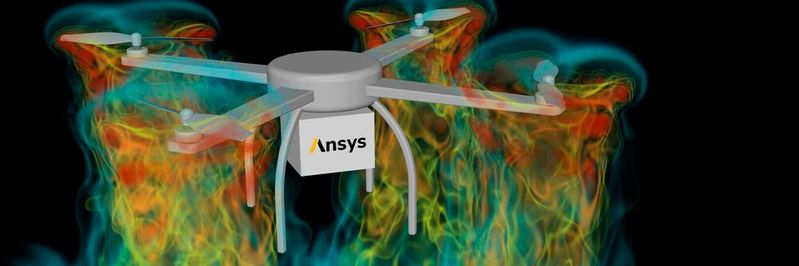
(Image: Ansys)
In engineering, CAE is the overarching term for all computer-based design, calculation, and simulation methods that significantly accelerate the development process of products or components. Since many processes in the industry would not function at all without technical support, CAE is just as relevant for companies of all sizes and industries as it is for research and education.
How does CAE work and where is it used?
Using CAE software, component geometries are created and then, for example, their mechanical, thermal, or structural load properties are simulated on a computer. Thus, even before a physical product exists in the form of a prototype, components can be designed on a computer in various versions and virtually tested for the desired properties in advance, in order to ultimately obtain an optimal solution. This saves time, material, and costs, because it may also eliminate the need for expensive equipment, for example for mechanical strength testing.
The main advantages of CAE therefore lie in
comparatively lower product development costs,
shorter development times and
an improved product quality and lifespan.
CAE software is therefore used in many technical fields; a small excerpt:
Mechanical engineering
Electrical engineering
Aerospace
Architecture and automotive industry
What sub-areas does CAE include?
CAE is multifaceted and has many sub-areas, including Finite Element Analysis (FEA) for investigating mechanical structures, Computational Fluid Dynamics (CFD) for analyzing flows and heat transfer, electronic simulations for electronic components and circuits, as well as many other specialized applications. The following areas are described:
FEM – Component strength and durability
CFD – Visualizing and simulating flow and thermal dynamics
CAD – CAE – CAM – From the model to automated manufacturing
CAM – Professional support for CNC manufacturing
CAPE – Computer-aided simulation of manufacturing
Electronic simulations – More safety and functionality
MKS – Multibody simulation for perfect interaction
DMU – Digital mock-up instead of costly real product testing
FEM (Finite Element Method) is a classic area of CAE, where the stress distribution in components under loads is determined. In this way, both the design and the use of appropriate materials are optimized before the creation of a prototype. FEM provides important insights regarding the sizing of components and entire assemblies. Thus, the strength of materials and components or products made from them can be simulated in advance and, if necessary, also corrected. This is particularly important, for example, in the automotive sector, because the deformation of components is significantly related to the safety of passengers in vehicles. Impact situations can be simulated here with FEM, providing important clues for the design of components on and in cars.
CFD – Visualizing and simulating flow and thermal dynamics
An exciting sub-area of CAE is CFD (Computational Fluid Dynamics), the numerical fluid mechanics. Mathematically complex calculations based on physical principles are solved here using CFD through numerical methods for the approximate solution of fluid mechanics problems involving gases and liquids.
Application areas can be found, for example, in aerodynamics in the automotive and aviation industries, where, for example, the flow behavior of air on specific components of the models generated on a computer is examined. Other areas of application for CFD include meteorology (e.g., the simulation, modeling, and investigation of weather phenomena) or fluid mechanics (e.g., investigation of the flow behavior of water or other liquid media in piping systems).
CAD – CAE – CAM – from the model to automated manufacturing
CAD stands for "Computer Aided Design". Whenever something needs to be designed in the industry, meaningful 2D or 3D models are first created and/or modified using CAD software. CAD thus encompasses all computer-based tasks related to design, construction, planning, and improvement of new products (e.g., devices, machines, vehicles, aircraft, furniture, clothing, tools, etc.). The design process therefore includes geometric modeling, as well as calculation and simulation, etc. Once a CAD draft is created, it can be dimensioned and optimized with CAE and then the product or component can be manufactured automatically using CAM.
CAM – Professional support for CNC manufacturing
CAM stands for "Computer Aided Manufacturing" and enables the autonomous execution of production processes. CAM software is used to create programs for a variety of CNC machines using NC codes (NC: Numeric Control) for the machine controls. This tells a machine through the NC code which workpiece is to be machined with which tools and in what form. Pure CAM applications mainly focus on creating tool paths for CNC machines. CAD/CAM applications additionally offer a high number of design possibilities.
Date: 08.12.2025
Naturally, we always handle your personal data responsibly. Any personal data we receive from you is processed in accordance with applicable data protection legislation. For detailed information please see our privacy policy.
Consent to the use of data for promotional purposes
I hereby consent to Vogel Communications Group GmbH & Co. KG, Max-Planck-Str. 7-9, 97082 Würzburg including any affiliated companies according to §§ 15 et seq. AktG (hereafter: Vogel Communications Group) using my e-mail address to send editorial newsletters. A list of all affiliated companies can be found here
Newsletter content may include all products and services of any companies mentioned above, including for example specialist journals and books, events and fairs as well as event-related products and services, print and digital media offers and services such as additional (editorial) newsletters, raffles, lead campaigns, market research both online and offline, specialist webportals and e-learning offers. In case my personal telephone number has also been collected, it may be used for offers of aforementioned products, for services of the companies mentioned above, and market research purposes.
Additionally, my consent also includes the processing of my email address and telephone number for data matching for marketing purposes with select advertising partners such as LinkedIn, Google, and Meta. For this, Vogel Communications Group may transmit said data in hashed form to the advertising partners who then use said data to determine whether I am also a member of the mentioned advertising partner portals. Vogel Communications Group uses this feature for the purposes of re-targeting (up-selling, cross-selling, and customer loyalty), generating so-called look-alike audiences for acquisition of new customers, and as basis for exclusion for on-going advertising campaigns. Further information can be found in section “data matching for marketing purposes”.
In case I access protected data on Internet portals of Vogel Communications Group including any affiliated companies according to §§ 15 et seq. AktG, I need to provide further data in order to register for the access to such content. In return for this free access to editorial content, my data may be used in accordance with this consent for the purposes stated here. This does not apply to data matching for marketing purposes.
Right of revocation
I understand that I can revoke my consent at will. My revocation does not change the lawfulness of data processing that was conducted based on my consent leading up to my revocation. One option to declare my revocation is to use the contact form found at https://contact.vogel.de. In case I no longer wish to receive certain newsletters, I have subscribed to, I can also click on the unsubscribe link included at the end of a newsletter. Further information regarding my right of revocation and the implementation of it as well as the consequences of my revocation can be found in the data protection declaration, section editorial newsletter.
CAPE – Computer-aided simulation of manufacturing
CAPE is the acronym for "Computer Aided Production Engineering". CAPE is a relatively new branch of engineering and is intended to help engineers improve and optimize production facilities and their operational processes. Ideally, with CAPE, manufacturing can be simulated in advance to eliminate potential weaknesses and sources of error beforehand and to base the production operations from the beginning on a solid foundation with high productivity.
Electronic simulations – More safety and functionality
In hardly any other area is CAE as closely linked to the topic of safety as in electronic simulations (circuit simulations). The reason is clear: Only electronic processes or circuits without sources of error or interference can function safely. Computer-aided simulations help to ensure a high level of safety before an electrical system goes into operation. The same applies to the functionality of mechanical systems and their components. Here too, electronic processes can be simulated in advance with CAE, allowing potential sources of error to be discovered and eliminated in time to avoid disruptions that could lead to failures and, potentially, high costs in real processes.
MKS – Multibody simulation for perfect interaction
In multibody simulation, real multibody systems (e.g., the chassis of a car) are represented by several rigid bodies whose mobility in relation to each other is restricted by idealized kinematic joints through numerical simulation. Multibody simulation allows the motion sequence of such systems to be calculated and analyzed to obtain important results or insights, e.g., about forces, velocities, and accelerations, and thus durability, safety, and efficiency. Weaknesses can be identified and eliminated, and the design can be optimized even before the realization of a physical prototype. In this way, the product development time (Time-to-Market) is shortened and development costs are reduced. Since multibody systems are widely used in many areas, MBS is an important component of CAE.
DMU – Digital mock-up instead of costly real product testing
DMU (Digital Mock-Up) is a digital, as realistic as possible, computer-aided trial model that can replace some of the often costly, real product testing. For instance, in mechanical engineering projects, it can be used to check whether a part made to customer order is technically feasible, or whether changes in the design are necessary. Studies on the installation and removal of parts are also included in the range of applications for the mock-up on a digital basis. Such virtual examinations or tests all share a common goal: to prevent error developments in manufacturing and thus prototypes that later cannot be used, right from the outset.
Quality assurance is indispensable in all operational processes to ensure efficient workflows. Within the CAE toolkit, there is a solution with CAQ (Computer Aided Quality Assurance) for this purpose.
CAQ accompanies the quality management of a company from planning through implementation to control with computer-aided digitization. This allows even the smallest defects to be detected and remedied at an early stage. This has a whole range of convincing advantages, e.g., higher manufacturing efficiency, sustainable cost savings, higher customer satisfaction, a decreasing complaint rate, and the avoidance of unnecessary downtime in operational processes.
What are the advantages of CAE?
CAE offers numerous advantages that extend to all areas of industry. The main advantages have already been mentioned: lower product development costs, shorter or accelerated development times, and improved product quality and lifespan. In addition, CAE offers some more crucial advantages in practice:
Efficiency: By incorporating simulation into the design process, workflows are streamlined. With CAE, teams spend less time on construction and more time on development and improvement.
Optimization: With CAE tools, the behavior of a product or component under load conditions in a specific operating environment can be simulated and thus validated. This also helps to avoid over-engineering, for example, by using other and possibly more expensive materials or components that have unnecessarily large wall thicknesses with respect to strength and stability.
Safety: Pre-simulation of components or products increases their safety and reliability.
Quality: Testing product properties using virtual models enables the production of high-quality final products.
Functionality testing on virtual models for prototypes with series capability.
Cost reducing: Physical processes such as flow and resistance can be simulated instead of costly tests in experimental facilities (e.g., wind and water tunnels).
Quality assurance: Comprehensive quality management for operational procedures and processes through verifiable figures and data.
Objectifiable results through computer measurements and unlimited divisibility through digitalization.
Always available: Results from simulations and studies that have already been conducted are available at any time and can be used for similar projects.
This article was created with the friendly support of Dipl.-Ing. Dietmar Arndt, – Company for computer-supported product development and process management mbH & Co. Service KG
Providers of CAE software and related software applications
Altair Engineering
Ansys
Autodesk
Bentley Systems
Createasoft
Dassault Systèmes
Maplesoft
Mathworks
Meshworks
Moldflow
Open Mind
PTC
Siemens
Simscale
This list is an excerpt without claim to completeness.



:quality(80)/p7i.vogel.de/wcms/53/f7/53f7dadbe4d656a3fd4f4077445f29f6/0129828707v1.jpeg "Thanks to its compact design and drilling/unscrewing function, the Fire Birdie is suitable for applications with limited installation space and frequent tool changes. (Image:Marcel Kraibühler)")
:quality(80)/p7i.vogel.de/wcms/da/4d/da4da8d34671dc6bce80e496212de877/0129850788v1.jpeg "Mate-XT Go supports the arms and shoulders during overhead work and repetitive tasks and is designed to significantly reduce muscle strain in everyday working life. (Image:Comau)")
:quality(80)/p7i.vogel.de/wcms/95/97/95976dbaac68b249eb65e74c5aad5300/0129651893v1.jpeg "The C2.0 centric clamps, the S2 fixed jaw clamps and the \"gredoc\" zero-point clamping systems are used for machining the raw parts. Fastening is carried out with width across flats 27. (Image:Gressel)")
:quality(80)/p7i.vogel.de/wcms/57/1b/571b8895efb299d70846bbdbd7af2338/0130043886v1.jpeg "Servo hydraulics independent of the control system: The servo hydraulics software module is integrated directly into the b Maxx 5500 servo drive (pictured: Mehmet Sari, Export Sales Manager at Hürsan Pres (left), Özgür Deniz Demirbaş, Country Manager at Baumüller Turkey) (Image:Baumüller)")
:quality(80)/p7i.vogel.de/wcms/3b/27/3b27f6c5848be73acecb04054bf0a146/0130115209v1.jpeg "Spectroscopic glucose measurement with infrared spectroscopy enables more regular measurements without physical strain. (Image:Endrich)")
:quality(80)/p7i.vogel.de/wcms/3f/cc/3fccb748b0fe16f1f61249d94c72f126/0130149439v1.jpeg "Requirements for integrated power supply systems: Precise AC and DC power supply systems that not only provide energy, but also reliably combine measurement, analysis and system integration. (Image:Schulz Electronic)")
:quality(80)/p7i.vogel.de/wcms/fd/93/fd93e01c16f5a4709278499d981a459c/0130061090v1.jpeg "Revealed: These servo drives are assembled at Aerotech in Fürth. (Image:Aerotech)")
:quality(80)/p7i.vogel.de/wcms/cb/8a/cb8ae7f5205365efce3e7285154fc3cf/0130132198v1.jpeg "Markus Huber (left) and Nicolai Friis from TU Wien know how to make quantum computers multidimensional in order to perform computing operations even better. (Image:TU Vienna / A. Rommel)")
:quality(80)/p7i.vogel.de/wcms/63/21/6321beb732bf7d92640df46d7aa77573/0130125122v1.jpeg "As part of the Carbon Lab Factory Lausitz, a pilot plant for the production of sustainable, cost-effective and competitive carbon fibers will be built at the Guben site. (Image:Fraunhofer IAP / Kristin Stein)")
:quality(80)/p7i.vogel.de/wcms/53/4f/534fe0f168f6ee070ded4a48faca4cef/business-wire-main-image-1103x620v1.jpeg "The new UR AI Trainer, developed by Universal Robots and Scale AI, is the first direct lab-to-factory solution for AI model training.
(Source: Universal Robots)")
:quality(80)/p7i.vogel.de/wcms/08/70/087062e2e1a9b9add5777410dd746ee9/adobestock-1923991605-5607x3156v1v1.jpeg "A new type of tactile sensor, inspired by human skin, even recognizes grains of sand. (Image:Curioso.Photography - stock.adobe.com)")
:quality(80)/p7i.vogel.de/wcms/7f/08/7f087d7013424d123ab7275cd2e3fe55/adobestock-809456218--c2-a9-20degimages-20-e2-80-93-20stock-adobe-com-ki-generiert-4179x2351v1v1.jpeg "The digital upgrading of existing machines conserves resources, saves energy and reduces the need for new production. (Image:Degimages - stock.adobe.com/AI-generated)")
:quality(80)/p7i.vogel.de/wcms/90/db/90db3087d3af0560fcdb4dbc42443ce1/0130157448v1.jpeg "The switch to SDV is the most complex transformation the industry has ever had to master. The end consumer gets a vehicle that gains rather than loses value over its lifetime. (Image:Sonatus)")
:quality(80)/p7i.vogel.de/wcms/73/f0/73f00bb99a23197db05bb584fe78f20f/0130080581v1.jpeg "The \"China Speed\" analysis by Roland Berger shows that the speed of development has only a limited connection with labor costs. (Image:freely licensed at Pexels)")
:quality(80)/p7i.vogel.de/wcms/2f/5b/2f5ba6a150b52c2b8efada560c5cdafe/0130143442v1.jpeg "Automotive suppliers are facing a severe crisis, which is primarily due to a combination of structural change and economic problems. (Image:freely licensed at Pexels)")
:quality(80)/p7i.vogel.de/wcms/22/d0/22d03cd48e992435338b59464c428d41/0129739814v1.jpeg "More electric vehicles on the roads mean a higher demand for electricity - which should ideally be covered by renewable energies. (Image:BMW)")
:quality(80)/p7i.vogel.de/wcms/94/7a/947ac066b98cbcd3470e83ff9da3e25f/0130096114v1.jpeg "The use of amorphous steels in the stator enables a significant reduction in losses and increases the efficiency of modern electric motors in vehicle drives. (Image:Horse Powertrain)")
:quality(80)/p7i.vogel.de/wcms/e5/f1/e5f171d3d7ae021332cc0aeae4d6e299/0130127049v1.jpeg "In collaboration with Shanghai Jiao Tong University, Lenovo has presented a silicon anode battery under the name \"ED1000\" as a proof of concept for mobile workstations. (Image:Lenovo)")
:quality(80)/p7i.vogel.de/wcms/fa/69/fa696e59706b96fff02283dd74cc2398/0130129635v1.jpeg "Samsung Co-CEO Jun Young-hyun wants to respond to the AI-driven boom in demand in the memory market with contracts for up to five years. This should provide more planning security in the traditionally volatile storage business. At the same time, however, this is likely to increase the pressure on customers to secure precise long-term requirements, prices and supply chains. (Image:Samsung)")
:quality(80)/p7i.vogel.de/wcms/31/a8/31a883a47b86634c382923e78fd9a4c9/0130133225v1.jpeg "Figure 1: GMSL-capable point-to-point connection. (Image:ADI)")
:fill(fff,0)/images.vogel.de/vogelonline/companyimg/76800/76895/65.jpg "FAULHABER_120mm.jpg ()")
:fill(fff,0)/p7i.vogel.de/companies/67/eb/67eba621ef6ea/logo2.png "logo2 (Wuxi InfiMotion)")
:quality(80)/p7i.vogel.de/wcms/46/8c/468c1c55c7907349df5ecd46cf29560d/0127654075v1.jpeg "CAD is no longer just a tool for creating geometries. The systems use AI and independently deliver results. (Image: ©Gorodenkoff - stock.adobe.com)")
:quality(80)/p7i.vogel.de/wcms/b5/74/b57433bf5017d155b7f19f4905a73449/0127384204v1.jpeg "A deep understanding and careful definition of the challenges are essential for the development of reliable and efficient electric drives. This requires the use of advanced simulation and optimization techniques. (Image: ©k_viktar - stock.adobe.com / AI-generated)")