Investments, (partial) sales, or complete takeoverExploring the Rumors Behind Intel’s Potential Sale
From
Sebastian Gerstl | Übersetzt von KI
13 min Reading Time
Since August, there has been speculation surrounding Intel potentially divesting parts of its business, even hinting at complete takeovers by competitors or politically motivated mergers. However, how realistic are these rumors? While Intel has faced intensified competition in recent years, especially in its core semiconductor sector, whether a complete takeover or merger is feasible depends on regulatory challenges, market positioning, and Intel's ongoing transformation efforts. Here’s an analysis of the factors in play.
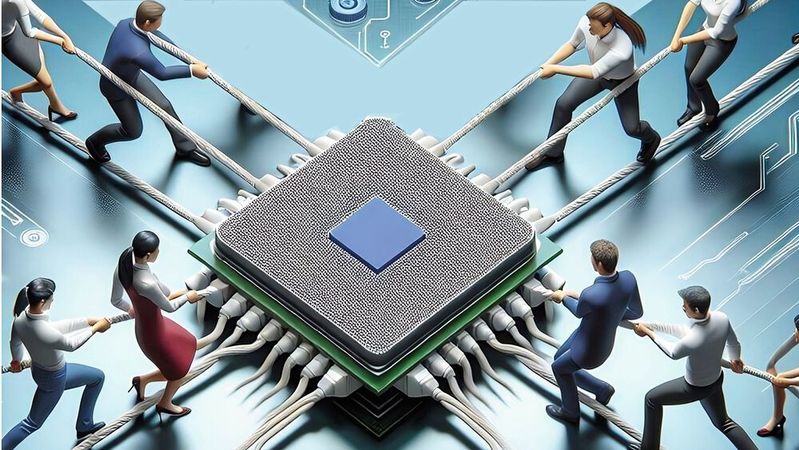
Tug of war: According to the rumor mill, investors and competitors have been vying for Intel for months. But how seriously should these reports be taken?
(Image: AI-generated / Microsoft Copilot)
$16.6 billion loss! This is the amount Intel had to report on November 1st in its third quarter 2024 report. It is the largest loss in the company's history and adds to the negative headlines that the struggling chip giant produced this year. In August of this year, it became known that Intel wants to cut up to 15,000 jobs by the end of the year–and agencies reported the first rumors that Intel is considering divesting at least parts of its business units. All, of course, citing "internal sources" who "prefer not to be named".
Since then, interested parties have practically been lining up. Corporations are considering billion-dollar investment packages. Market rivals have signaled interest in significant business sectors of the once world-leading semiconductor company. The preliminary highlight was marked by a report from the American news website Semafor: According to this, there were debates in government circles about whether a politically supported merger of Intel with a market rival like AMD or Marvell would be desirable!
That Intel is looking for ways to rebalance its troubled finances is beyond question. But what is really behind the numerous rumors? We have summarized and categorized the stories that have circulated in the media landscape on this topic in the three months between early August and early November (as of 6.11.).
Is Qualcomm aiming for a complete acquisition?
One of the first companies to signal interest is also one of the market's largest heavyweights: Qualcomm, one of the leading chip providers without its own production facilities, expressed interest as early as the beginning of September 2024 in a possible acquisition of Intel's semiconductor design business. Less than 14 days later, the renowned Wall Street Journal dropped a bombshell on September 21: Qualcomm had already made an inquiry to Intel for a complete takeover of the chip manufacturer — including the entire product division and the foundry business!
Is it likely? Possible, but the prospects for success are rather low. For Qualcomm, the offer is certainly very attractive, as the fabless provider could acquire five existing semiconductor fabs with advanced manufacturing technologies at a stroke: three in the USA, one in Leixlip, Ireland, and another in Israel. Additionally, there could potentially be two more locations, one in Ohio , USA, and another in Germany — although these plans would likely be put on hold in the event of an acquisition to keep costs lower.
One of the first companies to signal interest is also one of the market's largest heavyweights: Qualcomm, one of the leading chip providers without its own production facilities, expressed interest as early as the beginning of September 2024 in a possible acquisition of Intel's semiconductor design business. Less than 14 days later, the renowned Wall Street Journal dropped a bombshell on September 21: Qualcomm had already made an inquiry to Intel for a complete takeover of the chip manufacturer–including the entire product division and the foundry business!
Moreover, Qualcomm has long been striving to finally gain a foothold in the notebook and server markets. The recent advances with ARM-based processors were promising, but have so far failed to capture any significant market share. With the Intel portfolio, particularly the processor division, they would be purchasing an already well-established market dominance.
In addition, Qualcomm can negotiate from a strong position: According to recent stock market reports, Qualcomm's market value (196.06 billion USD) is more than twice that of Intel (96.98 billion USD; as of November 5, 2024).
However, it is questionable whether global antitrust regulators would go along with such an acquisition. Qualcomm has already had bad experiences with antitrust authorities: in 2018, the $40 billion attempt to acquire the Dutch chip manufacturer NXP failed due to the resistance of market regulators. In the same year, the company faced several fines from antitrust authorities in the EU, Taiwan, and South Korea. On October 16, 2024, Bloomberg reported that Qualcomm had informally inquired with Chinese market regulators about their stance on an acquisition. However, the Chinese authorities want to wait for an assessment until Qualcomm actually makes an offer.
According to Bloomberg, Qualcomm has decided to wait until the inauguration of the next U.S. President in January 2025. Only then will they make a final decision for or against an offer. The political composition of the next U.S. government could certainly change the outlook somewhat. However, an acquisition of Intel by Qualcomm is generally unlikely — not without Intel and Qualcomm being forced to sell or spin off significant parts of their business to others. This could turn into a Pyrrhic victory for Qualcomm.
Date: 08.12.2025
Naturally, we always handle your personal data responsibly. Any personal data we receive from you is processed in accordance with applicable data protection legislation. For detailed information please see our privacy policy.
Consent to the use of data for promotional purposes
I hereby consent to Vogel Communications Group GmbH & Co. KG, Max-Planck-Str. 7-9, 97082 Würzburg including any affiliated companies according to §§ 15 et seq. AktG (hereafter: Vogel Communications Group) using my e-mail address to send editorial newsletters. A list of all affiliated companies can be found here
Newsletter content may include all products and services of any companies mentioned above, including for example specialist journals and books, events and fairs as well as event-related products and services, print and digital media offers and services such as additional (editorial) newsletters, raffles, lead campaigns, market research both online and offline, specialist webportals and e-learning offers. In case my personal telephone number has also been collected, it may be used for offers of aforementioned products, for services of the companies mentioned above, and market research purposes.
Additionally, my consent also includes the processing of my email address and telephone number for data matching for marketing purposes with select advertising partners such as LinkedIn, Google, and Meta. For this, Vogel Communications Group may transmit said data in hashed form to the advertising partners who then use said data to determine whether I am also a member of the mentioned advertising partner portals. Vogel Communications Group uses this feature for the purposes of re-targeting (up-selling, cross-selling, and customer loyalty), generating so-called look-alike audiences for acquisition of new customers, and as basis for exclusion for on-going advertising campaigns. Further information can be found in section “data matching for marketing purposes”.
In case I access protected data on Internet portals of Vogel Communications Group including any affiliated companies according to §§ 15 et seq. AktG, I need to provide further data in order to register for the access to such content. In return for this free access to editorial content, my data may be used in accordance with this consent for the purposes stated here. This does not apply to data matching for marketing purposes.
Right of revocation
I understand that I can revoke my consent at will. My revocation does not change the lawfulness of data processing that was conducted based on my consent leading up to my revocation. One option to declare my revocation is to use the contact form found at https://contact.vogel.de. In case I no longer wish to receive certain newsletters, I have subscribed to, I can also click on the unsubscribe link included at the end of a newsletter. Further information regarding my right of revocation and the implementation of it as well as the consequences of my revocation can be found in the data protection declaration, section editorial newsletter.
Is Softbank's subsidiary ARM acquiring the processor business?
The next interested party that wanted to acquire at least part of Intel's business was ARM. On September 27, Bloomberg reported that the processor IP provider had made an offer for the acquisition of the product division, one of Intel's two main business branches. Interestingly, Intel had just divested its own shares in ARM earlier this summer. The offer may have been driven by the Japanese Softbank Group, which is the majority shareholder of ARM. Like Qualcomm, Softbank is interested in strengthening the creator of the eponymous processor architecture in business areas other than those still heavily driven by the smartphone and tablet market, such as servers or the desktop market.
Is it likely? Highly unlikely. The name Intel is closely associated with its products, especially the x86 and server CPUs. Selling this business branch would jeopardize the company's long-term recovery plans. Giving up the key products that many people associate with Intel would be like selling the company's identity. Accordingly, Bloomberg soon followed up with a report that Intel had already outright rejected this offer. Another attempt by ARM or Softbank is very unlikely.
Is a private equity firm investing in Intel?
A large part of the losses that Intel had to report is related to the absence of the hoped-for subsidies. More than $8 billion was expected from the US CHIPS Act fund for the expansion of fabs in Arizona, and €10 billion was also anticipated for the planned construction of the foundry facility in Magdeburg, Germany. However, as Intel's expansion plans have not progressed, these funds have been withheld; if they had been disbursed, they could have offset the loss.
However, Intel has high hopes for the expansion of its modern facilities, especially in the field of third-party contract manufacturing, where it sees great opportunities. It stands to reason that Intel is more likely seeking partners to support these plans without having to divest parts of the business.
One of these potential partners is the investment firm Apollo Global Management. The asset manager acquired a 49% stake in Intel's Fab 24 in Leixlip, Ireland, as early as June of this year. $11 billion had already been transferred in this agreement. At the end of September, various news agencies reported that Apollo and Intel were back at the negotiating table. Accordingly, there was consideration that Apollo could invest another $5 billion in Intel's ventures.
Is this likely? Quite likely, although it is associated with risks. With a financial injection from a private equity firm, Intel primarily buys time. The money can be used to advance the expansion of the planned facilities, even if subsidies are lacking.
However, the involvement of an investment firm is always a double-edged sword. They are primarily interested in ensuring their investments pay off. This puts Intel under additional pressure to return to profitability as quickly as possible. If this does not succeed, Apollo could force the company to sell off business segments and subsidiaries nonetheless. The long, painful investor dispute at Toshiba might serve as an example for this.
On the other hand, such pressure from investors could also prove to be a blessing and lead Intel to thoroughly rethink its strategy in its own acquisitions. After all, the multi-billion dollar acquisitions of companies like Altera, Movidius, or Habana Labs failed to show any serious long-term success in any of the mentioned cases.
Is an alliance with Samsung imminent?
In mid-October, the Asian trade journal Digitimes reported that Pat Gelsinger was rumored to have initiated talks with Samsung. Smartphone and tablet blogs then speculated that the South Korean electronics giant might also be interested in the portfolio of the American semiconductor leader.
Analysts from the semiconductor industry, on the other hand, assume that this conversation is primarily about the foundry business. Samsung Foundry is considered the world's second-largest contract manufacturer of semiconductor products after TSMC — an area in which Intel has also been trying to establish itself for several years. However, Intel is still struggling to attract major customers for this business. The business segment has so far fallen significantly short of investors' expectations.
Is it likely? It would be far-fetched to assume that Samsung could be seriously interested in Intel's product portfolio for its smartphone business. Samsung's processes in this area are well established, the company already has extensive vertical integration, and its in-house structural processes in the foundry business are among the most technologically advanced in the market.
A much more likely scenario, however, is that Intel could be seeking an alliance with Samsung in contract manufacturing. Since Samsung is also facing difficulties in the foundry business, the investments in fab expansion over the past few years have not yet paid off, with some production lines reportedly running at less than 50% capacity. A partnership here would make a lot of sense to mutually support each other, work more efficiently, and catch up with TSMC. The possibility that Intel and Samsung could form a joint venture for the foundry sector does not seem entirely out of thin air either.
Is Apple reaching for foundries and products from Intel?
Almost in the same breath as Samsung, smartphone and tablet blogs also brought Apple into play as a possible candidate. The tech company is increasingly interested in vertical integration. Since the end of 2020, the company has been installing in-house developed SoCs in its iPhones, iPads, and Macbook computers based on ARM processor IP. These chips are currently manufactured by TSMC. Wireless chips are also to be produced in-house in the future. Here, Intel's existing portfolio could be of interest.
Is it likely? These rumors are based on the false assumption that Samsung might also be interested in Intel's product portfolio. However, an acquisition of Intel does not fit into Apple's strategy in recent years. The introduction of the quite efficient M processor family was a deliberate shift away from x86-based processors and a focus on ARM; a return to CISC-based SoCs in Macbooks and iMacs would reverse much of this effort. Moreover, Apple has long-term agreements with TSMC for the production of its own chips and only at the end of last year started a packaging facility with Amkor in Arizona.
Can a sale of Altera repair Intel's budget?
With the spin-off of the Intel Programmable Solutions Group and the rebirth of the FPGA company Altera, market observers first speculated that Intel might at least partially divest the subsidiary acquired in 2015. These speculations gained additional momentum with the release of the poor quarterly figures in August. Nevertheless, it remained surprisingly quiet around the FPGA specialist for a long time.
Since the beginning of November, however, the story has gained significant momentum. On November 4, the news agency Reuters reported that a number of potential suitors had already been found who were interested in acquiring at least a minority stake in Altera. Three specific names have already been mentioned: Bain Capital, who led the entry of a multinational investor group in the Toshiba spin-off Kioxia; Silver Lake, which holds significant stakes in Germany's Software AG, among others; and Francisco Partners, a private equity group focused on technology companies. According to Reuters, other companies and groups were also preparing concrete bids.
Is it likely? It is now almost certain that Intel will at least partially divest Altera. The attempted integration of the FPGA manufacturer into the company had been unsuccessful in recent years, unlike the case with the competitor AMD/Xilinx. The spin-off under the name Altera was also done to restore new confidence among FPGA customers in the portfolio of the programmable logic specialist. The partial sale of an already spun-off subsidiary is guaranteed to bring significant billions into the coffers.
It is questionable, however, whether the ambitious goals can also be achieved. According to Reuters, Intel wants to recoup the old purchase price of 2015 through a partial sale to investors, without losing its majority stake in Altera. Certainly, this would be attractive: the purchase of Altera cost Intel $16.7 billion in 2015. This corresponds almost exactly to the amount reported as a loss in the third quarter of 2024. On paper, this would certainly be an elegant solution. FPGAs are also in greater demand than ever before, especially concerning current developments in artificial intelligence or more efficient embedded systems.
But Intel acquired Altera in 2015 at the company's previous peak. What followed were nine years of sluggish integration that hardly yielded any notable technical advancements in the existing FPGA portfolio. Altera remains a significant player in the market but still needs to prove itself anew. Therefore, it is very unlikely that Intel will be able to fill its financial gap through a partial sale without also giving up majority control over Altera.
Could a politically motivated merger with AMD or Marvell be imminent?
Which brings us to the provisional climax of the rumor mill. It is not surprising that the issue of Intel is being discussed in American politics: the company was a technological pioneer in the chip industry for decades, an indispensable global presence in the electronics sector — and thus a beacon and mainstay of the U.S. economy. If such an important flagship company falters or falls under the control of a company outside the USA, it could have disastrous ripple effects for other companies as well.
The report from the news website Semafor therefore attracted worldwide attention: In an exclusive report citing insider circles, it was stated that policymakers in Washington were already quietly discussing scenarios on how to provide further support to the struggling chip giant. These are supposed to go beyond the already promised subsidies from the CHIPS Act, without actually increasing the investment amount. A bailout like during the 2008 banking crisis is currently not an option.
Almost as a side note, the scenario of a potential merger was mentioned, which was subsequently picked up by numerous other news media. According to this, the discussions — at least temporarily — also included the option of merging Intel's chip design business with a competitor like AMD or Marvell: a private sector-led merger that could potentially be supported by the government.
Is it likely? The idea that a merger of the chip design business units of AMD and Intel could be forthcoming is almost absurd! Even if such a move were supported by the U.S. government—regardless of who will hold the presidency in January 2025—the antitrust authorities in the rest of the world would not go along with it. After all, this would create a clear monopoly among x86 manufacturers. Antitrust regulators would either have to determine that there is no imbalance in sectors like servers, notebooks, or PCs due to competition from ARM-based products, or they would have to insist that Intel and AMD completely spin off this business unit for such a merger, thereby creating a new company.
For the first scenario, however, the ARM competition in the mentioned fields is still too weak, despite increasing progress in recent years. Neither Intel nor AMD would have a serious interest in the latter option, as it would significantly weaken the existing business field of both companies.
A merger with Marvell Technology seems equally unlikely. Although it is also a flagship company in the American chip industry, and certain synergies between its peripheral semiconductor portfolio and Intel's core business with processors, as well as modem chips, are at least conceivable, it is highly questionable whether Marvell would have a serious interest in such a merger, as the company is also in a significantly weaker position. After all, Marvell's annual revenue is still only about one-tenth of Intel's revenue, despite the disastrous quarterly figures.
Summary
In summary, it can be said that it is most likely that Intel will do everything possible to bring investors on board. Certainly, it wouldn't hurt the company to shed less profitable divisions—a slimming down would probably do the chip giant some good. A partial sale of Altera seems assured. The involvement of investment firms is also likely to be more in Intel's interest, despite the associated medium-term risks. An alliance or joint venture with Samsung in the foundry business could possibly offer advantages for both companies.
If these efforts fail, a partial sale or even an acquisition could be threatened. This seems unlikely given Intel's still high business value, but it is not entirely out of the question—consider Broadcom's 2018 attempt to acquire Qualcomm for more than $100 billion, which ultimately failed due to a U.S. presidential veto. Such a veto would likely be absent if the takeover offer also came from an American company—as would be the case with Qualcomm. In this case, it would ultimately depend on the assessments of the global antitrust authorities.
That Softbank via ARM would attempt another move seems unlikely. In the current political climate, even with a change at the top, the U.S. government would likely be unwilling to allow a non-American company to gain control over significant parts of Intel. The idea that Apple might show interest is also unlikely, given the course the company has pursued in recent years. A politically motivated merger with AMD need not be seriously discussed. (sg)



:quality(80)/p7i.vogel.de/wcms/dd/08/dd086510d9ae7b50181f6070e4463b44/0129363730v1.jpeg "Typical application for ionizing devices: Wrapping films. (Picture: ©Adobe Stock/SMC)")
:quality(80)/p7i.vogel.de/wcms/35/57/3557c819943c53acec41a0ccba87da4f/0130049064v1.jpeg "Researchers at the Fraunhofer IWU in Chemnitz have long known that many typical sheet metal parts can be manufactured more cost-effectively using hollow embossing rollers. Now there is news to report ... (Image:Fraunhofer IWU)")
:quality(80)/p7i.vogel.de/wcms/59/02/590246e3b3f415c65edbee377c14ca77/26-06-pi-fraunhofer-iws-41450-direktplattieren-pic-01-7771x4369v1v1.jpeg "The Fraunhofer IWS has developed the new \"direct laser cladding\" process, which creates a functional layer directly on the base body by applying a strip-shaped metal to rotationally symmetrical components in a spiral and bonding it locally by laser. (Image:Christoph Wilsnack/Fraunhofer IWS)")
:quality(80)/p7i.vogel.de/wcms/73/60/73608418789b1d9c393f5e2fa974eda2/0130209906v1.jpeg "The robots of the X6 generation from b+m enable very high painting quality and are also particularly compact and easy to maintain. (Image:Beckhoff)")
:quality(80)/p7i.vogel.de/wcms/78/e9/78e9188c25a8a94e67c34c9bf8ffe495/visual-agile-20robots-20and-20google-20deepmind-20partner-20to-20bring-20intelligence-20to-20robotics-2500x1406v1v1.jpeg "Together, the partners are developing adaptable, intelligent robots for a wide range of applications (Image:Agile Robots SE)")
:quality(80)/p7i.vogel.de/wcms/e7/66/e7669ecf0260ae8fc54c214e34e4902a/0130316817v1.jpeg "Siemens and Palo Alto Networks offer tested cybersecurity solution for industrial 5G. (Image:Siemens)")
:quality(80)/p7i.vogel.de/wcms/9f/55/9f55324832c4f426958031375124d9de/siemens-20ubtech-20hmnd-1920x1079v1v1.png "Ready for the factory floor: While Ubtech is planning mass production, Siemens is already testing humanoids in real factory applications in Erlangen. (Image:Siemens)")
:quality(80)/p7i.vogel.de/wcms/11/36/113695ed260e29c8c2d9d39dc5f9d869/0130213768v1.jpeg "AI can work cheaply in China and deliver the results rapidly all over the world. (Image:Dall-E / AI-generated)")
:quality(80)/p7i.vogel.de/wcms/62/5f/625f41e87ebfef156a98c8e6393e32fd/0130211654v1.jpeg "Axial flux motors have some advantages over radial flux motor—but their production is currently still expensive. (Image:RWTH Aachen University)")
:quality(80)/p7i.vogel.de/wcms/77/9b/779b0685d010dfe45c9c2cb1cfecd467/0128886425v1.jpeg "The BlueEye is the first \"real\" hyperspectral camera for the UV range and covers the wavelength range from 220 to 380nm. (Image:Inno-spec GmbH)")
:quality(80)/p7i.vogel.de/wcms/e4/51/e451d52ce0182fb0aaa46a5774f832ef/26-04-pi-fraunhofer-iws-21160-bioslide-pic-01-4128x2321v1v1.jpeg "With the BioSlide research project, the Fraunhofer IWS is investigating how sliding systems can be designed to be more sustainable and energy-efficient. New materials can be tested in a particularly application-oriented manner on this plain bearing test stand. (Image:Fraunhofer IWS)")
![Thanks to advanced 3D printing technology, a more efficient use of resources should contribute to lower-emission aviation—this is the goal of ['skai]-lab. (Image:Oleksandr Pashchenko - stock.adobe.com / AI-generated)](https://cdn1.vogel.de/nghHNSbySccfOjG3n1qCA-FVOjQ=/288x162/smart/filters:format(jpg):quality(80)/p7i.vogel.de/wcms/62/64/626424c97a16e69f871bf216c9629c2a/adobestock-1927043193--c2-a9-20oleksandr-20pashchenko-20-e2-80-93-20stock-adobe-com-ki-generiertv1v1.jpeg "Thanks to advanced 3D printing technology, a more efficient use of resources should contribute to lower-emission aviation—this is the goal of ['skai]-lab. (Image:Oleksandr Pashchenko - stock.adobe.com / AI-generated)")
:quality(80)/p7i.vogel.de/wcms/c3/c4/c3c4ce270b083eeac55654148611f064/0130237945v1.jpeg "China is not giving up on hydrogen, but is intensifying its efforts. (Image:freely licensed from Pixabay)")
:quality(80)/p7i.vogel.de/wcms/4e/c0/4ec0bd19390b169edfa23677373dcdf1/0130260089v1.jpeg "Renewable fuels can supply European road traffic, according to a study. (Image:Aral)")
:quality(80)/p7i.vogel.de/wcms/6f/c9/6fc9050301d745cad25585c6780f8f51/0130197341v1.jpeg "Production facilities are a worthwhile target and are therefore at risk. (Image:ABB Robotics)")
:quality(80)/p7i.vogel.de/wcms/b6/62/b662adc2cec8227d8172509bbfb6ee42/25c0207-107-4961x2789v1v1.jpeg "The GLB is the second model based on Mercedes' new MMA platform. Apparently, Geely's platform is better and cheaper, which is why the two companies are negotiating a partnership. (Image:Mercedes-Benz)")
:quality(80)/p7i.vogel.de/wcms/4d/dd/4dddf438e91f394c04a095dbfd109d1c/0130236430v1.jpeg "Measurement modules: The 720301 module in combination with the SL2000 enables RMS and power calculations, among other things. (Image:Yokogawa)")
:quality(80)/p7i.vogel.de/wcms/61/fc/61fcf95f5cca15494ad18343901ae585/0130317237v1.jpeg "With the AGI CPU, Arm says it is taking a \"historic step\": With the processor aimed at AI in data centers, the company is presenting itself for the first time as a provider of its own chips, not just as a pure IP licensor. (Image:Arm)")
:quality(80)/p7i.vogel.de/wcms/82/90/8290dfe3595b6c6b33726ae8b76172c7/0130319587v1.jpeg "The concept image illustrates how the pattern of tiny protrusions and depressions created on the substrate (MgO, bottom) controls the arrangement of atoms in the superconducting material (YBCO, top). At the interface between the two layers, an electronic structure enables superconductivity to occur at higher temperatures than previously possible. (Image:Chalmers University of Technology / Riccardo Arpaia)")
:quality(80)/p7i.vogel.de/wcms/a7/b6/a7b627f8a3f25db18c302753699dbebf/0124202292v1.jpeg "A new start: After several months of negotiations, the Silver Lake investor group acquires 51% of the shares in FPGA manufacturer Altera from Intel. After 9 years as part of the Intel family, the FPGA veteran is once again operating as an independent company. (Image:Altera)")
:quality(80)/p7i.vogel.de/wcms/b4/a8/b4a82a0f554fd526f6deff1561aa5847/0128153246v1.jpeg "Samsung began chip production in summer 2022 using 3-nm process technology with GAA architecture. (Image:Samsung)")