Robots are integral components in the automation of many industrial sectors and work around the clock. What exactly defines an industrial robot? How can they be categorized, and what are the differences between the various designs?
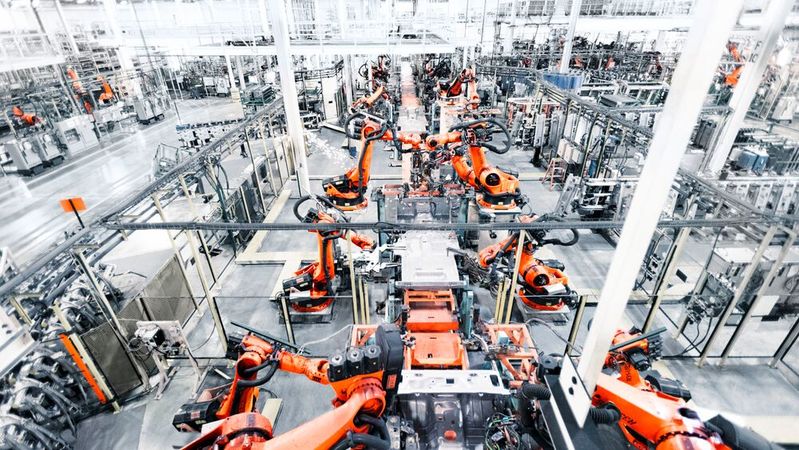
Typical application area: Industrial robots are used in numerous different production steps in the automotive industry.
(Image: KUKA Group)
An industrial robot (also known as an industrial manipulator) is a universal, programmable machine for handling, assembling, and processing components and workpieces. Such robots were specifically developed for industrial use and are part of the mechanical engineering discipline of automation technology, where the term handling systems is also commonly used.
Where Does the Term Robot Come from And Since When Have Industrial Robots Existed?
The term robot originally comes from science fiction stories. It first appeared in 1921 in a play by Czech writer Karel Čapek titled "R.U.R. (Rossum's Universal Robots)." In the play, the writer describes machines that resemble humans and are forced to perform drudgery or slave labor. The machines are called robots, derived from the Slavic word "robota," which means "work" in Polish or "serf labor" in Czech.
The first robot was invented in 1954 by George Devol, who filed a patent in the U.S. for a programmable manipulator (robot arm) and, together with engineer, entrepreneur, and physicist Joseph Engelberger, founded the first robotics company named Unimation two years later. The first robots, called "Unimate" by Devol, were used in 1962 at General Motors for removing and separating injection-molded parts.
What Components Do Industrial Robots Consist of?
In general, industrial robots consist of a manipulator, the robot arm, with an end effector (grippers, tools, etc.) as well as a controller that allows movement sequences to be programmed and controlled. Robots are often additionally equipped with sensors, such as cameras for so-called bin-picking. Additional peripherals, such as feeders or safety fences, are included to protect people from potential hazards and thereby distinguish industrial robots, among other things, from cobots, which are collaborative robots designed to work more closely with humans.
How Do Industrial And Service Robots Differ?
Industrial robots handle and manufacture parts or workpieces in production and are therefore an integral part of the automation of manufacturing processes.
Service robots are not directly integrated into industrial production and manufacturing processes, but rather perform simple tasks and services for employees in companies. They are therefore used in a somewhat supportive manner in certain areas of activity.
Into Which Categories Are Industrial Robots Classified?
Industrial robots come in very different configurations, with a basic module typically being adapted to specific tasks using application-specific end effectors and sensors.
Industrial robots are fundamentally distinguished based on their respective kinematics. They have either a serial or parallel kinematics:
Robots with serial kinematics consist of several connected articulated arms. The robot axes are thus arranged serially.
The axes of robots with parallel kinematics act directly on the platform to be moved, which can, for example, accommodate a tool. All drive axes must be moved simultaneously, i.e., parallel to each other.
Robots With Serial Kinematics
The range of robots with serial kinematics is extensive, as this design offers particularly high mobility and flexibility among all robot types. Accordingly, the variety of solutions is wide, and a distinction can generally be made between articulated arm robots and gantry robots.
—Articulated Arm Robots
Articulated robots are also known as jointed-arm robots. These are three-dimensionally movable industrial robots whose joints can move similarly to human arms and are therefore suitable for tasks requiring precise movement sequences, such as welding, assembly, painting, and various pick-and-place tasks. Among articulated robots, there are different designs:
5- and 6-axis articulated-arm robots have a single-arm serial arrangement of rotating parts. Unlike 6-axis articulated-arm robots, 5-axis articulated-arm robots lack a fourth axis, preventing rotation of the upper arm. The 6-axis articulated-arm robot is one of the most well-known designs and is widely used in industry. 7-axis articulated-arm robots offer even greater freedom of movement with an additional axis between the second and third axes, allowing them to reach around corners.
Dual-arm robots even have 15 axes and therefore usually have an additional rotation axis in addition to two 7-axis arms. Such robots make it possible to automate tasks without having to first adapt the respective processes to the kinematics. The individual process steps can thus be arranged around the robot as they already existed before automation.
SCARA robots (Selective Compliance Assembly Robot Arms) are horizontal articulated robots with an articulated arm that can only pivot horizontally. SCARA robots typically have four axes and four degrees of freedom. The robot stands on a fixed robot base, around which the first joint of the horizontal pivot arm, consisting of two parts, rotates. The links of the pivot arm are connected to each other via the second vertical axis of rotation. At the end of the second arm is the rotatable Z-axis, to which an end effector can be mounted. SCARA robots can be used very universally for a wide variety of fast pick-and-place applications or assembly and joining tasks with high repeatability.
Palletizing robots typically have four rotation axes and, with the help of a variety of grippers, handle palletized goods, such as Euro pallets or workpiece carriers. Palletizing robots are typically required where large quantities of parts need to be handled with a high degree of flexibility. Preferred areas of application include packaging, logistics, and shipping.
—Gantry Robots
In addition to the various designs of articulated arm robots mentioned above, gantry robots form a separate group among solutions with serial kinematics. They have at least three translational axes, and a distinction is made between:
Robots with linear gantry systems are among the simplest solutions, with the robot gripper's target areas located on a single axis. Horizontal movement along the robot's main axis is achieved via a gantry carriage. The gantry arm handles vertical movement.
Robots with a cantilever gantry have an additional movement axis that runs orthogonally to the gantry longitudinal axis.
Area-covering gantry robots are used when large distances need to be covered vertically or horizontally. The so-called H-loader has two robot arms with a robot gripper on one axis. The robot arms are arranged parallel and fixed. Such gantry robots are suitable, for example, for handling and transporting long shafts.
Gantry robots are often found in CNC manufacturing, for example, to supply machines from above with workpieces or tools for processing. The tools are often located in a so-called gantry tool storage, which is mounted on a hall wall above the production area.
Robots With Parallel Kinematics
Robots with parallel kinematics include delta robots and hexapod robots.
—Delta Robots
Delta robots are parallel-arm robots with a linkage kinematic structure, where the axes of the spider-like machine form a closed kinematic chain in interaction. The base or body of the robot is mounted above the parts to be handled. From there, at least three arms extend downward, resembling the Greek letter Delta. The lower parts of the articulated arms are designed as parallelograms and thus consist of two rods each, with ball joints at the ends. Delta robots are also available in designs with four, six, or seven articulated arms.
Compared to articulated robots, delta robots have high rigidity with low intrinsic mass, as the motors are located in the base or body rather than in the joints. Therefore, delta robots are ideal for extremely fast and highly precise pick-and-place applications and are frequently used in the packaging industry as well as in the medical and pharmaceutical industries.
—Hexapod Robots
The term hexapod comes from Greek and means "six-legged." Therefore, a hexapod robot has a total of six linear axes and, due to its parallel kinematics, offers high mobility and positioning accuracy. Hexapod robots are used, for example, for machining complex workpieces (e.g., 5-axis machining) in the metalworking industry. Additionally, they are often found in motion simulations. One example is flight simulators, which allow all conceivable flight scenarios to be simulated in a completely safe yet highly realistic manner during pilot training.
Date: 08.12.2025
Naturally, we always handle your personal data responsibly. Any personal data we receive from you is processed in accordance with applicable data protection legislation. For detailed information please see our privacy policy.
Consent to the use of data for promotional purposes
I hereby consent to Vogel Communications Group GmbH & Co. KG, Max-Planck-Str. 7-9, 97082 Würzburg including any affiliated companies according to §§ 15 et seq. AktG (hereafter: Vogel Communications Group) using my e-mail address to send editorial newsletters. A list of all affiliated companies can be found here
Newsletter content may include all products and services of any companies mentioned above, including for example specialist journals and books, events and fairs as well as event-related products and services, print and digital media offers and services such as additional (editorial) newsletters, raffles, lead campaigns, market research both online and offline, specialist webportals and e-learning offers. In case my personal telephone number has also been collected, it may be used for offers of aforementioned products, for services of the companies mentioned above, and market research purposes.
Additionally, my consent also includes the processing of my email address and telephone number for data matching for marketing purposes with select advertising partners such as LinkedIn, Google, and Meta. For this, Vogel Communications Group may transmit said data in hashed form to the advertising partners who then use said data to determine whether I am also a member of the mentioned advertising partner portals. Vogel Communications Group uses this feature for the purposes of re-targeting (up-selling, cross-selling, and customer loyalty), generating so-called look-alike audiences for acquisition of new customers, and as basis for exclusion for on-going advertising campaigns. Further information can be found in section “data matching for marketing purposes”.
In case I access protected data on Internet portals of Vogel Communications Group including any affiliated companies according to §§ 15 et seq. AktG, I need to provide further data in order to register for the access to such content. In return for this free access to editorial content, my data may be used in accordance with this consent for the purposes stated here. This does not apply to data matching for marketing purposes.
Right of revocation
I understand that I can revoke my consent at will. My revocation does not change the lawfulness of data processing that was conducted based on my consent leading up to my revocation. One option to declare my revocation is to use the contact form found at https://contact.vogel.de. In case I no longer wish to receive certain newsletters, I have subscribed to, I can also click on the unsubscribe link included at the end of a newsletter. Further information regarding my right of revocation and the implementation of it as well as the consequences of my revocation can be found in the data protection declaration, section editorial newsletter.
Robots are indispensable in many industrial sectors. They often enable an easy entry into automation with high productivity and a flexible range of applications.
Industrial robots consistently deliver reproducible movement sequences with high repeatability, ensuring consistently high process quality, which in turn leads to consistently high product quality. In many industrial sectors, industrial robots perform repetitive, monotonous tasks, thereby relieving humans of heavy, tiring, and non-ergonomic activities. Additionally, robots sometimes take on dangerous tasks, thereby protecting human health.
In addition to these and many other advantages, some disadvantages must also be mentioned. For example, the investment costs for industrial robots are usually high. If processes or work steps change, and thus movement sequences, robots need to be reprogrammed, which generally requires specialized knowledge.
Last but not least, the operation and maintenance of an industrial robot, depending on its complexity, require the employment of qualified personnel.
Typical Application Areas of Industrial Robots
The potential application fields of industrial robots are immensely diverse. Since an almost complete listing is not possible, here is just a brief overview of typical areas of application:
Loading and unloading of machines
Pick & Place, Packing, Palletizing, Stacking
Measuring and testing
Welding
Cut
Milling and drilling
Painting
Assemble
Clean
Marking and labeling
Joining, gluing and connecting
Deburring/Finishing
Suppliers of Industrial Robots
ABB
Cloos
Denso
Dürr
Epson
Fanuc
Igus
Kawasaki
Kuka
Nachi
Omron
OTC Daihen
Siemens
Stäubli
Weiss
Yamaha
Yaskawa
This listing is an excerpt without claim to completeness.



:quality(80)/p7i.vogel.de/wcms/dd/08/dd086510d9ae7b50181f6070e4463b44/0129363730v1.jpeg "Typical application for ionizing devices: Wrapping films. (Picture: ©Adobe Stock/SMC)")
:quality(80)/p7i.vogel.de/wcms/35/57/3557c819943c53acec41a0ccba87da4f/0130049064v1.jpeg "Researchers at the Fraunhofer IWU in Chemnitz have long known that many typical sheet metal parts can be manufactured more cost-effectively using hollow embossing rollers. Now there is news to report ... (Image:Fraunhofer IWU)")
:quality(80)/p7i.vogel.de/wcms/59/02/590246e3b3f415c65edbee377c14ca77/26-06-pi-fraunhofer-iws-41450-direktplattieren-pic-01-7771x4369v1v1.jpeg "The Fraunhofer IWS has developed the new \"direct laser cladding\" process, which creates a functional layer directly on the base body by applying a strip-shaped metal to rotationally symmetrical components in a spiral and bonding it locally by laser. (Image:Christoph Wilsnack/Fraunhofer IWS)")
:quality(80)/p7i.vogel.de/wcms/73/60/73608418789b1d9c393f5e2fa974eda2/0130209906v1.jpeg "The robots of the X6 generation from b+m enable very high painting quality and are also particularly compact and easy to maintain. (Image:Beckhoff)")
:quality(80)/p7i.vogel.de/wcms/78/e9/78e9188c25a8a94e67c34c9bf8ffe495/visual-agile-20robots-20and-20google-20deepmind-20partner-20to-20bring-20intelligence-20to-20robotics-2500x1406v1v1.jpeg "Together, the partners are developing adaptable, intelligent robots for a wide range of applications (Image:Agile Robots SE)")
:quality(80)/p7i.vogel.de/wcms/e7/66/e7669ecf0260ae8fc54c214e34e4902a/0130316817v1.jpeg "Siemens and Palo Alto Networks offer tested cybersecurity solution for industrial 5G. (Image:Siemens)")
:quality(80)/p7i.vogel.de/wcms/9f/55/9f55324832c4f426958031375124d9de/siemens-20ubtech-20hmnd-1920x1079v1v1.png "Ready for the factory floor: While Ubtech is planning mass production, Siemens is already testing humanoids in real factory applications in Erlangen. (Image:Siemens)")
:quality(80)/p7i.vogel.de/wcms/11/36/113695ed260e29c8c2d9d39dc5f9d869/0130213768v1.jpeg "AI can work cheaply in China and deliver the results rapidly all over the world. (Image:Dall-E / AI-generated)")
:quality(80)/p7i.vogel.de/wcms/62/5f/625f41e87ebfef156a98c8e6393e32fd/0130211654v1.jpeg "Axial flux motors have some advantages over radial flux motor—but their production is currently still expensive. (Image:RWTH Aachen University)")
:quality(80)/p7i.vogel.de/wcms/77/9b/779b0685d010dfe45c9c2cb1cfecd467/0128886425v1.jpeg "The BlueEye is the first \"real\" hyperspectral camera for the UV range and covers the wavelength range from 220 to 380nm. (Image:Inno-spec GmbH)")
:quality(80)/p7i.vogel.de/wcms/e4/51/e451d52ce0182fb0aaa46a5774f832ef/26-04-pi-fraunhofer-iws-21160-bioslide-pic-01-4128x2321v1v1.jpeg "With the BioSlide research project, the Fraunhofer IWS is investigating how sliding systems can be designed to be more sustainable and energy-efficient. New materials can be tested in a particularly application-oriented manner on this plain bearing test stand. (Image:Fraunhofer IWS)")
![Thanks to advanced 3D printing technology, a more efficient use of resources should contribute to lower-emission aviation—this is the goal of ['skai]-lab. (Image:Oleksandr Pashchenko - stock.adobe.com / AI-generated)](https://cdn1.vogel.de/nghHNSbySccfOjG3n1qCA-FVOjQ=/288x162/smart/filters:format(jpg):quality(80)/p7i.vogel.de/wcms/62/64/626424c97a16e69f871bf216c9629c2a/adobestock-1927043193--c2-a9-20oleksandr-20pashchenko-20-e2-80-93-20stock-adobe-com-ki-generiertv1v1.jpeg "Thanks to advanced 3D printing technology, a more efficient use of resources should contribute to lower-emission aviation—this is the goal of ['skai]-lab. (Image:Oleksandr Pashchenko - stock.adobe.com / AI-generated)")
:quality(80)/p7i.vogel.de/wcms/c3/c4/c3c4ce270b083eeac55654148611f064/0130237945v1.jpeg "China is not giving up on hydrogen, but is intensifying its efforts. (Image:freely licensed from Pixabay)")
:quality(80)/p7i.vogel.de/wcms/4e/c0/4ec0bd19390b169edfa23677373dcdf1/0130260089v1.jpeg "Renewable fuels can supply European road traffic, according to a study. (Image:Aral)")
:quality(80)/p7i.vogel.de/wcms/6f/c9/6fc9050301d745cad25585c6780f8f51/0130197341v1.jpeg "Production facilities are a worthwhile target and are therefore at risk. (Image:ABB Robotics)")
:quality(80)/p7i.vogel.de/wcms/b6/62/b662adc2cec8227d8172509bbfb6ee42/25c0207-107-4961x2789v1v1.jpeg "The GLB is the second model based on Mercedes' new MMA platform. Apparently, Geely's platform is better and cheaper, which is why the two companies are negotiating a partnership. (Image:Mercedes-Benz)")
:quality(80)/p7i.vogel.de/wcms/4d/dd/4dddf438e91f394c04a095dbfd109d1c/0130236430v1.jpeg "Measurement modules: The 720301 module in combination with the SL2000 enables RMS and power calculations, among other things. (Image:Yokogawa)")
:quality(80)/p7i.vogel.de/wcms/61/fc/61fcf95f5cca15494ad18343901ae585/0130317237v1.jpeg "With the AGI CPU, Arm says it is taking a \"historic step\": With the processor aimed at AI in data centers, the company is presenting itself for the first time as a provider of its own chips, not just as a pure IP licensor. (Image:Arm)")
:quality(80)/p7i.vogel.de/wcms/82/90/8290dfe3595b6c6b33726ae8b76172c7/0130319587v1.jpeg "The concept image illustrates how the pattern of tiny protrusions and depressions created on the substrate (MgO, bottom) controls the arrangement of atoms in the superconducting material (YBCO, top). At the interface between the two layers, an electronic structure enables superconductivity to occur at higher temperatures than previously possible. (Image:Chalmers University of Technology / Riccardo Arpaia)")
:fill(fff,0)/images.vogel.de/vogelonline/companyimg/76800/76895/65.jpg "FAULHABER_120mm.jpg ()")
:fill(fff,0)/p7i.vogel.de/companies/69/88/69882c428938e/tmts2026-ticec-banner-en-2000px.png "tmts2026-ticec-banner-en-2000px (https://www.tmts.tw/en)")
:quality(80)/p7i.vogel.de/wcms/6e/36/6e361c6a25aafe0c993978134cbb61fa/0123135870v1.jpeg "Frequency converters can be used in numerous applications—from simple speed control to encoderless torque regulation and dynamic positioning operations. (Image:SEW Eurodrive)")
:quality(80)/p7i.vogel.de/wcms/06/39/0639d9356c160cf1eb36072eb77a5a7c/hochpr-c3-a4zise-20bearbeitung-20eines-20pr-c3-bcfk-c3-b6rpers-20aus-20stahl-4000x2250v1.jpeg "The successful high-precision machining of a steel part shows that the machining robot on the linear axis is able to close the gap between industrial robots and machine tools. (Image: Fraunhofer IFAM)")
:quality(80)/p7i.vogel.de/wcms/86/d3/86d3e80177392a7d11f68a6ed8bb0aa8/0127182524v1.jpeg "The Atro modular industrial robot system enables robot solutions to be implemented that are precisely tailored to the application and seamlessly integrated into TwinCAT. (Image:Beckhoff Automation GmbH & Co. KG)")