Europe will have a minimum demand of 700 TWh of hydrogen by 2050. The steel and chemical industries will be the main drivers of the hydrogen economy, creating a high demand for imports and electrolyzers. To connect the separate centers of production, storage, and consumption, a Europe-wide pipeline network is needed. These are some of the findings of the current White Paper by the hydrogen flagship project TransHyDE System Analysis, coordinated by Fraunhofer IEG and DECHEMA e.V.
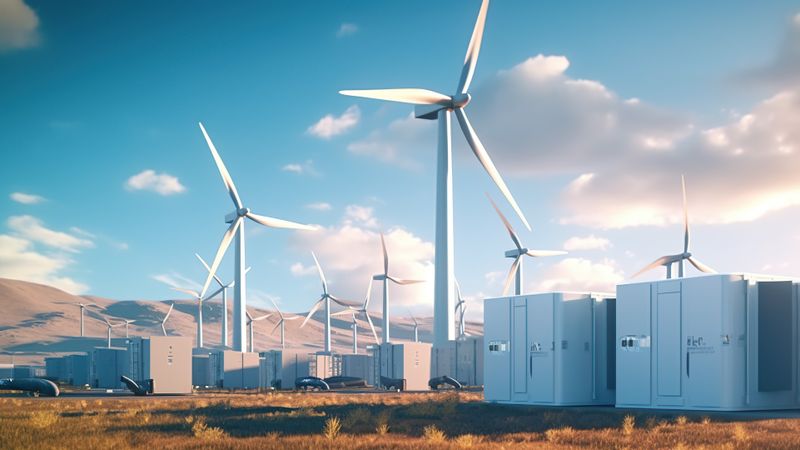
Production plant for green hydrogen with storage and pipelines.
The researchers have examined the demand from industry, households, and the transportation sector. After 2030, significant cost reductions in green energy sources are expected, but these alone will not be sufficient to economically produce low-temperature heat, heat and process heat. Overall, the researchers have determined a minimum demand of 700 TWh of gaseous hydrogen for Europe and the UK by 2050. Hydrogen can only contribute to the energy transition if its availability matches the respective needs in terms of time and location. Hydrogen will mainly be needed for high-temperature- and energy-intensive process heat applications, as well as for feedstock in the industry and centralized power and district heating generation.
Steel and chemical production with high hydrogen demand
In the industrial sector, it is primarily the steel production and related high-temperature processes that account for a hydrogen demand of 200 to 300 TWh alone. The advantage is that the steel industry requires large amounts of climate-neutral hydrogen but can also flexibly switch to mixtures of hydrogen with natural gas, which helps with a continuous transformation. The chemical industry can also be an important driving force for the expansion of the European hydrogen infrastructure. Production of green ammonia or high-value chemicals requires large amounts of hydrogen. Co-coordinator Mario Ragwitz, director at Fraunhofer IEG, says: "However, it is uncertain whether the complete value chain from solar and wind power to hydrogen production and the production of various chemicals can be realized in Europe. Imports of intermediates such as green methanol or ammonia could reduce the demand for hydrogen in the European industrial sector. Therefore, these sensitivities were considered within the framework of TransHyDE."
The biggest uncertainty factor in the transportation sector is the competition between direct electrification and hydrogen fuel cell propulsion in heavy-duty trucks.
Transportation as the second most important consumer
The transportation sector is the second most important consumer of hydrogen. Co-author Christoph Nolden, Head of Gas, Hydrogen, & Material Infrastructures at Fraunhofer IEG, says: "International air and maritime transport depend on synthetic fuels based on hydrogen. This creates a hydrogen demand of a total of 450 TWh for green fuels in 2050. The biggest uncertainty factor in the transportation sector is the competition between direct electrification and hydrogen fuel cell propulsion in heavy-duty trucks. Various scenarios show an additional demand of up to 380 TWh in 2050 if 40% of heavy-duty trucks were equipped with fuel cells."
Hydrogen production in Europe
According to the researchers, hydrogen production in Europe depends on whether ambitious goals for the expansion of European wind and solar installations are achieved.The role of electrolysis in sector coupling will significantly develop during the market ramp-up, says co-coordinator Florian Ausfelder, head of energy and climate at DECHEMA e.V.: "Initially, electrolyzers will be integrated into clusters to ensure the secure and continuous supply of hydrogen for industrial use. Once the hydrogen infrastructure is established, electrolyzers can feed into the grid and provide flexibility in the power grid: Network operators can use electrolyzers to reduce the expansion needs of the power grid and thus reduce costs." It should be noted that green hydrogen may be lacking at the beginning of the market ramp-up to meet the demand. During this phase, alternatives such as blue hydrogen will have to cover the existing demand.
Transportation and storage of hydrogen and its derivatives
Co-author Tobias Fleiter, Coordinator of Business Unit Demand Analyses and Projections at Fraunhofer ISI, says: "Supply security and the transformation into a hydrogen economy also depend on the expansion of the corresponding transport and storage infrastructure. The modeling results show that a suitably dimensioned hydrogen core network enables the supply of hydrogen demand at minimal overall system costs." The core network can connect the potential renewable energy producers, especially in the northern and southern parts of Europe, with underground storage facilities and industrial centers in Central Europe.Co-author My Yen Förster, DECHEMA e.V.: "The repurposing of former natural gas pipelines plays a crucial role in the transformation of the German and European energy systems. The research results confirm that with this repurposing, supply requirements can be met in various scenarios. Imports from non-EU countries seem to be particularly competitive when they are tied to pipelines." Pipeline-bound imports could be made through the MENA region (Middle East and North Africa). Imports of hydrogen derivatives or intermediate products, such as ammonia or sponge iron, are expected to be more cost-effective than their production in Europe.
Participating Partners
Contributors to the White Paper include employees from Fraunhofer Research Institution for Energy Infrastructures and Geothermal Systems IEG, DECHEMA Gesellschaft für Chemische Technik und Biotechnologie e. V. (Society for Chemical Engineering and Biotechnology), – Fraunhofer Institute for Systems and Innovation Research ISI, Salzgitter Mannesmann Forschung GmbH, Forschungsstelle für Energiewirtschaft FfE, Brandenburg University of Technology, Fraunhofer Institute for Solar Energy Systems ISE, VNG AG, Fraunhofer Institute for Factory Operation and Automation IFF, – DVGW Research Center at Engler-Bunte-Institut of Karlsruhe Institute of Technology (KIT), Fraunhofer Institute for Ceramic Technologies and Systems IKTS, Institut für Zukunftsenergie- und Stoffstromsysteme gGmbH, Technical University of Berlin. The TransHyDE flagship project is funded by the Federal Ministry of Education and Research.
Date: 08.12.2025
Naturally, we always handle your personal data responsibly. Any personal data we receive from you is processed in accordance with applicable data protection legislation. For detailed information please see our privacy policy.
Consent to the use of data for promotional purposes
I hereby consent to Vogel Communications Group GmbH & Co. KG, Max-Planck-Str. 7-9, 97082 Würzburg including any affiliated companies according to §§ 15 et seq. AktG (hereafter: Vogel Communications Group) using my e-mail address to send editorial newsletters. A list of all affiliated companies can be found here
Newsletter content may include all products and services of any companies mentioned above, including for example specialist journals and books, events and fairs as well as event-related products and services, print and digital media offers and services such as additional (editorial) newsletters, raffles, lead campaigns, market research both online and offline, specialist webportals and e-learning offers. In case my personal telephone number has also been collected, it may be used for offers of aforementioned products, for services of the companies mentioned above, and market research purposes.
Additionally, my consent also includes the processing of my email address and telephone number for data matching for marketing purposes with select advertising partners such as LinkedIn, Google, and Meta. For this, Vogel Communications Group may transmit said data in hashed form to the advertising partners who then use said data to determine whether I am also a member of the mentioned advertising partner portals. Vogel Communications Group uses this feature for the purposes of re-targeting (up-selling, cross-selling, and customer loyalty), generating so-called look-alike audiences for acquisition of new customers, and as basis for exclusion for on-going advertising campaigns. Further information can be found in section “data matching for marketing purposes”.
In case I access protected data on Internet portals of Vogel Communications Group including any affiliated companies according to §§ 15 et seq. AktG, I need to provide further data in order to register for the access to such content. In return for this free access to editorial content, my data may be used in accordance with this consent for the purposes stated here. This does not apply to data matching for marketing purposes.
Right of revocation
I understand that I can revoke my consent at will. My revocation does not change the lawfulness of data processing that was conducted based on my consent leading up to my revocation. One option to declare my revocation is to use the contact form found at https://contact.vogel.de. In case I no longer wish to receive certain newsletters, I have subscribed to, I can also click on the unsubscribe link included at the end of a newsletter. Further information regarding my right of revocation and the implementation of it as well as the consequences of my revocation can be found in the data protection declaration, section editorial newsletter.



:quality(80)/p7i.vogel.de/wcms/a0/47/a04725ef9bd09fb6c9341a1bea1b5d93/0130443083v1.jpeg "Here, a type of plastic pallet is produced by thermoforming (vacuum forming or deep drawing) at the corresponding division of New England Plastics in the USA. This division, which specializes in so-called liners, is now part of Ringmetall ... (Image:New England Plastics)")
:quality(80)/p7i.vogel.de/wcms/e3/42/e342b3c593ea92d56604d3be969e9c9a/0130437231v1.jpeg "Daimler Truck will be building even more trucks at its Czech plant in Cheb in the future. This is because it is now being expanded for strategic cost-saving reasons ... (Image:Daimler Truck)")
:quality(80)/p7i.vogel.de/wcms/23/99/23992bf2dcdc432c9b7209c34a4a7c48/0129733089v1.jpeg "Stork relies on the modular Neoswiss turning system from Iscar to shorten the set-up times for its sliding headstock lathes and work more productively. (Image:Iscar)")
:quality(80)/p7i.vogel.de/wcms/7d/e2/7de2923434b2f1a78ba5482d8d335269/0113143253v1.jpeg "In our China Market Insider we regularly provide you with relevant information directly from China. (Image:© Eisenhans - stock.adobe.com)")
:quality(80)/p7i.vogel.de/wcms/b7/36/b736dfebc16c42d6901d0d0e1f390493/3d-druck-20factory-20--20ki-20generiert-1920x1079v1.png "(Source: AI-generated)")
:quality(80)/p7i.vogel.de/wcms/79/b2/79b21aad663f4a7bd4472afc1c1afc62/0130433994v1.jpeg "Mission Joyride: The free-flying robot (shown here in the rendering) will relieve the ISS crew of logistics tasks from 2027 with its two mechanical arms. (Image:Icarus Robotics)")
:quality(80)/p7i.vogel.de/wcms/6b/45/6b4546fa6ebf305c3660326909363f32/0130437089v1.jpeg "Industrial AI in action: Rockwell Automation presents practical solutions for self-controlling production systems at the Hannover Messe. (Image:Rainer Jensen, Deutsche Messe)")
:quality(80)/p7i.vogel.de/wcms/78/e9/78e9188c25a8a94e67c34c9bf8ffe495/visual-agile-20robots-20and-20google-20deepmind-20partner-20to-20bring-20intelligence-20to-20robotics-2500x1406v1v1.jpeg "Together, the partners are developing adaptable, intelligent robots for a wide range of applications (Image:Agile Robots SE)")
:quality(80)/p7i.vogel.de/wcms/59/a2/59a2b11f0aa1b700eff02addd5de8703/adobestock-1788280853--c2-a9-20satria-20-e2-80-93-20stock-adobe-com-5081x2860v1v1.jpeg "Quantum computers require extreme cooling to temperatures close to absolute zero in order to keep qubits stable. (Image:satria - stock.adobe.com)")
:quality(80)/p7i.vogel.de/wcms/62/5f/625f41e87ebfef156a98c8e6393e32fd/0130211654v1.jpeg "Axial flux motors have some advantages over radial flux motor—but their production is currently still expensive. (Image:RWTH Aachen University)")
:quality(80)/p7i.vogel.de/wcms/f6/ae/f6aec4f6241b36ed5e3a990ac9176b42/0130429460v1.jpeg "Verne, Pony.ai and Uber want to launch a robotaxi service in Europe. (Image:Verne)")
:quality(80)/p7i.vogel.de/wcms/d7/88/d788699f2974708a332baa4e7a62fa9e/0130438967v1.jpeg "Skoda is withdrawing from China. The brand has produced well over three million vehicles there. (Image:Skoda car)")
:quality(80)/p7i.vogel.de/wcms/b0/43/b043b86899837532aad62d63368a917a/0130371361v1.jpeg "Skoda leaves the chinese market.
(Image:Skoda)")
:quality(80)/p7i.vogel.de/wcms/c3/c4/c3c4ce270b083eeac55654148611f064/0130237945v1.jpeg "China is not giving up on hydrogen, but is intensifying its efforts. (Image:freely licensed from Pixabay)")
:quality(80)/p7i.vogel.de/wcms/ee/09/ee09acbd6dc896df25affaa9e871e6e5/0130440053v1.jpeg "IMS chip module for simple system integration into an ion mobility spectrometer. (Image:Fraunhofer IPMS)")
:quality(80)/p7i.vogel.de/wcms/10/6c/106cd22de5f68a0f74639d654827228c/0130345302v1.jpeg "Made in India: According to the India Electronics and Semiconductor Association (IESA), the country should be able to produce between 75 and 80 million chips by the beginning of 2027, once the plants currently under construction become operational. (Image:Pixabay (Montage: Sebastian Gerstl))")
:quality(80)/p7i.vogel.de/wcms/a5/ed/a5ed6fda029d362732a293d6b19d74c4/0130444216v1.jpeg "Thirteen executives from the Chinese chip industry have drawn up a plan to achieve an 80% self-sufficiency rate for semiconductors by 2030. (Image:Maxim_Kazmin - stock.adobe.com)")
:quality(80)/p7i.vogel.de/wcms/31/a6/31a646018b34d8e0a44bfc8bf17837f6/0130361632v1.jpeg "For many companies, PFAS are considered indispensable in electronics production. (Image:freely licensed)")
:fill(fff,0)/images.vogel.de/vogelonline/companyimg/76800/76895/65.jpg "FAULHABER_120mm.jpg ()")
:quality(80)/p7i.vogel.de/wcms/22/d0/22d03cd48e992435338b59464c428d41/0129739814v1.jpeg "More electric vehicles on the roads mean a higher demand for electricity - which should ideally be covered by renewable energies. (Image:BMW)")
:quality(80)/p7i.vogel.de/wcms/5c/c3/5cc38d3e9f835e048f1d38663237c9ef/0127265829v1.jpeg "The converter at Dillinger is filled with pig iron. (Image:Dillinger)")