Google, Microsoft, and Amazon have each unveiled major advancements in quantum computing chip technology within weeks of each other. But what sets these quantum chips apart, and how do their innovations compare? This article explores the key differences, breakthroughs, and future potential of quantum computing from the world’s leading cloud providers.
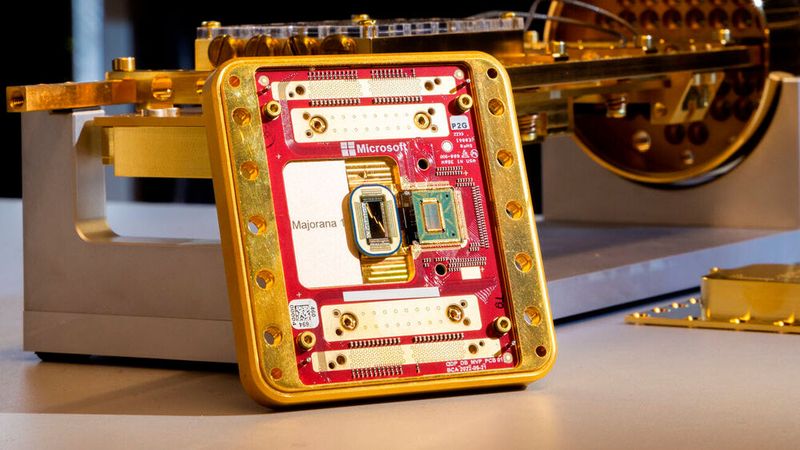
With the Majorana-1 quantum processor, Microsoft announced its first quantum processor in mid-February 2025 with great media attention, which relies on a completely novel architecture—and even materials. But Google and Amazon also reported milestones in the field of quantum computing at the turn of the year 2024/25. The race for the "best" quantum computing architecture is already in full swing.
(Image: Microsoft)
The development of quantum computers is advancing rapidly. While classical computers are limited to binary states, quantum processors open up entirely new computational possibilities through superposition and entanglement. However, one of the greatest challenges remains error tolerance—qubits are extremely sensitive and tend to lose information through decoherence.
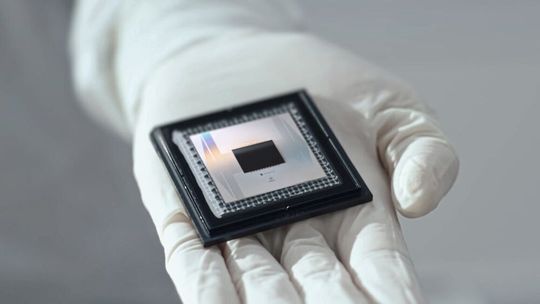
Google last introduced its own quantum processor in 2019. Now, with Willow, the company has presented a 105-qubit processor, which it claims has impressive stability and leading error correction mechanisms.
(Image: Google)
However, if you believe the statements from Google, Microsoft, or Amazon, each of these companies has made new progress in overcoming these problems. All three providers rely on fundamentally different strategies to realize reliable and scalable quantum computers.
Google Willow: Error-corrected qubits with extremely long stability
In 2019, Google introduced its own quantum processor for the first time and immediately proclaimed "quantum supremacy" based on the state-of-the-art technology at that time. However, in the following five years, the company's efforts in the field had largely gone quiet.
With the quantum computer chip "Willow," the company returned in December 2024 and announced the achievement of a significant milestone: A logical qubit, consisting of 105 hardware qubits, was able to be kept stable for one hour. This remarkable stability is a crucial advancement for scaling quantum computers and for the ability to perform complex calculations error-free.
Google's technology relies on the so-called "surface code" for error correction. Numerous physical qubits are combined into a single logical qubit, allowing errors to not only be detected but also efficiently corrected. The critical factor here is that error correction becomes exponentially more effective the more qubits are integrated into the logical system.
By gradually increasing the "distance," or code distance, from 3 to 5 and then to 7, Google demonstrated that the error rate was halved each time. This scaling shows that the practical implementation of large, error-corrected quantum computers is becoming increasingly realistic.
Another key element is Google's new manufacturing facility, which allows for detailed control over the production process. Previously, quantum processors were manufactured in universal cleanroom labs. But now, according to the company, customized qubits with optimized structures can be produced.
In the process, the company has deliberately developed larger physical qubit components that are less susceptible to environmental disturbances. The combination of structural improvements and advanced error correction allows for an unprecedented period of stability.
This progress indicates that complex calculations, taking hours, may soon be realizable by quantum computers. The theoretical prediction that a significant increase in the number of qubits drastically improves error correction has now been experimentally confirmed. This takes Google a big step closer to realizing a usable quantum computer. How close they are to practical usability, however, remains a different matter. The quantum processor "Eagle," introduced by IBM in 2021, was already able to demonstrate 127 qubits.
Microsoft Majorana: Topological qubits with Majorana quasiparticles
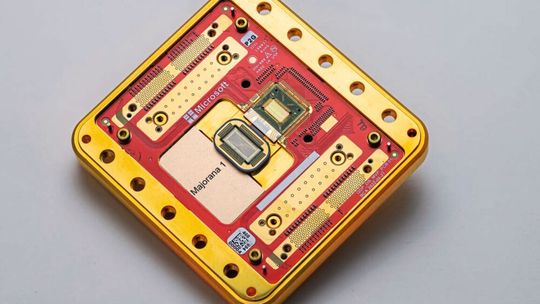
With Majorana-1, Microsoft introduced what it claims to be the world's first topological quantum processor, which relies on a new type of qubits and fundamentally new base material.
(Image: John Brecher / Microsoft)
Microsoft bases its quantum computer research on an entirely new physical foundation: Majorana quasiparticles. These exotic particles possess special topological properties that make them nearly immune to environmental disturbances. For a long time, the existence of these quasiparticles was considered purely theoretical, but Microsoft has now provided experimental confirmation of their existence.
Majorana quasiparticles arise in special nanostructures made of superconductors and semiconductors. They are localized at the ends of nanowires and behave like massless fermions. As a result, the resulting qubits are particularly resistant to the so-called decoherence and the storage of quantum information is especially stable.
Microsoft's first processor based on this, the "Majorana-1," introduced in mid-February 2025, features eight qubits. This is a low number compared to competing chips, but due to the inherent error-resistance, significantly fewer qubits may be needed to carry out error-corrected computations.
Date: 08.12.2025
Naturally, we always handle your personal data responsibly. Any personal data we receive from you is processed in accordance with applicable data protection legislation. For detailed information please see our privacy policy.
Consent to the use of data for promotional purposes
I hereby consent to Vogel Communications Group GmbH & Co. KG, Max-Planck-Str. 7-9, 97082 Würzburg including any affiliated companies according to §§ 15 et seq. AktG (hereafter: Vogel Communications Group) using my e-mail address to send editorial newsletters. A list of all affiliated companies can be found here
Newsletter content may include all products and services of any companies mentioned above, including for example specialist journals and books, events and fairs as well as event-related products and services, print and digital media offers and services such as additional (editorial) newsletters, raffles, lead campaigns, market research both online and offline, specialist webportals and e-learning offers. In case my personal telephone number has also been collected, it may be used for offers of aforementioned products, for services of the companies mentioned above, and market research purposes.
Additionally, my consent also includes the processing of my email address and telephone number for data matching for marketing purposes with select advertising partners such as LinkedIn, Google, and Meta. For this, Vogel Communications Group may transmit said data in hashed form to the advertising partners who then use said data to determine whether I am also a member of the mentioned advertising partner portals. Vogel Communications Group uses this feature for the purposes of re-targeting (up-selling, cross-selling, and customer loyalty), generating so-called look-alike audiences for acquisition of new customers, and as basis for exclusion for on-going advertising campaigns. Further information can be found in section “data matching for marketing purposes”.
In case I access protected data on Internet portals of Vogel Communications Group including any affiliated companies according to §§ 15 et seq. AktG, I need to provide further data in order to register for the access to such content. In return for this free access to editorial content, my data may be used in accordance with this consent for the purposes stated here. This does not apply to data matching for marketing purposes.
Right of revocation
I understand that I can revoke my consent at will. My revocation does not change the lawfulness of data processing that was conducted based on my consent leading up to my revocation. One option to declare my revocation is to use the contact form found at https://contact.vogel.de. In case I no longer wish to receive certain newsletters, I have subscribed to, I can also click on the unsubscribe link included at the end of a newsletter. Further information regarding my right of revocation and the implementation of it as well as the consequences of my revocation can be found in the data protection declaration, section editorial newsletter.
According to Microsoft, a central advantage of this architecture is scalability: theoretically, millions of these qubits could be accommodated on a single chip. This could allow Microsoft to develop high-performance quantum computers in the long term that require significantly fewer correction mechanisms.
Whether this is indeed the case remains an open question. "The paper is very good," said Klaus Ensslin, physics professor and semiconductor expert at ETH Zurich, in response to the Majorana announcement to Die Zeit. "But Majorana states were not demonstrated in it." He also believes that Microsoft has yet to prove that the chip is suitable as a qubit processor. Professor Ensslin is involved as a research group leader in the development of quantum processors at Zurich, which IBM is working on in collaboration with ETH Zurich.
Amazon Ocelot: Error resistance through cat qubits and transmon links
Amazon's quantum computer chip, named Ocelot, uses two different types of qubits to achieve, according to the company, an error correction rate of "up to 90%": "cat qubits" and "transmon qubits."
(Image: Amazon)
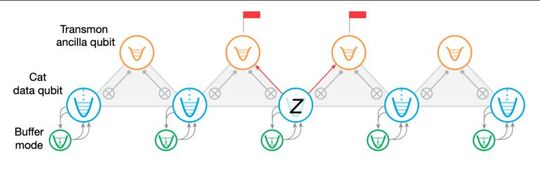
Just a few weeks after Microsoft's introduction of the Majorana-1, Amazon announced the release of its own chip named Ocelot, developed in collaboration with the California Institute of Technology (CalTech). In parallel, a paper on the topic of error correction in qubits was published in the journal Nature. Compared to the approaches of Google and Microsoft, the approach presented in the study "Hardware-efficient quantum error correction via concatenated bosonic qubits" pursues a hybrid strategy: instead of developing an entirely new qubit technology, the company relies on a clever combination of two different types of qubits: "Cat Qubits" and "Transmon Qubits."
The units Amazon refers to as "cat qubits" are a special form of superconducting qubits, where a single quantum state is distributed over multiple photons. This architecture makes them particularly resistant to bit-flip errors. However, as the number of photons increases, the risk of phase-flip errors rises.
The structure of Amazon's hardware. Data-holding "cat qubits" (blue) alternate with transmons (orange), which can be measured for error detection.
(Image: Harald Putterman et al. / Amazon)
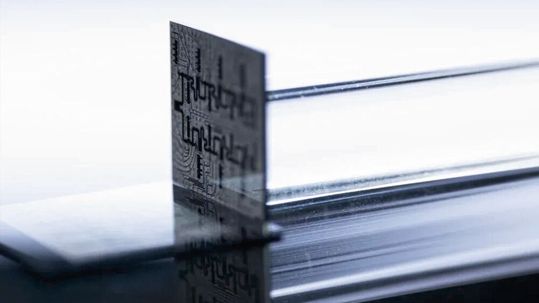
To solve this problem, Amazon combines these Cat Qubits with classical Transmon Qubits. The Transmons act as error detectors, capturing phase-flip errors that can then be corrected. This mix allows for efficient error correction with a small number of qubits. The setup, developed together with CalTech, consists of two small silicon microchips stacked on top of each other. The company claims that the chip's design could reduce error correction costs by up to 90%.
The biggest disadvantage of this method is that the transmon qubits themselves are prone to errors. Additionally, the residual risk of rare bit-flip errors in the cat qubits remains, which could affect scalability in the long term.
Comparison of chip technologies
In summary, the three different approaches are characterized by the following features:
Google (Willow):
Classic superconducting qubits with strong error correction
Exponential error suppression through more hardware qubits
Stability of a logical qubit up to one hour
Microsoft (Majorana-1):
Use of topological qubits with high error resistance
Potential scaling to millions of qubits per chip
Simplified control through digital signals
Amazon (Ocelot):
Hybrid approach for error correction
High stability through the combination of robust qubits
Challenges due to remaining error susceptibility
No question: Each of these presented technologies promises unique advantages for the field of quantum computing. However, which of them will become the leading technology in practical hardware has yet to be determined. According to experts, a quantum processor must have at least 1,000 qubits to be suitable for practical applications. Even Google's Willow, with 105 qubits, is still far from this mark. For comparison, IBM's quantum processor Osprey already reached 433 qubits at the end of 2022, leveraging quantum software for error correction and noise reduction.
These developments are exciting but also highlight another challenge: the architectural approaches among the companies are fundamentally different. The extent to which porting between architectures or scalability within the same is possible is currently unproven. Even if the magical threshold of 1,000 qubits may not be too far off, users are likely to face another issue when the first functional quantum computers arrive: a platform dispute among the various providers!



:quality(80)/p7i.vogel.de/wcms/dd/08/dd086510d9ae7b50181f6070e4463b44/0129363730v1.jpeg "Typical application for ionizing devices: Wrapping films. (Picture: ©Adobe Stock/SMC)")
:quality(80)/p7i.vogel.de/wcms/35/57/3557c819943c53acec41a0ccba87da4f/0130049064v1.jpeg "Researchers at the Fraunhofer IWU in Chemnitz have long known that many typical sheet metal parts can be manufactured more cost-effectively using hollow embossing rollers. Now there is news to report ... (Image:Fraunhofer IWU)")
:quality(80)/p7i.vogel.de/wcms/59/02/590246e3b3f415c65edbee377c14ca77/26-06-pi-fraunhofer-iws-41450-direktplattieren-pic-01-7771x4369v1v1.jpeg "The Fraunhofer IWS has developed the new \"direct laser cladding\" process, which creates a functional layer directly on the base body by applying a strip-shaped metal to rotationally symmetrical components in a spiral and bonding it locally by laser. (Image:Christoph Wilsnack/Fraunhofer IWS)")
:quality(80)/p7i.vogel.de/wcms/73/60/73608418789b1d9c393f5e2fa974eda2/0130209906v1.jpeg "The robots of the X6 generation from b+m enable very high painting quality and are also particularly compact and easy to maintain. (Image:Beckhoff)")
:quality(80)/p7i.vogel.de/wcms/78/e9/78e9188c25a8a94e67c34c9bf8ffe495/visual-agile-20robots-20and-20google-20deepmind-20partner-20to-20bring-20intelligence-20to-20robotics-2500x1406v1v1.jpeg "Together, the partners are developing adaptable, intelligent robots for a wide range of applications (Image:Agile Robots SE)")
:quality(80)/p7i.vogel.de/wcms/e7/66/e7669ecf0260ae8fc54c214e34e4902a/0130316817v1.jpeg "Siemens and Palo Alto Networks offer tested cybersecurity solution for industrial 5G. (Image:Siemens)")
:quality(80)/p7i.vogel.de/wcms/9f/55/9f55324832c4f426958031375124d9de/siemens-20ubtech-20hmnd-1920x1079v1v1.png "Ready for the factory floor: While Ubtech is planning mass production, Siemens is already testing humanoids in real factory applications in Erlangen. (Image:Siemens)")
:quality(80)/p7i.vogel.de/wcms/11/36/113695ed260e29c8c2d9d39dc5f9d869/0130213768v1.jpeg "AI can work cheaply in China and deliver the results rapidly all over the world. (Image:Dall-E / AI-generated)")
:quality(80)/p7i.vogel.de/wcms/62/5f/625f41e87ebfef156a98c8e6393e32fd/0130211654v1.jpeg "Axial flux motors have some advantages over radial flux motor—but their production is currently still expensive. (Image:RWTH Aachen University)")
:quality(80)/p7i.vogel.de/wcms/77/9b/779b0685d010dfe45c9c2cb1cfecd467/0128886425v1.jpeg "The BlueEye is the first \"real\" hyperspectral camera for the UV range and covers the wavelength range from 220 to 380nm. (Image:Inno-spec GmbH)")
:quality(80)/p7i.vogel.de/wcms/e4/51/e451d52ce0182fb0aaa46a5774f832ef/26-04-pi-fraunhofer-iws-21160-bioslide-pic-01-4128x2321v1v1.jpeg "With the BioSlide research project, the Fraunhofer IWS is investigating how sliding systems can be designed to be more sustainable and energy-efficient. New materials can be tested in a particularly application-oriented manner on this plain bearing test stand. (Image:Fraunhofer IWS)")
![Thanks to advanced 3D printing technology, a more efficient use of resources should contribute to lower-emission aviation—this is the goal of ['skai]-lab. (Image:Oleksandr Pashchenko - stock.adobe.com / AI-generated)](https://cdn1.vogel.de/nghHNSbySccfOjG3n1qCA-FVOjQ=/288x162/smart/filters:format(jpg):quality(80)/p7i.vogel.de/wcms/62/64/626424c97a16e69f871bf216c9629c2a/adobestock-1927043193--c2-a9-20oleksandr-20pashchenko-20-e2-80-93-20stock-adobe-com-ki-generiertv1v1.jpeg "Thanks to advanced 3D printing technology, a more efficient use of resources should contribute to lower-emission aviation—this is the goal of ['skai]-lab. (Image:Oleksandr Pashchenko - stock.adobe.com / AI-generated)")
:quality(80)/p7i.vogel.de/wcms/c3/c4/c3c4ce270b083eeac55654148611f064/0130237945v1.jpeg "China is not giving up on hydrogen, but is intensifying its efforts. (Image:freely licensed from Pixabay)")
:quality(80)/p7i.vogel.de/wcms/4e/c0/4ec0bd19390b169edfa23677373dcdf1/0130260089v1.jpeg "Renewable fuels can supply European road traffic, according to a study. (Image:Aral)")
:quality(80)/p7i.vogel.de/wcms/6f/c9/6fc9050301d745cad25585c6780f8f51/0130197341v1.jpeg "Production facilities are a worthwhile target and are therefore at risk. (Image:ABB Robotics)")
:quality(80)/p7i.vogel.de/wcms/b6/62/b662adc2cec8227d8172509bbfb6ee42/25c0207-107-4961x2789v1v1.jpeg "The GLB is the second model based on Mercedes' new MMA platform. Apparently, Geely's platform is better and cheaper, which is why the two companies are negotiating a partnership. (Image:Mercedes-Benz)")
:quality(80)/p7i.vogel.de/wcms/4d/dd/4dddf438e91f394c04a095dbfd109d1c/0130236430v1.jpeg "Measurement modules: The 720301 module in combination with the SL2000 enables RMS and power calculations, among other things. (Image:Yokogawa)")
:quality(80)/p7i.vogel.de/wcms/61/fc/61fcf95f5cca15494ad18343901ae585/0130317237v1.jpeg "With the AGI CPU, Arm says it is taking a \"historic step\": With the processor aimed at AI in data centers, the company is presenting itself for the first time as a provider of its own chips, not just as a pure IP licensor. (Image:Arm)")
:quality(80)/p7i.vogel.de/wcms/82/90/8290dfe3595b6c6b33726ae8b76172c7/0130319587v1.jpeg "The concept image illustrates how the pattern of tiny protrusions and depressions created on the substrate (MgO, bottom) controls the arrangement of atoms in the superconducting material (YBCO, top). At the interface between the two layers, an electronic structure enables superconductivity to occur at higher temperatures than previously possible. (Image:Chalmers University of Technology / Riccardo Arpaia)")
:fill(fff,0)/p7i.vogel.de/companies/67/eb/67eba621ef6ea/logo2.png "logo2 (Wuxi InfiMotion)")
:quality(80)/p7i.vogel.de/wcms/15/c3/15c366aeb7135bb3d442c2e72fa97af5/0122910391v1.jpeg "IonQ has launched the first European quantum computer: IonQ's Forte system can be scaled up to 36 algorithmic qubits (#AQ) and can process over 34 billion possibilities simultaneously. (Image:IonQ)")
:quality(80)/p7i.vogel.de/wcms/f5/8f/f58f17d5029941f1eff3c9de3ddb98c2/0122920267v1.jpeg "Empa researcher Eve Ammerman at the scanning tunneling microscope (Image:Empa)")
:quality(80)/p7i.vogel.de/wcms/ac/f5/acf53be9b7efdeca0f6dcceb8377714a/0125121446v1.jpeg "A rendered image of the \"Starling\" quantum computer planned for 2029. IBM aims to introduce a scalable, fault-tolerant quantum computer system with 2000 qubits within the next four years. (Image:IBM)")
:quality(80)/p7i.vogel.de/wcms/56/66/5666509400ae8bb448b8efb523c0adc5/0127565358v1.jpeg "Google's quantum computer chip \"Willow,\" with its 105 qubits, served as the basis for the calculations with the algorithm \"Quantum Echoes.\" (Image:Google)")