From
Michael Specht/SP-X | Translated by AI
4 min Reading Time
VW is now also Germany's strongest car brand in electromobility. An overview of the planned models.
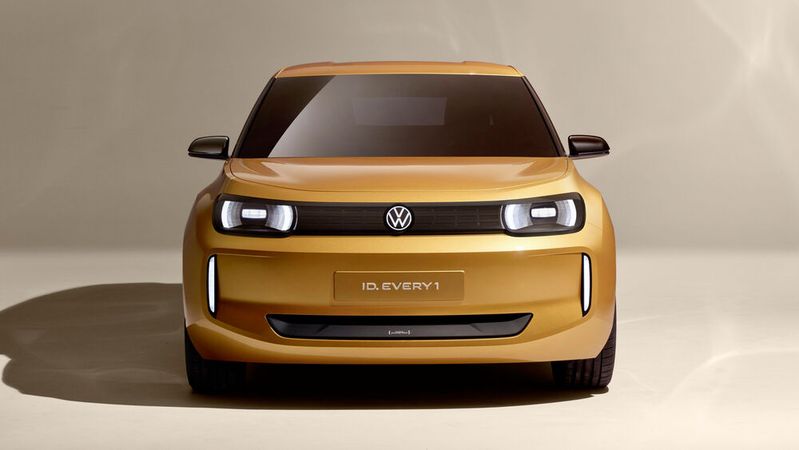
VW's entry-level electric vehicle is set to launch at the end of 2027.
(Image: VW)
Starting late, but then overtaking confidently. This approach has been attested to VW several times. Just mention the Touran and Tiguan. After their debuts, they quickly developed into bestsellers in their segment and easily passed the competition. A similar thing is happening in the electric sector. Recent registration numbers show that the VW ID 7 secured the top position in Germany for the fourth consecutive time in April, followed by the ID 3 and ID 4, as well as its coupé version ID 5.
"As the market leader in Europe and Germany, we must also claim a pole position in electromobility," says Martin Sander, Head of Sales, Marketing, and After Sales at Volkswagen. "Our deliveries of electric vehicles have doubled in the first quarter compared to the previous year." Another figure shows how well business is developing for VW. By the end of the month, the Wolfsburg brand will have delivered 1.5 million ID models, an increase of a good 50 percent since May 2025.
Sales professional Sander is confident that the future of individual mobility is electric, regardless of the forecasts given for the exit from the combustion engine world. Sander recently experienced how well even long journeys work with electric drive using an ID 7 Tourer. With the mid-size estate car, the VW manager visited various dealers in Austria, France, Belgium, and Germany, covering over 3,000 kilometers (approx. 1,864 miles) in five days. "For the final leg from Brussels to Hamburg (Germany), just under 800 kilometers (approx. 497 miles), only a short charging stop of ten minutes was necessary," says Sander.
Affordable Entry-Level Model
VW will quickly expand its electric portfolio downward to make the silent drive suitable for the masses. Even an electric city car is in development. The mini electric car, in the size of a VW up! (A0 segment), with the study named ID Every1, is expected to cost less than 20,000 euros (22,698 USD) in its basic version from around fall 2027. To maintain this price, the engineers are pursuing a stringent strategy of common parts within the framework of the modular electronics toolkit MEB, as well as the use of smaller and, above all, cheaper LFP batteries (lithium iron phosphate).
Already this late summer, the Wolfsburg team plans to present a concept car named ID 2 X at the IAA in Munich, whose design largely corresponds to the production model. The technical basis is the front-wheel-drive platform MEB 21. The ID 2 X is the SUV variant of the ID 2, a model in Polo size, whose production is scheduled to start in May 2026. The market launch for the SUV offshoot X is also planned for 2026.
Iconic Names Remain
There is much speculation regarding the model names. The secret is to be revealed during the IAA. Allegedly, the small electric cars won't simply be called ID 1, ID 2, and ID 2 X, although the typology would suggest it. Brand board member Thomas Schäfer has already hinted that iconic names like Golf, Polo, Tiguan, and Passat, and even the abbreviation GTI, should continue to live on in the electric era. The latter has recently been confirmed. The ID 2 GTI study will enter series production in 2026, just in time for the 50th anniversary of the Wolfsburg sports car legend Golf GTI. The names T-Roc and T-Cross could also survive the electric transition, albeit without the T. So why not call the SUV derivatives ID Roc or ID Cross?
VW's first MEB model, the ID 3, will receive a fairly extensive facelift next year. The front section will resemble the design of the ID 2. Its cockpit layout will also be incorporated into the ID 3. Even the cheap solution (Diess legacy) of the window lifts will be discarded. There will once again be four switches for four windows and not, as before, two for the front plus a switch button for the rear.
Combustion Engines Continue Running
To remain competitive in terms of prices, the entry-level version of the ID 3 will be equipped with LFP batteries. There will also be new engines, which come from the APP-550 generation of the ID 7.
Of course, today's combustion engine variants will continue to run in parallel and be kept up-to-date through targeted updates into the next decade. VW is even launching entirely new models. Later this year, the second generation of the T-Roc will be introduced. Slightly larger in dimensions, the crossover vehicle will, in 2026, become the first VW model to feature a full hybrid (HEV). The hybrid drivetrain is also expected to be available in the Golf in 2027, helping to further reduce CO2 emissions. This should finally dispel the rumor that VW would import range-extender hybrid technology, as recently introduced in China, to Europe. The EREV (Extended Range Electric Vehicle) is likely to remain exclusive to the Chinese market.
Date: 08.12.2025
Naturally, we always handle your personal data responsibly. Any personal data we receive from you is processed in accordance with applicable data protection legislation. For detailed information please see our privacy policy.
Consent to the use of data for promotional purposes
I hereby consent to Vogel Communications Group GmbH & Co. KG, Max-Planck-Str. 7-9, 97082 Würzburg including any affiliated companies according to §§ 15 et seq. AktG (hereafter: Vogel Communications Group) using my e-mail address to send editorial newsletters. A list of all affiliated companies can be found here
Newsletter content may include all products and services of any companies mentioned above, including for example specialist journals and books, events and fairs as well as event-related products and services, print and digital media offers and services such as additional (editorial) newsletters, raffles, lead campaigns, market research both online and offline, specialist webportals and e-learning offers. In case my personal telephone number has also been collected, it may be used for offers of aforementioned products, for services of the companies mentioned above, and market research purposes.
Additionally, my consent also includes the processing of my email address and telephone number for data matching for marketing purposes with select advertising partners such as LinkedIn, Google, and Meta. For this, Vogel Communications Group may transmit said data in hashed form to the advertising partners who then use said data to determine whether I am also a member of the mentioned advertising partner portals. Vogel Communications Group uses this feature for the purposes of re-targeting (up-selling, cross-selling, and customer loyalty), generating so-called look-alike audiences for acquisition of new customers, and as basis for exclusion for on-going advertising campaigns. Further information can be found in section “data matching for marketing purposes”.
In case I access protected data on Internet portals of Vogel Communications Group including any affiliated companies according to §§ 15 et seq. AktG, I need to provide further data in order to register for the access to such content. In return for this free access to editorial content, my data may be used in accordance with this consent for the purposes stated here. This does not apply to data matching for marketing purposes.
Right of revocation
I understand that I can revoke my consent at will. My revocation does not change the lawfulness of data processing that was conducted based on my consent leading up to my revocation. One option to declare my revocation is to use the contact form found at https://contact.vogel.de. In case I no longer wish to receive certain newsletters, I have subscribed to, I can also click on the unsubscribe link included at the end of a newsletter. Further information regarding my right of revocation and the implementation of it as well as the consequences of my revocation can be found in the data protection declaration, section editorial newsletter.



:quality(80)/p7i.vogel.de/wcms/23/99/23992bf2dcdc432c9b7209c34a4a7c48/0129733089v1.jpeg "Stork relies on the modular Neoswiss turning system from Iscar to shorten the set-up times for its sliding headstock lathes and work more productively. (Image:Iscar)")
:quality(80)/p7i.vogel.de/wcms/7d/e2/7de2923434b2f1a78ba5482d8d335269/0113143253v1.jpeg "In our China Market Insider we regularly provide you with relevant information directly from China. (Image:© Eisenhans - stock.adobe.com)")
:quality(80)/p7i.vogel.de/wcms/9d/2b/9d2b802f800e5caf17b2831e74228cd3/screenshot-202026-03-03-20103822-609x343v1v1.png "Visual comparison: on the left, a clean, burr-free cut edge; on the right, typical burr formation with oxidation discoloration. This illustrates how strongly parameter control and gas management influence the quality of the result. (CO₂ laser, oxygen cutting gas, sheet thickness approx. 15 mm). (Image:Picture: Rime)")
:quality(80)/p7i.vogel.de/wcms/dd/08/dd086510d9ae7b50181f6070e4463b44/0129363730v1.jpeg "Typical application for ionizing devices: Wrapping films. (Picture: ©Adobe Stock/SMC)")
:quality(80)/p7i.vogel.de/wcms/79/b2/79b21aad663f4a7bd4472afc1c1afc62/0130433994v1.jpeg "Mission Joyride: The free-flying robot (shown here in the rendering) will relieve the ISS crew of logistics tasks from 2027 with its two mechanical arms. (Image:Icarus Robotics)")
:quality(80)/p7i.vogel.de/wcms/6b/45/6b4546fa6ebf305c3660326909363f32/0130437089v1.jpeg "Industrial AI in action: Rockwell Automation presents practical solutions for self-controlling production systems at the Hannover Messe. (Image:Rainer Jensen, Deutsche Messe)")
:quality(80)/p7i.vogel.de/wcms/78/e9/78e9188c25a8a94e67c34c9bf8ffe495/visual-agile-20robots-20and-20google-20deepmind-20partner-20to-20bring-20intelligence-20to-20robotics-2500x1406v1v1.jpeg "Together, the partners are developing adaptable, intelligent robots for a wide range of applications (Image:Agile Robots SE)")
:quality(80)/p7i.vogel.de/wcms/e7/66/e7669ecf0260ae8fc54c214e34e4902a/0130316817v1.jpeg "Siemens and Palo Alto Networks offer tested cybersecurity solution for industrial 5G. (Image:Siemens)")
:quality(80)/p7i.vogel.de/wcms/59/a2/59a2b11f0aa1b700eff02addd5de8703/adobestock-1788280853--c2-a9-20satria-20-e2-80-93-20stock-adobe-com-5081x2860v1v1.jpeg "Quantum computers require extreme cooling to temperatures close to absolute zero in order to keep qubits stable. (Image:satria - stock.adobe.com)")
:quality(80)/p7i.vogel.de/wcms/62/5f/625f41e87ebfef156a98c8e6393e32fd/0130211654v1.jpeg "Axial flux motors have some advantages over radial flux motor—but their production is currently still expensive. (Image:RWTH Aachen University)")
:quality(80)/p7i.vogel.de/wcms/77/9b/779b0685d010dfe45c9c2cb1cfecd467/0128886425v1.jpeg "The BlueEye is the first \"real\" hyperspectral camera for the UV range and covers the wavelength range from 220 to 380nm. (Image:Inno-spec GmbH)")
:quality(80)/p7i.vogel.de/wcms/e4/51/e451d52ce0182fb0aaa46a5774f832ef/26-04-pi-fraunhofer-iws-21160-bioslide-pic-01-4128x2321v1v1.jpeg "With the BioSlide research project, the Fraunhofer IWS is investigating how sliding systems can be designed to be more sustainable and energy-efficient. New materials can be tested in a particularly application-oriented manner on this plain bearing test stand. (Image:Fraunhofer IWS)")
:quality(80)/p7i.vogel.de/wcms/f6/ae/f6aec4f6241b36ed5e3a990ac9176b42/0130429460v1.jpeg "Verne, Pony.ai and Uber want to launch a robotaxi service in Europe. (Image:Verne)")
:quality(80)/p7i.vogel.de/wcms/d7/88/d788699f2974708a332baa4e7a62fa9e/0130438967v1.jpeg "Skoda is withdrawing from China. The brand has produced well over three million vehicles there. (Image:Skoda car)")
:quality(80)/p7i.vogel.de/wcms/b0/43/b043b86899837532aad62d63368a917a/0130371361v1.jpeg "Skoda leaves the chinese market.
(Image:Skoda)")
:quality(80)/p7i.vogel.de/wcms/c3/c4/c3c4ce270b083eeac55654148611f064/0130237945v1.jpeg "China is not giving up on hydrogen, but is intensifying its efforts. (Image:freely licensed from Pixabay)")
:quality(80)/p7i.vogel.de/wcms/31/a6/31a646018b34d8e0a44bfc8bf17837f6/0130361632v1.jpeg "For many companies, PFAS are considered indispensable in electronics production. (Image:freely licensed)")
:quality(80)/p7i.vogel.de/wcms/4d/dd/4dddf438e91f394c04a095dbfd109d1c/0130236430v1.jpeg "Measurement modules: The 720301 module in combination with the SL2000 enables RMS and power calculations, among other things. (Image:Yokogawa)")
:quality(80)/p7i.vogel.de/wcms/61/fc/61fcf95f5cca15494ad18343901ae585/0130317237v1.jpeg "With the AGI CPU, Arm says it is taking a \"historic step\": With the processor aimed at AI in data centers, the company is presenting itself for the first time as a provider of its own chips, not just as a pure IP licensor. (Image:Arm)")
:quality(80)/p7i.vogel.de/wcms/82/90/8290dfe3595b6c6b33726ae8b76172c7/0130319587v1.jpeg "The concept image illustrates how the pattern of tiny protrusions and depressions created on the substrate (MgO, bottom) controls the arrangement of atoms in the superconducting material (YBCO, top). At the interface between the two layers, an electronic structure enables superconductivity to occur at higher temperatures than previously possible. (Image:Chalmers University of Technology / Riccardo Arpaia)")
:quality(80):fill(efefef,0)/p7i.vogel.de/wcms/67/ad/67adf4a647532/elatec-wp-machine-authentication.png "Elatec WP Machine Authentication")
:quality(80)/p7i.vogel.de/wcms/f1/85/f185e43914a70b95a9481c62b8001991/0126764939v1.jpeg "ID.GTI concept (Image:VW)")
:quality(80)/p7i.vogel.de/wcms/e6/53/e6539c6b5df2d2af2970ca981131fb42/0130215307v1.jpeg "Volkswagen is in first place in the first two months of 2026—no one has sold as many cars in China as the car manufacturer. (Image:Volkswagen)")