Complex requirements, such as the use of touch displays with or without gloves, demand superior usability that not only enables error-free operation but also leads to innovative solutions. What could this look like?
In safety-critical situations, simple, intuitive usability is crucial to minimize accident risks and ensure operability.
As a development partner, we work internationally on various technologically advanced capital goods. The interaction between humans and machines is regularly the focus, aiming to make highly complex operations and processes simple and understandable to operate. This involves not only direct operation but also indirect handling, service, and maintenance of the machines.
Demographic change demands industrial goods that are increasingly easy to understand: this is due to the shortage of skilled workers and the use of less specialized workers on machines, while in our daily lives we have become accustomed to increasingly high-quality user interfaces and applications. This expectation is transferred to machines and their interfaces, as well as to physical handling processes—especially in industrial systems, the gap between expectation and reality remains significant.
Why Usability is Important
Intuitive, quickly comprehensible user interfaces, whether physical or digital, reduce learning times and give the user a sense of control.
Ergonomically well-arranged and user-appropriate controls support the user and thus not only reduce fatigue but also enhance safety: Quickly and clearly comprehensible interfaces ensure error prevention and exclude incorrect operation.
For this, usability principles with a high success rate can be applied:
Clarity of assignment and allocation,
clear labeling and
Order through grouping and separation
are the foundations of good usability. For physical handling processes, the Japanese Poka-Yoke principle for error prevention remains unbeaten—adhering to the motto: "Only what is meant to fit, fits."
Future of Industrial Usability—Conference & Expo
The industrial future is user-friendly—Future of Industrial Usability points the way and serves as a platform where experts report on the latest developments and real exchange is possible—cross-industry and practical. In addition to news on trends and developments, participants learn methods, approaches, and techniques of usability engineering, connect with representatives from various industries, and find answers to current challenges through exchange.
What Does This Look Like in Practice?
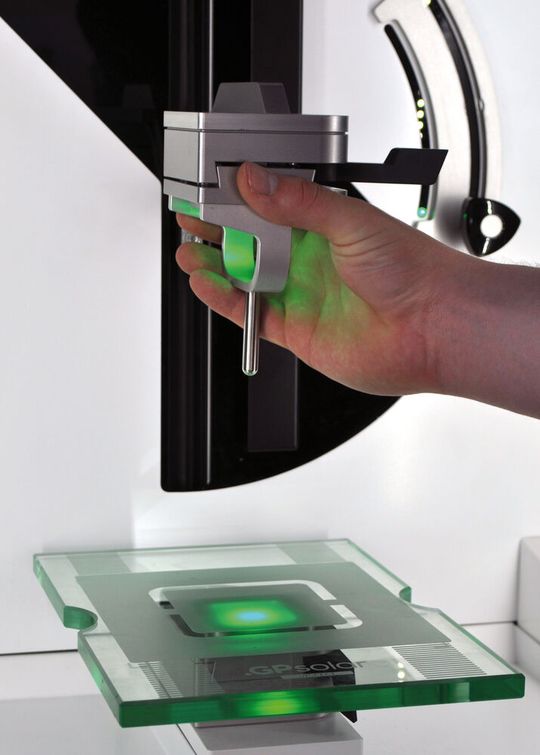
Test device for solar cells
(Image: Defortec GmbH)
The first example is a testing device for measuring the properties of a solar cell wafer, which requires extremely short measurement cycles and very high throughput rates. Clear usability in the physical domain protects the device from potential self-destruction.
The device, designed with shy-tech principles for a reserved appearance, promotes focus and concentration instead of an overwhelming, oversized touch interface, which could otherwise cause distractions. A simple LED directly at the test inserts signals in red or green whether the correct pairing of the test inserts has been made. The test inserts are chip-coded, and the machine does not start without the correct pairing—yet the feedback to the user is crystal clear.
The principle is quickly understandable—even for people who struggle with reading. Reducing influences on the user sharpens focus and minimizes distraction. Interfaces can also distract if they display too much or offer too many setting options.
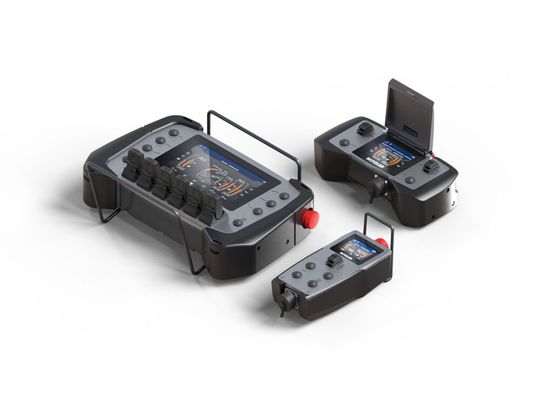
Necessary information on one screen
(Image: Defortec GmbH)
A clear requirement for the wireless remote control of Rotzler's winches was to immediately and clearly display the applied force and the rope extension length on the new interface. These are critical factors in recovery operations under the harshest conditions, which can take place in arctic temperatures of -40 °F, in pouring rain, at night, or under intense sunlight at up to 158°F in the desert.
These weather conditions pose a challenge not only to the materials but also to the operators: most of the time, these are highly unique extreme cases, and the winches are used to move several hundred tons—making this a safety-critical operation. Under such conditions, glove operation is a mandatory requirement, which makes touch screens inadmissible.
Haptic buttons and joysticks make operation tactile and clearly perceptible, while the visual receptors can be used to closely observe the situation—a separation of hand and eye movement that would not be possible with a touchscreen. The result is a remote control with haptic controls and a modular interface—offering high adaptability to customer requirements and ease of navigation between differently complex recovery systems, which can vary from one to up to six joysticks.
Date: 08.12.2025
Naturally, we always handle your personal data responsibly. Any personal data we receive from you is processed in accordance with applicable data protection legislation. For detailed information please see our privacy policy.
Consent to the use of data for promotional purposes
I hereby consent to Vogel Communications Group GmbH & Co. KG, Max-Planck-Str. 7-9, 97082 Würzburg including any affiliated companies according to §§ 15 et seq. AktG (hereafter: Vogel Communications Group) using my e-mail address to send editorial newsletters. A list of all affiliated companies can be found here
Newsletter content may include all products and services of any companies mentioned above, including for example specialist journals and books, events and fairs as well as event-related products and services, print and digital media offers and services such as additional (editorial) newsletters, raffles, lead campaigns, market research both online and offline, specialist webportals and e-learning offers. In case my personal telephone number has also been collected, it may be used for offers of aforementioned products, for services of the companies mentioned above, and market research purposes.
Additionally, my consent also includes the processing of my email address and telephone number for data matching for marketing purposes with select advertising partners such as LinkedIn, Google, and Meta. For this, Vogel Communications Group may transmit said data in hashed form to the advertising partners who then use said data to determine whether I am also a member of the mentioned advertising partner portals. Vogel Communications Group uses this feature for the purposes of re-targeting (up-selling, cross-selling, and customer loyalty), generating so-called look-alike audiences for acquisition of new customers, and as basis for exclusion for on-going advertising campaigns. Further information can be found in section “data matching for marketing purposes”.
In case I access protected data on Internet portals of Vogel Communications Group including any affiliated companies according to §§ 15 et seq. AktG, I need to provide further data in order to register for the access to such content. In return for this free access to editorial content, my data may be used in accordance with this consent for the purposes stated here. This does not apply to data matching for marketing purposes.
Right of revocation
I understand that I can revoke my consent at will. My revocation does not change the lawfulness of data processing that was conducted based on my consent leading up to my revocation. One option to declare my revocation is to use the contact form found at https://contact.vogel.de. In case I no longer wish to receive certain newsletters, I have subscribed to, I can also click on the unsubscribe link included at the end of a newsletter. Further information regarding my right of revocation and the implementation of it as well as the consequences of my revocation can be found in the data protection declaration, section editorial newsletter.
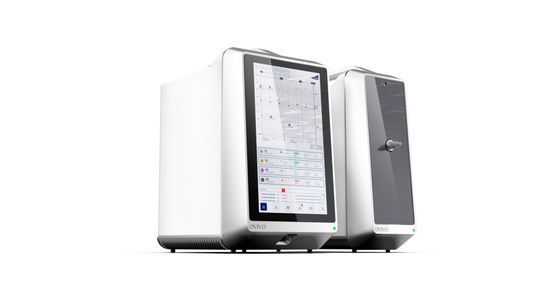
Large data volumes
(Image: Defortec GmbH)
What if data volumes become not only complex but also large? This is the challenge faced in ultra-pure water treatment. This ultra-pure process water is used in the semiconductor industry, for example, for rinsing processes in wafer or circuit trace production. Even the smallest impurities—which can already include foreign molecules—result in defects in semiconductor traces only a few nanometers in size. These enormous requirements demand not only sophisticated treatment processes but also continuous analysis and adjustment.
The most advanced particle analysis system currently comes from Ovivo—particle sizes as small as 5 nm (2 × 10⁻⁷ inches) can be continuously quantified. The device has a compact and modular design, which becomes a unique selling point in confined installation situations: maximum customer flexibility and information density with minimal dimensions. A distinctive touchscreen on the device enables intuitive interaction and rapid information transfer: at first glance, the device prominently displays the current measurement values. Through interaction with the analysis device, the user accesses a significantly more complex menu.
Here, the interface digitally represents the modularity and flexibility: up to four specially developed high-tech ultrasonic sensors can analyze ultra-pure water across four measurement channels. The touchscreen allows the now familiar interaction: zooming and scrolling enable seamless switching between data, making the overview of measurement progressions and trends almost effortless and playful. Another advantage of such a complex system is the ability to integrate videos for troubleshooting or training purposes—conveniently accessible directly on the analyzer. This is especially useful in large treatment plants where distances can be substantial. Additionally, data import and export are simple and intuitive: for those who have not directly integrated the analyzer into the system, the analysis data can be easily exported with just a few clicks.
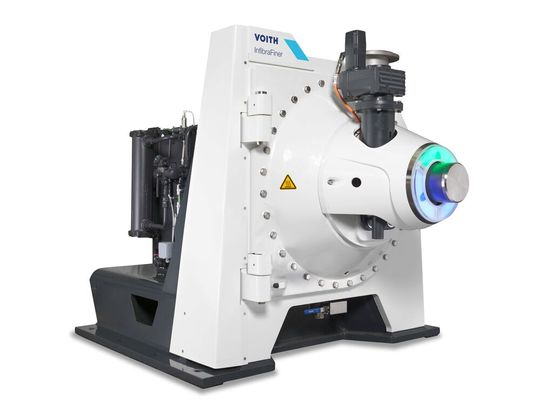
User guidance in service and maintenance processes
(Image: Defortec GmbH)
How Industry 4.0 and predictive maintenance can become a game changer was developed by us with Voith on their InfibraRefiner.
This is a machine for processing paper fibers in a liquid state, and it is essential for paper quality —the wear of the internal fittings is only permissible to a certain extent, after which there is a risk of web breaks in the still-wet paper web, leading to production downtime and waste.
The machine continuously measures process parameters via different sensors. If certain values are exceeded, the device provides information about the next required fitting change directly onsite through a ring light on its "nose" and via digital interfaces to the control center—predictive maintenance ensures maximum productivity here:
The fitting can be replaced before it is critically worn down and time pressure arises. Through appropriate coding of the ring light, the operator knows when a replacement is due—also here, it is simple and quickly recognizable. The complex touch interface for parameter settings is completely pushed into the background.
Usability is Unique
Targeted usability development is always tailored to the customer and the machine's purpose. Critical points must be identified and resolved in a context-appropriate manner—good usability is individual.
The blind use of touchscreens is not always promising, even though they surround us as a matter of course today. They offer many advantages but don't solve every problem—and in some cases, they must not be used. Our tip: Look for professionals who understand industrial systems, capital goods, and machinery, as well as good, application-appropriate usability.



:quality(80)/p7i.vogel.de/wcms/21/b6/21b61c2ac1df28254fb0dad1574fb2d7/0132853015v1.jpeg "The rose-gold, TiAlSiN-based coating material InoxaCon contributes significantly to the stability and service life of HPTec's new RQR-350 milling tool. It enables safe and efficient automated processes in the manufacturing of surgical instruments. (Image:Cemecon)")
:quality(80)/p7i.vogel.de/wcms/d2/73/d273374d6347651e4e6200cf6061ea4e/0132860560v1.jpeg "Even in July, the flag of the Chinese economy did not flutter particularly briskly in the air. Read here what’s happening and why production in China is apparently declining ... (Image:AI-generated)")
:quality(80)/p7i.vogel.de/wcms/18/47/1847f131e3afda201d1dbb98ad0ecb04/0132826776v1.jpeg "Image 1: Difender armored steels from Dillinger stand out with top scores in ballistic testing and cold bending. Defense companies therefore readily choose them. They can be found, for example, in the armored vehicles Fuchs and GTK Boxer of the German Armed Forces. (Image: Dillinger)")
:quality(80)/p7i.vogel.de/wcms/1e/7d/1e7d651782e0e97b3efc25abf2b52350/img-3485v1.jpeg "The Siemens Energy employees attach balancing weights at the precisely calculated and adjusted angular position to achieve the best possible result. (Source: Schenck Rotec)")
:quality(80)/p7i.vogel.de/wcms/a7/38/a73840cb81da9dc3c503f4c04bf66b96/0132892768v1.jpeg "Unitree's IPO symbolizes the high expectations for humanoid robots and embodied AI. (Image:Dall-E / AI-generated)")
:quality(80)/p7i.vogel.de/wcms/1c/a5/1ca5e3ef5d834c3a42de8909c872e3c6/0132876444v1.jpeg "The autonomous transport system Active Shuttle marketed by Bosch Rexroth has been sold to Neura Robotics. (Image:Bosch Rexroth)")
:quality(80)/p7i.vogel.de/wcms/30/1a/301a1aa59e093d848b69e9ff7006b83e/image1v1.jpeg "Wireless switching devices offer advantages in numerous industrial applications – wherever wired communication reaches its limits (Image: Steute) (Image:)")
:quality(80)/p7i.vogel.de/wcms/a2/85/a285b12508af812e28b17be3482a736c/0132488872v1.jpeg "NIS2 is no longer an abstract requirement in the distant future for many industrial companies. (Image:AI-generated)")
:quality(80)/p7i.vogel.de/wcms/41/fc/41fc456ff1ff8f30807924663e8df127/img-0942v1.jpeg "In industrial additive manufacturing, the production strategy must influence the design from the very beginning. (Source: Materialise)")
:quality(80)/p7i.vogel.de/wcms/44/fe/44fe86a16c26c09bb363b3671bf0b930/0132847771v1.jpeg "CoreTechnologie (CT) points out that the 3D printing software 4D_Additive has been equipped with additional application possibilities. Here you can learn more about what the new version 1.8 can do – such as generating complex lattice structures or optimizing faulty data ... (Image:CT)")
:quality(80)/p7i.vogel.de/wcms/b4/f2/b4f2c272247f79c5e87334a6839f20cb/0132549860v1.jpeg "Morefire analysis: Many mechanical engineering websites focus on technical specs instead of customer benefits. Translating features into clear benefits increases visibility, inquiries, and competitiveness. (Image: ©peopleimages.com - stock.adobe.com)")
:quality(80)/p7i.vogel.de/wcms/b4/9a/b49aaad0500e06e253f7d75ecb77338a/adobestock-4840668--dani-kreienb-hl-stock-adobe-comv1.jpeg "Metal processing in 2026 will be more digital, automated, and data-driven – but not automatically easier. (Image:© Dani Kreienbühl - stock.adobe.com)")
:quality(80)/p7i.vogel.de/wcms/5b/88/5b88d94e6a43f2b857462cd1921f7386/0132281427v1.jpeg "The eTurbo solves a well-known turbocharger problem: by combining an exhaust gas turbocharger and a permanently excited synchronous motor into a highly integrated core assembly, the compressor achieves sufficient speed even when the exhaust energy is actually not yet sufficient. (Image: BorgWarner)")
:quality(80)/p7i.vogel.de/wcms/75/fe/75feffb63bc6275786606d78a8d797c4/0132901853v1.jpeg "Steyr Motors reports similar business results as last year. Here you can learn more about the details of the Austrian company's situation ... (Image:E-Steyr)")
:quality(80)/p7i.vogel.de/wcms/57/d2/57d2b75d884c18866b46e776126fb46b/org-blobs-user-response-file-output-dac07b02-0e97-4452-9a3a-26528da583b3-file-1787126178766-jpgv1.jpeg "The memory manufacturer CXMT has had an extremely successful IPO. Among the investors are several car manufacturers. (Image:KI-generiert)")
:quality(80)/p7i.vogel.de/wcms/d0/68/d0681c9d26012538a22ff5c103429612/0132875205v1.jpeg "Electric vehicles: Structure of the zone architecture in a modern vehicle. (Image:TI)")
:quality(80)/p7i.vogel.de/wcms/22/82/22826566c11220ed61efac5982fb94a2/0132896083v1.jpeg "Electrodes made from paper and copper paste deliver comparable signal quality to the established gold standard. They perform significantly better in all environmental impact analyses. (Image:Screentec)")
:quality(80)/p7i.vogel.de/wcms/c4/9f/c49f5b8173f678f7ef071355b1fbbd7c/yamu-jay-ai-generated-9088888v1.jpeg "As part of a strategic partnership, Siemens and Reinhausen are advancing the future of energy supply solutions for AI data centers. (Symbol image) (Source: pixabay / AI-generated)")
:quality(80)/p7i.vogel.de/wcms/28/20/28204a4592a69a8682bfbf9a8f7e1dc2/0132846993v1.jpeg "The health status of a lithium-ion battery changes with increasing aging. AI models can utilize characteristic changes in the charge and voltage curves to estimate the state of health. (Image:freely licensed)")
:quality(80)/p7i.vogel.de/wcms/90/dc/90dc332e30a3e4bd3ff77646ed0633b7/0132833369v1.jpeg "Through a compromised repository of the widely used open-source tool LiteLLM, attackers were able to capture several terabytes of data and login credentials. Security company CloudSEK concludes, after analyzing the data, that the attack conducted in March of this year affected more than 2,000 companies, including major players like Microsoft, Nvidia, AWS, and Deutsche Bahn. (Image:freely licensed)")
:fill(fff,0)/p7i.vogel.de/companies/69/88/69882c428938e/tmts2026-ticec-banner-en-2000px.png "tmts2026-ticec-banner-en-2000px (https://www.tmts.tw/en)")
:fill(fff,0)/p7i.vogel.de/companies/69/de/69de1b7403b0d/simtos-logo.jpeg "simtos-logo (SIMTOS)")

:quality(80):fill(efefef,0)/p7i.vogel.de/wcms/67/ad/67adf92d254d2/elatec-wp-smart-factory.png "Elatec WP Smart Factory")
:quality(80)/p7i.vogel.de/wcms/6a/8e/6a8e92f6e4acb35e8bb56921300ecbd2/0129494745v1.jpeg "Jumo Dicon Touch: What used to require separate devices is now managed by a single powerful, touch-controlled device that seamlessly combines measurement, control and recording. (Image:Jumo)")
:quality(80)/p7i.vogel.de/wcms/d8/75/d87565f91d192686259e599c5087ef62/0126380583v1.jpeg "Voice-controlled IIoT devices are transforming the shop floor. (Image:AI-generated)")