


:quality(80)/p7i.vogel.de/wcms/bc/29/bc29ee18ce776b1915e10e07c1525f3a/0129766196v1.jpeg "The control cabinet is integrated into the rear of the press frame and offers accessibility with a small overhang thanks to the variable door opening. (Image:Tox)")
:quality(80)/p7i.vogel.de/wcms/fe/8a/fe8af1b829b085210fef4c1fa8abddb5/0129784389v1.jpeg "As an integral part of Koch Pac-Systeme's Predictive Pack digital service product, the gearboxes with Cynapse and Wittenstein's Smart Services make it possible to detect damage risks in the packaging specialist's machines at an early stage. (Image:Koch Pac systems)")
:quality(80)/p7i.vogel.de/wcms/9f/7b/9f7be35880605811e045acd3af8b571b/0129558586v1.jpeg "An example of the V210 processing machine, which, according to Voortman, supplements the laser cutting of the V353 with drilling, thread cutting and milling. (Image:Voortman)")
:quality(80)/p7i.vogel.de/wcms/b0/41/b041264d931df4347bc760fff1c7cb7b/0129439236v1.jpeg "The circular milling system proves to be a problem solver in the numerous standard variants, as well as in special shapes for some other milling processes. (Image:Horn/Sauermann)")
:quality(80)/p7i.vogel.de/wcms/6b/0d/6b0d694b060190016a4db18401fa55eb/0129937458v1.jpeg "(Picture: ©AI-generated)")
:quality(80)/p7i.vogel.de/wcms/db/68/db689490e348201603dd30447711ea2b/0129578734v1.jpeg "With three-axis vibration measurement (X, Y and Z axes) and temperature detection, the CMSVT38 condition monitoring sensor provides detailed status information that helps to detect machine damage at an early stage. (Image:Kübler)")
:quality(80)/p7i.vogel.de/wcms/49/09/49095c6192a6c46d47b567e1def31ea6/0130024626v1.jpeg "The new TUM \"RoboGym\" (powered by Neura) is Europe's largest training center for next-generation humanoid robots. It focuses on the implementation of artificial intelligence in robotic systems. At the same time, it is a forge for AI experts ... (Image:Neura Robotics)")
:quality(80)/p7i.vogel.de/wcms/92/5e/925ee98ea36ad9bd574fa1cea11d0e53/0129964352v1.jpeg "The production of hardware components for humanoid robots offers great market potential. (Image:Fraunhofer IPA)")
:quality(80)/p7i.vogel.de/wcms/7f/08/7f087d7013424d123ab7275cd2e3fe55/adobestock-809456218--c2-a9-20degimages-20-e2-80-93-20stock-adobe-com-ki-generiert-4179x2351v1v1.jpeg "The digital upgrading of existing machines conserves resources, saves energy and reduces the need for new production. (Image:Degimages - stock.adobe.com/AI-generated)")
:quality(80)/p7i.vogel.de/wcms/dd/ce/ddcef80b290218276bf857cdb64a45e1/finkel-stephan-4162x2341v1.jpeg "Stephan Finkel, Partner and Industry Lead Defence & Security at 3DSE (Source: 3DSE)")
:quality(80)/p7i.vogel.de/wcms/cb/fe/cbfe2741917274bbbf93d5b93e47a4f5/contact-software-launcht-fourier-20aiv1v1.png "Fourier AI combines AI models with AI applications developed for demanding engineering tasks. (Image:Contact Software)")
:quality(80)/p7i.vogel.de/wcms/bc/f7/bcf7a56980850be13ed37d220cd514bc/elchinator-security-5042249-1280-1280x720v1v1.jpeg "The HP Wolf Security Report shows: Attackers use AI for speed, modularity and automation, while the quality of campaigns is low. (Image:Picture: Pixabay)")
:quality(80)/p7i.vogel.de/wcms/f5/80/f5809e877017e40b413b48fcd8452246/cefmof-hydrogen-station-29-2048x1366-2048x1152v1v1.jpeg "The hydrogen filling station in Jyväskylä. The electrolyzer is installed in the fenced area at the top right. (Image:Cefmof Hydrogen)")
:quality(80)/p7i.vogel.de/wcms/69/f5/69f516f07a0ba999c5ba8763891853f1/0130030553v1.jpeg "Can be reloaded in 210 seconds for a return trip on the Greenford branch line: the GWR's 230001. (Image:Jack Boskett Media | GWR)")
:quality(80)/p7i.vogel.de/wcms/31/84/3184f9ac736d8df7c2e934593684bc74/0130024314v1.jpeg "Here, the Bavarian car manufacturer BMW looks ahead to 2025: business was sluggish due to US tariffs and weakening sales in China ... (Image:BMW)")
:quality(80)/p7i.vogel.de/wcms/f0/5e/f05e720c52f757660ddbf7c410074f64/adobestock-222131875-5616x3157v1.jpeg "(Source: © jeson - stock.adobe.com)")
:quality(80)/p7i.vogel.de/wcms/02/36/02364f083b3023cee3b3f0893ea3f859/0129857003v1.jpeg "AI will continue to drive growth in the semiconductor market in 2026. (Image:Dall-E / AI-generated)")
:quality(80)/p7i.vogel.de/wcms/61/8f/618f16f8fa95ec6cc838ca9bfb5dbaf1/0130027046v1.jpeg "The Belgian Research Institute has set up a European university consortium on the subject of CMOS 2.0. It brings together 26 university groups to research chip technologies that go beyond conventional transistor scaling. (Image:Imec)")
:quality(80)/p7i.vogel.de/wcms/db/a2/dba29322d0934dea1bbc4b31df80e392/0129953760v1.jpeg "SEM image: High-density electrode array with 128 nm dots. (Image:imec)")
:quality(80)/p7i.vogel.de/wcms/c2/a8/c2a8a93f306c1475489dff074ad59731/0129967672v1.jpeg "Figure 1: Imec's logic technology roadmap showing the extension of the nanosheet era from 2nm to the A10 node with the outer-wall forksheet, before the transition to CFET for A7 and beyond. (Image:imec)")
:fill(fff,0)/p7i.vogel.de/companies/69/88/69882c428938e/tmts2026-ticec-banner-en-2000px.png "tmts2026-ticec-banner-en-2000px (https://www.tmts.tw/en)")
:fill(fff,0)/p7i.vogel.de/companies/67/eb/67eba621ef6ea/logo2.png "logo2 (Wuxi InfiMotion)")
Date: 08.12.2025
Naturally, we always handle your personal data responsibly. Any personal data we receive from you is processed in accordance with applicable data protection legislation. For detailed information please see our privacy policy.
Consent to the use of data for promotional purposes
I hereby consent to Vogel Communications Group GmbH & Co. KG, Max-Planck-Str. 7-9, 97082 Würzburg including any affiliated companies according to §§ 15 et seq. AktG (hereafter: Vogel Communications Group) using my e-mail address to send editorial newsletters. A list of all affiliated companies can be found here
Newsletter content may include all products and services of any companies mentioned above, including for example specialist journals and books, events and fairs as well as event-related products and services, print and digital media offers and services such as additional (editorial) newsletters, raffles, lead campaigns, market research both online and offline, specialist webportals and e-learning offers. In case my personal telephone number has also been collected, it may be used for offers of aforementioned products, for services of the companies mentioned above, and market research purposes.
Additionally, my consent also includes the processing of my email address and telephone number for data matching for marketing purposes with select advertising partners such as LinkedIn, Google, and Meta. For this, Vogel Communications Group may transmit said data in hashed form to the advertising partners who then use said data to determine whether I am also a member of the mentioned advertising partner portals. Vogel Communications Group uses this feature for the purposes of re-targeting (up-selling, cross-selling, and customer loyalty), generating so-called look-alike audiences for acquisition of new customers, and as basis for exclusion for on-going advertising campaigns. Further information can be found in section “data matching for marketing purposes”.
In case I access protected data on Internet portals of Vogel Communications Group including any affiliated companies according to §§ 15 et seq. AktG, I need to provide further data in order to register for the access to such content. In return for this free access to editorial content, my data may be used in accordance with this consent for the purposes stated here. This does not apply to data matching for marketing purposes.
Right of revocation
I understand that I can revoke my consent at will. My revocation does not change the lawfulness of data processing that was conducted based on my consent leading up to my revocation. One option to declare my revocation is to use the contact form found at https://contact.vogel.de. In case I no longer wish to receive certain newsletters, I have subscribed to, I can also click on the unsubscribe link included at the end of a newsletter. Further information regarding my right of revocation and the implementation of it as well as the consequences of my revocation can be found in the data protection declaration, section editorial newsletter.
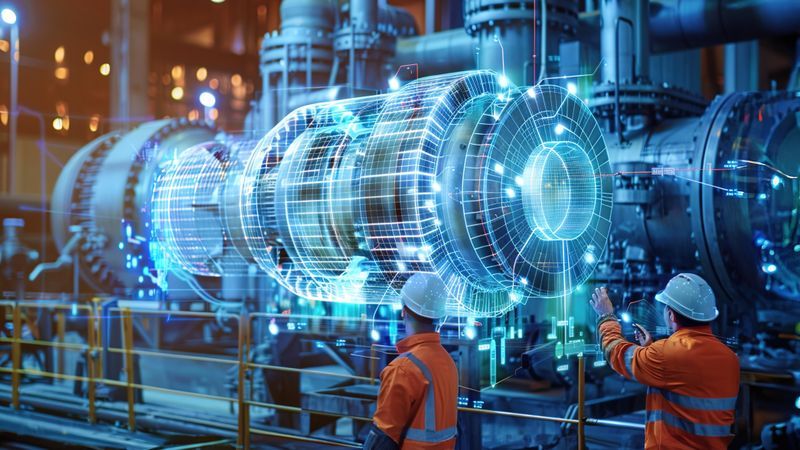
:quality(80)/p7i.vogel.de/wcms/ba/68/ba68ee9ac951abee6281276994636d50/0124605735v1.jpeg "Research project: An AI should automatically create a digital twin of existing plants in the future (like this image). (Image:AI-generated)")
:quality(80)/p7i.vogel.de/wcms/9b/0b/9b0b36b44295aec66449dc602f0db193/0127926769v1.jpeg "During ongoing operations, the digital twin becomes the central \"hub\" for process understanding. (Image:Hexagon)")