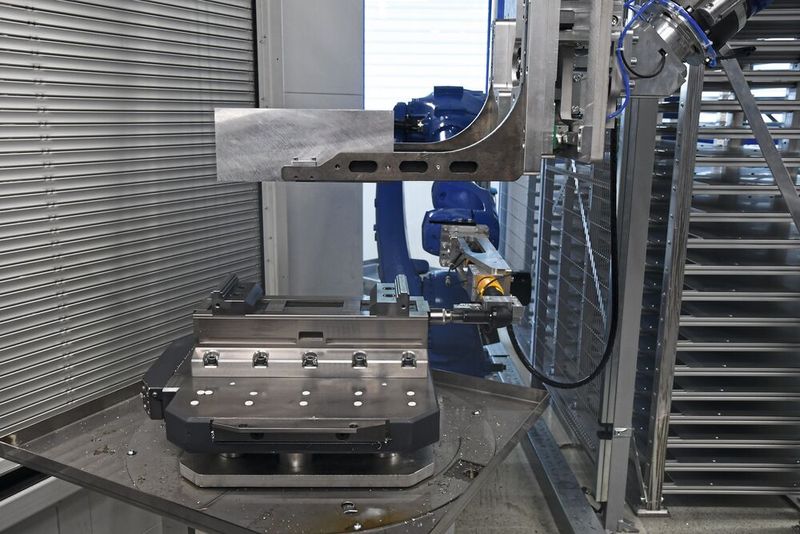
Rohde & Schwarz relies on up to 24 hours of unmanned milling production in Teisnach (Germany) with automated blank handling and clamping technology from Gressel.
The C2.0 centric clamps, the S2 fixed jaw clamps and the "gredoc" zero-point clamping systems are used for machining the raw parts. Fastening is carried out with width across flats 27.
(Image: Gressel)
In 2017, Rohde & Schwarz implemented interlinked production for the automated milling of aluminum parts at the Teisnach site. After several sister systems were implemented in the following years, the first system has now been expanded to include automated raw part handling. As a partner for workpiece clamping technology, Gressel accompanied the development throughout the years.
The milling area in Teisnach is divided into two areas, which are characterized by precise time specifications for order processing. The department headed by Georg Kauschinger, Head of CNC milling horizontal, has to adhere to a throughput time with an exact daily target from receipt of the order. If associated processes such as material procurement or delivery are taken into account, just over half of these days remain for the machining department to complete the respective order. Although certain products have to be manufactured in quantities in the low four-digit range over the year, the individual batches are in the two-digit range. On the other hand, the throughput time only allows for this order of magnitude. The daily target has been defined since Rohde & Schwarz put the interlinked system into operation.
From the Individual Machine to the Interlinked System
In 2017, the company set out to implement the dedicated project. It began with initial internal explorations: "Where exactly do we want to go? Which components are suitable? Which partners can we implement this with?" says Kauschinger. One thing was clear: we wanted to move away from individual machines towards larger systems. Several 5-axis machining centers were to be supplied with parts via a pallet handling system. In the end, four identical "Heller HF 5500" machines were chosen, which are connected via a "PHS 1500" from Liebherr and fed by a rail-mounted handling system.
One of the most important reasons why Rohde & Schwarz opted for the PHS 1500 was its master control system: this was already in place in a smaller system with two interlinked machines. "Based on our positive experiences, we now wanted to expand the consistency," says Kauschinger. "That's why we opted for 'Soflex'."
Like the production control system, the entire production concept was designed from the outset with connection and expansion options in mind. And so it quickly became clear that the raw parts handling system would also be integrated into the system in due course. While the PHS could originally accommodate 69 pallets, the number of spaces would then be reduced by six. "But that was the plan," emphasizes Kauschinger. To this day, Rohde & Schwarz is still purebred with the material that is processed in this constellation: only aluminum is machined. In order to keep to the planned cycle time, the components are almost always fixed using multiple clamping systems, for example using pyramids with three clamping points.
Our C2.0 centric clamp in various sizes, the S2 fixed-jaw clamp in jaw width 125 and the gredoc mechanical zero-point clamping system are used. Ultimately, parts up to 15 × 15 inches are placed on the system.
Sokha Hem, Sales Engineer AT & DE South at Gressel
In 2017, when the project was launched, it was far from clear what impact the production principle would have on the two milling departments. In the end, however, expectations were clearly exceeded. With direct consequences, as similar projects were now being planned. Not only in Kauschinger's department, but also in the sister department, where a system is also to include four machines, but now with blank automation.
So what were the results of the first system that triggered this development? "First and foremost, of course, the set-up time," says Kauschinger.
Today, we are at a third of the previous standardized times. By linking the individual systems in conjunction with the standardized and optimized clamping system, we have been able to improve the production process enormously compared to existing systems.
Georg Kauschinger, Head of CNC milling horizontal, Rohde & Schwarz
In addition, the number of staff would be almost halved compared to the previous requirement, allowing the relevant employees to take on other tasks. Against the background of working in three shifts, the importance of unmanned processing also increased massively.
How this is implemented is now organized by the employees themselves. Whereas we used to have an unmanned follow-up time of a maximum of 3 to 5 hours, today it is up to 24 hours.
Georg Kauschinger, Head of CNC milling horizontal, Rohde & Schwarz
The blanks are currently being loaded into the first system, with the parts being handled almost fully automatically. Only at the beginning of the system are the pallets with raw parts moved into the pin-picking cell. From then on, everything runs automatically: scanning the production order and the raw part data, destacking, measuring length, width and height. Bad parts are automatically ejected. All the others are placed in racks with several hundred spaces, a volume that results from the average parts lead time that has to be bridged at the weekend.
To avoid using clamping devices and to keep production as flexible as possible, the semi-finished parts produced at the weekend are buffered without clamping devices. "Centric clamps C2.0, fixed jaw clamps S2 and the gredoc mechanical zero-point clamping system are used to hold the unmachined parts," says Hem. And Kauschinger adds: "As long as the blanks have clean cubic shapes, we want to run them all through this handling system. The target is 95 percent of the blanks."
Date: 08.12.2025
Naturally, we always handle your personal data responsibly. Any personal data we receive from you is processed in accordance with applicable data protection legislation. For detailed information please see our privacy policy.
Consent to the use of data for promotional purposes
I hereby consent to Vogel Communications Group GmbH & Co. KG, Max-Planck-Str. 7-9, 97082 Würzburg including any affiliated companies according to §§ 15 et seq. AktG (hereafter: Vogel Communications Group) using my e-mail address to send editorial newsletters. A list of all affiliated companies can be found here
Newsletter content may include all products and services of any companies mentioned above, including for example specialist journals and books, events and fairs as well as event-related products and services, print and digital media offers and services such as additional (editorial) newsletters, raffles, lead campaigns, market research both online and offline, specialist webportals and e-learning offers. In case my personal telephone number has also been collected, it may be used for offers of aforementioned products, for services of the companies mentioned above, and market research purposes.
Additionally, my consent also includes the processing of my email address and telephone number for data matching for marketing purposes with select advertising partners such as LinkedIn, Google, and Meta. For this, Vogel Communications Group may transmit said data in hashed form to the advertising partners who then use said data to determine whether I am also a member of the mentioned advertising partner portals. Vogel Communications Group uses this feature for the purposes of re-targeting (up-selling, cross-selling, and customer loyalty), generating so-called look-alike audiences for acquisition of new customers, and as basis for exclusion for on-going advertising campaigns. Further information can be found in section “data matching for marketing purposes”.
In case I access protected data on Internet portals of Vogel Communications Group including any affiliated companies according to §§ 15 et seq. AktG, I need to provide further data in order to register for the access to such content. In return for this free access to editorial content, my data may be used in accordance with this consent for the purposes stated here. This does not apply to data matching for marketing purposes.
Right of revocation
I understand that I can revoke my consent at will. My revocation does not change the lawfulness of data processing that was conducted based on my consent leading up to my revocation. One option to declare my revocation is to use the contact form found at https://contact.vogel.de. In case I no longer wish to receive certain newsletters, I have subscribed to, I can also click on the unsubscribe link included at the end of a newsletter. Further information regarding my right of revocation and the implementation of it as well as the consequences of my revocation can be found in the data protection declaration, section editorial newsletter.
Sister System Joins the Department
With the effects of the first system—reduced set-up times, optimized personnel deployment, unmanned production—it soon became clear that a second system would be installed in Kauschinger's department, which would copy the proven principle one-to-one. Again consisting of a 5-axis machining center, pallet handling system and Soflex control system, it is only one size smaller—based on the workpieces. Here, too, the blank handling was initially dispensed with so that the experience gained from the first system could be used later.
"We can imagine a year here," Kauschinger estimates. "If everything runs smoothly, we will then integrate the blank handling system into the second system." The workpiece clamping technology from Gressel is identical, but one size smaller. "For the smaller system, these are once again the C2.0 centric clamps, S2 fixed jaw clamps and the gredoc zero-point clamping systems," confirms Hem.
Fewer Types, More Consistency
The fact that it was economical to copy the system concept several times is primarily due to the detailed planning of the project partners. "Even before the start of each project, we discussed all the technical aspects from scratch at a series of meetings. Our design department worked closely with that of Gressel," emphasizes Kauschinger. "The aim was always to clarify as many questions as possible in advance and ultimately only use standard components."
In workpiece clamping technology, this has meant that, despite the large variety of parts, "we have been able to significantly reduce the variety of clamping device types. At the same time, we have drastically increased the consistency of the systems and the clarity. We now cover almost the entire range of parts with just a handful of clamping systems. We no longer manufacture 5 percent on individual systems," says Kauschinger with satisfaction. The large number of identical clamping systems also has the advantage that the required components are always available. "This means we are never faced with the embarrassment of not being able to produce a part."
The detailed clarification at the beginning of each project naturally meant additional work at first, but ultimately saved a lot of problems and work, Kauschinger is certain. Gressel is a partner that offers that extra bit of performance. By providing a special tool for fixed-jaw clamps, for example, but also with a little help when operating the clamping devices. "There is a specific width across flats depending on the size," Hem explains. "Rohde & Schwarz wanted to standardize this. So we agreed on wrench size 27 and implemented it with the first system." Technically not a huge effort, it shows that Gressel is approaching the customer's world down to the last detail.
For us, Gressel is therefore more than just a clamping device manufacturer. For us, Gressel is a system house from which we receive the complete service.
Georg Kauschinger, Head of CNC milling horizontal, Rohde & Schwarz



:quality(80)/p7i.vogel.de/wcms/53/f7/53f7dadbe4d656a3fd4f4077445f29f6/0129828707v1.jpeg "Thanks to its compact design and drilling/unscrewing function, the Fire Birdie is suitable for applications with limited installation space and frequent tool changes. (Image:Marcel Kraibühler)")
:quality(80)/p7i.vogel.de/wcms/da/4d/da4da8d34671dc6bce80e496212de877/0129850788v1.jpeg "Mate-XT Go supports the arms and shoulders during overhead work and repetitive tasks and is designed to significantly reduce muscle strain in everyday working life. (Image:Comau)")
:quality(80)/p7i.vogel.de/wcms/95/97/95976dbaac68b249eb65e74c5aad5300/0129651893v1.jpeg "The C2.0 centric clamps, the S2 fixed jaw clamps and the \"gredoc\" zero-point clamping systems are used for machining the raw parts. Fastening is carried out with width across flats 27. (Image:Gressel)")
:quality(80)/p7i.vogel.de/wcms/57/1b/571b8895efb299d70846bbdbd7af2338/0130043886v1.jpeg "Servo hydraulics independent of the control system: The servo hydraulics software module is integrated directly into the b Maxx 5500 servo drive (pictured: Mehmet Sari, Export Sales Manager at Hürsan Pres (left), Özgür Deniz Demirbaş, Country Manager at Baumüller Turkey) (Image:Baumüller)")
:quality(80)/p7i.vogel.de/wcms/3b/27/3b27f6c5848be73acecb04054bf0a146/0130115209v1.jpeg "Spectroscopic glucose measurement with infrared spectroscopy enables more regular measurements without physical strain. (Image:Endrich)")
:quality(80)/p7i.vogel.de/wcms/3f/cc/3fccb748b0fe16f1f61249d94c72f126/0130149439v1.jpeg "Requirements for integrated power supply systems: Precise AC and DC power supply systems that not only provide energy, but also reliably combine measurement, analysis and system integration. (Image:Schulz Electronic)")
:quality(80)/p7i.vogel.de/wcms/fd/93/fd93e01c16f5a4709278499d981a459c/0130061090v1.jpeg "Revealed: These servo drives are assembled at Aerotech in Fürth. (Image:Aerotech)")
:quality(80)/p7i.vogel.de/wcms/cb/8a/cb8ae7f5205365efce3e7285154fc3cf/0130132198v1.jpeg "Markus Huber (left) and Nicolai Friis from TU Wien know how to make quantum computers multidimensional in order to perform computing operations even better. (Image:TU Vienna / A. Rommel)")
:quality(80)/p7i.vogel.de/wcms/63/21/6321beb732bf7d92640df46d7aa77573/0130125122v1.jpeg "As part of the Carbon Lab Factory Lausitz, a pilot plant for the production of sustainable, cost-effective and competitive carbon fibers will be built at the Guben site. (Image:Fraunhofer IAP / Kristin Stein)")
:quality(80)/p7i.vogel.de/wcms/53/4f/534fe0f168f6ee070ded4a48faca4cef/business-wire-main-image-1103x620v1.jpeg "The new UR AI Trainer, developed by Universal Robots and Scale AI, is the first direct lab-to-factory solution for AI model training.
(Source: Universal Robots)")
:quality(80)/p7i.vogel.de/wcms/08/70/087062e2e1a9b9add5777410dd746ee9/adobestock-1923991605-5607x3156v1v1.jpeg "A new type of tactile sensor, inspired by human skin, even recognizes grains of sand. (Image:Curioso.Photography - stock.adobe.com)")
:quality(80)/p7i.vogel.de/wcms/7f/08/7f087d7013424d123ab7275cd2e3fe55/adobestock-809456218--c2-a9-20degimages-20-e2-80-93-20stock-adobe-com-ki-generiert-4179x2351v1v1.jpeg "The digital upgrading of existing machines conserves resources, saves energy and reduces the need for new production. (Image:Degimages - stock.adobe.com/AI-generated)")
:quality(80)/p7i.vogel.de/wcms/90/db/90db3087d3af0560fcdb4dbc42443ce1/0130157448v1.jpeg "The switch to SDV is the most complex transformation the industry has ever had to master. The end consumer gets a vehicle that gains rather than loses value over its lifetime. (Image:Sonatus)")
:quality(80)/p7i.vogel.de/wcms/73/f0/73f00bb99a23197db05bb584fe78f20f/0130080581v1.jpeg "The \"China Speed\" analysis by Roland Berger shows that the speed of development has only a limited connection with labor costs. (Image:freely licensed at Pexels)")
:quality(80)/p7i.vogel.de/wcms/2f/5b/2f5ba6a150b52c2b8efada560c5cdafe/0130143442v1.jpeg "Automotive suppliers are facing a severe crisis, which is primarily due to a combination of structural change and economic problems. (Image:freely licensed at Pexels)")
:quality(80)/p7i.vogel.de/wcms/22/d0/22d03cd48e992435338b59464c428d41/0129739814v1.jpeg "More electric vehicles on the roads mean a higher demand for electricity - which should ideally be covered by renewable energies. (Image:BMW)")
:quality(80)/p7i.vogel.de/wcms/94/7a/947ac066b98cbcd3470e83ff9da3e25f/0130096114v1.jpeg "The use of amorphous steels in the stator enables a significant reduction in losses and increases the efficiency of modern electric motors in vehicle drives. (Image:Horse Powertrain)")
:quality(80)/p7i.vogel.de/wcms/e5/f1/e5f171d3d7ae021332cc0aeae4d6e299/0130127049v1.jpeg "In collaboration with Shanghai Jiao Tong University, Lenovo has presented a silicon anode battery under the name \"ED1000\" as a proof of concept for mobile workstations. (Image:Lenovo)")
:quality(80)/p7i.vogel.de/wcms/fa/69/fa696e59706b96fff02283dd74cc2398/0130129635v1.jpeg "Samsung Co-CEO Jun Young-hyun wants to respond to the AI-driven boom in demand in the memory market with contracts for up to five years. This should provide more planning security in the traditionally volatile storage business. At the same time, however, this is likely to increase the pressure on customers to secure precise long-term requirements, prices and supply chains. (Image:Samsung)")
:quality(80)/p7i.vogel.de/wcms/31/a8/31a883a47b86634c382923e78fd9a4c9/0130133225v1.jpeg "Figure 1: GMSL-capable point-to-point connection. (Image:ADI)")
:fill(fff,0)/images.vogel.de/vogelonline/companyimg/76800/76895/65.jpg "FAULHABER_120mm.jpg ()")
:fill(fff,0)/p7i.vogel.de/companies/67/eb/67eba621ef6ea/logo2.png "logo2 (Wuxi InfiMotion)")
:quality(80)/p7i.vogel.de/wcms/f7/86/f7863279f4fc09052f9d62ae5736ad32/0129651901v1.jpeg "One of the strengths in the implementation of the projects was the early, far-reaching planning, in which Stefan Rothmeier, sales representative at Schunk, Georg Kauschinger, Head of CNC milling horizontal, and Sokha Hem, Sales Technician AT & DE South at Gressel, (from left) were involved.(Image: Gressel)")
:quality(80)/p7i.vogel.de/wcms/23/62/23628a17ba3704c22d3feb2f4c9c9c9e/0129651885v1.jpeg "The components are clamped with \"C2.0\" centric clamps, \"S2\" fixed-jaw clamps and \"gredoc\" mechanical zero-point clamping systems from Gressel.(Image: Gressel)")
:quality(80)/p7i.vogel.de/wcms/a0/3f/a03faf2f9caeea4bb277a276149c6d2e/0129651879v1.jpeg "In one of Rohde & Schwarz's interlinked systems in Teisnach, four identical \"Heller HF 5500\" machines are supplied with aluminum components via a \"PHS 1500\" pallet handling system including rail-mounted workpiece handling.(Image: Gressel)")
:quality(80)/p7i.vogel.de/wcms/b2/64/b264e4632b0c12e2554f1ffc50cf3f41/0129655215v1.jpeg "In one of Rohde & Schwarz's interlinked systems in Teisnach, four identical \"Heller HF 5500\" machines are supplied with aluminum components via a \"PHS 1500\" pallet handling system including rail-mounted workpiece handling.(Image: Gressel)")
:quality(80):fill(efefef,0)/p7i.vogel.de/wcms/67/ad/67adf4a647532/elatec-wp-machine-authentication.png "Elatec WP Machine Authentication")
:quality(80)/p7i.vogel.de/wcms/a3/c9/a3c97bee203d9bfa84428358641a6248/0125885004v1.jpeg "The IQ clamping devices with measurement intelligence from Hainbuch clamp and measure simultaneously. (Image:Hainbuch GmbH)")
:quality(80)/p7i.vogel.de/wcms/da/78/da781ee7a171a683026e669d03268052/0125773339v1.jpeg "Typical application area: Industrial robots are used in numerous different production steps in the automotive industry. (Image:KUKA Group)")