In our "Fascination with Technology" section, we present impressive projects from research and development to engineers each week. Today: how researchers managed to develop a kind of magical meta-lens that halves the wavelength of light, thus transforming infrared light into visible light.
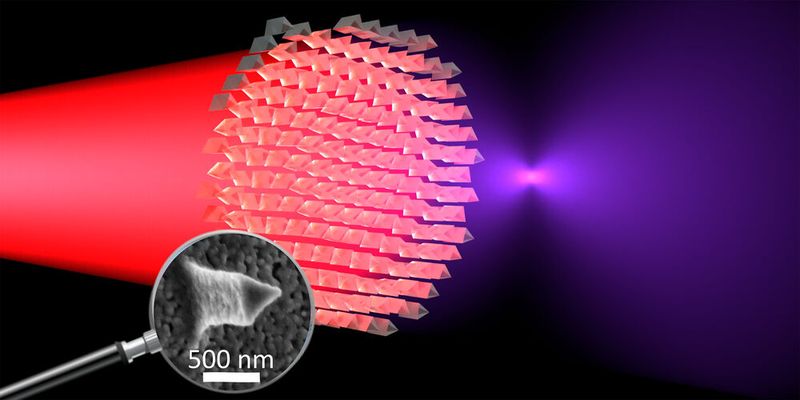
Infrared light passes through the metalens and is converted into violet light due to the material and special surface structures (magnified in the lens), and is bundled at a focal point.
(Image: Ü.Talts / ETH Zurich)
A team of physicists from ETH Zurich has developed tiny meta-lenses that can halve the wavelength of light. They achieved this through the material of the lenses—a metal oxide called lithium niobate—and through tiny structures that the researchers stamped into the material. Such meta-lenses could be used as a security feature on banknotes or to produce extremely thin camera elements.
Lenses are among the most commonly used optics. Camera lenses, for example, focus light to a focal point to capture sharp photos and videos. The rapid development of optics in recent decades is demonstrated by the shift from bulky cameras to compact smartphone cameras. Yet even current smartphone cameras consist of several lenses, often making up the thickest part of the device. This minimum size results from the functioning of classical lenses: light refraction is based on the curvature of the lens or the change in the thickness of the lens.
How Meta-Lenses Work
To overcome this limitation, researchers have developed new solutions over the past decade: so-called meta-lenses. They work like normal lenses but are flat. The lenses have a uniform thickness across the entire surface. This allows them to be about 40 times thinner than a human hair—and they are not made of glass.
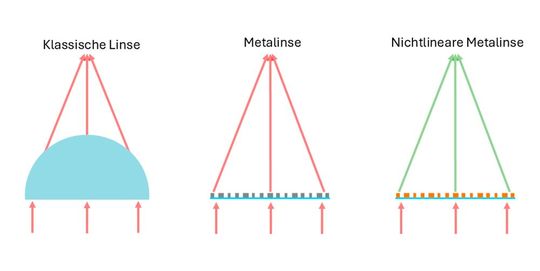
Schematic representation of a classic lens compared to a meta-lens. The arrows symbolize the light color and direction.
(Image: Ü.L. Talts / ETH Zurich)
In meta-lenses, special structures on the surface deflect light. These structures are only a few hundred nanometers in size, allowing the lenses to be heavily miniaturized. When researchers combine the nanostructures with special materials, they can also study extraordinary properties of light. An example is nonlinear optics, where light is converted from one color to another. Green laser pointers operate on this principle: infrared light passes through a high-quality crystal material and generates light of half the wavelength—in this case, green light.
A common material for such effects is lithium niobate. It is used in telecommunications for coupling electronics and optical fibers.
Comparable to Gutenberg's Printing Press
Rachel Grange, a professor at the Institute for Quantum Electronics at ETH Zurich, researches the production of nanostructures from this material. She and her team have now developed a new process for this. It allows them to work with lithium niobate so that it functions as a meta-lens.
The lithium niobate solution can be stamped directly in the liquid state with a mold negative—similar to Gutenberg's printing press.
Ülle-Linda Talts
For their new method, the physicists combined chemical processes with high-precision nanofabrication technology: "The lithium niobate solution can be stamped in its liquid state directly with a mold negative—similar to Gutenberg's printing press," explains co-first author Ülle-Linda Talts, a doctoral student with Rachel Grange. When the researchers heat the material to 1110 °F, the stamped material acquires the crystalline properties that enable light conversion akin to the green laser pointer.
Mass Production Possible
The new method has several advantages: creating nanostructures in lithium niobate using conventional techniques is difficult because this material is very stable and hard. The new method, however, is even suitable for mass production, as the print template can be used multiple times to produce the desired number of meta-lenses. This saves time and costs compared to previous methods.
Ultrathin Lenses Generate New Light
Thus, for the first time, the ETH researchers around Grange have succeeded in manufacturing meta-lenses from lithium niobate with precisely crafted nanostructures using this technique. These meta-lenses function like normal lenses but can additionally generate and control laser light of half the wavelength. When the researchers pass infrared light with a wavelength of 800 nanometers through the meta-lens, visible light with a wavelength of 400 nanometers emerges on the other side, focused on a defined focal point.
This magic of light conversion, as Rachel Grange calls it, is only possible because the ultrathin meta-lens is specially structured and the material enables this nonlinear optical effect in the first place. The effect is not limited to a specific laser wavelength and is thus versatile across different fields.
From Counterfeit-Proof Banknotes to New Microscopy
Meta-lenses or similar nanostructures that generate holograms could serve as security features on banknotes or for the authenticity verification of artworks. The structures are too small to be seen with visible light, and the nonlinear material properties allow for reliable verification.
Date: 08.12.2025
Naturally, we always handle your personal data responsibly. Any personal data we receive from you is processed in accordance with applicable data protection legislation. For detailed information please see our privacy policy.
Consent to the use of data for promotional purposes
I hereby consent to Vogel Communications Group GmbH & Co. KG, Max-Planck-Str. 7-9, 97082 Würzburg including any affiliated companies according to §§ 15 et seq. AktG (hereafter: Vogel Communications Group) using my e-mail address to send editorial newsletters. A list of all affiliated companies can be found here
Newsletter content may include all products and services of any companies mentioned above, including for example specialist journals and books, events and fairs as well as event-related products and services, print and digital media offers and services such as additional (editorial) newsletters, raffles, lead campaigns, market research both online and offline, specialist webportals and e-learning offers. In case my personal telephone number has also been collected, it may be used for offers of aforementioned products, for services of the companies mentioned above, and market research purposes.
Additionally, my consent also includes the processing of my email address and telephone number for data matching for marketing purposes with select advertising partners such as LinkedIn, Google, and Meta. For this, Vogel Communications Group may transmit said data in hashed form to the advertising partners who then use said data to determine whether I am also a member of the mentioned advertising partner portals. Vogel Communications Group uses this feature for the purposes of re-targeting (up-selling, cross-selling, and customer loyalty), generating so-called look-alike audiences for acquisition of new customers, and as basis for exclusion for on-going advertising campaigns. Further information can be found in section “data matching for marketing purposes”.
In case I access protected data on Internet portals of Vogel Communications Group including any affiliated companies according to §§ 15 et seq. AktG, I need to provide further data in order to register for the access to such content. In return for this free access to editorial content, my data may be used in accordance with this consent for the purposes stated here. This does not apply to data matching for marketing purposes.
Right of revocation
I understand that I can revoke my consent at will. My revocation does not change the lawfulness of data processing that was conducted based on my consent leading up to my revocation. One option to declare my revocation is to use the contact form found at https://contact.vogel.de. In case I no longer wish to receive certain newsletters, I have subscribed to, I can also click on the unsubscribe link included at the end of a newsletter. Further information regarding my right of revocation and the implementation of it as well as the consequences of my revocation can be found in the data protection declaration, section editorial newsletter.
Researchers can also use the conversion and control of laser light to detect infrared light as visible light with simple and inexpensive camera sensors.
However, it may still be some time before such meta-lenses reach the market. The research field of these ultrathin optical elements at the intersection of physics, materials science, and chemistry is still young.
We have only begun to grasp the potential of this technological field and are eager to see the impact this cost-effective method will have in the future.
Rachel Grange
The study was partially funded by an SNF Consolidator Grant to Rachel Grange.



:quality(80)/p7i.vogel.de/wcms/ef/1e/ef1e248f58a3697ec1384f6849762d5a/0129842086v1.jpeg "Bodo will soon be hitting it off smart! Signing the memorandum of understanding in Las Vegas: Steffen Haack, Member of the Board of Bosch Rexroth, and Yoshimoto Matsuda, Managing Director of Precision Machinery & Robot Company, Kawasaki Heavy Industries. Here's what it's all about ... (Image:Bosch Rexroth)")
:quality(80)/p7i.vogel.de/wcms/f9/7d/f97deef8fde21c8630d76411b18a20a7/0129803665v1.jpeg "Skoda has invested well over 220 million US dollars in the high-tech battery plant that has now opened in Mlada Boleslav. It has now started its work, which is highly automated ... (Image:Skoda)")
:quality(80)/p7i.vogel.de/wcms/f5/61/f561ad7c72ed41fd7a67ad9c481cb15d/0129799343v1.jpeg "Engine-generator units (MGU) from Steyr Motors are at work in the Leopard 2 main battle tank and the Leguan bridge vehicle (pictured). An extended contract is now to secure at least 500 more systems of this type for the Bundeswehr ... (Image:German Armed Forces)")
:quality(80)/p7i.vogel.de/wcms/6c/b5/6cb5ce2155433f6e73b16399adc4c561/0113143253v1.jpeg "In our China Market Insider we regularly provide you with relevant information directly from China. (Image:© Eisenhans - stock.adobe.com)")
:quality(80)/p7i.vogel.de/wcms/9c/ac/9cac6246660e746c5a3989399ac4d250/0128561645v1.jpeg "Artificial intelligence can drive efficiency in smart factories through centralized data management and predictive maintenance. (Picture: ©Fardived - stock.adobe.com)")
:quality(80)/p7i.vogel.de/wcms/6b/e2/6be235b5ad8a442ccd9d164b0b300d8b/0129763992v1.jpeg "As early as 2020, the Zimmer Group announced that it would convert its production to be sustainably CO2-neutral. (Image:Zimmer Group)")
:quality(80)/p7i.vogel.de/wcms/d4/ba/d4bab9481e66f8570f40eb8ef2a90198/0129795613v1.jpeg "A camera inspection during removal ensures that the components are placed correctly in the KLTs. (Image:Yaskawa Europe)")
:quality(80)/p7i.vogel.de/wcms/cb/56/cb56e42b01638b618e8d1b9b38f32faa/0129810132v1.jpeg "From summer 2026, \"AEON\" will support people at the BMW plant in Leipzig. (Image:diephotodesigner.de/BMW)")
:quality(80)/p7i.vogel.de/wcms/b5/5e/b55ed9355e0395ec0caf111d6af6b494/adobestock-495980372--c2-a9-20natali-mis-20-e2-80-93-20stock-adobe-com-6720x3778v1v1.jpeg "Which engineering skills will be in vogue in 2026? (Image:natali_mis - stock.adobe.com)")
:quality(80)/p7i.vogel.de/wcms/bf/a5/bfa5d882e93f159ce93e933742272b00/nord-vibn-cmyk-2196x1235v1v1.jpeg "With digital twins for virtual commissioning, Nord supports customers in ensuring that systems are available more quickly, even with complex drive systems. (Image:Nord Drivesystems)")
:quality(80)/p7i.vogel.de/wcms/f5/7e/f57ef535ee35e7b3b7ff15a8a63cef10/eds-keyvisual-8000x4496v1.jpeg "(Source: European Defence Supply)")
:quality(80)/p7i.vogel.de/wcms/af/a3/afa312176d956068af20491957eef642/newsimage418262-3100x1745v1v1.jpeg "The autonomous shuttle of the Aula AI project during a demonstration of sensor data with artificial fog. (Image:University of Magdeburg)")
:quality(80)/p7i.vogel.de/wcms/40/b3/40b38efc9eae25e69d644512a2dc4b7c/0129806862v1.jpeg "This is one of the new MDA power clamping nuts from Jakob Antriebstechnik from various angles. It is described as particularly durable and powerful. Here are a few specific data ... (Image:Jakob Drive Technology)")
:quality(80)/p7i.vogel.de/wcms/29/3a/293a6a8483f59bc2fa65a7e1a4d9a703/0129822140v1.jpeg "The Fraunhofer IDMT, Mercedes-Benz and Burmester have developed the 3D audio technology \"Audiofields\". (Image:Thomas Günnel - Automotive Industry)")
:quality(80)/p7i.vogel.de/wcms/cb/23/cb23acd8e9de969d52522692b62b1892/0129680605v1.jpeg "The Z22198 is an extremely compact, three-axis IEPE acceleration sensor for measuring oscillations (vibrations) and shocks in demanding applications. With an edge length of just 0.24 inches and a weight of 0.03 ounces, it is ideal for lightweight structures and confined spaces. (Image:Copyright 2020 ScROGERS,All Rights Reserved)")
:quality(80)/p7i.vogel.de/wcms/c4/40/c44043c61f9dd99b80ccca398c284018/0129795093v1.jpeg "Subaru manufactures the E-Outback at its Yajima plant, marking the first time it has produced an electric vehicle in-house. (Image:Subaru)")
:quality(80)/p7i.vogel.de/wcms/8f/48/8f48b0ed0d6c5c4f299b1310a7b577e9/0129830738v1.jpeg "Data centers in orbit are indeed dreams of the future, while data centers under water are already being tested. (Image:Dall-E / AI-generated)")
:quality(80)/p7i.vogel.de/wcms/36/ec/36ec46b311c3fb2cf9759ba4843047c5/0129831604v1.jpeg "Keysight and Ericsson enable validation of pre-6G interoperability with real network infrastructure and devices. (Image:Keysight)")
:quality(80)/p7i.vogel.de/wcms/c5/7a/c57ab05221defbbcaf6bddc346d21464/0129752421v1.jpeg "(Image:concept electronic GmbH)")
:quality(80)/p7i.vogel.de/wcms/12/e4/12e428b994a4f83779ce72d333964fcf/wth1pi1740-01-2048x1152v1v1.jpeg "Würth Elektronik has developed a customized transformer for the intelligent Motion Mate orthosis from Powered Orthotics, which was presented at DLD. (Image:Philipp Guelland for DLD Hubert Burda Media)")
:fill(fff,0)/images.vogel.de/vogelonline/companyimg/76800/76895/65.jpg "FAULHABER_120mm.jpg ()")
:fill(fff,0)/p7i.vogel.de/companies/67/eb/67eba621ef6ea/logo2.png "logo2 (Wuxi InfiMotion)")
:quality(80):fill(efefef,0)/p7i.vogel.de/wcms/67/ad/67adf92d254d2/elatec-wp-smart-factory.png "Elatec WP Smart Factory")
:quality(80)/p7i.vogel.de/wcms/91/fd/91fd55d7dc44ce321bd7587272059d08/0128103878v1.jpeg "This ETH Zurich logo consists of 2,800 nano light-emitting diodes and, with a height of 20 micrometers, is approximately the size of a human cell. A single pixel measures around 0.2 micrometers. At this resolution, the following article could be printed about 2,000 times on the area of a period. (Image:Amanda Paganini / ETH Zurich)")
:quality(80)/p7i.vogel.de/wcms/63/a7/63a708ecf94aa481889584e366f64214/0125053232v1.jpeg "Integrated optical circuits: Fraunhofer IOF has developed both the optical and electrical interconnection technology for the LNOI circuits. (Image:Fraunhofer IOF)")