In 2025, China's automotive industry has aroused much admiration worldwide - and stirred up new fears. What will happen in 2026?
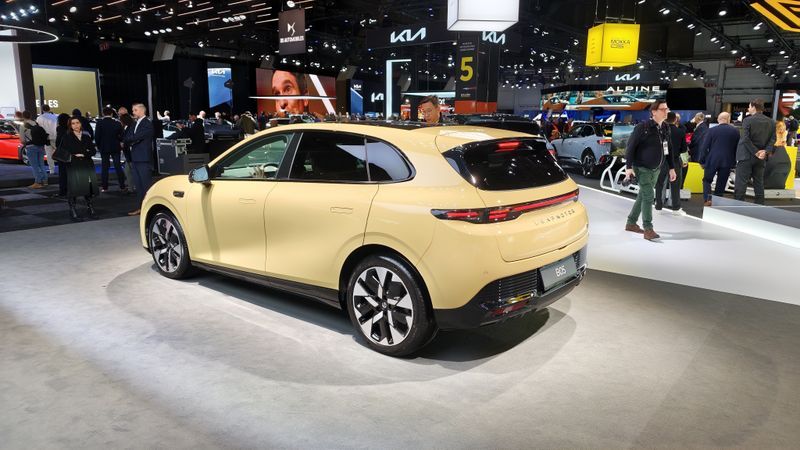
Japanese and Korean manufacturers once came to Europe. Now a wave of new brands from China is following (pictured: Leapmotor).
(Image: Wehner - VCG)
Every few days there were new headlines about technological innovations such as flying cars or electric cars, from whose roof drones can take off to survey traffic jams or photograph landscapes. The emergence of an entire industry, the many innovations and the ambition of Chinese engineers and entrepreneurs could no longer be overlooked.
In almost every report about profit drops, plant closures, or job cuts in the German and European automotive industry, China is also mentioned. The growing competition from the now largest car-exporting nation in the world is seen as a reason for some difficulties at home.
What is a source of justified pride for the Chinese often appears threatening from a German perspective. There has not been such a rapid rise of a competitor since the entry of the Japanese and later the South Koreans into the global vehicle market.
New Strategy Instead of Panic
However, regardless of one's stance on this upheaval, it must be closely monitored if Germany wants to remain an automotive nation in the future. Similar to the initial exports of the Japanese and Koreans, the key is not to fall into panic, but to adjust one's own strategy and face the competition. This provides a reason to take a look at the trends for 2026 that are already emerging:
1. The Domestic Automotive Market in China Will Cool Down in 2026
The latest figures, particularly for December 2025 and the fourth quarter of the previous year, indicate a weakening of the rapid growth in the Chinese automotive industry for 2026.
Overall, car sales in China increased by nearly four percent last year. However, this was already a slight slowdown compared to 2024, when new sales rose by over five percent.
Sales of electric vehicles and hybrid vehicles, collectively categorized as "New Energy Vehicles" (NEV) in China's statistics, saw significant growth in 2025 in terms of absolute sales figures. However, even in this segment, a slowdown in the growth curve is now anticipated.
In 2025, more electric vehicles and hybrids were sold in China for the first time than vehicles with internal combustion engines. New sales increased by almost 18 percent compared to the previous year, a figure that would likely be celebrated happily in many countries around the world. However, in the Chinese context, this indicates an end to the craziest years of the NEV boom. In 2024, the growth in NEV sales compared to the previous year was still 40 percent.
Cui Dongshu, Secretary General of the Chinese Passenger Car Association (CPCA), predicted "zero growth or slightly positive growth" for his industry in 2026, according to state media. A number of factors are responsible for this economic slowdown. One of these is the reduction of tax exemptions for electric vehicles and hybrids at the end of the year.
Additionally, in many provinces, funds for so-called "trade-in bonuses" for surrendering an old vehicle have been depleted, which also results in a practical reduction of governmental purchase incentives.
Overall, the confidence of Chinese consumers has not fully recovered from the period of excessive COVID-19 measures and the subsequent slump in the real estate market. All of this limits the desire to purchase a car for many in 2026.
2. Competition in China Will Continue to Intensify
Even in a phase of weakened economic growth, there are numerous success stories in the Chinese automotive industry. However, much to the chagrin of German and other foreign manufacturers, it is primarily a few Chinese OEMs that are achieving record results despite a challenging market environment.
Xiaomi, the Chinese manufacturer of smartphones and household appliances, has only been in the electric vehicle market for just over a year. Nonetheless, Xiaomi managed to sell more than 410,000 of its SU7 sedans and YU7 SUVs in 2025. It is expected that this number will increase in the current year.
The start-up Leapmotor was able to more than double its sales in 2025 compared to the previous year. The company has set a growth target of 68 percent for 2026.
These are just two examples. Many of these well-built, surprisingly affordable cars enable their Chinese manufacturers to capture further market shares from Porsche, BMW, Mercedes-Benz, and other foreign brands.
Just five years ago, joint venture manufacturers—multinational automakers with their Chinese partners—held a 64 percent share of the Chinese passenger car market. Meanwhile, 65 percent of this market now belongs to Chinese automakers.
Date: 08.12.2025
Naturally, we always handle your personal data responsibly. Any personal data we receive from you is processed in accordance with applicable data protection legislation. For detailed information please see our privacy policy.
Consent to the use of data for promotional purposes
I hereby consent to Vogel Communications Group GmbH & Co. KG, Max-Planck-Str. 7-9, 97082 Würzburg including any affiliated companies according to §§ 15 et seq. AktG (hereafter: Vogel Communications Group) using my e-mail address to send editorial newsletters. A list of all affiliated companies can be found here
Newsletter content may include all products and services of any companies mentioned above, including for example specialist journals and books, events and fairs as well as event-related products and services, print and digital media offers and services such as additional (editorial) newsletters, raffles, lead campaigns, market research both online and offline, specialist webportals and e-learning offers. In case my personal telephone number has also been collected, it may be used for offers of aforementioned products, for services of the companies mentioned above, and market research purposes.
Additionally, my consent also includes the processing of my email address and telephone number for data matching for marketing purposes with select advertising partners such as LinkedIn, Google, and Meta. For this, Vogel Communications Group may transmit said data in hashed form to the advertising partners who then use said data to determine whether I am also a member of the mentioned advertising partner portals. Vogel Communications Group uses this feature for the purposes of re-targeting (up-selling, cross-selling, and customer loyalty), generating so-called look-alike audiences for acquisition of new customers, and as basis for exclusion for on-going advertising campaigns. Further information can be found in section “data matching for marketing purposes”.
In case I access protected data on Internet portals of Vogel Communications Group including any affiliated companies according to §§ 15 et seq. AktG, I need to provide further data in order to register for the access to such content. In return for this free access to editorial content, my data may be used in accordance with this consent for the purposes stated here. This does not apply to data matching for marketing purposes.
Right of revocation
I understand that I can revoke my consent at will. My revocation does not change the lawfulness of data processing that was conducted based on my consent leading up to my revocation. One option to declare my revocation is to use the contact form found at https://contact.vogel.de. In case I no longer wish to receive certain newsletters, I have subscribed to, I can also click on the unsubscribe link included at the end of a newsletter. Further information regarding my right of revocation and the implementation of it as well as the consequences of my revocation can be found in the data protection declaration, section editorial newsletter.
The pressure is increasing for Volkswagen, Toyota, GM, and other foreign manufacturers in the People's Republic, and this trend is likely to continue in 2026.
3. Artificial Intelligence is Revolutionizing How Cars Are Developed, Built, and Driven in China
Following the first wave of disruption (electrification) and the second wave (intelligent driving), the third wave of disruption through AI has now begun. By 2026, it is expected to challenge nearly all previous certainties along the entire automotive value chain.
In AI factories like the one run by Xiaomi in the Beijing suburb of Yizhuang, a new electric vehicle rolls off the production line every 76 seconds, starting at the end of 2024. 700 robots and 180 AMRs (autonomous mobile transport robots) have largely taken over the work, while central computers and AI agents control many of the processes.
In 2026, more of these state-of-the-art factories will be built in China, which, according to the prestigious US trade magazine Industrial Equipment News (IEN), will "usher in a new era of manufacturing."
The beginning of this year has also made a significant impact in autonomous driving. Xpeng and Geely introduced new "World Models" at CES in Las Vegas, revolutionizing AI training with millions of videos. Analysts believe this represents a technological breakthrough on the path to autonomous driving at Levels 3 and 4.
4. Automotive and Robotics Industries Will Converge Faster
Embodied AI is not only making its way into China's automotive factories in the form of AI agents that control cobots or humanoids learning teamwork, but it is also creating new business models in the automotive industry.
Geely, China's second-largest automaker, has just consolidated all its business units in the AI sector into a new subsidiary in Chongqing. Under the new brand "Afari," Geely plans to introduce AI-defined assistance systems like its recently presented "G-ASD," but it also has much bigger plans.
Li Shufu, the founder of Geely and a major shareholder in Daimler, aims to repurpose the technology developed for autonomous driving for use in robots. He has announced his intention to make Geely the largest robotics manufacturer in the world.
Embodied AI and autonomous driving have much in common. The same World Models and vertical AI models that enable environmental perception and action instructions in autonomous driving can also control robots.
Technologically, the year 2026 will once again be extremely exciting in the Chinese automotive industry. The conquest of airspace with eVTOL aircraft will also accelerate.
Following last year's initial commercialization of new mobility with regular routes for unmanned cargo drones, the new year is likely to bring the first relevant business models in passenger transport.
"In 2026, the automotive industry will undergo a profound transformation from electrification towards comprehensive intelligence, with breakthroughs in AI and new energy technology being the key drivers," writes the automotive portal Zhongguo Qiche Bao in its "Technology Outlook" for the newly commenced year.
5. China's Government Regulates the Automotive Industry Tighter Than Ever Before
The State Administration for Market Regulation in Beijing has introduced binding limits on the energy consumption of electric vehicles starting January 1 of this year. This is a world first and signals that the central planners in Beijing want to drive their domestic automotive industry towards even more research and development to secure a global leadership role.
There are now tiered maximum limits for electricity consumption, depending on the weight of the vehicles. For models weighing around two tons, the newly established standard sets a maximum electricity consumption of 15.1 kilowatt-hours per 100 kilometers ( approx. 15.1 kWh/62 miles).
Stricter regulations for battery safety are also set to come into effect in July of this year. According to the updated rules, batteries for electric vehicles must not catch fire or explode for at least two hours after experiencing thermal runaway.
Their temperatures must not exceed 60 °C (140 °F) during normal operation. Here too, the responsible Ministry of Industry and Information Technology (MIIT) is forcing manufacturers to seek further innovations in the interest of consumers and the reputation of the Chinese automotive industry.
Market observers in Beijing also consider it possible that the government could introduce guidelines for "compliant pricing behavior in the automotive industry" in 2026. The extreme price competition (keyword "involution") would then be curtailed.
6. China's Government Reduces Subsidies for Electric Vehicles and Hybrids
The acquisition tax for NEVs, which includes electric vehicles, hybrids, and vehicles with other alternative drives like fuel cells, has been partially reinstated as of January 1, 2026. It is now 50 percent applicable.
The tax rate for NEVs increases from zero to five percent. The maximum tax reduction per NEV is halved from 30,000 yuan (approximately €3,700 / $4,300). Plug-in hybrids with an all-electric range of less than 100 kilometers will no longer receive any subsidies.
Through this measure, the legislator in Beijing is creating new incentives for innovations, which are, of course, costly, thereby indirectly promoting the consolidation of the industry and its shift from "quantity to quality." The international competitiveness of the Chinese automotive industry is thus expected to be further strengthened.
7. China to Export Even More Cars and Build Abroad in 2026
Chinese automakers are increasingly pushing into the global market. BYD was able to sell more than one million electric vehicles and hybrids last year, surpassing the previous global market leader Tesla in the sales of pure electric vehicles for the first time. It is fair to say that there is significant consumer interest in these vehicles in Europe, Southeast Asia, and other regions of the world.
The total number of vehicles exported from China in 2025 is not yet available but is estimated by market observers in Beijing and Shanghai to be nearly seven million. From January to November 2025, exports had already increased by nearly 19 percent year-over-year to more than 6.3 million vehicles. For the current year 2026, forecasts indicate that "more than eight million" vehicles will be exported.
This export success occurs despite a very challenging international market environment for Chinese manufacturers. In the USA, for instance, Chinese electric vehicles, which constitute the majority of China's export growth, are not allowed to be sold at all.
Chinese electric vehicles have also been subjected to additional tariffs by the EU Commission in Brussels, citing an alleged "flooding" of the European market. After western automakers sold an estimated 60 million cars in China over the past few decades, EU bureaucrats are now trying to shield the domestic market even at the arrival of the first few hundred thousand Chinese electric vehicles.
China's OEMs are responding by opening automotive plants in Eastern Europe, Turkey, and countries with abundant green energy like Spain. Some are also opting for contract manufacturing, such as with Magna in Graz. This trend is expected to continue in the ongoing year.



:quality(80)/p7i.vogel.de/wcms/31/84/3184f9ac736d8df7c2e934593684bc74/0130024314v1.jpeg "Here, the Bavarian car manufacturer BMW looks ahead to 2025: business was sluggish due to US tariffs and weakening sales in China ... (Image:BMW)")
:quality(80)/p7i.vogel.de/wcms/49/09/49095c6192a6c46d47b567e1def31ea6/0130024626v1.jpeg "The new TUM \"RoboGym\" (powered by Neura) is Europe's largest training center for next-generation humanoid robots. It focuses on the implementation of artificial intelligence in robotic systems. At the same time, it is a forge for AI experts ... (Image:Neura Robotics)")
:quality(80)/p7i.vogel.de/wcms/fe/8a/fe8af1b829b085210fef4c1fa8abddb5/0129784389v1.jpeg "As an integral part of Koch Pac-Systeme's Predictive Pack digital service product, the gearboxes with Cynapse and Wittenstein's Smart Services make it possible to detect damage risks in the packaging specialist's machines at an early stage. (Image:Koch Pac systems)")
:quality(80)/p7i.vogel.de/wcms/9f/7b/9f7be35880605811e045acd3af8b571b/0129558586v1.jpeg "An example of the V210 processing machine, which, according to Voortman, supplements the laser cutting of the V353 with drilling, thread cutting and milling. (Image:Voortman)")
:quality(80)/p7i.vogel.de/wcms/db/68/db689490e348201603dd30447711ea2b/0129578734v1.jpeg "With three-axis vibration measurement (X, Y and Z axes) and temperature detection, the CMSVT38 condition monitoring sensor provides detailed status information that helps to detect machine damage at an early stage. (Image:Kübler)")
:quality(80)/p7i.vogel.de/wcms/92/5e/925ee98ea36ad9bd574fa1cea11d0e53/0129964352v1.jpeg "The production of hardware components for humanoid robots offers great market potential. (Image:Fraunhofer IPA)")
:quality(80)/p7i.vogel.de/wcms/08/72/0872dd2dd119a54824c41e0e580e45a8/0129576591v1.jpeg "The Rose enclosure systems can be customized on request. (Image:Rose Systemtechnik GmbH)")
:quality(80)/p7i.vogel.de/wcms/73/17/7317794432521bf911711b91287cfc28/0129961259v1.jpeg "ABB Robotics and Nvidia are enabling the widespread use of physical AI in the world of robotics. This means that systems can be created virtually and with high precision and optimized much more cost-effectively. In the large image the virtual system, next to it the real robot cell ... (Image:ABB)")
:quality(80)/p7i.vogel.de/wcms/cb/fe/cbfe2741917274bbbf93d5b93e47a4f5/contact-software-launcht-fourier-20aiv1v1.png "Fourier AI combines AI models with AI applications developed for demanding engineering tasks. (Image:Contact Software)")
:quality(80)/p7i.vogel.de/wcms/bc/f7/bcf7a56980850be13ed37d220cd514bc/elchinator-security-5042249-1280-1280x720v1v1.jpeg "The HP Wolf Security Report shows: Attackers use AI for speed, modularity and automation, while the quality of campaigns is low. (Image:Picture: Pixabay)")
:quality(80)/p7i.vogel.de/wcms/68/89/688937087188b77da95b2079399ca862/0130009534v1.jpeg "Here you can see the Dualis layout configurator in use at Montratec. (Picture: ©Gorodenkoff - stock.adobe.com)")
:quality(80)/p7i.vogel.de/wcms/9e/98/9e984afbf9c6f2bcc8963bd13465b180/26-02-pi-fraunhofer-iws-41300-ultragrain-project-closing-pic-02-1562x878v1v1.png "The process of laser wire build-up welding (DED-LB) with pulse laser-induced plasma, which contributed to the success of the Ultra Grain project, is shown at high speed. (Image:Fraunhofer IWS)")
:quality(80)/p7i.vogel.de/wcms/69/f5/69f516f07a0ba999c5ba8763891853f1/0130030553v1.jpeg "Can be reloaded in 210 seconds for a return trip on the Greenford branch line: the GWR's 230001. (Image:Jack Boskett Media | GWR)")
:quality(80)/p7i.vogel.de/wcms/f0/5e/f05e720c52f757660ddbf7c410074f64/adobestock-222131875-5616x3157v1.jpeg "(Source: © jeson - stock.adobe.com)")
:quality(80)/p7i.vogel.de/wcms/b2/64/b2641254fef5afa15645cefc37089c88/0130021093v1.jpeg "Daimler Truck and Quantum Systems are jointly developing unmanned military vehicles. (Image:Quantum Systems)")
:quality(80)/p7i.vogel.de/wcms/30/7e/307e71ec64f7c52c29458544ca29adf1/org-blobs-user-response-file-output-799034cb-2ad7-4031-859a-15013f5b78e3-plugin-output-toolu-01vwfuenhw3cadvud7pddgyq-1536x864v1v1.png "China's government is debating the contents of the 15th five-year plan. The focus will change for the automotive industry. (Image:AI-generated)")
:quality(80)/p7i.vogel.de/wcms/61/8f/618f16f8fa95ec6cc838ca9bfb5dbaf1/0130027046v1.jpeg "The Belgian Research Institute has set up a European university consortium on the subject of CMOS 2.0. It brings together 26 university groups to research chip technologies that go beyond conventional transistor scaling. (Image:Imec)")
:quality(80)/p7i.vogel.de/wcms/db/a2/dba29322d0934dea1bbc4b31df80e392/0129953760v1.jpeg "SEM image: High-density electrode array with 128 nm dots. (Image:imec)")
:quality(80)/p7i.vogel.de/wcms/c2/a8/c2a8a93f306c1475489dff074ad59731/0129967672v1.jpeg "Figure 1: Imec's logic technology roadmap showing the extension of the nanosheet era from 2nm to the A10 node with the outer-wall forksheet, before the transition to CFET for A7 and beyond. (Image:imec)")
:quality(80)/p7i.vogel.de/wcms/07/79/0779a3ba2b38d583fc9b515900be2add/0129957428v1.jpeg "If the Chinese government has its way, domestic data centers full of Nvidia hardware will be a thing of the past. (Image:Nvidia)")
:fill(fff,0)/p7i.vogel.de/companies/67/eb/67eba621ef6ea/logo2.png "logo2 (Wuxi InfiMotion)")
:quality(80)/p7i.vogel.de/wcms/33/be/33be0659e7949b9459d12230d26bbc14/byd-haendlertagung-de-5-20-281-29-3240x1822v1v1.jpeg "The photo was taken at the BYD dealer conference in Germany. Globally, the manufacturer has significantly expanded its sales network and thereby been able to substantially increase its sales. (Image:BYD)")
:quality(80)/p7i.vogel.de/wcms/92/91/9291b2991ec54e858178d63d1017cb36/grimm-vcg-1489x837v1.png "Supported by a strong domestic market, Chinese brands like Nio are seeking breakthroughs in many global markets.
(Image:Grimm – VCG )")