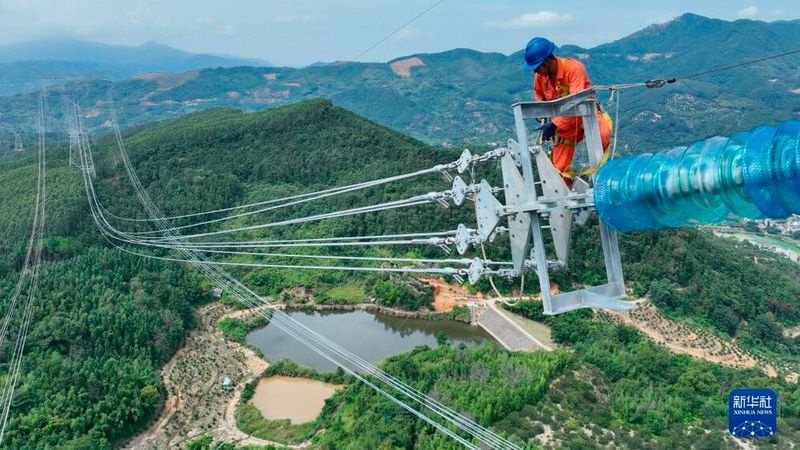
China is currently building a nationwide network of ultra-high voltage lines to harness even more solar and wind energy. The high-tech monster lines are often several thousand kilometers long and bring electricity from remote locations to densely populated industrial regions.
"Ultra-High-Voltage" or UHV transmission lines often transport electricity several thousand kilometers from remote regions of China to the country's industrial regions.
(Image: german.china.org.cn)
Henrik Bork, a longtime China correspondent for the Süddeutsche Zeitung and the Frankfurter Rundschau, is Managing Director at Asia Waypoint, a consulting agency specializing in China, based in Beijing.
One of the latest examples of "Ultra-High-Voltage" or UHV transmission lines was put into operation at the end of October. The 1,000-kilovolt UHV AC line "Zhangbei-Shengli" will transport electricity from wind farms on the edge of the Gobi Desert to Beijing and Tianjin, and via further lines to Jiangsu province on the coast, more than 932 miles away.
The line will be able to transmit more than 70 billion TWh of electricity, enough power for 19 million households for an entire year. This will "increase the consumption of green energy at the endpoint of the power grid," reports the official news agency Xinhua.
Giant spiderweb under high voltage
The technology of UHV transmission was not invented in China, but it is now being perfected there on a scale never before seen worldwide—in terms of both the quality and quantity of the vast spiderweb under high voltage.
The UHV technology is based on the principle that the electrical currents must be lower for a certain amount of transmitted energy the higher the voltage can be maintained. In China, lines are classified as "UHV" if they can transmit direct currents (DC) of 800,000 volts or more or alternating currents (AC) of 1,000,000 volts or more.
Central piece of China's energy strategy
The expansion of this network has become a central piece of China's energy strategy in recent years. The country has enormous resources of renewable energies, which are often harvested in the Gobi and Taklamakan deserts, many thousands of miles away from the urban centers where the greatest demand is found.
The problem is universal, but it is particularly relevant in China due to the sheer size of the country. Storing green energy in batteries or other "storage media" is expensive. It is often better to transmit the electricity directly to urban centers without intermediate storage.
Committed to ambitious climate goals
Despite the massive initial investments required for UHV lines, in the long term, the low-cost solar and wind power can be better fed into the grid to cover the consumption of Chinese industry and keep electricity costs low for consumers. Additionally, China has committed to ambitious climate goals and sees this UHV grid expansion in the context of climate protection.
The development of a UHV network in China began just over a decade ago, primarily for the transmission of coal power from the northwest and north of the country to the megacities on the coast.
It was then recognized as cheaper and more efficient to send electricity from the mining regions in the north through power lines than to clog three-quarters of the country's total freight capacity with the shipment of coal and other fossil fuels. It was also intended to eliminate bottlenecks that repeatedly led to "blackouts."
Experience in constructing UHV lines
Very early on, in 2010, a 1,180-miles-long UHV line from the Xiangjiaba hydropower plant on the Jinsha River, one of the upper reaches of the Yangtze River, to Shanghai was put into operation.
For this ultra-high voltage line, 3,939 power pylons were erected, carrying their massive cables over gorges, rivers, and the seemingly endless expanses of rice and vegetable fields to Shanghai, where today they cover around 40% of the metropolis's energy needs.
Recently, the central government in Beijing recognized that UHV lines are also central to the further expansion of renewable energies. Therefore, the expansion of the network is currently being significantly accelerated.
According to unofficial reports in Chinese specialist media, Beijing has already invested the equivalent of more than 200 billion euros in the expansion of the ultra-high voltage lines.
Billion-dollar investments in UHV projects
By April 2024, 38 UHV lines were already in operation, 18 of them AC and the rest DC lines. This means that China's State Grid, which operates most of them, has already achieved the goal set in the 14th Five-Year Plan by 2025 ahead of schedule. Additionally, 14 new lines are currently in planning or already under construction.
Official figures for the required investments are hard to come by, but China's State Grid has announced that it will invest about 380 billion yuan (around 50 billion euros) in UHV projects between 2021 and 2025, an increase of 35.7 percent compared to the previous five years.
According to unofficial reports in Chinese specialist media, Beijing has already invested the equivalent of more than 200 billion euros in the expansion of ultra-high voltage lines.
In China, UHV lines are also called "the Shinkansen for electricity," using the Japanese term for particularly fast and efficient high-speed trains. Similar to its own network of high-speed rail lines, Beijing is now rapidly and resolutely expanding the infrastructure of its UHV power lines.
Date: 08.12.2025
Naturally, we always handle your personal data responsibly. Any personal data we receive from you is processed in accordance with applicable data protection legislation. For detailed information please see our privacy policy.
Consent to the use of data for promotional purposes
I hereby consent to Vogel Communications Group GmbH & Co. KG, Max-Planck-Str. 7-9, 97082 Würzburg including any affiliated companies according to §§ 15 et seq. AktG (hereafter: Vogel Communications Group) using my e-mail address to send editorial newsletters. A list of all affiliated companies can be found here
Newsletter content may include all products and services of any companies mentioned above, including for example specialist journals and books, events and fairs as well as event-related products and services, print and digital media offers and services such as additional (editorial) newsletters, raffles, lead campaigns, market research both online and offline, specialist webportals and e-learning offers. In case my personal telephone number has also been collected, it may be used for offers of aforementioned products, for services of the companies mentioned above, and market research purposes.
Additionally, my consent also includes the processing of my email address and telephone number for data matching for marketing purposes with select advertising partners such as LinkedIn, Google, and Meta. For this, Vogel Communications Group may transmit said data in hashed form to the advertising partners who then use said data to determine whether I am also a member of the mentioned advertising partner portals. Vogel Communications Group uses this feature for the purposes of re-targeting (up-selling, cross-selling, and customer loyalty), generating so-called look-alike audiences for acquisition of new customers, and as basis for exclusion for on-going advertising campaigns. Further information can be found in section “data matching for marketing purposes”.
In case I access protected data on Internet portals of Vogel Communications Group including any affiliated companies according to §§ 15 et seq. AktG, I need to provide further data in order to register for the access to such content. In return for this free access to editorial content, my data may be used in accordance with this consent for the purposes stated here. This does not apply to data matching for marketing purposes.
Right of revocation
I understand that I can revoke my consent at will. My revocation does not change the lawfulness of data processing that was conducted based on my consent leading up to my revocation. One option to declare my revocation is to use the contact form found at https://contact.vogel.de. In case I no longer wish to receive certain newsletters, I have subscribed to, I can also click on the unsubscribe link included at the end of a newsletter. Further information regarding my right of revocation and the implementation of it as well as the consequences of my revocation can be found in the data protection declaration, section editorial newsletter.
1,200,000 megawatts of solar and wind power
When it comes to the installation of renewable energies, China is already a global leader. Recently, the milestone of 1,200,000 megawatts of solar and wind power has been reached, which, according to the country's self-imposed energy transition goals, was not due for another six years. (Our sister magazine MaschinenMarkt reported).
In 2024 alone, around 260,000 MW of solar and wind power installations will be newly deployed in China, more than anywhere else on Earth and about nine times as much as in Germany and four and a half times as much as in the USA during the same period. It has just been decided to triple the pace of this expansion of renewable energies over the next six years.
China's carbon dioxide emissions decrease for the first time
The UHV network will enable China to further increase the share of solar and wind power in the overall energy mix from the current 15.6 percent. Already in the first half of 2024, the construction of new coal-fired power plants in China has slowed for the first time, despite the country's growing energy demand. China's carbon dioxide emissions have also recently decreased for the first time.
Most of the existing UHV lines in China currently transport a mix of coal power and green power. In 2022, the share of renewable energy transmitted through China's UHV network was 56.2 percent, as recently reported by the BBC. However, about half of that was still electricity from hydropower.
In the coming years, Beijing now aims to significantly increase the share of solar and wind power fed into the grid via long UHV lines. More and more solar and wind farms will be connected to UHV lines.
Use UHV for renewable energies
Recently, new UHV lines have also been established exclusively for the long-distance transport of renewable energies. More than 60 percent of all solar power and one-third of all wind power come from northwest China and the Gobi and Taklamakan deserts. Now, it is to be distributed more effectively across the entire country, and the magic formula for this is UHV.
In 2023, construction began on the first "purely green" UHV line, which will transport wind and solar power from the northwestern province of Ningxia to the populous province of Hunan in the south of the country.
Affordable electricity prices for industry
Since renewable energies are the cheapest of all energy sources in the long term, Beijing also expects a further increase in the international competitiveness of its manufacturing industry. Already, electricity prices for Chinese companies are much lower than those for German companies at home.
E-cars, chemicals, and many other goods can be produced much more cost-effectively in China than in our country. Beijing's energy policy is significantly responsible for the success of new industries such as electromobility or the explosive growth of data centers for AI applications in China.
Subsidies for these new economic sectors, contrary to what is often assumed in the West, have only a relatively small share in these success stories. Cheap energy is China's biggest recipe for success—and this despite rapid economic growth and the energy needs of a billion people.
It is already certain that the relative "energy advantage" for Chinese industry will continue to grow in the coming years due to the simultaneous strong expansion of renewable energies and the UHV transmission network. In contrast, German industrial companies, which increasingly compete directly with Chinese companies, will be even more disadvantaged in their exports on the global market due to China's strategic energy and grid policy.



:quality(80)/p7i.vogel.de/wcms/dd/08/dd086510d9ae7b50181f6070e4463b44/0129363730v1.jpeg "Typical application for ionizing devices: Wrapping films. (Picture: ©Adobe Stock/SMC)")
:quality(80)/p7i.vogel.de/wcms/35/57/3557c819943c53acec41a0ccba87da4f/0130049064v1.jpeg "Researchers at the Fraunhofer IWU in Chemnitz have long known that many typical sheet metal parts can be manufactured more cost-effectively using hollow embossing rollers. Now there is news to report ... (Image:Fraunhofer IWU)")
:quality(80)/p7i.vogel.de/wcms/59/02/590246e3b3f415c65edbee377c14ca77/26-06-pi-fraunhofer-iws-41450-direktplattieren-pic-01-7771x4369v1v1.jpeg "The Fraunhofer IWS has developed the new \"direct laser cladding\" process, which creates a functional layer directly on the base body by applying a strip-shaped metal to rotationally symmetrical components in a spiral and bonding it locally by laser. (Image:Christoph Wilsnack/Fraunhofer IWS)")
:quality(80)/p7i.vogel.de/wcms/73/60/73608418789b1d9c393f5e2fa974eda2/0130209906v1.jpeg "The robots of the X6 generation from b+m enable very high painting quality and are also particularly compact and easy to maintain. (Image:Beckhoff)")
:quality(80)/p7i.vogel.de/wcms/78/e9/78e9188c25a8a94e67c34c9bf8ffe495/visual-agile-20robots-20and-20google-20deepmind-20partner-20to-20bring-20intelligence-20to-20robotics-2500x1406v1v1.jpeg "Together, the partners are developing adaptable, intelligent robots for a wide range of applications (Image:Agile Robots SE)")
:quality(80)/p7i.vogel.de/wcms/e7/66/e7669ecf0260ae8fc54c214e34e4902a/0130316817v1.jpeg "Siemens and Palo Alto Networks offer tested cybersecurity solution for industrial 5G. (Image:Siemens)")
:quality(80)/p7i.vogel.de/wcms/9f/55/9f55324832c4f426958031375124d9de/siemens-20ubtech-20hmnd-1920x1079v1v1.png "Ready for the factory floor: While Ubtech is planning mass production, Siemens is already testing humanoids in real factory applications in Erlangen. (Image:Siemens)")
:quality(80)/p7i.vogel.de/wcms/11/36/113695ed260e29c8c2d9d39dc5f9d869/0130213768v1.jpeg "AI can work cheaply in China and deliver the results rapidly all over the world. (Image:Dall-E / AI-generated)")
:quality(80)/p7i.vogel.de/wcms/62/5f/625f41e87ebfef156a98c8e6393e32fd/0130211654v1.jpeg "Axial flux motors have some advantages over radial flux motor—but their production is currently still expensive. (Image:RWTH Aachen University)")
:quality(80)/p7i.vogel.de/wcms/77/9b/779b0685d010dfe45c9c2cb1cfecd467/0128886425v1.jpeg "The BlueEye is the first \"real\" hyperspectral camera for the UV range and covers the wavelength range from 220 to 380nm. (Image:Inno-spec GmbH)")
:quality(80)/p7i.vogel.de/wcms/e4/51/e451d52ce0182fb0aaa46a5774f832ef/26-04-pi-fraunhofer-iws-21160-bioslide-pic-01-4128x2321v1v1.jpeg "With the BioSlide research project, the Fraunhofer IWS is investigating how sliding systems can be designed to be more sustainable and energy-efficient. New materials can be tested in a particularly application-oriented manner on this plain bearing test stand. (Image:Fraunhofer IWS)")
![Thanks to advanced 3D printing technology, a more efficient use of resources should contribute to lower-emission aviation—this is the goal of ['skai]-lab. (Image:Oleksandr Pashchenko - stock.adobe.com / AI-generated)](https://cdn1.vogel.de/nghHNSbySccfOjG3n1qCA-FVOjQ=/288x162/smart/filters:format(jpg):quality(80)/p7i.vogel.de/wcms/62/64/626424c97a16e69f871bf216c9629c2a/adobestock-1927043193--c2-a9-20oleksandr-20pashchenko-20-e2-80-93-20stock-adobe-com-ki-generiertv1v1.jpeg "Thanks to advanced 3D printing technology, a more efficient use of resources should contribute to lower-emission aviation—this is the goal of ['skai]-lab. (Image:Oleksandr Pashchenko - stock.adobe.com / AI-generated)")
:quality(80)/p7i.vogel.de/wcms/c3/c4/c3c4ce270b083eeac55654148611f064/0130237945v1.jpeg "China is not giving up on hydrogen, but is intensifying its efforts. (Image:freely licensed from Pixabay)")
:quality(80)/p7i.vogel.de/wcms/4e/c0/4ec0bd19390b169edfa23677373dcdf1/0130260089v1.jpeg "Renewable fuels can supply European road traffic, according to a study. (Image:Aral)")
:quality(80)/p7i.vogel.de/wcms/6f/c9/6fc9050301d745cad25585c6780f8f51/0130197341v1.jpeg "Production facilities are a worthwhile target and are therefore at risk. (Image:ABB Robotics)")
:quality(80)/p7i.vogel.de/wcms/b6/62/b662adc2cec8227d8172509bbfb6ee42/25c0207-107-4961x2789v1v1.jpeg "The GLB is the second model based on Mercedes' new MMA platform. Apparently, Geely's platform is better and cheaper, which is why the two companies are negotiating a partnership. (Image:Mercedes-Benz)")
:quality(80)/p7i.vogel.de/wcms/4d/dd/4dddf438e91f394c04a095dbfd109d1c/0130236430v1.jpeg "Measurement modules: The 720301 module in combination with the SL2000 enables RMS and power calculations, among other things. (Image:Yokogawa)")
:quality(80)/p7i.vogel.de/wcms/61/fc/61fcf95f5cca15494ad18343901ae585/0130317237v1.jpeg "With the AGI CPU, Arm says it is taking a \"historic step\": With the processor aimed at AI in data centers, the company is presenting itself for the first time as a provider of its own chips, not just as a pure IP licensor. (Image:Arm)")
:quality(80)/p7i.vogel.de/wcms/82/90/8290dfe3595b6c6b33726ae8b76172c7/0130319587v1.jpeg "The concept image illustrates how the pattern of tiny protrusions and depressions created on the substrate (MgO, bottom) controls the arrangement of atoms in the superconducting material (YBCO, top). At the interface between the two layers, an electronic structure enables superconductivity to occur at higher temperatures than previously possible. (Image:Chalmers University of Technology / Riccardo Arpaia)")
:fill(fff,0)/p7i.vogel.de/companies/67/eb/67eba621ef6ea/logo2.png "logo2 (Wuxi InfiMotion)")
:quality(80)/p7i.vogel.de/wcms/c0/fe/c0fe3f3e15722a98aeb95230288ea18b/0121087561v1.jpeg "For more than a century, scientists around the world have been trying to develop long-lasting nuclear batteries. Now, there is a success report from China. (Image:Thomas Bethge - stock.adobe.com)")
:quality(80)/p7i.vogel.de/wcms/25/55/255542be50cd5fdba0bef2f35dca9e77/0128669102v1.jpeg "China is rapidly increasing the share of wind and solar power in its energy mix. The newly completed transformer is intended to help transport green electricity via direct current and at ultra-high voltage over thousands of kilometers. (Image: ©Adin - stock.adobe.com)")
:quality(80)/p7i.vogel.de/wcms/11/36/113695ed260e29c8c2d9d39dc5f9d869/0130213768v1.jpeg "AI can work cheaply in China and deliver the results rapidly all over the world. (Image:Dall-E / AI-generated)")