Here we present three optimized solutions for simulation in body-in-white, tool and mold making, as well as for the design and optimization of the injection molding process.
Three optimized solutions from the world of simulation.
(Image: Autoform Engineering)
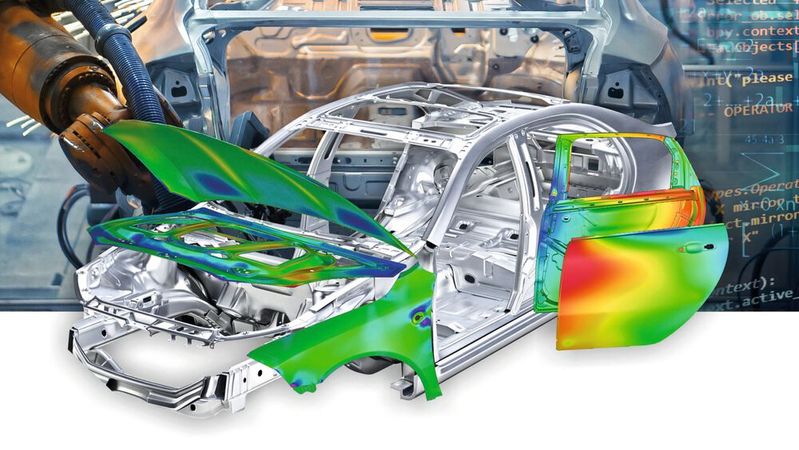
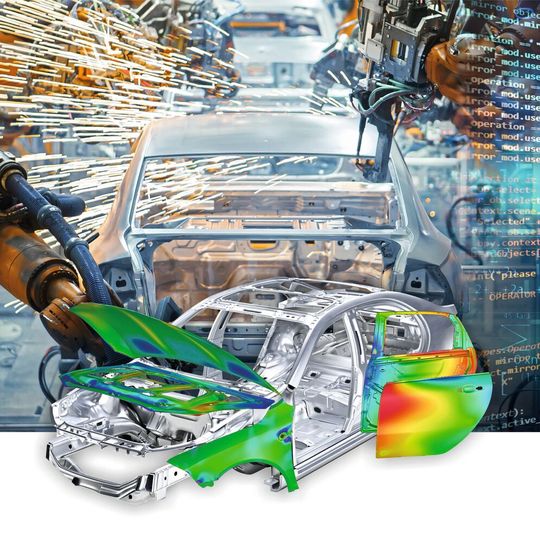
Autoform Assembly R12: Improved body-in-white process development, optimization, and evaluation
Autoform Engineering presents its latest software version Autoform Assembly R12. This version offers new possibilities and extensions for the body-in-white process chain. In this phase, users must import CAD data, which often contains a large amount of information that is not entirely necessary for defining the body-in-white process.
Autoform Assembly R12 offers new possibilities and extensions for the body-in-white process chain, particularly for process engineering, process optimization, evaluation, and hemming.
(Image: Autoform Engineering)
Autoform Assembly R12 makes it possible to filter the CAD data relevant for defining the body-in-white process. It allows you to easily select elements for import that retain the same CAD structure and original element names after import. This way, users maintain a better overview of the CAD data import and the imported elements necessary for defining the body-in-white process.
More realistic welding simulations
In addition, the behavior of the thermal model has been improved to enable the prediction of thermally induced deformations in welding processes. Line welding now takes into account the time-dependent thermal behavior of the process, allowing for more realistic welding simulations. The newly implemented time-dependent thermal model for line welding allows users to optimize welding processes at an early stage.
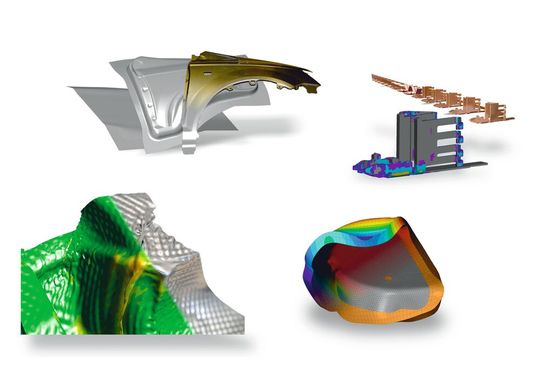
Stampack has introduced the new version 2024.1 of its eponymous software and promises, among other things, to make the cumbersome process of tryouts more efficient. "Tryout is the step in the engineering and manufacturing process of a tool, where the tool is mounted in the press and an attempt is made to produce a component for the first time. Any changes that need to be made after the creation of the tool require a remake or modification of the mold parts, causing high costs," emphasizes Markus Wagner, Managing Director of Stampack GmbH. "Stampack Xpress, on the other hand, shifts the tryout from the workshop to the design department, thereby avoiding lengthy and expensive tuning work on the actually finished tool."
As in the previous versions, Stampack Xpress 2024 incorporates extensive improvements to both the calculation module and the user interface.
(Image: Stampack)
Prevent component deformation
As in previous versions, extensive improvements have been made to both the calculation module and the user interface in 2024.1. Stampack now simulates not only the forming process but also the opening of the press after forming has taken place. A component deformation during ramp-up is displayed and can be prevented by the designer through a balanced distribution of forces.
Improvements for Catia users
Another important feature, especially for Catia users, is the new 'Tipping' function, which provides automatic coordinate transformation from the vehicle to the press coordinate system. Additionally, there are a total of 27 detailed improvements, such as optimized visibility during evaluation and the integration of the Floating Manager into the license tool. Stampack offers the possibility to simulate forming both in the shell and more precisely with its own volume solver. The selection of the calculation method is independent of the process definition.
Moldex 3D 2024: Tool for more sustainability and cost-effectiveness
The plastics industry is undergoing a transformation. With the aim of a low-carbon and circular economy, new opportunities are emerging. Plastics excel in meeting industry requirements—from lightweight construction to energy savings and design flexibility. According to Simpatec, Moldex 3D 2024 is the answer to these trends and offers simulation solutions to handle complex processes easily. Through unique cloud platform services, users could optimize production processes already in the design phase, making Moldex 3D 2024 an important tool for sustainability and efficiency.
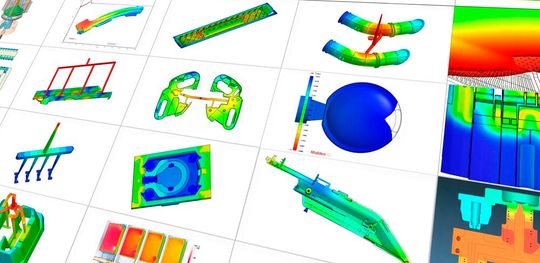
Moldex3D 2024 provides designers and toolmakers with a solution that supports the design and production of high-quality products while reducing costs and time-to-market.
(Image: Simpatec)
Precise encapsulation of electronic assemblies
Modern electric cars require sensors that provide precise vehicle information. Electronic systems must withstand harsh conditions such as water, humidity, and temperature fluctuations. Simulations help identify production errors early and accelerate market launch. Moldex 3D 2024 introduces the first solution for simulating the encapsulation of electronic assemblies. The software allows realistic visualization of material distribution through practical modeling tools and takes into account physical effects such as surface tension and capillary action.
Comprehensive support for cloud services
The service offering in the field of plastic injection molding is expanded by the data management platform Moldex 3D iSLM. New features include the Personal Mode for individual use and the Server Mode for cross-team collaboration. Additionally, the software improves organizing project-related data as well as comparing models and includes enhanced support for CAD formats. The implemented functions for calculating the CO2 footprint actively support users in complying with current CO2 emission standards.
Date: 08.12.2025
Naturally, we always handle your personal data responsibly. Any personal data we receive from you is processed in accordance with applicable data protection legislation. For detailed information please see our privacy policy.
Consent to the use of data for promotional purposes
I hereby consent to Vogel Communications Group GmbH & Co. KG, Max-Planck-Str. 7-9, 97082 Würzburg including any affiliated companies according to §§ 15 et seq. AktG (hereafter: Vogel Communications Group) using my e-mail address to send editorial newsletters. A list of all affiliated companies can be found here
Newsletter content may include all products and services of any companies mentioned above, including for example specialist journals and books, events and fairs as well as event-related products and services, print and digital media offers and services such as additional (editorial) newsletters, raffles, lead campaigns, market research both online and offline, specialist webportals and e-learning offers. In case my personal telephone number has also been collected, it may be used for offers of aforementioned products, for services of the companies mentioned above, and market research purposes.
Additionally, my consent also includes the processing of my email address and telephone number for data matching for marketing purposes with select advertising partners such as LinkedIn, Google, and Meta. For this, Vogel Communications Group may transmit said data in hashed form to the advertising partners who then use said data to determine whether I am also a member of the mentioned advertising partner portals. Vogel Communications Group uses this feature for the purposes of re-targeting (up-selling, cross-selling, and customer loyalty), generating so-called look-alike audiences for acquisition of new customers, and as basis for exclusion for on-going advertising campaigns. Further information can be found in section “data matching for marketing purposes”.
In case I access protected data on Internet portals of Vogel Communications Group including any affiliated companies according to §§ 15 et seq. AktG, I need to provide further data in order to register for the access to such content. In return for this free access to editorial content, my data may be used in accordance with this consent for the purposes stated here. This does not apply to data matching for marketing purposes.
Right of revocation
I understand that I can revoke my consent at will. My revocation does not change the lawfulness of data processing that was conducted based on my consent leading up to my revocation. One option to declare my revocation is to use the contact form found at https://contact.vogel.de. In case I no longer wish to receive certain newsletters, I have subscribed to, I can also click on the unsubscribe link included at the end of a newsletter. Further information regarding my right of revocation and the implementation of it as well as the consequences of my revocation can be found in the data protection declaration, section editorial newsletter.



:quality(80)/p7i.vogel.de/wcms/8e/63/8e631ccb75fda465c197fc52848289fa/0130260202v1.jpeg "According to the Laser-Zentrum Hannover, what is sizzling away underwater marks the first steps towards a way of repairing steel structures more cheaply and without complications using robots, laser 3D printing and AI ... (Image:LZH)")
:quality(80)/p7i.vogel.de/wcms/67/30/6730b015b3dd6f925877edd795eda319/0130247463v1.jpeg "The comparison between the SLA printable plastics Accura Xtreme Grey (above) and the robust newcomer Accura Xtreme Black now used at Speedpart, which represents an inexpensive and deep black alternative to mechanically processed plastic prototypes ... (Image:Speedpart)")
:quality(80)/p7i.vogel.de/wcms/06/9d/069d939b77a4feab0a8d2ece62c28dc1/0129655701v1.jpeg "This turned part is slotted twice. The deburring that would otherwise be necessary is no longer required for high-pressure machining. (Image:Knoll)")
:quality(80)/p7i.vogel.de/wcms/3f/72/3f72e30d61f3522bff192171b60776a4/0130245214v1.jpeg "No idea what else your humanoid robot can do, or where it fails? Then it might be worth taking a look at the Humanoid Capabilities Navigator, which now helps you to find the right robot for a job, or to improve humanoids in a targeted manner ... (Image:Fraunhofer IPA)")
:quality(80)/p7i.vogel.de/wcms/ba/28/ba28ec056a82abd76758c8c87296c0d5/0130213997v1.jpeg "The Nexy automatic material call-off system (AMS) controls the replenishment of non-stocked materials or components. (Image:Steute Technologies GmbH & Co. KG, Löhne)")
:quality(80)/p7i.vogel.de/wcms/21/3b/213b5e5454b0c4344ba0eaa700857607/0129635774v1.jpeg "The QRV flow control valves from Lee are available in sizes from 5.5 to 18 mm and cover a flow rate of 0.2 to 20 l/min. Depending on the version, the pressure range is either between 0.1 and 2.75 bar (1.5 - 40 psi) or between 0.17 and 2 bar (2.5 - 30 psi). (Image:Lee)")
:quality(80)/p7i.vogel.de/wcms/63/e9/63e9db3259a656cca88c5f7158af3fcb/0129385769v1.jpeg "The Agibot A2 at a Fortune China event in December 2025. (Image:Agibot)")
:quality(80)/p7i.vogel.de/wcms/df/a1/dfa1786a3b05f5ff2e51d0f633695c57/0130137877v1.jpeg "Openclaw inspires AI communities. (Image:Openclaw.ai)")
:quality(80)/p7i.vogel.de/wcms/e4/51/e451d52ce0182fb0aaa46a5774f832ef/26-04-pi-fraunhofer-iws-21160-bioslide-pic-01-4128x2321v1v1.jpeg "With the BioSlide research project, the Fraunhofer IWS is investigating how sliding systems can be designed to be more sustainable and energy-efficient. New materials can be tested in a particularly application-oriented manner on this plain bearing test stand. (Image:Fraunhofer IWS)")
![Thanks to advanced 3D printing technology, a more efficient use of resources should contribute to lower-emission aviation—this is the goal of ['skai]-lab. (Image:Oleksandr Pashchenko - stock.adobe.com / AI-generated)](https://cdn1.vogel.de/nghHNSbySccfOjG3n1qCA-FVOjQ=/288x162/smart/filters:format(jpg):quality(80)/p7i.vogel.de/wcms/62/64/626424c97a16e69f871bf216c9629c2a/adobestock-1927043193--c2-a9-20oleksandr-20pashchenko-20-e2-80-93-20stock-adobe-com-ki-generiertv1v1.jpeg "Thanks to advanced 3D printing technology, a more efficient use of resources should contribute to lower-emission aviation—this is the goal of ['skai]-lab. (Image:Oleksandr Pashchenko - stock.adobe.com / AI-generated)")
:quality(80)/p7i.vogel.de/wcms/78/28/7828775af76773458b4d1409ceb1cf0c/368945-20dam-20imagery-digital-transformation-pc-1920x1079v1v1.jpeg "Complex development projects with high regulatory requirements, such as in the aerospace industry, benefit in particular from the Intelligent Product Lifecycle. (Image:PTC)")
:quality(80)/p7i.vogel.de/wcms/e7/82/e7822e208621ba2ae892d609e60481e8/texas-20uni-850x478v1v1.jpeg "Superfoam is a composite that is capable of absorbing 10 times more energy than a conventional foam. (Image:Abbey Toronjo/Texas A&M University Division of Marketing & Communications)")
:quality(80)/p7i.vogel.de/wcms/e6/53/e6539c6b5df2d2af2970ca981131fb42/0130215307v1.jpeg "Volkswagen is in first place in the first two months of 2026—no one has sold as many cars in China as the car manufacturer. (Image:Volkswagen)")
:quality(80)/p7i.vogel.de/wcms/b0/6d/b06d9ad54bfc39053e1db5494df5cb9a/0130237932v1.jpeg "Pleased about their partnership in the field of bidirectional charging: Christian Haferkamp and Aurélie Alemany from enercity as well as Stefan Mecha and Lars Krause, both Volkswagen Commercial Vehicles (from left to right). (Image:PSONNACK)")
:quality(80)/p7i.vogel.de/wcms/2b/0b/2b0b5ff55299be32174cb0ed76718253/0130177406v1.jpeg "Rolls-Royce has received funding of 70 million US dollars from the EU public-private partnership \"Joint Undertakings for Clean Aviation\". (Image:Rolls-Royce)")
:quality(80)/p7i.vogel.de/wcms/95/7e/957ed49b185794b3e76b9e610a8a389f/0130217926v1.jpeg "Bosch wants to offer components for e-vehicles in India together with Tata. (Image:Bosch)")
:quality(80)/p7i.vogel.de/wcms/22/08/22085b4997a696887dd5a712a30b262b/0130211045v1.jpeg "Imec has announced that the world's most advanced high numerical aperture (High NA) EUV lithography system, the ASML EXE:5200, has arrived at its 300mm cleanroom in Leuven. (Image:Imec)")
:quality(80)/p7i.vogel.de/wcms/48/f2/48f250e2385d3f43743dc44133cc4731/0130161592v1.jpeg "The world's first fully functional quantum battery as a proof-of-concept, developed by CSIRO and its cooperation partners, the University of Melbourne and RMIT. (Image:CSIRO and collaborators, The University of Melbourne and RMIT)")
:quality(80)/p7i.vogel.de/wcms/16/9c/169c092e854d8740928a080cead3b88e/0130241261v1.jpeg "NVIDIA's GB300 AI chip with HBM3E and HBM4 from SK Hynix. (Image:SK Hynix)")
:quality(80)/p7i.vogel.de/wcms/3a/50/3a50d3f269f38f14d7a25a93c6f2b2f8/0130147601v1.jpeg "The compact modulator enables fast and energy-efficient data transmission and can be manufactured cost-effectively. (Image:Hugo Larocque, EPFL)")
:fill(fff,0)/p7i.vogel.de/companies/69/88/69882c428938e/tmts2026-ticec-banner-en-2000px.png "tmts2026-ticec-banner-en-2000px (https://www.tmts.tw/en)")
:fill(fff,0)/p7i.vogel.de/companies/67/eb/67eba621ef6ea/logo2.png "logo2 (Wuxi InfiMotion)")
:quality(80)/p7i.vogel.de/wcms/a1/bb/a1bb1a1c7ee6f0bb8b2e33f92ecfc9b1/0125742544v1.jpeg "Check and optimize in advance: The \"Stampack Xpress\" simulation software calculates trimming contours and shows the springback behavior of sheets to be formed at the CAD/CAM workstation. (Image:Stampack)")
:quality(80)/p7i.vogel.de/wcms/74/15/74155fb4aa1ec895b58deab3814f6a86/0124299305v1.jpeg "Rosenberger Stanztechnik focuses on the production of demanding, high-precision contact parts for the automotive, telecommunications, and electronics industries. (Image:Rosenberger Stanztechnik)")