Here we present three advanced solutions for simulation: HyperWorks 2026 for scalable design decisions, Simcenter X for unified multiphysics and cloud optimization, and Ansys 2025 R2, which excels with AI and intelligent automation.
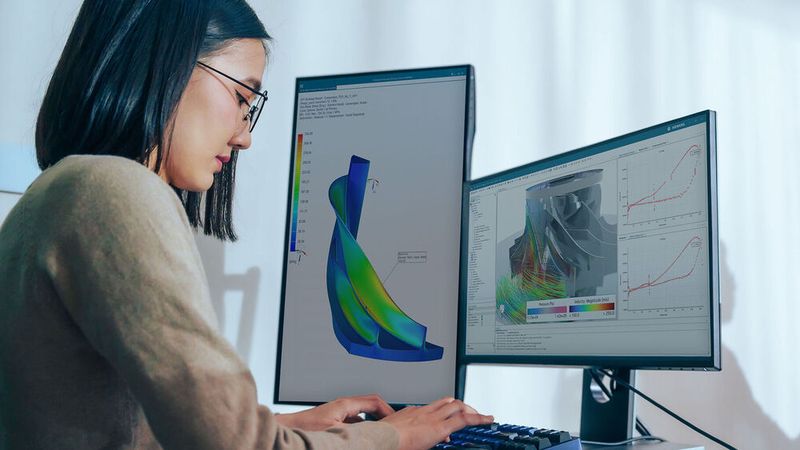
Optimized software for simulation in focus.
(Image: Siemens)
HyperWorks 2026: Scalable, Fast, and Secure Design Decisions
The new version of HyperWorks 2026 is designed to provide engineering teams with comprehensive computer-aided design and simulation processes (CAE) thanks to advancements in AI, high-performance computing (HPC), and multiphysics integration. This is said to accelerate innovation and improve product performance across various industries.
Thanks to accelerated simulation, AI-driven real-time feedback, and GPU-accelerated reduced-order models, HyperWorks 2026 enables scalable, faster, and more secure design decisions.
(Image: Altair)
HyperWorks 2026 offers the following innovations, among others:
AI-assisted design and simulation: Geometric deep learning, generative algorithms, and GPU-accelerated Reduced Order Modeling (ROM) enable near real-time predictions and faster validation. Physics-based AI models can be deployed in secure, browser-based environments and deliver results up to 1,000 times faster than traditional solver simulations. Enhanced support for vectors and Smoothed-Particle-Hydrodynamics (SPH) expands the range of applications.
Enterprise-wide pre-processing and model assembly: Engineers can now quickly and consistently simulate large, complex assemblies, thereby shortening development and validation cycles. Improved navigation, batch meshing, and connector management optimize pre-processing, while data management for
Consistency across teams is ensured. Integrated multiphysics simulation: Thanks to unified solvers and domain coupling, engineers can analyze complex interactions—such as thermo-fluid or electromagnetic-structural systems—with greater accuracy. New workflows support the optimization of electric motors, battery safety investigations, and high-temperature analyses, while co-simulation standards enhance digital continuity. Electromagnetic simulations run up to 40 percent faster, and wave propagation modeling is up to 20 times faster. Additionally, radar and EMC (electromagnetic compatibility) analysis has been expanded for next-generation applications.
Automation, collaboration, and connectivity: Enhanced Python and API support, intuitive no-code workflow tools, and cloud integration promote digital continuity. Improved visualization and plotting tools simplify the interpretation and sharing of results, while seamless interoperability with third-party software increases the accuracy of digital twins.
Simcenter X: Unified Multiphysics and Optimization in the Cloud
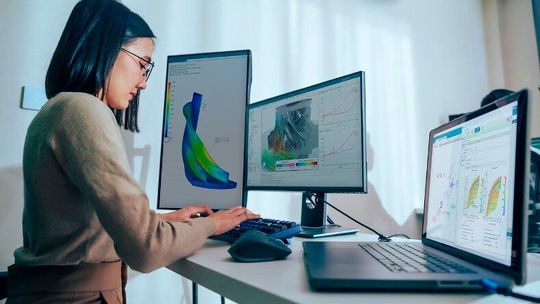
Simcenter X offers a scalable Software-as-a-Service (SaaS) engineering simulation suite designed to reduce IT complexity, enable more flexibility, and promote collaboration.
(Image: Siemens)
Siemens has introduced updates to its Simcenter X software, a cloud-based environment that unites the entire range of simulation and optimization technologies in a single, unified solution. With universal access to Computational Fluid Dynamics (CFD), mechanical simulation systems, and Multidisciplinary Design Analysis and Optimization (MDAO), engineers can now collaborate, explore, and innovate more quickly, the company states.
Various tools in one environment with one license
At the core of the newly released Simcenter X Advanced is Siemens' Simcenter multi-domain simulation portfolio, which is designed to allow users to combine various tools in a data-managed environment with a single license and a shared token pool.
The tight integration of applications – including Simcenter Star-CCM+, Simcenter Amesim, Simcenter Heeds, Simcenter 3D, and Simcenter Femap – eliminates silos, reduces IT overhead, and increases productivity through simultaneous pre- and post-processing sessions, flexible solvers, and advanced access to capabilities.
The following features are now available in Simcenter X:
Centralized SaaS deployment: Customers retain desktop workflows and benefit from cloud-managed permissions, reducing onboarding time from days to minutes.
Scalable collaboration: Every user has access to secure, traceable, and scalable simulation data management as well as collaboration with Teamcenter X.
AI-enhanced productivity: AI features include a chat for documentation support and setup instructions. Optimization studies are boosted by AI-powered design exploration techniques.
CFD simulation with HPC and remote desktop: Enables instant, elastic computing power and browser-based access to Simcenter STAR-CCM+ – no installations, flexible credit-based licensing, and seamless integration.
Simplified licensing and flexible multi-domain access: Named user licenses guarantee simultaneous pre- and post-processing access, while floating tokens unlock solver capabilities across various domains.
Ansys 2025 R2, now part of Synopsys, offers AI-driven capabilities across its entire portfolio to accelerate simulation and enhance accessibility. Additionally, R2 provides improved solvers, optimized workflows, and greater engineering agility with extended Python compatibility and on-demand cloud computing. The Ansys technology enables teams to scale models, explore more innovative design possibilities, and make informed product decisions earlier – from next-generation satellites to data center design, the company states.
Physics-based AI for intuitive simulations
With Ansys 2025 R2, the Ansys Engineering Copilot is introduced: a secure, robust, and reliable virtual assistant. It provides AI-driven support directly within Ansys products and offers a consistent, seamless user experience with instant access to an extensive knowledge base. This includes Ansys-GPT, integration of the Microsoft Azure AI Foundry, including Azure Open-AI in Foundry Models, all Ansys websites, thousands of articles, over 800 innovation courses, a global user forum, and the ability to create and track support cases.
2025 R2 expands the Ansys portfolio with AI capabilities for the automatic creation, validation, and optimization of high-fidelity simulations, accelerating model creation, reducing manual effort, and minimizing human errors:
Ansys Engineering Copilot is included in the products Ansys Mechanical, Ansys Discovery, Ansys Fluent, Ansys HFSS, Ansys Electronics Desktop (AEDT), Ansys Scade One, Ansys Speos, Ansys Maxwell, Ansys optiSLang, and Ansys Lumerical. It connects engineers to technical expertise with just one click.
17 times faster results and more accurate simulations of beam steering for phased-array antennas in radiation pattern calculations with HFSS – crucial for applications like 5G/6G, radar sensors, and satellite communication.
Seven Ansys products feature integrated AI capabilities (AI+) that make simulations simpler, faster, and more accessible. This includes the new Ansys Missions AI+ ODTK tool for orbital accuracy.
The integration of OptiSLang and the Ansys SimAI platform accelerates dataset creation and AI training.
Intelligent automation
The extended Python compatibility provides users with an additional level of flexibility. It enables engineers to create custom automations that accelerate workflows, improve data management, and ensure project repeatability. Over 40 Python libraries are integrated into the Py-Ansys collection, allowing workflows to be automated and boosting productivity and efficiency across all applications.
Naturally, we always handle your personal data responsibly. Any personal data we receive from you is processed in accordance with applicable data protection legislation. For detailed information please see our privacy policy.
Consent to the use of data for promotional purposes
I hereby consent to Vogel Communications Group GmbH & Co. KG, Max-Planck-Str. 7-9, 97082 Würzburg including any affiliated companies according to §§ 15 et seq. AktG (hereafter: Vogel Communications Group) using my e-mail address to send editorial newsletters. A list of all affiliated companies can be found here
Newsletter content may include all products and services of any companies mentioned above, including for example specialist journals and books, events and fairs as well as event-related products and services, print and digital media offers and services such as additional (editorial) newsletters, raffles, lead campaigns, market research both online and offline, specialist webportals and e-learning offers. In case my personal telephone number has also been collected, it may be used for offers of aforementioned products, for services of the companies mentioned above, and market research purposes.
Additionally, my consent also includes the processing of my email address and telephone number for data matching for marketing purposes with select advertising partners such as LinkedIn, Google, and Meta. For this, Vogel Communications Group may transmit said data in hashed form to the advertising partners who then use said data to determine whether I am also a member of the mentioned advertising partner portals. Vogel Communications Group uses this feature for the purposes of re-targeting (up-selling, cross-selling, and customer loyalty), generating so-called look-alike audiences for acquisition of new customers, and as basis for exclusion for on-going advertising campaigns. Further information can be found in section “data matching for marketing purposes”.
In case I access protected data on Internet portals of Vogel Communications Group including any affiliated companies according to §§ 15 et seq. AktG, I need to provide further data in order to register for the access to such content. In return for this free access to editorial content, my data may be used in accordance with this consent for the purposes stated here. This does not apply to data matching for marketing purposes.
Right of revocation
I understand that I can revoke my consent at will. My revocation does not change the lawfulness of data processing that was conducted based on my consent leading up to my revocation. One option to declare my revocation is to use the contact form found at https://contact.vogel.de. In case I no longer wish to receive certain newsletters, I have subscribed to, I can also click on the unsubscribe link included at the end of a newsletter. Further information regarding my right of revocation and the implementation of it as well as the consequences of my revocation can be found in the data protection declaration, section editorial newsletter.



:quality(80)/p7i.vogel.de/wcms/9e/23/9e23111e49d73012e9e3b7c69428ad5c/0134019347v1.jpeg "The Dominant VA45 high-helix tap from Bass, made of lead-free brass. The long chips, which result from the absence of lead, are clearly visible. (Image:Bass, Inc.)")
:quality(80)/p7i.vogel.de/wcms/1d/09/1d0999956ef87709b72ab1d0402ba207/csf-minis-gruppe-final-01-outputv1.jpeg "Since mid-2026, Harmonic Drive has been offering its CSF Mini gearheads in size 7 as well, in six variants designed for different installation scenarios. (Source: Harmonic Drive)")
:quality(80)/p7i.vogel.de/wcms/ab/08/ab08675922c3a7edea45128248b45b00/0133857009v1.jpeg "In the aerospace industry—one of the most demanding sectors of all—the Shanghai-based company TOPNC has already made a name for itself. (Image:TOPNC)")
:quality(80)/p7i.vogel.de/wcms/ff/48/ff48b1154746e79128935f28bd73ba0e/0113143253v1.jpeg "In our China Market Insider, we regularly provide you with relevant information straight from China. (Image:© Eisenhans - stock.adobe.com)")
:quality(80)/p7i.vogel.de/wcms/ca/24/ca24d741a2fd714fa14d2a3e9db1c904/image1v1.jpeg "With 117,500 units sold, transportation and logistics will remain the leading application area for service robotics in 2025 as well. (Image:Innok Robotics)")
:quality(80)/p7i.vogel.de/wcms/b7/95/b795d5fb82459f8a526e880f0698dffa/1-maxon-mind-covershot-landscapev1.jpeg "Claude Jaquemet demonstrates the Maxon Mind demo system. (Source: Maxon)")
:quality(80)/p7i.vogel.de/wcms/be/66/be661616d5250d4c3814a25688f3904b/0133917202v1.jpeg "Neuron AI combines 3D vision, touch, hearing, proprioception, and language—along with memory—into a Perception-Language-Action (PLA) model. Robots can grasp objects they cannot see. (Image:Neura)")
:quality(80)/p7i.vogel.de/wcms/c7/12/c712b688dba2262fa3906e3a4c1d2f7d/humanoide-robotikv1.jpeg "“Find a job that the humanoid can actually do, and understand your processes”—that’s the advice robotics expert Sebastian Prinz gives companies so they can benefit from the technology in the long term. (Source: Fraunhofer IEM / Janosch Gruschczyk)")
:quality(80)/p7i.vogel.de/wcms/51/b8/51b8e08d2105fdd9952aff385f154192/graphic-2-adma1v1.png "The new surface hardening process enhances the performance of corrosion-resistant alloys by improving their tribological and mechanical surface properties, while preserving the properties of the base material. (Source: Bodycote)")
:quality(80)/p7i.vogel.de/wcms/96/ef/96effc239916cb7e0f396ab75627b8c0/image-space-testingv1.jpeg "Two scientists in front of a vacuum chamber used for testing: As technical instruments for spaceflight become more sensitive, the test facilities are becoming a critical system. (Source: Busch Group)")
:quality(80)/p7i.vogel.de/wcms/5a/12/5a1294a38a634f839f542c0055024d7a/jie-yin-feather-star-header-1500v1.jpeg "Underwater Acrobatics: The new soft robot mimics brittle stars—using minimal propulsion technology. (Source: North Carolina State University)")
:quality(80)/p7i.vogel.de/wcms/96/89/9689197f666e4aa9bc4a1f395c25d3ef/0133739635v1.jpeg "The 2026 Nobel Prize in Medicine laureates: Karl Deisseroth, Peter Hegemann, and Georg Nagel. (Image:Nobel Prize Outreach)")
:quality(80)/p7i.vogel.de/wcms/fe/f7/fef766ae8b8310ca6dd0852208923e4e/hendrik-malinowski-coo-01v1.png "Hendrik Malinowski Takes on New Role as CCO of BUGATTI RIMAC (Source: Bugatti)")
:quality(80)/p7i.vogel.de/wcms/d9/5f/d95fd82eb5368ce77a8bc9de3a085376/yoshihiro-nakatav1.jpeg "“We are a European manufacturer”: Yoshihiro Nakata, CEO of Toyota Motor Europe, at the corporate briefing in Brussels. (Image:Toyota)")
:quality(80)/p7i.vogel.de/wcms/e3/0b/e30b87c9b7a6c41b7e7336f34f0a8214/0133970831v1.jpeg "Tesla's planned expansion of vehicle and battery production capacity in Grünheide, near Berlin, appears to be gaining momentum, according to a recent announcement by the U.S. electric car manufacturer ... (Image: AI-generated)")
:quality(80)/p7i.vogel.de/wcms/23/5f/235fa4afabc57699636224d17e106b4b/kraemer-p2p-display-technologyv1.png "The cockpit display system from Krämer Automotive Systems shows driving-related information, infotainment, and vehicle functions. (Source: Krämer Automotive)")
:quality(80)/p7i.vogel.de/wcms/8b/35/8b35660420abba32fb891a4c5cc42fbd/0134018092v1.jpeg "Long-range UVC LED with lens and reflector: Close-up of a square LED with a transparent, dome-shaped lens on a dark base plate. The hermetically sealed housing ensures greater reliability and durability under demanding environmental conditions. (Image:FBH_Schurian)")
:quality(80)/p7i.vogel.de/wcms/a4/1c/a41cd52e0a26e5173bd4e1f834d4f7f4/0134025034v1.jpeg "As chips become more complex, the demands on semiconductor testing increase. Teradyne and FormFactor plan to combine their technologies for future applications. (Image:freely licensed)")
:quality(80)/p7i.vogel.de/wcms/7b/64/7b64e9fe595b88d2b01ed79e0f2baf94/pm-weidm-ller-elatec-substation-line-switchv1.jpeg "Caption: The Substation Line managed switches can accommodate up to three HSR/PRP modules. (Image:Weidmüller)")
:quality(80)/p7i.vogel.de/wcms/b3/bf/b3bf55a31510b319bb473f73aa205477/0133987448v1.jpeg "In court, Qualcomm achieved a partial victory in its legal dispute with Arm, but was awarded only a symbolic $2 in damages—for now. (Image:Dall-E / AI-generated)")
:fill(fff,0)/p7i.vogel.de/companies/69/88/69882c428938e/tmts2026-ticec-banner-en-2000px.png "tmts2026-ticec-banner-en-2000px (https://www.tmts.tw/en)")
:fill(fff,0)/p7i.vogel.de/companies/69/de/69de1b7403b0d/simtos-logo.jpeg "simtos-logo (SIMTOS)")
:quality(80)/p7i.vogel.de/wcms/b5/74/b57433bf5017d155b7f19f4905a73449/0127384204v1.jpeg "A deep understanding and careful definition of the challenges are essential for the development of reliable and efficient electric drives. This requires the use of advanced simulation and optimization techniques. (Image: ©k_viktar - stock.adobe.com / AI-generated)")
:quality(80)/p7i.vogel.de/wcms/c1/09/c1095edbd0ff2cfe766e5bc54b6af30e/0127794630v1.jpeg "Rolls-Royce, with the help of Siemens, has optimized an engine component through a seamless digital process. (Image:Siemens)")