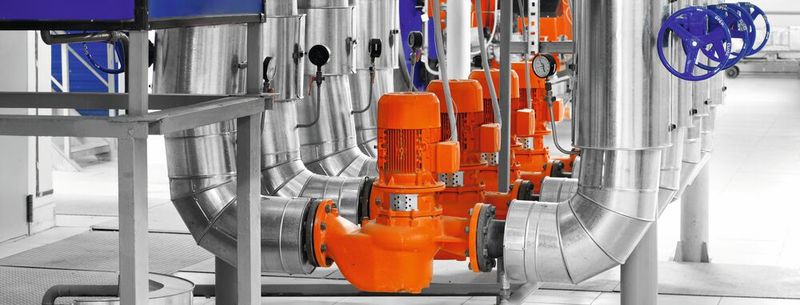
Pumps are the heart of many industrial processes and are constantly evolving. But alongside technical innovations in and around the pump itself, five trends are currently shaping the market. These form the basis for modern pump systems.
Pumps are and remain indispensable in many industrial processes.
The recession has not spared the sales of pumps either: Orders at pump manufacturers have declined or stagnated, while cost increases are eating up any remaining profits. According to market research firm Ibis World, sales of pumps, compressors, valves, and fittings in Europe have fallen by 6.2 percent over the past five years. And the economic situation remains subdued here.
Despite everything, pumps remain the heart of many industrial processes and are indispensable for energy technology, battery manufacturing, the circular economy, and the production of "green" hydrogen. Moreover, when considering the global pump market, emerging countries like Brazil and India, and now probably the USA, will drive the demand for pumps. They are investing in mining, gas and oil extraction, and water and wastewater supply—unthinkable without pumps.
Trend 1: Energy efficiency and sustainability
But what are the current trends in pumps? Looking at trade shows and market research firms, the trends clearly reflect developments in the entire industry—for example, the increasing importance of energy efficiency and sustainability. The industry must comply with more and more environmental regulations, which pushes it to use more environmentally friendly and energy-efficient solutions. Pump manufacturers are naturally responding to this, with their products meeting increasingly stringent standards, such as emissions, energy consumption, and waste reduction.
Pumps account for a large portion of energy consumption in industry, but now savings potential is possible in various ways:
efficient drives: operate pumps with frequency converters and use motors with a high efficiency class;
optimal system: precisely coordinate hydraulics, drive, and automation, while thoroughly analyzing the entire pump system—including pipes, fittings, and valves—and design it for the application;
Use of intelligent, connected components.
Sustainability, and thus the topics of recycling and the CO2 footprint, are also coming more into focus. There are now recycling programs, such as Grundfos Take Back or the return of old pumps at Wilo, to recycle materials and components. Such programs strike a chord, as awareness of sustainable circular economy is increasing.
Trend 2: Predictive maintenance
Smart pumps equipped with sensors provide valuable insights into their condition and performance. This monitoring allows for predictive maintenance and can identify issues before they lead to equipment failures. Various pump manufacturers already offer solutions that fundamentally rely on analyzing data from ongoing operations and making corresponding predictions.
For example, the Abel Smart Pump Assistant can automatically detect faults by evaluating data from ongoing operations using machine learning algorithms. At the same time, the optimal next maintenance date is calculated. Timmer offers something similar with Tim IOT. KSB can also equip existing pumps with "intelligence" through the KSB Guard. Connected to the KSB Cloud, it sends the data to where it is processed in the KSB Guard Monitoring Center. Phoenix Contact takes a different approach with the Pump Monitor: The control cabinet solution captures bearing and machine vibrations and can be integrated into higher-level control systems.
These proactive approaches minimize downtime, reduce maintenance costs through demand-oriented maintenance intervals, and reduce energy consumption.
Trend 3: Digitalization
The digitization of pump applications forms the basis for digital services that can benefit both manufacturers and users. The data provided is used for condition monitoring and also for optimizing processes and machines. For example, Grundfos offers the Demand Driven Distribution (DDD) pressure management system, which uses pressure sensors at critical points in the water supply network to optimally control system pressure. This reduces leaks, lowers energy consumption, and decreases pipe damage.
Another use of digital data is pump services offered by pump manufacturers. In addition to digital monitoring and specific recommendations for action, many also offer remote maintenance or, like KSB, take over the complete operation and maintenance.
Date: 08.12.2025
Naturally, we always handle your personal data responsibly. Any personal data we receive from you is processed in accordance with applicable data protection legislation. For detailed information please see our privacy policy.
Consent to the use of data for promotional purposes
I hereby consent to Vogel Communications Group GmbH & Co. KG, Max-Planck-Str. 7-9, 97082 Würzburg including any affiliated companies according to §§ 15 et seq. AktG (hereafter: Vogel Communications Group) using my e-mail address to send editorial newsletters. A list of all affiliated companies can be found here
Newsletter content may include all products and services of any companies mentioned above, including for example specialist journals and books, events and fairs as well as event-related products and services, print and digital media offers and services such as additional (editorial) newsletters, raffles, lead campaigns, market research both online and offline, specialist webportals and e-learning offers. In case my personal telephone number has also been collected, it may be used for offers of aforementioned products, for services of the companies mentioned above, and market research purposes.
Additionally, my consent also includes the processing of my email address and telephone number for data matching for marketing purposes with select advertising partners such as LinkedIn, Google, and Meta. For this, Vogel Communications Group may transmit said data in hashed form to the advertising partners who then use said data to determine whether I am also a member of the mentioned advertising partner portals. Vogel Communications Group uses this feature for the purposes of re-targeting (up-selling, cross-selling, and customer loyalty), generating so-called look-alike audiences for acquisition of new customers, and as basis for exclusion for on-going advertising campaigns. Further information can be found in section “data matching for marketing purposes”.
In case I access protected data on Internet portals of Vogel Communications Group including any affiliated companies according to §§ 15 et seq. AktG, I need to provide further data in order to register for the access to such content. In return for this free access to editorial content, my data may be used in accordance with this consent for the purposes stated here. This does not apply to data matching for marketing purposes.
Right of revocation
I understand that I can revoke my consent at will. My revocation does not change the lawfulness of data processing that was conducted based on my consent leading up to my revocation. One option to declare my revocation is to use the contact form found at https://contact.vogel.de. In case I no longer wish to receive certain newsletters, I have subscribed to, I can also click on the unsubscribe link included at the end of a newsletter. Further information regarding my right of revocation and the implementation of it as well as the consequences of my revocation can be found in the data protection declaration, section editorial newsletter.
Trend 4: Use of AI
AI-supported analyses of pump data help to recognize patterns, predict potential failures, and optimize performance for specific processes. In the area of predictive maintenance, AI models can be trained to monitor pump applications based on critical measurement parameters. Deviations from the normal state trigger an alarm. Work is also underway to continuously optimize operating processes and adapt them to environmental conditions using neural networks.
Trend 5: Mobile pumps
For changing or unforeseen work environments, mobile pumps are the first choice. They are versatile, easy to transport, and generally designed for simple maintenance. This flexibility makes them popular because they can be quickly deployed wherever needed: from the raw materials industry, food industry, and agriculture to firefighting. Lutz Pumps also places such a mobile pump on a transport trolley, which is easy to maneuver.
These pumps are usually powered by either an electric motor or a combustion engine; battery versions are also now available.



:quality(80)/p7i.vogel.de/wcms/a0/47/a04725ef9bd09fb6c9341a1bea1b5d93/0130443083v1.jpeg "Here, a type of plastic pallet is produced by thermoforming (vacuum forming or deep drawing) at the corresponding division of New England Plastics in the USA. This division, which specializes in so-called liners, is now part of Ringmetall ... (Image:New England Plastics)")
:quality(80)/p7i.vogel.de/wcms/23/99/23992bf2dcdc432c9b7209c34a4a7c48/0129733089v1.jpeg "Stork relies on the modular Neoswiss turning system from Iscar to shorten the set-up times for its sliding headstock lathes and work more productively. (Image:Iscar)")
:quality(80)/p7i.vogel.de/wcms/7d/e2/7de2923434b2f1a78ba5482d8d335269/0113143253v1.jpeg "In our China Market Insider we regularly provide you with relevant information directly from China. (Image:© Eisenhans - stock.adobe.com)")
:quality(80)/p7i.vogel.de/wcms/9d/2b/9d2b802f800e5caf17b2831e74228cd3/screenshot-202026-03-03-20103822-609x343v1v1.png "Visual comparison: on the left, a clean, burr-free cut edge; on the right, typical burr formation with oxidation discoloration. This illustrates how strongly parameter control and gas management influence the quality of the result. (CO₂ laser, oxygen cutting gas, sheet thickness approx. 15 mm). (Image:Picture: Rime)")
:quality(80)/p7i.vogel.de/wcms/b7/36/b736dfebc16c42d6901d0d0e1f390493/3d-druck-20factory-20--20ki-20generiert-1920x1079v1.png "(Source: AI-generated)")
:quality(80)/p7i.vogel.de/wcms/79/b2/79b21aad663f4a7bd4472afc1c1afc62/0130433994v1.jpeg "Mission Joyride: The free-flying robot (shown here in the rendering) will relieve the ISS crew of logistics tasks from 2027 with its two mechanical arms. (Image:Icarus Robotics)")
:quality(80)/p7i.vogel.de/wcms/6b/45/6b4546fa6ebf305c3660326909363f32/0130437089v1.jpeg "Industrial AI in action: Rockwell Automation presents practical solutions for self-controlling production systems at the Hannover Messe. (Image:Rainer Jensen, Deutsche Messe)")
:quality(80)/p7i.vogel.de/wcms/78/e9/78e9188c25a8a94e67c34c9bf8ffe495/visual-agile-20robots-20and-20google-20deepmind-20partner-20to-20bring-20intelligence-20to-20robotics-2500x1406v1v1.jpeg "Together, the partners are developing adaptable, intelligent robots for a wide range of applications (Image:Agile Robots SE)")
:quality(80)/p7i.vogel.de/wcms/59/a2/59a2b11f0aa1b700eff02addd5de8703/adobestock-1788280853--c2-a9-20satria-20-e2-80-93-20stock-adobe-com-5081x2860v1v1.jpeg "Quantum computers require extreme cooling to temperatures close to absolute zero in order to keep qubits stable. (Image:satria - stock.adobe.com)")
:quality(80)/p7i.vogel.de/wcms/49/38/493876a248943456b7e4a6db6edfc454/0130230765v1.jpeg "Safe and reliable in aircraft construction: light-curing adhesive bond combined with universal fastening elements. (Source: Delo)")
:quality(80)/p7i.vogel.de/wcms/b5/c7/b5c749d16c8a2e789c1469c2c8c1c387/0130452780v1.jpeg "Volvo Trucks completes road tests with its new hydrogen-powered trucks. (Image:Volvo Trucks)")
:quality(80)/p7i.vogel.de/wcms/ba/69/ba6975f417a85147084f38dc2cd209e2/0130451386v1.jpeg "Together with Nvidia, Hyundai wants to develop an architecture that will be used for level 4 robotaxis (image) as well as for level 2 customer vehicles. (Image:Hyundai)")
:quality(80)/p7i.vogel.de/wcms/93/4d/934de334b47abaa526c78cba1417d7af/0130343495v1.jpeg "The new SU7 is available in three price categories, \"Standard\", \"Pro\" and \"Max\" (Image:Xiaomi)")
:quality(80)/p7i.vogel.de/wcms/df/a0/dfa048434bb94f1b7d030e346b25b3ae/0130373541v1.jpeg "From August, BMW will be producing the i3 at its main plant in Munich - which the car manufacturer has extensively rebuilt for this purpose. (Image:Rainer Haeckl)")
:quality(80)/p7i.vogel.de/wcms/ee/09/ee09acbd6dc896df25affaa9e871e6e5/0130440053v1.jpeg "IMS chip module for simple system integration into an ion mobility spectrometer. (Image:Fraunhofer IPMS)")
:quality(80)/p7i.vogel.de/wcms/10/6c/106cd22de5f68a0f74639d654827228c/0130345302v1.jpeg "Made in India: According to the India Electronics and Semiconductor Association (IESA), the country should be able to produce between 75 and 80 million chips by the beginning of 2027, once the plants currently under construction become operational. (Image:Pixabay (Montage: Sebastian Gerstl))")
:quality(80)/p7i.vogel.de/wcms/a5/ed/a5ed6fda029d362732a293d6b19d74c4/0130444216v1.jpeg "Thirteen executives from the Chinese chip industry have drawn up a plan to achieve an 80% self-sufficiency rate for semiconductors by 2030. (Image:Maxim_Kazmin - stock.adobe.com)")
:quality(80)/p7i.vogel.de/wcms/31/a6/31a646018b34d8e0a44bfc8bf17837f6/0130361632v1.jpeg "For many companies, PFAS are considered indispensable in electronics production. (Image:freely licensed)")
:fill(fff,0)/images.vogel.de/vogelonline/companyimg/76800/76895/65.jpg "FAULHABER_120mm.jpg ()")
:fill(fff,0)/p7i.vogel.de/companies/69/88/69882c428938e/tmts2026-ticec-banner-en-2000px.png "tmts2026-ticec-banner-en-2000px (https://www.tmts.tw/en)")
:quality(80)/p7i.vogel.de/wcms/17/21/1721b98b7580a86c7790f607395878a1/0129697493v1.jpeg "Universal: Motors are used everywhere. (Image:Microchip Technology)")
:quality(80)/p7i.vogel.de/wcms/5e/e3/5ee329167f111885b28f2c94bf380e0d/0127110091v1.jpeg "Digitalization: Digital twins are changing the way manufacturers manage their operations, perform maintenance, and make decisions. (Image:Gerd Altmann)")