Max Planck scientists combine the extraction, manufacturing, mixing, and processing of metals and alloys in a single, environmentally friendly step. The compact metallurgy saves up to 40 percent energy and is CO2-free.
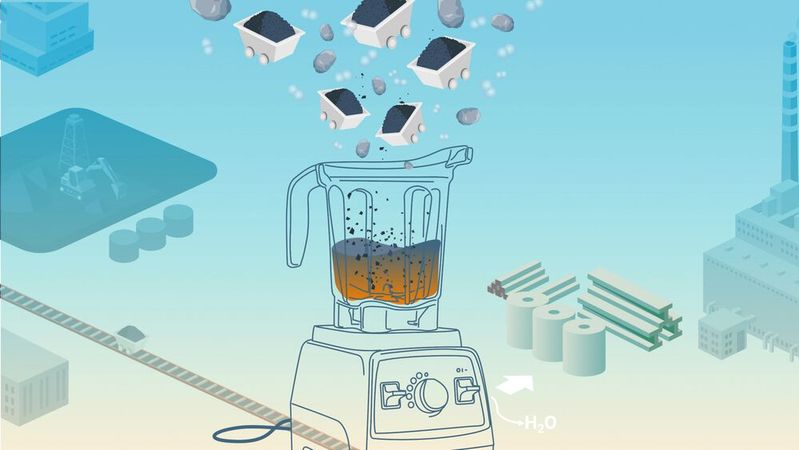
The "Thermomix" for metallurgy: in a single reactor, iron and nickel ores are processed into ready-to-use alloys using hydrogen. The only byproduct is water.
(Image: Tianyi You, Max Planck Institute for Sustainable Materials GmbH)
The production of approximately two billion tons of metals annually is responsible for 10 percent of global CO2 emissions. To produce just one ton of iron, two tons of CO2 are emitted. In the case of nickel, producing one ton results in 14 tons or more of CO2. Yet iron and nickel are crucial for aerospace, the transport of liquid hydrogen, and the energy transition. They form so-called invar alloys, which are ideal for these applications due to their low thermal expansion.
How can such alloys be produced CO2-free and with low energy consumption? Scientists at the Max Planck Institute for Sustainable Materials (MPI-SusMat) have developed a radically new strategy for this purpose. In a single process step and reactor, metal extraction, alloying, i.e., mixing, and thermomechanical processing are integrated, resulting in the finished material. This method enables the direct conversion of ores into applicable products. The Max Planck team has published their results in the scientific journal Nature.
Compact metallurgy saves up to 40 percent energy and is CO2-free
"We asked ourselves: Can we produce an alloy with optimal properties directly from ores and without CO2 emissions?" says Dr. Shaolou Wei, Humboldt Research Fellow at MPI-SusMat and first author of the publication. Conventional alloy production has for more than 6000 years typically been a three-step process: First, oxygen is removed from the ores to obtain the pure metal. This step is called reduction: iron or nickel ore is thus reduced to metal. Then, several metals or other elements are heated and liquefied to mix them, known as alloying. Finally, the alloy is thermomechanically processed, i.e., forged, rolled, heated, to achieve the desired properties. Each of these steps is energy-intensive, especially since the ores and metals are repeatedly heated, liquefied, and cooled down. Moreover, carbon is still used as an energy source and reducing agent, leading to significant CO2 emissions.
The key idea is to understand the thermodynamics and kinetics of each involved element and use elements with similar reduction and mixing behavior at around 700 degrees Celsius.
Dr. Shaolou Wei, Humboldt-Research-Fellow at the MPI-SusMat and first author of the publication
"At 700 degrees Celsius, we can remove the oxygen from the ores and alloy the resulting metals in a single step, without having to liquefy the material. This saves enormous amounts of energy." Unlike conventional methods, where ores are reduced with carbon, the Max Planck scientists use hydrogen as a reducing agent.
The use of hydrogen instead of carbon offers four crucial advantages. First, the hydrogen-based reduction results in only water as a byproduct, and no CO2. Second, it directly produces pure metals or even their finished alloys.
Dierk Raabe, Managing Director at the MPI-SusMat and corresponding author of the study
"You don't have to remove any remaining carbon from the final product. This saves time and energy. Third, we conduct the process at relatively low temperatures and in the solid phase, not in liquid melts, thus saving energy again. Fourth, we avoid the frequent cooling and reheating characteristic of conventional metallurgical processes, allowing us to save significant energy there as well," explains Professor Dierk Raabe, managing director at MPI-SusMat and corresponding author of the study. Overall, the energy consumption is reduced by up to 40 percent compared to conventional metallurgy.
The Invar alloys produced using this method have the same low thermal expansion as conventionally produced Invar alloys and even offer better mechanical strength due to the refined microstructure resulting from this process.
From the laboratory to the industry
The Max Planck scientists have demonstrated that manufacturing Invar alloys through a rapid, CO2-free, and energy-efficient process is promising. To bring this method from the current laboratory scale to industrial application, the scientists must overcome three key challenges:
Firstly, in the current research work, the scientists used pure oxides. However, in the industry, cheaper, contaminated oxides are used. This means that the Max Planck team must adjust their process to maintain the same quality of alloys. Secondly, the use of pure hydrogen in the reduction process is effective but costly for industrial applications. The team is now conducting experiments with lower hydrogen concentrations at higher temperatures to find an optimal balance between hydrogen consumption and energy costs, making the process more economical for the industry. Thirdly, for industrial purposes, very finely porous metals are needed, which with the new method from the Max Planck scientists would not be produced directly but would require an additional step, sintering.
The new process is not only interesting for invar alloys but also for all alloys based on iron, nickel, copper, or cobalt. The Düsseldorf Max Planck team is now also focusing on complex alloys consisting of more than five different elements, known as high-entropy alloys. These are used, for example, in aircraft turbines and electric motors. Another promising direction could be the use of metallurgical waste instead of pure oxides.
Date: 08.12.2025
Naturally, we always handle your personal data responsibly. Any personal data we receive from you is processed in accordance with applicable data protection legislation. For detailed information please see our privacy policy.
Consent to the use of data for promotional purposes
I hereby consent to Vogel Communications Group GmbH & Co. KG, Max-Planck-Str. 7-9, 97082 Würzburg including any affiliated companies according to §§ 15 et seq. AktG (hereafter: Vogel Communications Group) using my e-mail address to send editorial newsletters. A list of all affiliated companies can be found here
Newsletter content may include all products and services of any companies mentioned above, including for example specialist journals and books, events and fairs as well as event-related products and services, print and digital media offers and services such as additional (editorial) newsletters, raffles, lead campaigns, market research both online and offline, specialist webportals and e-learning offers. In case my personal telephone number has also been collected, it may be used for offers of aforementioned products, for services of the companies mentioned above, and market research purposes.
Additionally, my consent also includes the processing of my email address and telephone number for data matching for marketing purposes with select advertising partners such as LinkedIn, Google, and Meta. For this, Vogel Communications Group may transmit said data in hashed form to the advertising partners who then use said data to determine whether I am also a member of the mentioned advertising partner portals. Vogel Communications Group uses this feature for the purposes of re-targeting (up-selling, cross-selling, and customer loyalty), generating so-called look-alike audiences for acquisition of new customers, and as basis for exclusion for on-going advertising campaigns. Further information can be found in section “data matching for marketing purposes”.
In case I access protected data on Internet portals of Vogel Communications Group including any affiliated companies according to §§ 15 et seq. AktG, I need to provide further data in order to register for the access to such content. In return for this free access to editorial content, my data may be used in accordance with this consent for the purposes stated here. This does not apply to data matching for marketing purposes.
Right of revocation
I understand that I can revoke my consent at will. My revocation does not change the lawfulness of data processing that was conducted based on my consent leading up to my revocation. One option to declare my revocation is to use the contact form found at https://contact.vogel.de. In case I no longer wish to receive certain newsletters, I have subscribed to, I can also click on the unsubscribe link included at the end of a newsletter. Further information regarding my right of revocation and the implementation of it as well as the consequences of my revocation can be found in the data protection declaration, section editorial newsletter.
As high temperatures and fossil fuels are no longer required, this one-step, hydrogen-based process could drastically reduce the ecological footprint of alloy production and pave the way for a greener, more sustainable future in metallurgy.
The research was funded by an Alexander von Humboldt Foundation fellowship for Shaolou Wei and a European Advanced Research Grant for Dierk Raabe.



:quality(80)/p7i.vogel.de/wcms/60/eb/60ebe43de41f833157b476b2e1641811/0130090160v1.jpeg "The Surface Control Automotive measuring system from Micro-Epsilon automatically detects dents, scratches and other surface defects on body shells. (Image:Micro-Epsilon)")
:quality(80)/p7i.vogel.de/wcms/26/8a/268aba929d72bd089234bd512aab9b08/0130487474v1.jpeg "The works meeting at Volkswagen is over! Here is a brief overview of the most important aspects ... (Image:VW)")
:quality(80)/p7i.vogel.de/wcms/50/63/5063e5b91e7897c13b882440c7f106d4/0128575929v1.jpeg "How is Edge AI changing the industry? Local data processing meets distributed intelligence to promote sustainability and efficiency. (Picture: ©tippapatt - stock.adobe.com)")
:quality(80)/p7i.vogel.de/wcms/a0/47/a04725ef9bd09fb6c9341a1bea1b5d93/0130443083v1.jpeg "Here, a type of plastic pallet is produced by thermoforming (vacuum forming or deep drawing) at the corresponding division of New England Plastics in the USA. This division, which specializes in so-called liners, is now part of Ringmetall ... (Image:New England Plastics)")
:quality(80)/p7i.vogel.de/wcms/29/d8/29d83fa92093c7f247429e060be46c7b/0130378625v1.jpeg "Secures and monitors circuits directly in the field: Turck's IP67 TBIF fuse with IO-Link (Image:Turck GmbH)")
:quality(80)/p7i.vogel.de/wcms/d3/3d/d33d26b35aa1e64f5c41d19d22c5c5dc/0130496518v1.jpeg "(Image:Speedbot)")
:quality(80)/p7i.vogel.de/wcms/f0/ca/f0caaaa9fc2347a5221760a94f92e831/0129880873v1.jpeg "Human-machine collaboration takes on a new quality. This is because the automation task is formulated in natural language and the AI takes over its implementation directly in the project. This allows users to implement Codesys projects more quickly. (Image:Codesys)")
:quality(80)/p7i.vogel.de/wcms/b7/36/b736dfebc16c42d6901d0d0e1f390493/3d-druck-20factory-20--20ki-20generiert-1920x1079v1.png "(Source: AI-generated)")
:quality(80)/p7i.vogel.de/wcms/79/b2/79b21aad663f4a7bd4472afc1c1afc62/0130433994v1.jpeg "Mission Joyride: The free-flying robot (shown here in the rendering) will relieve the ISS crew of logistics tasks from 2027 with its two mechanical arms. (Image:Icarus Robotics)")
:quality(80)/p7i.vogel.de/wcms/59/a2/59a2b11f0aa1b700eff02addd5de8703/adobestock-1788280853--c2-a9-20satria-20-e2-80-93-20stock-adobe-com-5081x2860v1v1.jpeg "Quantum computers require extreme cooling to temperatures close to absolute zero in order to keep qubits stable. (Image:satria - stock.adobe.com)")
:quality(80)/p7i.vogel.de/wcms/49/38/493876a248943456b7e4a6db6edfc454/0130230765v1.jpeg "Safe and reliable in aircraft construction: light-curing adhesive bond combined with universal fastening elements. (Source: Delo)")
:quality(80)/p7i.vogel.de/wcms/26/e1/26e1c8d1f56a588b078196508a069155/0130500702v1.jpeg "Hyundai plans a large truck for North America (Image:Hyundai)")
:quality(80)/p7i.vogel.de/wcms/61/eb/61eb2c9fe2ec3295593bd63ebc610f59/0130504331v1.jpeg "Headquarters of the Chinese truck start-up Zeron. (Image:Jiangsu 01 Automobile Technology/Screen shot)")
:quality(80)/p7i.vogel.de/wcms/c2/57/c257d627beec10e94252cde72830adf6/0130472803v1.jpeg "With the Twingo E-Tech, Renault is now launching a purely electrically powered new edition of the Twingo small car (Image:Renault)")
:quality(80)/p7i.vogel.de/wcms/c1/43/c143c24b62e51b848b2586b52bcd20e2/0130468443v1.jpeg "Jörg Burzer, Head of Development at Mercedes Benz Group AG (Image:Mercedes)")
:quality(80)/p7i.vogel.de/wcms/89/f2/89f2b2de703956abfb30ea456d77a463/0130471595v1.jpeg "The joint venture between TDK and Nippon Chemical Industrial focuses on the development of ceramic materials for electronic components. (Image:TDK Corporation)")
:quality(80)/p7i.vogel.de/wcms/e4/a0/e4a0da27805e96aa8976f04add4b3bec/0130458429v1.jpeg "Fit for extreme conditions: This illustration shows a photonic chip whose components have been bonded with high stability using the new connection technology. (Image:NIST)")
:quality(80)/p7i.vogel.de/wcms/9b/84/9b845ee38e4fb3c8ea07d1735d9e36fd/0130451629v1.jpeg "The windshield as a projection screen: a high-precision and low-latency system architecture is required for implementation. This requires the seamless integration of different technologies. (Image:Harman)")
:quality(80)/p7i.vogel.de/wcms/86/e0/86e09ea9c278d112c55b995b843abfee/0130494578v1.jpeg "PV system on the roof of the Elbfabrik, a Fraunhofer IFF research factory. A sensor system can detect faults in large-scale PV systems at an early stage. (Image:Fraunhofer IFF/Anne Bornkessel)")
:fill(fff,0)/p7i.vogel.de/companies/69/88/69882c428938e/tmts2026-ticec-banner-en-2000px.png "tmts2026-ticec-banner-en-2000px (https://www.tmts.tw/en)")
:quality(80)/p7i.vogel.de/wcms/c1/e4/c1e4aebee7c968002751afe7b8f7af6e/0124307804v1.jpeg "Representatives of voestalpine, Rio Tinto, Mitsubishi Corporation, and Primetals Technologies during the signing ceremony in Vienna: Rafael Azevedo, General Manager Iron Ore Sales Atlantic and Thomas Apffel, Senior Vice President Steel Decarbonization, both from Rio Tinto; Kurt Satzinger, Senior Vice President of R&D and Innovation and Helmut Gruber, CTO and member of the board, both from voestalpine Stahl; Alexander Fleischanderl, CTO and Head of Green Steel and Satoru Iijima, board member, both from Primetals Technologies; Seitaro Takarabe, Head of Business Development DRI, Iron Ore Department at Mitsubishi Corporation (from left to right). (Image:Primetals Technologies)")
:quality(80)/p7i.vogel.de/wcms/2d/94/2d94f963581e567b3220f189ab11af87/0124128129v1.jpeg "The steel industry is investing billions in the transformation of its production facilities – pictured is the Voestalpine steel plant in Linz. (Image:Voestalpine)")