The numbers are in and show who counted among the rising stars in the Chinese car market in 2025 and who did not.
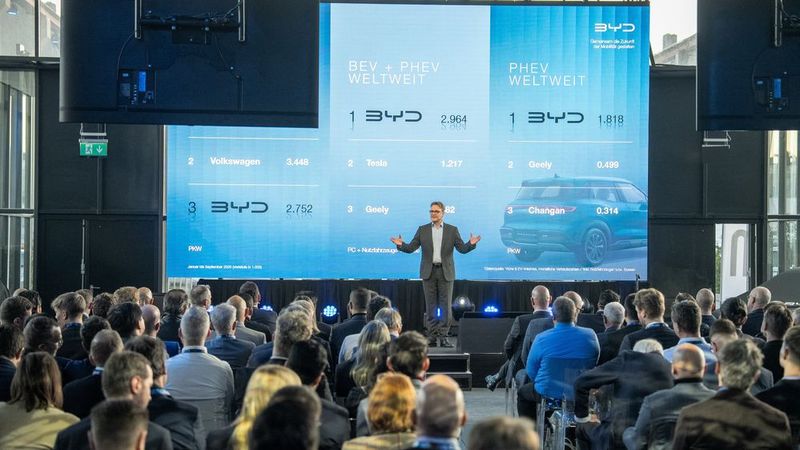
The photo was taken at the BYD dealer conference in Germany. Globally, the manufacturer has significantly expanded its sales network and thereby been able to substantially increase its sales.
(Image: BYD)
BYD not only defended its title as China's largest automaker but has now also beaten Tesla globally on its own turf. Geely and a number of other OEMs in China have made significant gains. In the segment of electric cars and hybrids, there has been a sort of baton change at the top.
BYD was able to sell approximately 4.6 million cars last year, more than any other manufacturer in China, according to the Chinese economic newspaper Meiri Jingji Xinwen. With this, BYD remains the undisputed sales champion among China's automakers, despite only producing electric vehicles and hybrids.
BYD is the Largest EV Manufacturer
On New Year's Day, it also became clear that BYD has dethroned the previous global champion Tesla in the sales of pure electric vehicles. The automaker in Shenzhen announced that it sold a total of 2.26 million electric vehicles in 2025, an increase of 28 percent.
For the first time, there were more pure electric vehicle sales globally over the year than Tesla. Tesla's sales fell by 8.6 percent to 1.6 million in 2025. Many analysts recalled this change in leadership, noting how Elon Musk did not take BYD seriously as a competitor back in 2011, making dismissive comments about the Chinese company.
Now, Tesla is ranked second behind BYD, even though the Chinese automaker is not allowed to sell cars in the USA, while China is Tesla's second-largest market. BYD has managed to grow not only in China itself but also in exports, while Tesla has been struggling.
Geely Has a Very Successful Year
The second-largest Chinese automaker, Geely, has also had a strong year. The company, owned by Daimler shareholder and Volvo buyer Li Shufu, sold just over three million cars in 2025. This was a historic record for the company, and it also achieved its annual target.
The Winners of 2025 : These Chinese automakers have exceeded their sales targets in 2025
Manufacturer
Sales (Units)
Year-over-Year Growth
Target (Units)
Target Achievement
BYD
4.602.436
7.7%
4.600.000
100%
Geely
3.024.567
39%
3.000.000
101%
Leapmotor
596.555
103%
500.000
119%
Xpeng
429.445
126%
350.000
123%
Xiaomi
400.000+
/
350.000
114%
Source: Company Information
Nearly 1.7 million of these were electric vehicles and hybrids, which are mostly collectively referred to as "New Energy Vehicles" or NEV in China. This represented a 90 percent growth for Geely's NEV segment year-over-year. It also means that in 2025, Geely sold more electric vehicles and hybrids in a single calendar year than conventional internal combustion engine cars for the first time.
China's Automotive Market Grows, Prices Drop
When focusing solely on sales in the People's Republic of China, the past year was characterized by very tough competition. A persistent price war put pressure on margins for many manufacturers. However, in terms of the number of cars sold, the market continued to grow overall.
The total figures for 2025 are not yet available, but from January to November 2025, nearly 13.8 million NEVs were sold in China, representing an increase of over 28 percent compared to the same period the previous year. During the same period, just over ten million internal combustion engine vehicles were sold in China, reflecting a decline of six percent compared to the previous year.
The Losers of 2025: These Chinese automakers did not achieve their sales targets in 2025
Manufacturer
Sales (Units)
Year-over-Year Growth
Target (Units)
Target Achievement
Great Wall Motor
1.323.672
7%
4.000.000
33%
Li Auto
406.343
−19%
640.000
63%
Nio
326.028
47%
440.000
74%
HIMA
589.107
32%
1.000.000
59%
Zeekr
224.133
1%
320.000
70%
Source: Company Information
Stellantis Partner Leapmotor Sees Largest Growth
Focusing the analysis on the NEV segment reveals some surprises for 2025. Leapmotor experienced the largest sales growth, delivering nearly 600,000 electric vehicles and hybrids, which is an increase of over 119 percent compared to the previous year.
With this, the old "triumvirate" among the so-called new forces of Chinese electromobility consisting of Nio, Xpeng, and Li Auto is now history. Xpeng remains strong, having sold 430,000 cars in the past year, reflecting a growth of 126 percent.
However, the other two did not perform as well. Both Leapmotor and the Harmony Intelligent Mobility Alliance (HIMA), a partner of Huawei, surpassed the three former showcase start-ups, Nio, Xpeng, and Li Auto, in absolute sales figures.
Despite an increase to more than 320,000 sold electric vehicles in the premium segment (+ 46.9% year-over-year), Nio could not achieve its self-imposed sales target for 2025. Meanwhile, Li Auto saw its sales decline by nearly 19 percent year-over-year to just over 400,000 units.
Xiaomi, which has just been selling electric vehicles for slightly less than a year, has reportedly achieved an impressive market launch with approximately 410,000 sales, according to several Chinese trade media. The successful foray of the mobile phone and electronics giant into the automotive industry is undoubtedly one of the biggest business success stories in China during the reporting period.
Date: 08.12.2025
Naturally, we always handle your personal data responsibly. Any personal data we receive from you is processed in accordance with applicable data protection legislation. For detailed information please see our privacy policy.
Consent to the use of data for promotional purposes
I hereby consent to Vogel Communications Group GmbH & Co. KG, Max-Planck-Str. 7-9, 97082 Würzburg including any affiliated companies according to §§ 15 et seq. AktG (hereafter: Vogel Communications Group) using my e-mail address to send editorial newsletters. A list of all affiliated companies can be found here
Newsletter content may include all products and services of any companies mentioned above, including for example specialist journals and books, events and fairs as well as event-related products and services, print and digital media offers and services such as additional (editorial) newsletters, raffles, lead campaigns, market research both online and offline, specialist webportals and e-learning offers. In case my personal telephone number has also been collected, it may be used for offers of aforementioned products, for services of the companies mentioned above, and market research purposes.
Additionally, my consent also includes the processing of my email address and telephone number for data matching for marketing purposes with select advertising partners such as LinkedIn, Google, and Meta. For this, Vogel Communications Group may transmit said data in hashed form to the advertising partners who then use said data to determine whether I am also a member of the mentioned advertising partner portals. Vogel Communications Group uses this feature for the purposes of re-targeting (up-selling, cross-selling, and customer loyalty), generating so-called look-alike audiences for acquisition of new customers, and as basis for exclusion for on-going advertising campaigns. Further information can be found in section “data matching for marketing purposes”.
In case I access protected data on Internet portals of Vogel Communications Group including any affiliated companies according to §§ 15 et seq. AktG, I need to provide further data in order to register for the access to such content. In return for this free access to editorial content, my data may be used in accordance with this consent for the purposes stated here. This does not apply to data matching for marketing purposes.
Right of revocation
I understand that I can revoke my consent at will. My revocation does not change the lawfulness of data processing that was conducted based on my consent leading up to my revocation. One option to declare my revocation is to use the contact form found at https://contact.vogel.de. In case I no longer wish to receive certain newsletters, I have subscribed to, I can also click on the unsubscribe link included at the end of a newsletter. Further information regarding my right of revocation and the implementation of it as well as the consequences of my revocation can be found in the data protection declaration, section editorial newsletter.
Market observers in China noted with regard to the annual figures that a second wave of consolidation is taking place as the transformation to electromobility continues. In the first wave, companies like Neta, WM Motor, HiPhi, and Jiyue had to give up. It is now becoming apparent that "the strong are getting stronger" and are increasingly widening the gap between themselves and the smaller "new forces."
Overall, while reliable figures will only be available in the coming weeks, a slightly slowed growth of the Chinese automotive market is currently indicated. As a result, competition among Chinese manufacturers is shifting even more towards exports in the new year. Thus, the first trend of the new year is already established. At the end of this new year, the largest winners and losers in the global market will be crowned.



:quality(80)/p7i.vogel.de/wcms/8e/7a/8e7a8d7cd0b947550da99f3d888a57a6/maas-blechnetbeitrag-20blechnext-2563x1440v1v1.png "Blechnext shows that the future of sheet metal processing lies not only in better machines, but also in smarter business models. \"Machine-as-a-Service\" is not just a financing tool; it is an accelerator for digital transformation. (Image:Blechnext)")
:quality(80)/p7i.vogel.de/wcms/d3/b7/d3b76d4685cc7167034912cdc4f6ca7c/0129496821v1.jpeg "According to an Allensbach study, the majority of German machine and plant manufacturers expect to lose their technological leadership to foreign countries. (Picture: ©Photocreo Bednarek - stock.adobe.com)")
:quality(80)/p7i.vogel.de/wcms/8e/fa/8efad6aa006fcf624d07c645b774d8ce/screenshot-202026-01-21-20113324-764x430v1v1.png "The system processes heavy sheets weighing up to 200 kg fully automatically, without programming or teaching. (Image:Teqram)")
:quality(80)/p7i.vogel.de/wcms/0c/58/0c587c8221ae96052b5dcc0f40eb3dcd/0128880879v1.jpeg "A chip surfer with a solid carbide head is used for finishing in the third operation. (Image:Ingersoll)")
:quality(80)/p7i.vogel.de/wcms/93/33/93337b12f88eb2c776c80d4f9e49d323/0129247650v1.jpeg "Isolated IoT data becomes connected real-time personalization. (Image: ©PB Studio Photo - stock.adobe.com)")
:quality(80)/p7i.vogel.de/wcms/4d/74/4d745446555110ca9797db1eabb7c9d3/0129551585v1.jpeg "Jochen Gemeinhardt is responsible for NTT Data's AI business in the DACH region as Head of Production & Supply Chain and Head of Industry Line Global Business. (Image:NTT Data)")
:quality(80)/p7i.vogel.de/wcms/af/9d/af9dc917a1eb91fd0e201d5bf8b7a57c/0129614075v1.jpeg "The future of manufacturing will be determined by demonstrable productivity gains - with more digitalization, networked data streams and simulation-based decisions. (Image:Visual Components)")
:quality(80)/p7i.vogel.de/wcms/63/c9/63c9b33f58938f4ffc2a3cefddd924e3/0129599881v1.jpeg "View of the manual casting process of a magnesium part. Apart from a few exceptions, the light metal actually leads a shadowy existence as an industrial material. However, researchers in Freiberg are now in the process of making magnesium much more attractive in terms of costs and sustainability. (Image:Metal Master)")
:quality(80)/p7i.vogel.de/wcms/6b/6f/6b6fff754fedf05375e5255460743297/0129197850v1.jpeg "A new core-shell design for anodes aims to reduce storage losses during the first charge cycle of sodium-ion batteries. (Image:BAM)")
:quality(80)/p7i.vogel.de/wcms/60/00/6000deb595c3e6b2dd0bfe508aa71653/newsimage418166-5084x2861v1v1.jpeg "The robot-guided friction stir welding gun \"Steppwelder\" in use on a conventional 6-axis industrial robot. (Image:Image: Dominik Walz, MPA, University of Stuttgart)")
:quality(80)/p7i.vogel.de/wcms/b0/95/b09529a8952b5b03f1fa096af571967c/0129618836v1.jpeg "The Aurora Botnia ferry currently has the largest battery capacity of any RoPax ship in the world. (Image:Wasaline)")
:quality(80)/p7i.vogel.de/wcms/f9/12/f9126b5a89a1d631b8de7da6775583be/0129663582v1.jpeg "Audi appoints Rouven Mohr as new CTO as of March 01, 2026. (Image:Audi)")
:quality(80)/p7i.vogel.de/wcms/37/23/372374e00db2f1803ae5cde2f00aff31/0129599814v1.jpeg "The new Euro 7 standard sets requirements for the wear of service brakes. These can be met with some technical methods. (Image:Aumovio)")
:quality(80)/p7i.vogel.de/wcms/0c/1d/0c1da1d70af62238b11e22b102bd256d/0129108406v1.jpeg "At the first ADAC glare symposium, experts illustrated and analyzed the topic of glare under real conditions. (Image:Dominsky – VCG)")
:quality(80)/p7i.vogel.de/wcms/0f/b2/0fb28656d39754b67a76b90b42243cda/0129655768v1.jpeg "Driven by GaN wafer production at 300 millimeters, Infineon's GaN products deliver outstanding performance with clear application benefits. (Image:Infineon Technologies AG)")
:quality(80)/p7i.vogel.de/wcms/98/c7/98c77993453c1edf3d2bd54b0028fa6a/0129630827v1.jpeg "Left: High Bandwidth Flash (HBF) stacks multiple layers of NAND chips to significantly increase storage capacity; Right: Concept of the \"hybrid\" H³ architecture presented in the IEEE study. (Image:Sandisk (left) / Sk hynix (right))")
:quality(80)/p7i.vogel.de/wcms/ae/cf/aecf874a057676aa69b3b5e4c7b52411/0129609464v1.jpeg "Glass storage in action: Microsoft has stored map data from the Flight Simulator on this piece of glass. (Image:Microsoft Research)")
:quality(80)/p7i.vogel.de/wcms/2c/8d/2c8da4b72e35ded278178929afb94d55/0129561713v1.jpeg "Change in direction: The shift away from PFAS in semiconductor manufacturing and the move toward sustainable chip production is demonstrated by the trilateral collaboration between Fraunhofer ENAS, the Paul Scherrer Institute PSI, and Memsstar Limited, which rely on the environmentally friendly Gas-MacEtch technology. (Image:andreyarmyagov/Canva)")
:fill(fff,0)/p7i.vogel.de/companies/67/eb/67eba621ef6ea/logo2.png "logo2 (Wuxi InfiMotion)")
:quality(80)/p7i.vogel.de/wcms/de/d6/ded641c0d57f9de47645d1bbab396905/b02-25c0327-001-copy-mercedes-benz-4957x2790v1v1.jpeg "Robotaxi service in Abu Dhabi: With Momenta, a Chinese AI specialist for autonomous driving, and the local partner Lumo, Mercedes-Benz aims to establish a shuttle service with highly automated S-Class vehicles in the United Arab Emirates. (Image:Mercedes-Benz)")
:quality(80)/p7i.vogel.de/wcms/26/fd/26fde3d58e7f8db97a67d315e7d9237a/download-4996x2812v1v1.jpeg "The supplier ZF sells its division for assistance systems. This step is being critically assessed in Asia. (Image:ZF)")
:quality(80)/p7i.vogel.de/wcms/e7/42/e7426e2bb83dd1196c8df39bcd3293e6/0125917549v1.jpeg "Geely achieved a highly regarded sales success in the first half of 2025 in China with the Xingyuan model. (Image:freely licensed/Wikipedia)")
:quality(80)/p7i.vogel.de/wcms/cd/ff/cdff8e0ba245e820c96c1cb8782a5c18/leapmotor-br-c3-bcssel-2026-4096x2302v1v1.jpeg "Japanese and Korean manufacturers once came to Europe. Now a wave of new brands from China is following (pictured: Leapmotor). (Image:Wehner - VCG)")