In a first system for processing profiles, the MX system for control cabinet-free automation from Beckhoff was convincing in all project phases. Why Schirmer Maschinen GmbH continues to rely on the plug-in system solution.
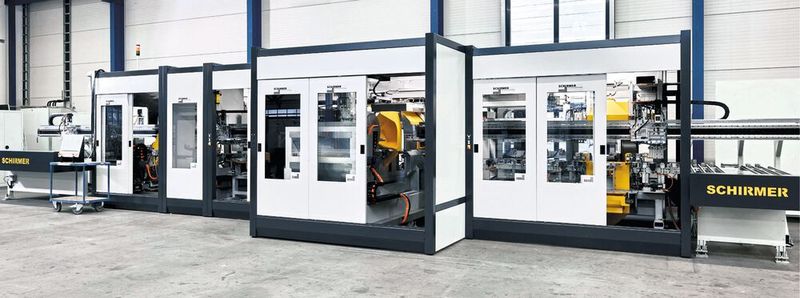
With this 14-meter-long Schirmer machine for fully automated processing of PVC window profiles, all previously required switch cabinets were replaced for the first time with the MX system.
(Image: Beckhoff)
*Editorial Management PR, Beckhoff Automation
Window and door construction is high-tech. This becomes clear from the first process step, the fully automated processing of so-called raw bars on a profile processing machine from Schirmer Maschinen GmbH. Schirmer was founded in 1979 and was Beckhoff's first customer. For over 40 years, the company has relied on PC-based control from Beckhoff, starting with the first positioning control up to the new MX system.
In particular, the latter plug-in system solution for control cabinet-less automation fits very well with Schirmer's machine concept: the development of individual machines based on largely standardized process modules to customer-specific solutions with high output and flexibility in terms of profiles and processes. The company has been a member of the Beckhoff Automation Group since 2016 and currently employs around 250 people.
Gallery
Schirmer machine for complete processing of profile bars
Schirmer's machines cover a multitude of different processes: From profile bars about 6 meters long, the individual parts for window frames and wings are produced in a continuous process. As far as possible, all drilling, milling or punching operations are carried out on the raw bar. This is followed by cutting and machining of the ends. Parallel to the processing of the profile bars, the reinforcing profiles are cut to size on a separate line, which are optionally automatically inserted and positioned into the PVC profile. Then follow further processes such as the screwing of the profile and reinforcement, steel processing (drilling, milling) as well as the insertion and screwing on of the locking parts.
Since the Schirmer machines have to deal with a variety of frequently changing profile geometries, the conversion is done automatically. "Manual setup is taboo for us," says Ludger Martinschledde, managing director of Schirmer Maschinen GmbH. Accordingly, many stops and brackets have to be positioned fully automatically. "Last year, for example, we implemented a line with a total of 210 axes," outlines Martinschledde the requirements for the control platform.
Control cabinets determine the production processes
The electrical equipment previously used in Schirmer machines reflects the status quo: drive amplifiers, power supplies, energy distribution and PC-based control technology are built into control cabinets. There are always several of these on the Schirmer machines, which are set up along the machine and to which the cables are laid from usually two to three process modules of the machine and connected. In addition, EtherCAT I/Os are used in sub-distributors. These are used to collect the actuators and sensors of the individual process modules.
However, the combination of several process functions in one control cabinet and the use of sub-distributors, to which the signal lines are clamped and not plugged in, represents a compromise for modular machine construction.
Managing Director Martinschledde describes the disadvantages of this solution as follows: "As a result, most of the electrical installation and commissioning takes place during final assembly—at a point in time when we actually want to put the system into operation as quickly as possible and then dismantle and deliver it again." The discrepancy between the modular concept of the machine and the central control cabinets has long been identified by Schirmer as a brake on creating a more efficient project process.
Therefore, he and the Schirmer designers perked up when they heard about the possibilities of completely cabinet-free automation with the MX system from Beckhoff in 2021. "The designers and Martinschledde immediately recognized the potential of the MX system for their modular machine construction," recalls Daniel Siegenbrink, product manager MX system at Beckhoff.
Machine completely redesigned and without a control cabinet
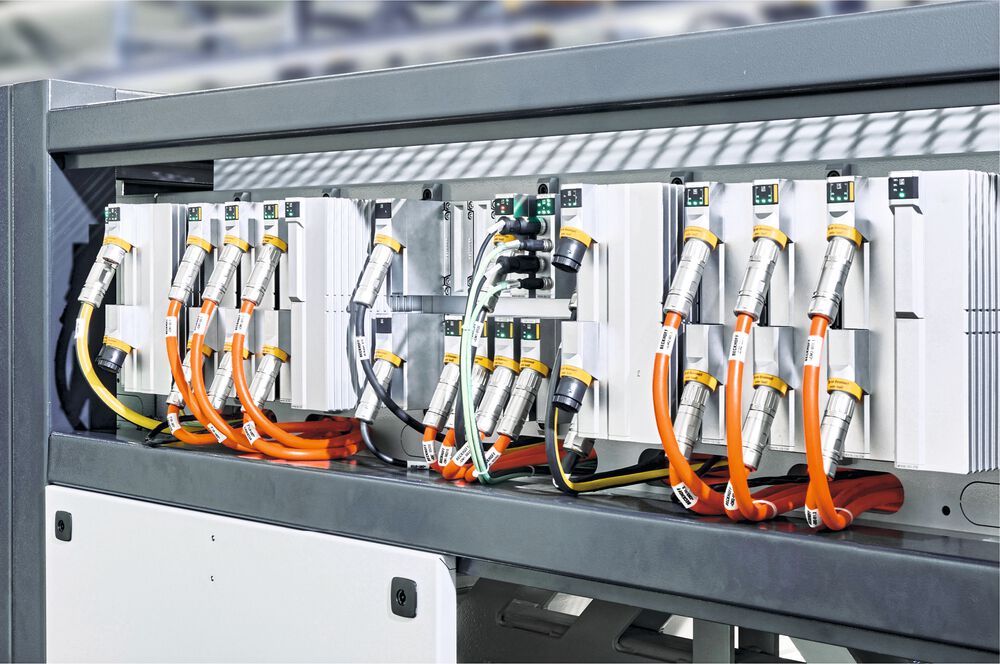
For the first time, Schirmer is now using the MX system on a machine, charting a new path. The main goal is to optimize the throughput times and processes in machine construction. Instead of the control cabinets that used to stand next to the machines, MX system base plates are now visible directly on the steel frames of the process modules. The tasks of the sub-distributors have either also been accommodated in the MX system or have been replaced by Beckhoff's decentralized I/O modules (Ethercat Box modules). This combination of MX system and Ethercat Box modules allows all lines to the motors, sensors and valve islands to be pluggable.
Date: 08.12.2025
Naturally, we always handle your personal data responsibly. Any personal data we receive from you is processed in accordance with applicable data protection legislation. For detailed information please see our privacy policy.
Consent to the use of data for promotional purposes
I hereby consent to Vogel Communications Group GmbH & Co. KG, Max-Planck-Str. 7-9, 97082 Würzburg including any affiliated companies according to §§ 15 et seq. AktG (hereafter: Vogel Communications Group) using my e-mail address to send editorial newsletters. A list of all affiliated companies can be found here
Newsletter content may include all products and services of any companies mentioned above, including for example specialist journals and books, events and fairs as well as event-related products and services, print and digital media offers and services such as additional (editorial) newsletters, raffles, lead campaigns, market research both online and offline, specialist webportals and e-learning offers. In case my personal telephone number has also been collected, it may be used for offers of aforementioned products, for services of the companies mentioned above, and market research purposes.
Additionally, my consent also includes the processing of my email address and telephone number for data matching for marketing purposes with select advertising partners such as LinkedIn, Google, and Meta. For this, Vogel Communications Group may transmit said data in hashed form to the advertising partners who then use said data to determine whether I am also a member of the mentioned advertising partner portals. Vogel Communications Group uses this feature for the purposes of re-targeting (up-selling, cross-selling, and customer loyalty), generating so-called look-alike audiences for acquisition of new customers, and as basis for exclusion for on-going advertising campaigns. Further information can be found in section “data matching for marketing purposes”.
In case I access protected data on Internet portals of Vogel Communications Group including any affiliated companies according to §§ 15 et seq. AktG, I need to provide further data in order to register for the access to such content. In return for this free access to editorial content, my data may be used in accordance with this consent for the purposes stated here. This does not apply to data matching for marketing purposes.
Right of revocation
I understand that I can revoke my consent at will. My revocation does not change the lawfulness of data processing that was conducted based on my consent leading up to my revocation. One option to declare my revocation is to use the contact form found at https://contact.vogel.de. In case I no longer wish to receive certain newsletters, I have subscribed to, I can also click on the unsubscribe link included at the end of a newsletter. Further information regarding my right of revocation and the implementation of it as well as the consequences of my revocation can be found in the data protection declaration, section editorial newsletter.
Two-row baseplate of the MX system: The open mounting on the base frames simplifies the cabling of the machine and facilitates diagnosis.
(Image:Beckhoff)
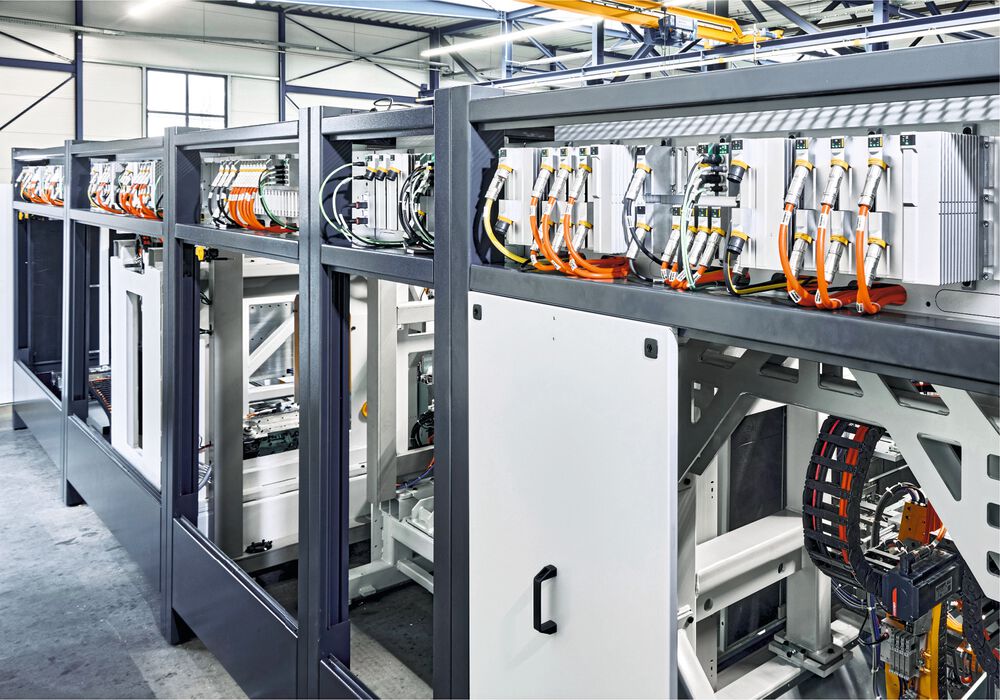
The decisive advantage of the MX system for Schirmer lies in the restructuring of internal processes. Because with this plug-in system solution, the machine builder can already mount all electrical components of a machine module in pre-assembly and simply connect them via pre-assembled lines. Another aspect is added: In pre-assembly, the machine modules are freely accessible from all sides, which significantly facilitates the laying of cables and their connection. Product manager Siegenbrink clarifies: "This saves a lot of time and greatly increases the efficiency of the workflows." This applies not only to assembly, but starts already with planning, work preparation and material provision in production.
For an automator, the back of the system is interesting: Each machine module has its own MX system baseplate, on which the various function modules are plugged in and screwed on.
(Image:Beckhoff)
With the functional modules of the MX system, the complex individual wiring of numerous sub-components, which is common in conventional control cabinet construction, is also eliminated. In this way, wiring errors are prevented and the variety of parts is reduced. Therefore, the required components—MX system base plates and modules and the pre-assembled system cabling - can be commissioned directly from the warehouse for pre-assembly after the electrical planning. "The goal is an order-independent warehouse that we want to manage through minimum inventories, requirements and replenishment times," says Martinschledde.
For Schirmer, two further findings have emerged from this initial development project: Short-term change requests are much easier to implement with less effort even in a late project phase. And in the case of a module-by-module partial commissioning, any functional errors are detected early and can be eliminated without time pressure.
Fast and efficient to the end customer
In final assembly, where the machines occupy a large area, Schirmer needs to move quickly to make room for the next systems. Here, according to Martinschledde, the advanced processes, such as especially the electrical installation and possibly partial commissioning, significantly reduce downtimes and thus increase space efficiency: Schirmer can thus build, accept and deliver more systems in the same hall.
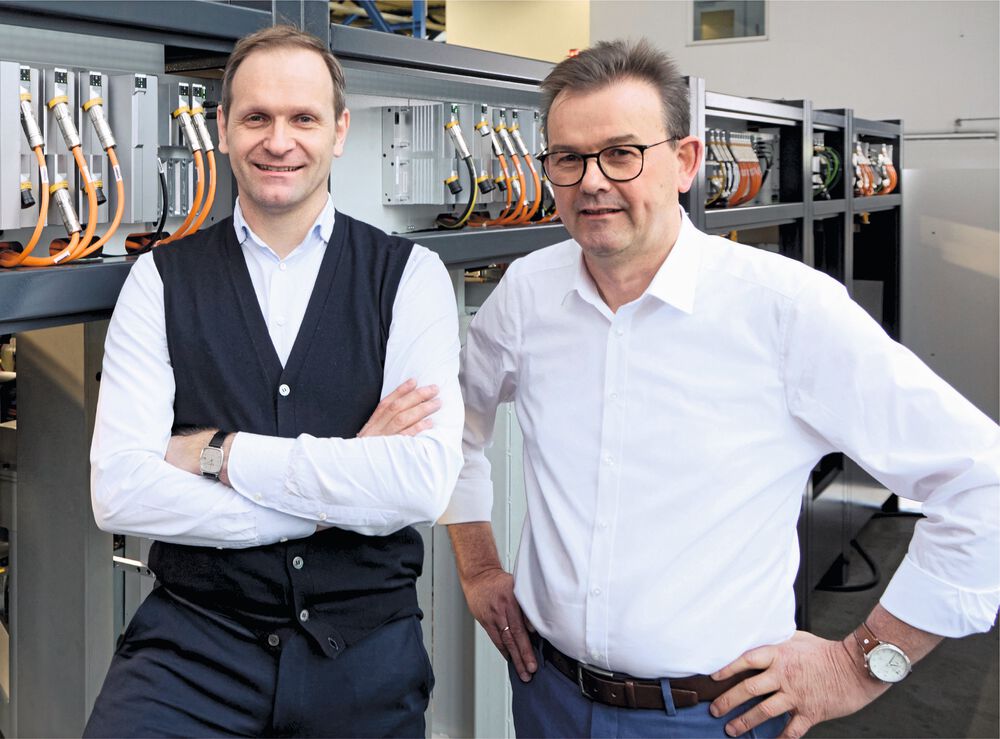
"With the MX system, we can shift value creation in the factory run through to the front and thus achieve a much more efficient production overall," says Ludger Martinschledde, Schirmer Maschinen GmbH (r.); next to him is Daniel Siegenbrink, product manager MX system at Beckhoff.
(Image:Beckhoff)
As a machine builder with an export share of 75 percent, the universal use of the automation solution is another important aspect for Schirmer. While the future installation site had to be taken into account during the electrical planning and procurement of materials, the machine can now be used worldwide without complex adjustments through the MX system, which is IEC, UL, and CSA-compliant, unlike the conventional control cabinet. This further increases the degree of standardization at Schirmer.
But it's not just Schirmer that benefits from cabinet-less automation. For the end users, the MX system also has tangible advantages. These include better accessibility of the machine areas and less space required due to the elimination of control cabinets. This allows the production plants to be set up more closely in the halls and optimally use the valuable space without violating, for example, the specifications regarding escape routes. The number of components, which is reduced by a factor of 10, also reduces the size of the spare parts warehouse.
The Beckhoff Diagnostics App, which is being introduced to the market with the MX system, is a tool that makes it easier for maintenance personnel to locate and fix errors. "The continuous plug-in capability and the use of the diagnostic app as a replacement for the multimeter mean that specially trained electrical specialists are not required for the connection or even the exchange of the MX system modules," emphasizes Siegenbrink.
Successful start into control cabinet-free automation
The use of Beckhoff's MX system has resulted in clear advantages and optimizations at many points along the entire process chain at Schirmer. For example, the previous effort for the electrical planning was reduced by around 50 percent; the usual two to three weeks assembly time for conventional control cabinet construction turned into just a few hours of system assembly. Ludger Martinschledde also expects a significant reduction in downtimes in final assembly.
"The MX system changes the way machines are designed and installed," says Ludger Martinschledde, managing director of Schirmer Maschinen GmbH. Accordingly, the new machine will not be the last plant on the way to a new era of cabinet-less automation: "Schirmer will continue to rely on this innovative solution from Beckhoff. It is clear to us that we are converting our machines to a cabinet-less automation with the MX system. And this will also apply to the product lines for aluminum and steel profiles in the future."



:quality(80)/p7i.vogel.de/wcms/31/84/3184f9ac736d8df7c2e934593684bc74/0130024314v1.jpeg "Here, the Bavarian car manufacturer BMW looks ahead to 2025: business was sluggish due to US tariffs and weakening sales in China ... (Image:BMW)")
:quality(80)/p7i.vogel.de/wcms/49/09/49095c6192a6c46d47b567e1def31ea6/0130024626v1.jpeg "The new TUM \"RoboGym\" (powered by Neura) is Europe's largest training center for next-generation humanoid robots. It focuses on the implementation of artificial intelligence in robotic systems. At the same time, it is a forge for AI experts ... (Image:Neura Robotics)")
:quality(80)/p7i.vogel.de/wcms/fe/8a/fe8af1b829b085210fef4c1fa8abddb5/0129784389v1.jpeg "As an integral part of Koch Pac-Systeme's Predictive Pack digital service product, the gearboxes with Cynapse and Wittenstein's Smart Services make it possible to detect damage risks in the packaging specialist's machines at an early stage. (Image:Koch Pac systems)")
:quality(80)/p7i.vogel.de/wcms/9f/7b/9f7be35880605811e045acd3af8b571b/0129558586v1.jpeg "An example of the V210 processing machine, which, according to Voortman, supplements the laser cutting of the V353 with drilling, thread cutting and milling. (Image:Voortman)")
:quality(80)/p7i.vogel.de/wcms/db/68/db689490e348201603dd30447711ea2b/0129578734v1.jpeg "With three-axis vibration measurement (X, Y and Z axes) and temperature detection, the CMSVT38 condition monitoring sensor provides detailed status information that helps to detect machine damage at an early stage. (Image:Kübler)")
:quality(80)/p7i.vogel.de/wcms/92/5e/925ee98ea36ad9bd574fa1cea11d0e53/0129964352v1.jpeg "The production of hardware components for humanoid robots offers great market potential. (Image:Fraunhofer IPA)")
:quality(80)/p7i.vogel.de/wcms/08/72/0872dd2dd119a54824c41e0e580e45a8/0129576591v1.jpeg "The Rose enclosure systems can be customized on request. (Image:Rose Systemtechnik GmbH)")
:quality(80)/p7i.vogel.de/wcms/73/17/7317794432521bf911711b91287cfc28/0129961259v1.jpeg "ABB Robotics and Nvidia are enabling the widespread use of physical AI in the world of robotics. This means that systems can be created virtually and with high precision and optimized much more cost-effectively. In the large image the virtual system, next to it the real robot cell ... (Image:ABB)")
:quality(80)/p7i.vogel.de/wcms/cb/fe/cbfe2741917274bbbf93d5b93e47a4f5/contact-software-launcht-fourier-20aiv1v1.png "Fourier AI combines AI models with AI applications developed for demanding engineering tasks. (Image:Contact Software)")
:quality(80)/p7i.vogel.de/wcms/bc/f7/bcf7a56980850be13ed37d220cd514bc/elchinator-security-5042249-1280-1280x720v1v1.jpeg "The HP Wolf Security Report shows: Attackers use AI for speed, modularity and automation, while the quality of campaigns is low. (Image:Picture: Pixabay)")
:quality(80)/p7i.vogel.de/wcms/68/89/688937087188b77da95b2079399ca862/0130009534v1.jpeg "Here you can see the Dualis layout configurator in use at Montratec. (Picture: ©Gorodenkoff - stock.adobe.com)")
:quality(80)/p7i.vogel.de/wcms/9e/98/9e984afbf9c6f2bcc8963bd13465b180/26-02-pi-fraunhofer-iws-41300-ultragrain-project-closing-pic-02-1562x878v1v1.png "The process of laser wire build-up welding (DED-LB) with pulse laser-induced plasma, which contributed to the success of the Ultra Grain project, is shown at high speed. (Image:Fraunhofer IWS)")
:quality(80)/p7i.vogel.de/wcms/69/f5/69f516f07a0ba999c5ba8763891853f1/0130030553v1.jpeg "Can be reloaded in 210 seconds for a return trip on the Greenford branch line: the GWR's 230001. (Image:Jack Boskett Media | GWR)")
:quality(80)/p7i.vogel.de/wcms/f0/5e/f05e720c52f757660ddbf7c410074f64/adobestock-222131875-5616x3157v1.jpeg "(Source: © jeson - stock.adobe.com)")
:quality(80)/p7i.vogel.de/wcms/b2/64/b2641254fef5afa15645cefc37089c88/0130021093v1.jpeg "Daimler Truck and Quantum Systems are jointly developing unmanned military vehicles. (Image:Quantum Systems)")
:quality(80)/p7i.vogel.de/wcms/30/7e/307e71ec64f7c52c29458544ca29adf1/org-blobs-user-response-file-output-799034cb-2ad7-4031-859a-15013f5b78e3-plugin-output-toolu-01vwfuenhw3cadvud7pddgyq-1536x864v1v1.png "China's government is debating the contents of the 15th five-year plan. The focus will change for the automotive industry. (Image:AI-generated)")
:quality(80)/p7i.vogel.de/wcms/61/8f/618f16f8fa95ec6cc838ca9bfb5dbaf1/0130027046v1.jpeg "The Belgian Research Institute has set up a European university consortium on the subject of CMOS 2.0. It brings together 26 university groups to research chip technologies that go beyond conventional transistor scaling. (Image:Imec)")
:quality(80)/p7i.vogel.de/wcms/db/a2/dba29322d0934dea1bbc4b31df80e392/0129953760v1.jpeg "SEM image: High-density electrode array with 128 nm dots. (Image:imec)")
:quality(80)/p7i.vogel.de/wcms/c2/a8/c2a8a93f306c1475489dff074ad59731/0129967672v1.jpeg "Figure 1: Imec's logic technology roadmap showing the extension of the nanosheet era from 2nm to the A10 node with the outer-wall forksheet, before the transition to CFET for A7 and beyond. (Image:imec)")
:quality(80)/p7i.vogel.de/wcms/07/79/0779a3ba2b38d583fc9b515900be2add/0129957428v1.jpeg "If the Chinese government has its way, domestic data centers full of Nvidia hardware will be a thing of the past. (Image:Nvidia)")
:fill(fff,0)/images.vogel.de/vogelonline/companyimg/76800/76895/65.jpg "FAULHABER_120mm.jpg ()")
:fill(fff,0)/p7i.vogel.de/companies/67/eb/67eba621ef6ea/logo2.png "logo2 (Wuxi InfiMotion)")
:quality(80)/p7i.vogel.de/wcms/84/47/84470bb28c69a9957d90cd2865a436ae/0118602103v1.jpeg "The loading magazine only requires two 48-V servo drives and a few digital signals, for which the compact single-row MX system baseplate with twelve data slots for MX modules with 24/48 V DC input voltage is ideally suited.(Image: Beckhoff)")
:quality(80)/p7i.vogel.de/wcms/66/32/66320309361364d934755c48044a5bc0/0118602096v1.jpeg "The entire machine is set up and operated via a customer-specific Beckhoff Control Panel.(Image: Beckhoff)")
:quality(80)/p7i.vogel.de/wcms/30/b6/30b6cdc4b187b1a4e683f198cc0b848a/0118602088v1.jpeg "With this 14-meter-long Schirmer machine for fully automated processing of PVC window profiles, all previously required switch cabinets were replaced for the first time with the MX system.(Image: Beckhoff)")
:quality(80)/p7i.vogel.de/wcms/37/00/3700767e37c57d70a69f9faa3fa1c09e/0126213739v1.jpeg "The machine for fully automatic pressing of window and door frames is the result of teamwork by Calvet, CNC Solutions, and Beckhoff (from left to right): Stefan Nees, Managing Director of Calvet, Maarten Knevels and Cédric Sabbe, both from Beckhoff Belgium, as well as Edward Baekelandt, Eddy Marissens, and Lander Debruyne from CNC Solutions. (Image:© Philippe van Gelooven)")
:quality(80)/p7i.vogel.de/wcms/92/ff/92ffd331bc54321f27cd8b65cf3b4da1/0124228537v1.jpeg "Turck's Ethernet multiprotocol I/O modules ensure efficient data communication along the system. (Image:Turck)")