Be it in e-scooters, robots, or washing machines: electric motors have long been the heart of modern technology. But with increasing functionality, engineers today need more than just components. They need intelligent tools for future-proof motor controls.
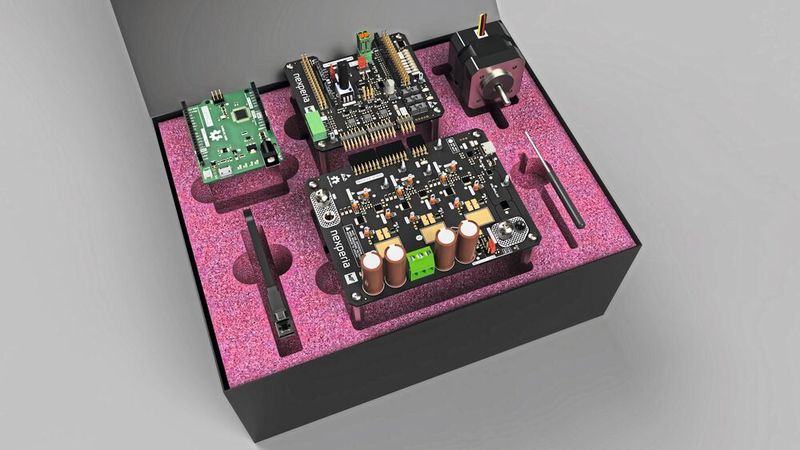
Out of the Box: The complete kit at a glance.
(Image: Nexperia)
Motorized products are playing an increasingly important role in all industries and consumer goods markets. From electric scooters and forklift trucks to robots, power tools, and smart household appliances—electric motors are now central components of many technical systems. As these products evolve, the demand for precise, efficient, and responsive motor controls has also increased. Additionally, engineers today face complex design requirements, tighter development timelines, and higher performance expectations.
To meet these challenges, it is no longer sufficient to simply select the right components. Engineers also need development tools that enable early, accurate evaluation and rapid prototyping. These tools must support various control methods, account for different sensors and power configurations, and provide meaningful predictions of future performance in real-world applications. With the increasing complexity of motor control systems, the demand for flexible evaluation environments is also growing.
Gallery
Meeting the Requirements of Various Applications
Although the performance requirements for motor-driven systems vary depending on the application, most focus on a few common factors: smooth operation, high energy efficiency, minimal noise generation, and reliable performance under various loads and environmental conditions.
In e-mobility applications such as e-scooters and e-bikes, the systems must provide precise speed control, rapid acceleration, and a quiet user experience under a wide range of operating conditions. In industrial applications, fans and pumps need to deliver continuous and consistent performance, often in compact housings with limited heat dissipation. Battery-powered tools require efficient torque delivery, compact design, and rapid response times. Household appliances are even more complex, as they often need to operate very quietly and must not overload the power grid. In robotics applications, precision in position and speed control, as well as adaptability to variable load conditions and environments, are crucial.
Regardless of the end product, however, all these systems place high demands on the hardware and software for motor control. Engineers must therefore validate design decisions early in the development process to ensure that the systems remain stable and function as expected in practical use. This requires evaluation platforms that can simulate realistic conditions and support a wide range of test cases.
Key Requirements for A Modern Evaluation Platform
Modern development tools for motor control must go beyond simple demo boards. To support rapid development, the setup must be intuitive and efficient. In many cases, depending on the complexity of hardware and software integration, it can take days or even weeks to get a motor operational. A platform that allows engineers to configure a board and get a motor running in just a few hours can significantly reduce development time. By minimizing this initial effort, faster iteration, earlier validation, and a smoother transition from concept to functional prototype can be achieved.
The platform should also be compatible with multiple communication protocols such as UART, SPI, I2C, and CAN to enable integration with various microcontrollers and development environments. With support for different control methods, including trapezoidal, sinusoidal, and field-oriented control (FOC), teams can test performance under various operating conditions and achieve system goals such as noise reduction, smooth operation, or torque behavior.
Integrated current measurement and built-in protection mechanisms are essential for safe operation and real-time feedback. With these features, engineers can assess the behavior of the power stage under load and quickly diagnose faults. Diagnostic LEDs, inline phase current measurement, and VBUS current monitoring are useful for early fault detection and verification of design assumptions.
Furthermore, open-source firmware and access to design files facilitate the customization of the platform to specific requirements or more complex use cases. Developers can experiment with new algorithms, optimize hardware settings, or simulate specific operating conditions with fewer constraints. Combined with simulation tools such as LTSpice, the platform becomes a bridge between modeling and physical validation.
Furthermore, a modular design offers a crucial advantage. Separating the inverter stage from the control logic simplifies upgrades, component replacement, and adaptation to individual requirements. This separation ensures that a platform can be adapted to different projects without extensive modifications.
Date: 08.12.2025
Naturally, we always handle your personal data responsibly. Any personal data we receive from you is processed in accordance with applicable data protection legislation. For detailed information please see our privacy policy.
Consent to the use of data for promotional purposes
I hereby consent to Vogel Communications Group GmbH & Co. KG, Max-Planck-Str. 7-9, 97082 Würzburg including any affiliated companies according to §§ 15 et seq. AktG (hereafter: Vogel Communications Group) using my e-mail address to send editorial newsletters. A list of all affiliated companies can be found here
Newsletter content may include all products and services of any companies mentioned above, including for example specialist journals and books, events and fairs as well as event-related products and services, print and digital media offers and services such as additional (editorial) newsletters, raffles, lead campaigns, market research both online and offline, specialist webportals and e-learning offers. In case my personal telephone number has also been collected, it may be used for offers of aforementioned products, for services of the companies mentioned above, and market research purposes.
Additionally, my consent also includes the processing of my email address and telephone number for data matching for marketing purposes with select advertising partners such as LinkedIn, Google, and Meta. For this, Vogel Communications Group may transmit said data in hashed form to the advertising partners who then use said data to determine whether I am also a member of the mentioned advertising partner portals. Vogel Communications Group uses this feature for the purposes of re-targeting (up-selling, cross-selling, and customer loyalty), generating so-called look-alike audiences for acquisition of new customers, and as basis for exclusion for on-going advertising campaigns. Further information can be found in section “data matching for marketing purposes”.
In case I access protected data on Internet portals of Vogel Communications Group including any affiliated companies according to §§ 15 et seq. AktG, I need to provide further data in order to register for the access to such content. In return for this free access to editorial content, my data may be used in accordance with this consent for the purposes stated here. This does not apply to data matching for marketing purposes.
Right of revocation
I understand that I can revoke my consent at will. My revocation does not change the lawfulness of data processing that was conducted based on my consent leading up to my revocation. One option to declare my revocation is to use the contact form found at https://contact.vogel.de. In case I no longer wish to receive certain newsletters, I have subscribed to, I can also click on the unsubscribe link included at the end of a newsletter. Further information regarding my right of revocation and the implementation of it as well as the consequences of my revocation can be found in the data protection declaration, section editorial newsletter.
An Exemplary Platform: Evaluation Kit NEVB-MTR1-KIT1
An example of a development platform that supports this flexible approach is the NEVB-MTR1-KIT1 from Nexperia and Würth Elektronik. It is designed for motor systems with low to medium voltage, supports a variety of applications between 12 and 48 V, and is designed for an output power of up to 1 kilowatt. The platform is modular and consists of two components: a dedicated three-phase inverter board and a microcontroller board (Image 1). It supports brushed DC motors, brushless DC motors (BLDC), and permanent magnet synchronous motors (PMSM).
The evaluation kit supports both sensor-based and sensorless control concepts, providing engineers with flexibility in development. Firmware is provided for sensor-based control using Hall-effect sensors, incremental encoders, and absolute encoders. For sensorless evaluation, the hardware includes an integrated circuit for detecting back-EMF (back-electromotive force), simplifying the development process by eliminating the need for external filters or microcontroller comparators. This approach reduces setup complexity and facilitates the exploration of sensorless control strategies using custom firmware. The kit can be integrated with Arduino Leonardo R3 and Nucleo form factor microcontrollers and easily connected to external systems via standard communication interfaces.
The power stage includes efficient LFPAK56 MOSFETs and integrated gate drivers. The integrated high-side and inline current measurement provides real-time feedback for torque and speed control. Protection features such as overcurrent and undervoltage shutdown reduce development risks during evaluation. An integrated DC-DC converter powers the logic and control, enabling the entire system to operate from a single input source (Image 2). In addition to the hardware, the kit includes LTSpice simulation models, complete schematics, a bill of materials, and layout files. The open-source firmware is provided under an MIT-like license, allowing full customization for specific use cases or new development requirements. This type of platform is particularly useful for engineers developing products in the fields of e-mobility, robotics, household appliances, or industrial systems. It offers a balanced combination of quick deployment, technical flexibility, and in-depth system insights, helping teams move quickly from concept to validated design.
The Focus is on Field-Oriented Control
Among the various supported control strategies, field-oriented control (FOC) has gained increasing importance in modern motor driver applications. FOC enables smoother, more precise, and more efficient motor operation, especially at varying speeds or under dynamic load conditions. It is particularly useful in high-performance applications such as robotics, e-mobility, and industrial automation.
In FOC, the three-phase stator currents are transformed into rotor coordinates. This mathematical transformation separates the torque-producing and flux-producing components of the current, allowing each component to be controlled independently. As a result, the motor behaves more like a brushed DC motor in terms of torque linearity and dynamic response, while still retaining the advantages of a brushless design.
The advantages of FOC include reduced torque ripple, lower noise, increased energy efficiency, and improved controllability at low speeds. These benefits make FOC the preferred choice for PMSM, which are often used in applications where performance and reliability are critical.
However, implementing field-oriented control (FOC) presents a significant challenge. It requires precise current measurement, accurate detection or estimation of the rotor position, and real-time control algorithms that need to be carefully tuned for each application. Because of this increased complexity, engineering teams often hesitate to adopt FOC in the early stages of development.
The evaluation kit includes the necessary hardware to support FOC, including integrated current measurement and interfaces for sensor-based or sensorless position feedback. This provides a solid hardware foundation for developers who want to implement and experiment with their own FOC algorithms. Since no application-specific circuits or board modifications are required, teams can focus entirely on developing control software and optimizing system behavior instead of dealing with low-level signal acquisition.
Combined with external firmware and simulation tools, this type of platform helps simplify the use of FOC for a wide range of applications and e-mobility systems. Its suitability for advanced control concepts such as FOC thus makes it a valuable resource for developers aiming to optimize motor performance at a deeper level.
Alignment of Tools With Development Goals
As electric motor technology becomes increasingly important, the significance of flexible and realistic evaluation environments also grows. Engineers need tools that allow them to validate designs under real conditions, compare various control methods, and make informed decisions early on. Platforms that offer modularity, open design access, and comprehensive control compatibility help development teams meet these new demands. Through rapid prototyping, reliable testing, and optimized adaptability, these tools reduce development effort and enhance project dynamics.
While no evaluation board can solve all challenges, well-designed platforms bring development significantly closer to achieving seamless hardware-software integration. Whether it concerns optimizing performance, reducing noise, improving efficiency, or expanding product functionality. Even with the ongoing advancement of motor technologies and increasing diversification of applications, engineers equipped with adaptable evaluation systems are well-positioned to remain at the forefront of future product innovations. (mr)



:quality(80)/p7i.vogel.de/wcms/72/a0/72a0ffc94f0929c8b193b4bc40638d72/0129755066v1.jpeg "Tens of billions less! After Ford and General Motors, Stellantis is now also feeling the painful consequences of Donald Trump's decision to change its electric car strategy ... (Image:Stellantis)")
:quality(80)/p7i.vogel.de/wcms/7f/fd/7ffd32863352c40f562f4245e4766e61/0129745849v1.jpeg "After US President Donald Trump once again resorted to his favorite weapon, tariffs, concerns rose in the EU that the so-called tariff deal could become invalid. But it looks as if the sea remains relatively calm ... (Image:F. Schneidler)")
:quality(80)/p7i.vogel.de/wcms/53/69/5369bed136061188d873441dfefd6d6e/0129245111v1.jpeg "The company revised the factory layout even though construction work had already begun. (Image:Efeso Management Consultants)")
:quality(80)/p7i.vogel.de/wcms/d2/d7/d2d79e3fb84663cb7e918c88f123989b/0129733908v1.jpeg "Mineral decision! This is how lithium is mined. There is a lot of it in Chile, Australia, Bolivia and also in Zimbabwe. However, the latter country has now announced that the export of all minerals, including lithium concentrate, will be stopped. Read more about the reasons here ... (Image:Largbatt)")
:quality(80)/p7i.vogel.de/wcms/d9/bd/d9bd1bfa7d02f586e092f06c61ee3d9a/0129464423v1.jpeg "This is what the Black Soldier Fly (BSF) looks like. The first impression is of a common two-winged insect. But appearances are deceptive, because its larvae are true protein reactors, whose industriousness is now to be exploited for food ... (Image:Fly Friends)")
:quality(80)/p7i.vogel.de/wcms/13/4d/134dee0c2b8af6b4f28937ca5b586e0d/0129499541v1.jpeg "The industry now needs to build a flexible, powerful and sovereign infrastructure that can exploit the full potential of artificial intelligence while guaranteeing control over data and processes. (Picture: ©Gorodenkoff - stock.adobe.com)")
:quality(80)/p7i.vogel.de/wcms/c6/71/c671ce338f12be49d39d1b04b40a54f7/0129697443v1.jpeg "Claas is working on making its combine harvesters fit for refurbishment. (Image:Claas)")
:quality(80)/p7i.vogel.de/wcms/f2/4b/f24b8f1c3070e7f13e4f0ffd7854e75a/0129653538v1.jpeg "The production of the BMW iX3 is to be taken as far as possible in terms of sustainability. This is also ensured by the climate-friendly Blueprint recycled steel from Thyssenkrupp Steel ... (Image:BMW)")
:quality(80)/p7i.vogel.de/wcms/f5/7e/f57ef535ee35e7b3b7ff15a8a63cef10/eds-keyvisual-8000x4496v1.jpeg "(Source: European Defence Supply)")
:quality(80)/p7i.vogel.de/wcms/af/a3/afa312176d956068af20491957eef642/newsimage418262-3100x1745v1v1.jpeg "The autonomous shuttle of the Aula AI project during a demonstration of sensor data with artificial fog. (Image:University of Magdeburg)")
:quality(80)/p7i.vogel.de/wcms/84/2d/842d51915fa4fe69c72da5cc4ba52ed1/newsimage418103-3408x1917v1v1.jpeg "3 Printing can also be sustainable—if recyclable ink is used. (Image:Hereon/Steffen Niemann)")
:quality(80)/p7i.vogel.de/wcms/b0/78/b078e07634ffd4d5ee6b73af42cc7c55/newsimage418259-1000x563v1v1.jpeg "Magnesium during forming. (Image:TU Bergakademie Freiberg)")
:quality(80)/p7i.vogel.de/wcms/c7/5e/c75e5942cd1d7e6bce973391af6dafe8/0129757614v1.jpeg "Pony.ai is cooperating with Moore Threads to bring Level 4 autonomous driving to the roads in China more quickly. (Image:Pony.ai)")
:quality(80)/p7i.vogel.de/wcms/a8/9f/a89ff7a3e28a19c03a22fd16cf3404b4/0129761837v1.jpeg "KD and Hitachi High-Tech have concluded a distribution agreement. (Image:KD)")
:quality(80)/p7i.vogel.de/wcms/29/b5/29b536a22d9b5ac80387b02620cce554/20260212-sue-60-6000x3372v1v1.jpeg "The People Mover at its world premiere. The large polycarbonate windshield is clearly visible. One of several materials contributed by Covestro. (Image:UE | STUDIOS)")
:quality(80)/p7i.vogel.de/wcms/a0/3e/a03e71cec3a956df095607a0b176a7b0/0129584071v1.jpeg "Andreas Mindt will be Head of Design at the Volkswagen Group from March. (Image:Volkswagen AG)")
:quality(80)/p7i.vogel.de/wcms/eb/4e/eb4e449562174ec95a5b3d30fb0137a2/0129648135v1.jpeg "The III-V germanium PV module with an efficiency of 34.2% is currently the most efficient solar module in the world. (Image:Jacob Forster)")
:quality(80)/p7i.vogel.de/wcms/92/c2/92c23fd5d95286c8c8c634314f6b22f8/0129722027v1.jpeg "The Meta Group has signed a five-year contract for GPU and CPU deliveries to expand its AI capacities. The agreement covers the delivery of up to 6 gigawatts of GPU computing power with a total value of around USD 60 billion. (Image:freely licensed)")
:quality(80)/p7i.vogel.de/wcms/01/77/017742db7d5eb5964c297bb8917df701/0129696639v1.jpeg "Mini-STX K3921-N: The motherboard masters Intel's Core i3 and N-Series processors and can connect multiple monitors with Full HD. (Image:Kontron)")
:quality(80)/p7i.vogel.de/wcms/17/21/1721b98b7580a86c7790f607395878a1/0129697493v1.jpeg "Universal: Motors are used everywhere. (Image:Microchip Technology)")
:fill(fff,0)/images.vogel.de/vogelonline/companyimg/76800/76895/65.jpg "FAULHABER_120mm.jpg ()")
:fill(fff,0)/p7i.vogel.de/companies/67/eb/67eba621ef6ea/logo2.png "logo2 (Wuxi InfiMotion)")
:quality(80)/p7i.vogel.de/wcms/dc/9d/dc9dae915fbd45514a05334bab2a404f/0127418671v1.jpeg "Image 1:
Modular design of the NEVB-MTR1-KIT1 with 2 boards.(Image: Nexperia)")
:quality(80)/p7i.vogel.de/wcms/76/b8/76b8dda0d1e02eeea94c4687a18adf3d/0127417716v1.jpeg "Out of the Box:
The complete kit at a glance.(Image: Nexperia)")
:quality(80)/p7i.vogel.de/wcms/5a/5a/5a5aaad259235421c0bb32ae855da67c/0127418678v1.jpeg "Image 2:
Component overview of the motor driver evaluation kit NEVB-MTR1-KIT1.(Image: Nexperia)")
:quality(80):fill(efefef,0)/p7i.vogel.de/wcms/67/ad/67adf92d254d2/elatec-wp-smart-factory.png "Elatec WP Smart Factory")
:quality(80)/p7i.vogel.de/wcms/17/21/1721b98b7580a86c7790f607395878a1/0129697493v1.jpeg "Universal: Motors are used everywhere. (Image:Microchip Technology)")
:quality(80)/p7i.vogel.de/wcms/d1/20/d1200ea644f9fabf17c2a919b5ada720/0127928583v1.jpeg "The i650 Motec frequency inverter, combined with the m550/m650 synchronous motor, offers a powerful and energy-efficient solution. (Image:Lenze)")