Is additive manufacturing a sustainable production method and how can this technology help improve the ecological footprint? We asked technology providers in 3D printing.
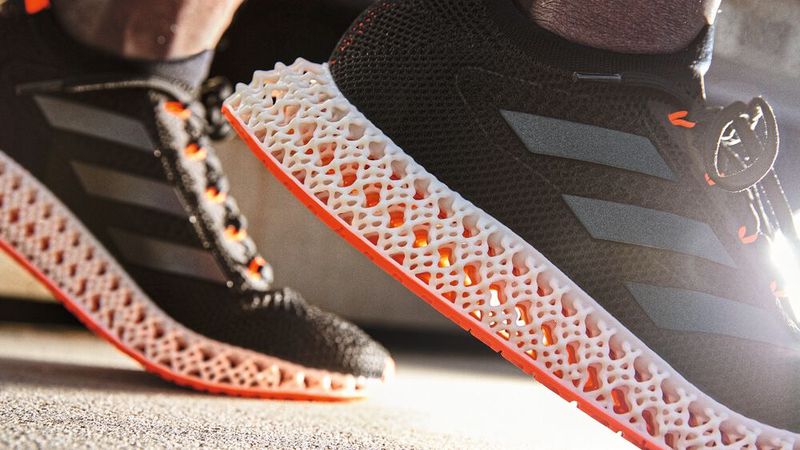
The Adidas/Carbon running shoes demonstrate how 3D printing enables success in the mass market. The 3D printed midsole made from Carbon EPU 44 contains 40 percent bio-based materials.
(Image: Adidas)
When discussing sustainability and additive manufacturing (AM), three aspects are at the forefront: Firstly, the sustainability of the technologies themselves, considering the supply chain, production and operation of the machines, consumed resources, required energy, and resulting waste streams. Secondly, the impact that additive manufacturing can have on traditional manufacturing chains from a sustainability perspective (for example, through efficiency improvements). And thirdly, the sustainable contribution that additively manufactured components can make during their lifespan.
So, compared to other production methods, is additive manufacturing the more sustainable option? "Unfortunately, it cannot be said that simply, even though it was often claimed not too long ago. However, we at EOS do believe that additive manufacturing can make an important contribution to more sustainable production. Our perspective is also based on our purpose 'Responsible Manufacturing'. We are committed to data-driven discovery of where this is the case and where adjustments may still be needed," explains Björn Hannappel, Head of Sustainability at EOS. In a life cycle analysis, EOS compared the traditional manufacture of glasses with production using 3D printing. "Here we found that the additive manufacturing of the eyeglass frame has up to three times smaller carbon footprint than conventional manufacturing," says Hannappel.
At Stratasys, we call this "Mindful Manufacturing." We rethink the way parts and processes are designed and integrate additive manufacturing into the production cycle where it is most beneficial for our customers.
Rosa Coblens, Vice President of Sustainability at Stratasys
How does AM help improve the ecological footprint?
Whether a process is ecologically sustainable depends significantly on the scope of the investigation. A view that is too narrow or too broad can prove or disprove almost any hypothesis and leaves much room for interpretation. In the case of additive manufacturing, the complexity is compounded by the fact that the technology itself is very multifaceted: there are dozens of methods, hundreds of providers, and thousands of materials. How can this technology help improve the ecological footprint? "At Stratasys, we call this 'Mindful Manufacturing.' We rethink how parts and processes are designed and integrate additive manufacturing into the production cycle where it is most beneficial for our customers," reveals Rosa Coblens, Vice President of Sustainability at Stratasys. In additive manufacturing, (almost) only the material that goes into the component is needed, resulting in significantly less waste. It also allows for designs that require significantly less material overall for equal or even improved performance of the component. "Furthermore, additive manufacturing enables local production, which can shorten supply chains and reduce transport emissions—we see this with many customers who, for example, digitalize spare parts inventories and only produce parts via 3D printing as needed, saving storage space," says Rudolf Franz, CEO of Voxeljet AG.
Gallery
Additive manufacturing also enables new, conventionally unmanufacturable components that can allow for significant energy savings through functional integration. "A good example is 3D-printed inductors, which are used in the automotive industry, for example. Integrated cooling channels not only save material during production and extend the lifespan of the component, but also significantly increase efficiency," emphasizes Hannappel.
A crucial factor is the choice of material
The choice of material in additive manufacturing also has a significant impact on the ecological footprint and overall sustainability. "The more materials available for additive manufacturing, the more applications can be addressed. Indirect processes like 3D printing for sand and investment casting have advantages over direct metal printing processes, as significantly more alloys can be cast than printed, thus meeting the demands of multiple industries. Especially in the foundry sector, more and more of our customers are focusing on inorganic, low-emission binders," explains Rudolf Franz. The choice of material affects the performance and durability of the final product. "Materials that extend the product's lifespan can lead to reduced resource consumption over time," says Rosa Coblens. Different materials may require varying amounts of energy in processing, the Vice President of Sustainability at Stratasys further notes. Choosing materials that are more energy-efficient in their production and processing can reduce the overall carbon footprint of AM.
The role of design for additive manufacturing in sustainability
A crucial factor in the sustainability of components in the field of additive manufacturing is the principle of Design for Additive Manufacturing (DfAM). One of the most important advantages of DfAM is the ability to customize components for specific applications. This customization leads to improved performance and efficiency, which in turn reduces energy consumption and waste during the operational phase. By manufacturing components tailored precisely to the specific application, manufacturers can achieve a level of efficiency that is simply not achievable with conventional methods. "Rocket engines are a good example of this. In conventional manufacturing, up to several hundred components had to be individually produced and then assembled, which can be reduced to just a few components through 3D printing, potentially with enhanced stability or improved properties," Hannappel provides as an example.
Date: 08.12.2025
Naturally, we always handle your personal data responsibly. Any personal data we receive from you is processed in accordance with applicable data protection legislation. For detailed information please see our privacy policy.
Consent to the use of data for promotional purposes
I hereby consent to Vogel Communications Group GmbH & Co. KG, Max-Planck-Str. 7-9, 97082 Würzburg including any affiliated companies according to §§ 15 et seq. AktG (hereafter: Vogel Communications Group) using my e-mail address to send editorial newsletters. A list of all affiliated companies can be found here
Newsletter content may include all products and services of any companies mentioned above, including for example specialist journals and books, events and fairs as well as event-related products and services, print and digital media offers and services such as additional (editorial) newsletters, raffles, lead campaigns, market research both online and offline, specialist webportals and e-learning offers. In case my personal telephone number has also been collected, it may be used for offers of aforementioned products, for services of the companies mentioned above, and market research purposes.
Additionally, my consent also includes the processing of my email address and telephone number for data matching for marketing purposes with select advertising partners such as LinkedIn, Google, and Meta. For this, Vogel Communications Group may transmit said data in hashed form to the advertising partners who then use said data to determine whether I am also a member of the mentioned advertising partner portals. Vogel Communications Group uses this feature for the purposes of re-targeting (up-selling, cross-selling, and customer loyalty), generating so-called look-alike audiences for acquisition of new customers, and as basis for exclusion for on-going advertising campaigns. Further information can be found in section “data matching for marketing purposes”.
In case I access protected data on Internet portals of Vogel Communications Group including any affiliated companies according to §§ 15 et seq. AktG, I need to provide further data in order to register for the access to such content. In return for this free access to editorial content, my data may be used in accordance with this consent for the purposes stated here. This does not apply to data matching for marketing purposes.
Right of revocation
I understand that I can revoke my consent at will. My revocation does not change the lawfulness of data processing that was conducted based on my consent leading up to my revocation. One option to declare my revocation is to use the contact form found at https://contact.vogel.de. In case I no longer wish to receive certain newsletters, I have subscribed to, I can also click on the unsubscribe link included at the end of a newsletter. Further information regarding my right of revocation and the implementation of it as well as the consequences of my revocation can be found in the data protection declaration, section editorial newsletter.
Topology optimization or bionic structures help minimize material usage without compromising functionality. And last but not least, optimized designs can extend product life cycles.
Rudolf Franz, CEO of the Voxeljet AG
This gives designers the opportunity to move from "Design for Manufacturing" to "Design for Functionality." "This results in new, highly efficient products. Multiple parts can also be consolidated into a single component, reducing material and production effort," explains the CEO of Voxeljet. Lighter and more efficient components lead to savings in production resources and later use, e.g., through reduced energy consumption in moving parts. "Topology optimization or bionic structures contribute to minimizing material usage without compromising functionality. And finally, optimized designs can extend product life cycles," summarizes Rudolf Franz. Additionally, DfAM supports the concept of recyclability (Design for Recycling). "By considering the end of the component's life, manufacturers can facilitate disassembly and recycling, promote a circular economy, and reduce landfill waste," says Coblens from Stratasys.
Conclusion: Additive manufacturing offers a potentially transformative way to reshape how we produce, consume, and think about the lifecycle of our products. When applied correctly, it can minimize waste, optimize design for efficiency, and make the most of sustainable materials.



:quality(80)/p7i.vogel.de/wcms/8e/63/8e631ccb75fda465c197fc52848289fa/0130260202v1.jpeg "According to the Laser-Zentrum Hannover, what is sizzling away underwater marks the first steps towards a way of repairing steel structures more cheaply and without complications using robots, laser 3D printing and AI ... (Image:LZH)")
:quality(80)/p7i.vogel.de/wcms/67/30/6730b015b3dd6f925877edd795eda319/0130247463v1.jpeg "The comparison between the SLA printable plastics Accura Xtreme Grey (above) and the robust newcomer Accura Xtreme Black now used at Speedpart, which represents an inexpensive and deep black alternative to mechanically processed plastic prototypes ... (Image:Speedpart)")
:quality(80)/p7i.vogel.de/wcms/06/9d/069d939b77a4feab0a8d2ece62c28dc1/0129655701v1.jpeg "This turned part is slotted twice. The deburring that would otherwise be necessary is no longer required for high-pressure machining. (Image:Knoll)")
:quality(80)/p7i.vogel.de/wcms/3f/72/3f72e30d61f3522bff192171b60776a4/0130245214v1.jpeg "No idea what else your humanoid robot can do, or where it fails? Then it might be worth taking a look at the Humanoid Capabilities Navigator, which now helps you to find the right robot for a job, or to improve humanoids in a targeted manner ... (Image:Fraunhofer IPA)")
:quality(80)/p7i.vogel.de/wcms/ba/28/ba28ec056a82abd76758c8c87296c0d5/0130213997v1.jpeg "The Nexy automatic material call-off system (AMS) controls the replenishment of non-stocked materials or components. (Image:Steute Technologies GmbH & Co. KG, Löhne)")
:quality(80)/p7i.vogel.de/wcms/21/3b/213b5e5454b0c4344ba0eaa700857607/0129635774v1.jpeg "The QRV flow control valves from Lee are available in sizes from 5.5 to 18 mm and cover a flow rate of 0.2 to 20 l/min. Depending on the version, the pressure range is either between 0.1 and 2.75 bar (1.5 - 40 psi) or between 0.17 and 2 bar (2.5 - 30 psi). (Image:Lee)")
:quality(80)/p7i.vogel.de/wcms/63/e9/63e9db3259a656cca88c5f7158af3fcb/0129385769v1.jpeg "The Agibot A2 at a Fortune China event in December 2025. (Image:Agibot)")
:quality(80)/p7i.vogel.de/wcms/df/a1/dfa1786a3b05f5ff2e51d0f633695c57/0130137877v1.jpeg "Openclaw inspires AI communities. (Image:Openclaw.ai)")
:quality(80)/p7i.vogel.de/wcms/e4/51/e451d52ce0182fb0aaa46a5774f832ef/26-04-pi-fraunhofer-iws-21160-bioslide-pic-01-4128x2321v1v1.jpeg "With the BioSlide research project, the Fraunhofer IWS is investigating how sliding systems can be designed to be more sustainable and energy-efficient. New materials can be tested in a particularly application-oriented manner on this plain bearing test stand. (Image:Fraunhofer IWS)")
![Thanks to advanced 3D printing technology, a more efficient use of resources should contribute to lower-emission aviation—this is the goal of ['skai]-lab. (Image:Oleksandr Pashchenko - stock.adobe.com / AI-generated)](https://cdn1.vogel.de/nghHNSbySccfOjG3n1qCA-FVOjQ=/288x162/smart/filters:format(jpg):quality(80)/p7i.vogel.de/wcms/62/64/626424c97a16e69f871bf216c9629c2a/adobestock-1927043193--c2-a9-20oleksandr-20pashchenko-20-e2-80-93-20stock-adobe-com-ki-generiertv1v1.jpeg "Thanks to advanced 3D printing technology, a more efficient use of resources should contribute to lower-emission aviation—this is the goal of ['skai]-lab. (Image:Oleksandr Pashchenko - stock.adobe.com / AI-generated)")
:quality(80)/p7i.vogel.de/wcms/78/28/7828775af76773458b4d1409ceb1cf0c/368945-20dam-20imagery-digital-transformation-pc-1920x1079v1v1.jpeg "Complex development projects with high regulatory requirements, such as in the aerospace industry, benefit in particular from the Intelligent Product Lifecycle. (Image:PTC)")
:quality(80)/p7i.vogel.de/wcms/e7/82/e7822e208621ba2ae892d609e60481e8/texas-20uni-850x478v1v1.jpeg "Superfoam is a composite that is capable of absorbing 10 times more energy than a conventional foam. (Image:Abbey Toronjo/Texas A&M University Division of Marketing & Communications)")
:quality(80)/p7i.vogel.de/wcms/e6/53/e6539c6b5df2d2af2970ca981131fb42/0130215307v1.jpeg "Volkswagen is in first place in the first two months of 2026—no one has sold as many cars in China as the car manufacturer. (Image:Volkswagen)")
:quality(80)/p7i.vogel.de/wcms/b0/6d/b06d9ad54bfc39053e1db5494df5cb9a/0130237932v1.jpeg "Pleased about their partnership in the field of bidirectional charging: Christian Haferkamp and Aurélie Alemany from enercity as well as Stefan Mecha and Lars Krause, both Volkswagen Commercial Vehicles (from left to right). (Image:PSONNACK)")
:quality(80)/p7i.vogel.de/wcms/2b/0b/2b0b5ff55299be32174cb0ed76718253/0130177406v1.jpeg "Rolls-Royce has received funding of 70 million US dollars from the EU public-private partnership \"Joint Undertakings for Clean Aviation\". (Image:Rolls-Royce)")
:quality(80)/p7i.vogel.de/wcms/95/7e/957ed49b185794b3e76b9e610a8a389f/0130217926v1.jpeg "Bosch wants to offer components for e-vehicles in India together with Tata. (Image:Bosch)")
:quality(80)/p7i.vogel.de/wcms/22/08/22085b4997a696887dd5a712a30b262b/0130211045v1.jpeg "Imec has announced that the world's most advanced high numerical aperture (High NA) EUV lithography system, the ASML EXE:5200, has arrived at its 300mm cleanroom in Leuven. (Image:Imec)")
:quality(80)/p7i.vogel.de/wcms/48/f2/48f250e2385d3f43743dc44133cc4731/0130161592v1.jpeg "The world's first fully functional quantum battery as a proof-of-concept, developed by CSIRO and its cooperation partners, the University of Melbourne and RMIT. (Image:CSIRO and collaborators, The University of Melbourne and RMIT)")
:quality(80)/p7i.vogel.de/wcms/16/9c/169c092e854d8740928a080cead3b88e/0130241261v1.jpeg "NVIDIA's GB300 AI chip with HBM3E and HBM4 from SK Hynix. (Image:SK Hynix)")
:quality(80)/p7i.vogel.de/wcms/3a/50/3a50d3f269f38f14d7a25a93c6f2b2f8/0130147601v1.jpeg "The compact modulator enables fast and energy-efficient data transmission and can be manufactured cost-effectively. (Image:Hugo Larocque, EPFL)")
:fill(fff,0)/images.vogel.de/vogelonline/companyimg/76800/76895/65.jpg "FAULHABER_120mm.jpg ()")
:fill(fff,0)/p7i.vogel.de/companies/69/88/69882c428938e/tmts2026-ticec-banner-en-2000px.png "tmts2026-ticec-banner-en-2000px (https://www.tmts.tw/en)")
:fill(fff,0)/p7i.vogel.de/companies/67/eb/67eba621ef6ea/logo2.png "logo2 (Wuxi InfiMotion)")
:quality(80)/p7i.vogel.de/wcms/a5/a3/a5a3d7d9cfe492070e4992804d4c67fc/0121104085v1.jpeg "For the 3D-printed YouMawo sunglasses, EOS, YouMawo, and Fraunhofer EMI determined a life cycle assessment. According to this, the carbon footprint of the additively manufactured glasses is 58 percent lower than that of a comparable frame.(Image: YouMawo)")
:quality(80)/p7i.vogel.de/wcms/fe/9c/fe9cf709e3daf7bb8a5bd5c3403d2c9f/0121104095v1.jpeg "The Adidas/Carbon running shoes demonstrate how 3D printing enables success in the mass market. The 3D printed midsole made from Carbon EPU 44 contains 40 percent bio-based materials.(Image: Adidas)")
:quality(80)/p7i.vogel.de/wcms/c3/fe/c3feee241654a8cdc04b0e6aa7db8407/0121104087v1.jpeg "Caracol and NextChem collaborated on the \"Beluga\" project, a one-piece sailboat 3D printed from recycled MyReplast polymer.(Image: Caracol)")
:quality(80)/p7i.vogel.de/wcms/29/99/2999f8ed8666a1fe372d84fb1dd3282f/0127536714v1.jpeg "Employees of Baettr Foundry prepare the 3D-printed sand molds of the VX9000 for casting. (Image:Baettr Foundry)")
:quality(80)/p7i.vogel.de/wcms/38/33/3833cda69bd733107d0f7afa61c78345/0128118792v1.jpeg "From the green part to the perfect surface: Auto-Smooth automates the entire post-processing in the Cold Metal Fusion process, including depowdering, smoothing, and complete feedstock reuse—as a seamless 3-in-1 process. (Image:Rösler Surface Technology)")