Fluid technology needs to become more sustainable, otherwise it will soon stand in the way of the industry's climate goals. Many of the open questions are technical in nature, but not all of them.
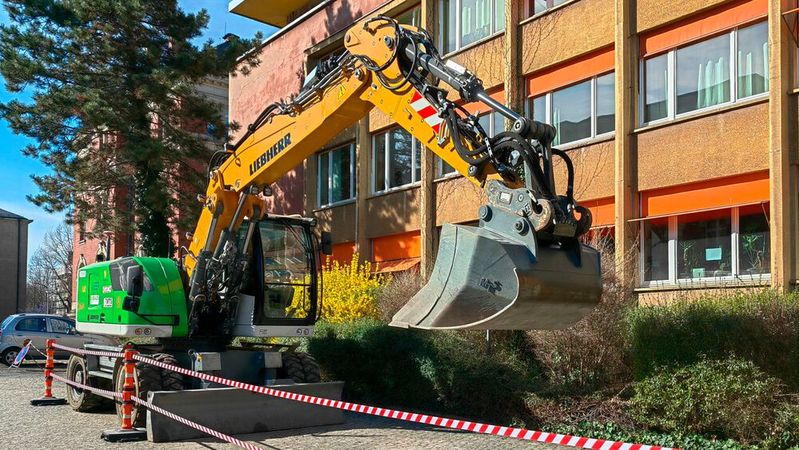
This excavator is used by the Dresden University of Technology for the demonstration of current research results.
(Image: Juliane Weber, TU Dresden)
The European fluid technology is trying to develop more sustainable solutions. At the same time, international competition, especially from China, is intensifying. Professor Jürgen Weber, head of the Institute for Mechatronic Mechanical Engineering at the TU Dresden, states: "The improvement of efficiency has gained new significance in the wake of rising energy prices. This can be seen in all areas. Whether in component development with pumps and valves or at the system level in stationary and mobile areas." The industry is discussing future drive technologies for mobile work machines, the digital construction site and necessary changes at the machine level, but also changing system concepts, which was evident, for example, at the International Fluid Power Conference (IFK) at the Technical University Dresden in March 2024.
If one wants to make wireless, mobile machines climate-neutral in one application area, either electricity or hydrogen may be suitable as a replacement for diesel depending on the type. Liebherr, for example, is one of the companies currently dealing with the limits and possibilities of different drive technologies in this area. "Political guidelines are expected to provide a significant development boost here," notes Jürgen Weber and adds, "This also creates new opportunities for fluid technology in the hydrogen sector."
However, it is not possible to replace the diesel drive 1:1 with an electric drive with a fuel cell in mobile machines, as Lukas Trommler from TU Dresden has explained in a current conference report: First, an infrastructure for the supply with (green) hydrogen is needed. Secondly, the currently common fuel cell technology needs about eight times as much space in a mobile machine as a diesel drive, if it is to provide the same operating time and performance, according to the report. This is because both the fuel cell and the battery need to be cooled. In addition, a hydrogen tank has significantly more volume than a diesel tank for the same energy content. Even at 700 bar, H2 only reaches 1.3 kWh/l. Diesel, on the other hand, has 10 kWh/l. Fairly, it should be added that hydrogen shows better values when comparing energy content by mass: 33.3 kWh/kg versus 11 kWh/kg for diesel. The volume is still a problem: If you reduce the tank volume at the expense of operating time, the technology is only practical for a part of the cases.
However, improvement is in sight, as the industry is investing in the development of hydrogen technology and new solutions are constantly coming onto the market. For example, a patented shut-off valve with a small magnet size was presented at the IFK, which is suitable for hydrogen tanks where the gas is stored at up to 1050 bar.
CPR systems instead of throttle control?
One of the reasons why hydrogen is seriously considered at all is the high energy demand of work hydraulics in many mobile machines, for example wheel loaders. Pure battery operation is difficult, but not impossible. More economical system designs, for example CPR systems (with Common Pressure Rail), could solve the problem, argued Robin Mommers from the company Innas at the IFK. These enable energy management and recuperation and thus higher efficiency. However, the system change is technically challenging.
A component needed in CPR systems for operating hydraulic cylinders is the hydraulic transformer. Innas has built a prototype with the FCT80, which is currently being field-tested. It is based on the floating-cup principle. "If the product now goes into series production, as announced, we can look forward to an exciting development," judges Professor Marcus Geimer, head of the Mobile Work Machines department at the Karlsruhe Institute of Technology.
Even in the rather unlikely event that mobile machines run on E-fuels in the future, the hydraulics would have to become more efficient in order not to waste this very expensive fuel.
Operators pursue ambitious plans
Time is pressing, as a look at the plans of larger operators shows: The road construction company Strabag has set itself the goal of being completely climate-neutral by 2040—from administration to building materials. The construction projects themselves are to be made sustainable by 2030 by the group, which employs 14,000 people.
Date: 08.12.2025
Naturally, we always handle your personal data responsibly. Any personal data we receive from you is processed in accordance with applicable data protection legislation. For detailed information please see our privacy policy.
Consent to the use of data for promotional purposes
I hereby consent to Vogel Communications Group GmbH & Co. KG, Max-Planck-Str. 7-9, 97082 Würzburg including any affiliated companies according to §§ 15 et seq. AktG (hereafter: Vogel Communications Group) using my e-mail address to send editorial newsletters. A list of all affiliated companies can be found here
Newsletter content may include all products and services of any companies mentioned above, including for example specialist journals and books, events and fairs as well as event-related products and services, print and digital media offers and services such as additional (editorial) newsletters, raffles, lead campaigns, market research both online and offline, specialist webportals and e-learning offers. In case my personal telephone number has also been collected, it may be used for offers of aforementioned products, for services of the companies mentioned above, and market research purposes.
Additionally, my consent also includes the processing of my email address and telephone number for data matching for marketing purposes with select advertising partners such as LinkedIn, Google, and Meta. For this, Vogel Communications Group may transmit said data in hashed form to the advertising partners who then use said data to determine whether I am also a member of the mentioned advertising partner portals. Vogel Communications Group uses this feature for the purposes of re-targeting (up-selling, cross-selling, and customer loyalty), generating so-called look-alike audiences for acquisition of new customers, and as basis for exclusion for on-going advertising campaigns. Further information can be found in section “data matching for marketing purposes”.
In case I access protected data on Internet portals of Vogel Communications Group including any affiliated companies according to §§ 15 et seq. AktG, I need to provide further data in order to register for the access to such content. In return for this free access to editorial content, my data may be used in accordance with this consent for the purposes stated here. This does not apply to data matching for marketing purposes.
Right of revocation
I understand that I can revoke my consent at will. My revocation does not change the lawfulness of data processing that was conducted based on my consent leading up to my revocation. One option to declare my revocation is to use the contact form found at https://contact.vogel.de. In case I no longer wish to receive certain newsletters, I have subscribed to, I can also click on the unsubscribe link included at the end of a newsletter. Further information regarding my right of revocation and the implementation of it as well as the consequences of my revocation can be found in the data protection declaration, section editorial newsletter.
From Strabag's point of view, digitalization with standardized data formats, uniform operating concepts and defined system architectures is needed as a basis. A clearly structured data flow and legal certainty in data usage are also required.
Need for action in digitalization
This example shows that sustainability and digitalization are closely linked. The industry relies on the AAS (Administration Shell/Asset Administration Shell). This is a standard for data exchange, which enables cross-company work with digital twins and which some companies are already using. At the IFK, there were individual cautionary voices about data exchange via AAS. The concern was that the data could primarily benefit competitors from China, whose interest in the German or European market is now unmistakable. However, in general, the necessity and benefit of digitalization are not questioned. Hartmut Rauen, deputy managing director of VDMA, even said at the IFK that he only sees a future for those products that support AAS. Steffen Haack, CEO at Bosch Rexroth, however, criticized at the event that not even all fluid technology products currently have a serial number. The industry still has homework to do in this area, Haack emphasized.



:quality(80)/p7i.vogel.de/wcms/dd/08/dd086510d9ae7b50181f6070e4463b44/0129363730v1.jpeg "Typical application for ionizing devices: Wrapping films. (Picture: ©Adobe Stock/SMC)")
:quality(80)/p7i.vogel.de/wcms/35/57/3557c819943c53acec41a0ccba87da4f/0130049064v1.jpeg "Researchers at the Fraunhofer IWU in Chemnitz have long known that many typical sheet metal parts can be manufactured more cost-effectively using hollow embossing rollers. Now there is news to report ... (Image:Fraunhofer IWU)")
:quality(80)/p7i.vogel.de/wcms/59/02/590246e3b3f415c65edbee377c14ca77/26-06-pi-fraunhofer-iws-41450-direktplattieren-pic-01-7771x4369v1v1.jpeg "The Fraunhofer IWS has developed the new \"direct laser cladding\" process, which creates a functional layer directly on the base body by applying a strip-shaped metal to rotationally symmetrical components in a spiral and bonding it locally by laser. (Image:Christoph Wilsnack/Fraunhofer IWS)")
:quality(80)/p7i.vogel.de/wcms/73/60/73608418789b1d9c393f5e2fa974eda2/0130209906v1.jpeg "The robots of the X6 generation from b+m enable very high painting quality and are also particularly compact and easy to maintain. (Image:Beckhoff)")
:quality(80)/p7i.vogel.de/wcms/78/e9/78e9188c25a8a94e67c34c9bf8ffe495/visual-agile-20robots-20and-20google-20deepmind-20partner-20to-20bring-20intelligence-20to-20robotics-2500x1406v1v1.jpeg "Together, the partners are developing adaptable, intelligent robots for a wide range of applications (Image:Agile Robots SE)")
:quality(80)/p7i.vogel.de/wcms/e7/66/e7669ecf0260ae8fc54c214e34e4902a/0130316817v1.jpeg "Siemens and Palo Alto Networks offer tested cybersecurity solution for industrial 5G. (Image:Siemens)")
:quality(80)/p7i.vogel.de/wcms/9f/55/9f55324832c4f426958031375124d9de/siemens-20ubtech-20hmnd-1920x1079v1v1.png "Ready for the factory floor: While Ubtech is planning mass production, Siemens is already testing humanoids in real factory applications in Erlangen. (Image:Siemens)")
:quality(80)/p7i.vogel.de/wcms/11/36/113695ed260e29c8c2d9d39dc5f9d869/0130213768v1.jpeg "AI can work cheaply in China and deliver the results rapidly all over the world. (Image:Dall-E / AI-generated)")
:quality(80)/p7i.vogel.de/wcms/62/5f/625f41e87ebfef156a98c8e6393e32fd/0130211654v1.jpeg "Axial flux motors have some advantages over radial flux motor—but their production is currently still expensive. (Image:RWTH Aachen University)")
:quality(80)/p7i.vogel.de/wcms/77/9b/779b0685d010dfe45c9c2cb1cfecd467/0128886425v1.jpeg "The BlueEye is the first \"real\" hyperspectral camera for the UV range and covers the wavelength range from 220 to 380nm. (Image:Inno-spec GmbH)")
:quality(80)/p7i.vogel.de/wcms/e4/51/e451d52ce0182fb0aaa46a5774f832ef/26-04-pi-fraunhofer-iws-21160-bioslide-pic-01-4128x2321v1v1.jpeg "With the BioSlide research project, the Fraunhofer IWS is investigating how sliding systems can be designed to be more sustainable and energy-efficient. New materials can be tested in a particularly application-oriented manner on this plain bearing test stand. (Image:Fraunhofer IWS)")
![Thanks to advanced 3D printing technology, a more efficient use of resources should contribute to lower-emission aviation—this is the goal of ['skai]-lab. (Image:Oleksandr Pashchenko - stock.adobe.com / AI-generated)](https://cdn1.vogel.de/nghHNSbySccfOjG3n1qCA-FVOjQ=/288x162/smart/filters:format(jpg):quality(80)/p7i.vogel.de/wcms/62/64/626424c97a16e69f871bf216c9629c2a/adobestock-1927043193--c2-a9-20oleksandr-20pashchenko-20-e2-80-93-20stock-adobe-com-ki-generiertv1v1.jpeg "Thanks to advanced 3D printing technology, a more efficient use of resources should contribute to lower-emission aviation—this is the goal of ['skai]-lab. (Image:Oleksandr Pashchenko - stock.adobe.com / AI-generated)")
:quality(80)/p7i.vogel.de/wcms/c3/c4/c3c4ce270b083eeac55654148611f064/0130237945v1.jpeg "China is not giving up on hydrogen, but is intensifying its efforts. (Image:freely licensed from Pixabay)")
:quality(80)/p7i.vogel.de/wcms/4e/c0/4ec0bd19390b169edfa23677373dcdf1/0130260089v1.jpeg "Renewable fuels can supply European road traffic, according to a study. (Image:Aral)")
:quality(80)/p7i.vogel.de/wcms/6f/c9/6fc9050301d745cad25585c6780f8f51/0130197341v1.jpeg "Production facilities are a worthwhile target and are therefore at risk. (Image:ABB Robotics)")
:quality(80)/p7i.vogel.de/wcms/b6/62/b662adc2cec8227d8172509bbfb6ee42/25c0207-107-4961x2789v1v1.jpeg "The GLB is the second model based on Mercedes' new MMA platform. Apparently, Geely's platform is better and cheaper, which is why the two companies are negotiating a partnership. (Image:Mercedes-Benz)")
:quality(80)/p7i.vogel.de/wcms/4d/dd/4dddf438e91f394c04a095dbfd109d1c/0130236430v1.jpeg "Measurement modules: The 720301 module in combination with the SL2000 enables RMS and power calculations, among other things. (Image:Yokogawa)")
:quality(80)/p7i.vogel.de/wcms/61/fc/61fcf95f5cca15494ad18343901ae585/0130317237v1.jpeg "With the AGI CPU, Arm says it is taking a \"historic step\": With the processor aimed at AI in data centers, the company is presenting itself for the first time as a provider of its own chips, not just as a pure IP licensor. (Image:Arm)")
:quality(80)/p7i.vogel.de/wcms/82/90/8290dfe3595b6c6b33726ae8b76172c7/0130319587v1.jpeg "The concept image illustrates how the pattern of tiny protrusions and depressions created on the substrate (MgO, bottom) controls the arrangement of atoms in the superconducting material (YBCO, top). At the interface between the two layers, an electronic structure enables superconductivity to occur at higher temperatures than previously possible. (Image:Chalmers University of Technology / Riccardo Arpaia)")
:fill(fff,0)/images.vogel.de/vogelonline/companyimg/76800/76895/65.jpg "FAULHABER_120mm.jpg ()")
:fill(fff,0)/p7i.vogel.de/companies/69/88/69882c428938e/tmts2026-ticec-banner-en-2000px.png "tmts2026-ticec-banner-en-2000px (https://www.tmts.tw/en)")
:fill(fff,0)/p7i.vogel.de/companies/67/eb/67eba621ef6ea/logo2.png "logo2 (Wuxi InfiMotion)")
:quality(80)/p7i.vogel.de/wcms/8f/5b/8f5b9bb5c2e50c641407cca8658bc73c/0118915076v1.jpeg "The biennial IFK (alternating at the TU Dresden and RWTH Aachen) is an important event for fluid technology, where the industry maintains its networks and discusses open questions.(Image: Juliane Weber, TU Dresden)")
:quality(80)/p7i.vogel.de/wcms/20/96/20966e32c52a3fa41bce66b2bbba99f9/0118915091v1.jpeg "At the IFK, almost all important players in German fluid technology from research and industry usually meet.(Image: dm/construction practice)")
:quality(80)/p7i.vogel.de/wcms/91/e2/91e22d8149b508375e50c1130ff8500c/0118766970v1.jpeg "Innas has developed these prototypes of hydraulic transformers named FCT80 for CPR systems. They are currently being field tested.(Image: Innas)")
:quality(80)/p7i.vogel.de/wcms/01/93/01933e43c2d5ae0a1c47e6971fd8d249/0118915075v1.jpeg "Prof. Jürgen Weber from TU Dresden suggests adopting the successful strategies of other industries in digitalization, as long as they can be transferred.(Image: Juliane Weber, TU Dresden)")
:quality(80)/p7i.vogel.de/wcms/53/ef/53ef65b954ddefadb2956dea1ca24369/bild1-deutz-agritechnica-4047x2275v1v1.jpeg "Telehandlers are pioneers in the application of electric drives. Pictured here: a Magni telehandler with a Deutz battery. (Image:Deutz AG)")
:quality(80)/p7i.vogel.de/wcms/49/d9/49d9da94bd1a3b8da34b924d40761d62/0125207134v1.jpeg "A cruise ship with an electric drive sails low-emission into the sunset. A symbol of change in maritime mobility. (Image:Dall-E / AI-generated)")