Researchers at the Fraunhofer Institute for Manufacturing Technology and Advanced Materials IFAM in Bremen have developed an innovative surface functionalization for bone implants that can be loaded with an antibiotic to prevent complications from infections after implant placement.
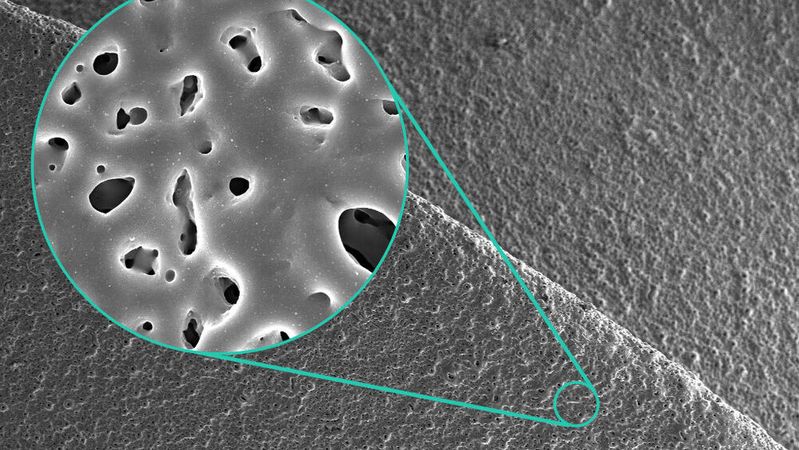
Scanning electron microscope image of a silver-doped porous micro-arc oxide layer on titanium.
(Image: Fraunhofer IFAM)
Complications from infections are not uncommon after implant placement. The risk increases with heavily contaminated wounds, which are particularly common in war zones like Ukraine—yet many bone injuries need treatment there. Given the heavy burden on Ukraine's healthcare system with a multitude of poorly healing bone defects, the Fraunhofer IFAM decided to help in 2023. In addition to the news situation, personal connections were decisive: "Two of our employees are from Lviv and were involved in the project from the very beginning. Through them, contact was established with the National Rehabilitation Center Unbroken in Ukraine, with which we are now working closely to best understand the local needs and further develop the technology in a targeted manner," says Dr. Kai Borcherding, Head of the Medical Technology and Life Sciences Division at Fraunhofer IFAM. The MAOmed project is funded by the Fraunhofer Future Foundation.
Special Process Creates Pores on the Surface
The researchers' idea: They use the so-called Micro-Arc Oxidation (MAO) to create an innovative surface on titanium implants. The metal parts are immersed in an electrolyte solution containing silver salts—a conductive liquid—and exposed to a voltage of up to 300 volts. High-energy plasma discharges form a silver-containing oxide layer on the material within a few minutes, where pores are created through targeted current control, and silver is incorporated as nanoparticles. These reservoirs can then absorb antibiotics or other active substances like a sponge.
Gallery
Local Antibiotic Delivery And Silver Reduce the Risk of Infection
Through the selection of the electrolyte and process control, the researchers can adjust the resulting pore structure in terms of size and design. This is crucial for the loading capacity and the duration of antibiotic release: "After completing the MAO layer, the metal parts are immersed in a highly concentrated antibiotic solution. The pores uniformly absorb the active substance up to a defined capacity through capillary forces, which is then released in the body through diffusion," explains Linda Gätjen, Co-Head of the Polymer Chemistry and Material Behavior Department at Fraunhofer IFAM. "How the antibiotic is released over the desired period was also tested directly here at the institute through in-vitro tests after developing the surface and successfully finding project partners." In laboratory tests, the researchers were also able to demonstrate that the integrated silver particles provide additional support to the antibiotic.
Overall, there are only a few solutions for medical devices that use an antibiotic-containing coating, and when they do, the manufacturing process is much more complex.
Kai Borcherding
In the field of implants, this type of surface treatment is entirely new: "There is nothing comparable on the market so far. Overall, there are only a few solutions for medical devices that use an antibiotic-containing coating, and when they do, the manufacturing process is much more complex," explains Kai Borcherding.
Simple And Fast Coating Process
The simple setup—even under challenging conditions—is a major advantage of the method: Essentially, a power supply and a cooling unit for the immersion bath are sufficient to carry out the MAO coating process. This makes it so simple and cost-effective that it could even be implemented directly in crisis areas during later development stages. Additionally, the excellent biocompatibility of the MAO surface ensures good and rapid integration of the implant into the body.
How the innovative coating performs in practice is to be tested in the future in Ukraine. The next steps initially involve the preclinical further development of the technology and clinical studies that could be conducted at the Unbroken National Rehabilitation Center in Lviv.
The method is also garnering interest in Germany. KLS Martin, as a technology partner of Fraunhofer IFAM, has already provided sample implants that the Bremen researchers are currently working with—a first step towards application. Dr. Tobias Wolfram, Head of Implant Research at KLS Martin, explains: "In addition to the high ethical value of the project, we see great potential in the MAO method for medical technology—not only in the field of bone implants. We are happy to support the team with our expertise and materials."
Date: 08.12.2025
Naturally, we always handle your personal data responsibly. Any personal data we receive from you is processed in accordance with applicable data protection legislation. For detailed information please see our privacy policy.
Consent to the use of data for promotional purposes
I hereby consent to Vogel Communications Group GmbH & Co. KG, Max-Planck-Str. 7-9, 97082 Würzburg including any affiliated companies according to §§ 15 et seq. AktG (hereafter: Vogel Communications Group) using my e-mail address to send editorial newsletters. A list of all affiliated companies can be found here
Newsletter content may include all products and services of any companies mentioned above, including for example specialist journals and books, events and fairs as well as event-related products and services, print and digital media offers and services such as additional (editorial) newsletters, raffles, lead campaigns, market research both online and offline, specialist webportals and e-learning offers. In case my personal telephone number has also been collected, it may be used for offers of aforementioned products, for services of the companies mentioned above, and market research purposes.
Additionally, my consent also includes the processing of my email address and telephone number for data matching for marketing purposes with select advertising partners such as LinkedIn, Google, and Meta. For this, Vogel Communications Group may transmit said data in hashed form to the advertising partners who then use said data to determine whether I am also a member of the mentioned advertising partner portals. Vogel Communications Group uses this feature for the purposes of re-targeting (up-selling, cross-selling, and customer loyalty), generating so-called look-alike audiences for acquisition of new customers, and as basis for exclusion for on-going advertising campaigns. Further information can be found in section “data matching for marketing purposes”.
In case I access protected data on Internet portals of Vogel Communications Group including any affiliated companies according to §§ 15 et seq. AktG, I need to provide further data in order to register for the access to such content. In return for this free access to editorial content, my data may be used in accordance with this consent for the purposes stated here. This does not apply to data matching for marketing purposes.
Right of revocation
I understand that I can revoke my consent at will. My revocation does not change the lawfulness of data processing that was conducted based on my consent leading up to my revocation. One option to declare my revocation is to use the contact form found at https://contact.vogel.de. In case I no longer wish to receive certain newsletters, I have subscribed to, I can also click on the unsubscribe link included at the end of a newsletter. Further information regarding my right of revocation and the implementation of it as well as the consequences of my revocation can be found in the data protection declaration, section editorial newsletter.
Future-Proof Authentication with Universal RFID Readers



:quality(80)/p7i.vogel.de/wcms/1d/85/1d856c359855885a633f48d9f77fe69c/0130227630v1.jpeg "Two \"HBZ AeroCell 160\" in the Moyola factory. The machines mark a significant milestone in Moyola's ongoing commitment to performance, innovation and global competitiveness. (Image:Moyola)")
:quality(80)/p7i.vogel.de/wcms/78/e3/78e3db1b32fb30c9a9195e36864db885/0129830906v1.jpeg "Siemens and Caphenia sign the partnership agreement. From left to right: Nicky Ahnert, Jürgen Giegerich, Frank Knauf (all Siemens), Dr. Mark Misselhorn, Dr. Andreas Waibel (both Caphenia). (Image:Siemens)")
:quality(80)/p7i.vogel.de/wcms/5a/d7/5ad72fd14971344dbfed431e07ae6423/0130200276v1.jpeg "A new machining job needs to be processed! Open the drawer—but the right tool is missing! That's what happens when you work with old data. But EVO Informationssysteme has an AI tool that means the problem will never slow down production again. (Image:EVO Information Systems)")
:quality(80)/p7i.vogel.de/wcms/53/f7/53f7dadbe4d656a3fd4f4077445f29f6/0129828707v1.jpeg "Thanks to its compact design and drilling/unscrewing function, the Fire Birdie is suitable for applications with limited installation space and frequent tool changes. (Image:Marcel Kraibühler)")
:quality(80)/p7i.vogel.de/wcms/21/3b/213b5e5454b0c4344ba0eaa700857607/0129635774v1.jpeg "The QRV flow control valves from Lee are available in sizes from 5.5 to 18 mm and cover a flow rate of 0.2 to 20 l/min. Depending on the version, the pressure range is either between 0.1 and 2.75 bar (1.5 - 40 psi) or between 0.17 and 2 bar (2.5 - 30 psi). (Image:Lee)")
:quality(80)/p7i.vogel.de/wcms/63/e9/63e9db3259a656cca88c5f7158af3fcb/0129385769v1.jpeg "The Agibot A2 at a Fortune China event in December 2025. (Image:Agibot)")
:quality(80)/p7i.vogel.de/wcms/df/a1/dfa1786a3b05f5ff2e51d0f633695c57/0130137877v1.jpeg "Openclaw inspires AI communities. (Image:Openclaw.ai)")
:quality(80)/p7i.vogel.de/wcms/16/9c/169ce3040d09673a91a403598d15dbf1/0130162776v1.jpeg "From networked cameras to vacuum robots, industrial robots, drones and humanoids, AI is moving ever closer to sensors and actuators as it develops from \"basic intelligence\" to \"multi-purpose intelligence\", while software-defined architectures make long-term systems flexibly upgradeable for new functions and AI models. (Image:Globalfoundries)")
:quality(80)/p7i.vogel.de/wcms/78/28/7828775af76773458b4d1409ceb1cf0c/368945-20dam-20imagery-digital-transformation-pc-1920x1079v1v1.jpeg "Complex development projects with high regulatory requirements, such as in the aerospace industry, benefit in particular from the Intelligent Product Lifecycle. (Image:PTC)")
:quality(80)/p7i.vogel.de/wcms/e7/82/e7822e208621ba2ae892d609e60481e8/texas-20uni-850x478v1v1.jpeg "Superfoam is a composite that is capable of absorbing 10 times more energy than a conventional foam. (Image:Abbey Toronjo/Texas A&M University Division of Marketing & Communications)")
:quality(80)/p7i.vogel.de/wcms/da/4d/da4da8d34671dc6bce80e496212de877/0129850788v1.jpeg "Mate-XT Go supports the arms and shoulders during overhead work and repetitive tasks and is designed to significantly reduce muscle strain in everyday working life. (Image:Comau)")
:quality(80)/p7i.vogel.de/wcms/3f/cc/3fccb748b0fe16f1f61249d94c72f126/0130149439v1.jpeg "Requirements for integrated power supply systems: Precise AC and DC power supply systems that not only provide energy, but also reliably combine measurement, analysis and system integration. (Image:Schulz Electronic)")
:quality(80)/p7i.vogel.de/wcms/2b/0b/2b0b5ff55299be32174cb0ed76718253/0130177406v1.jpeg "Rolls-Royce has received funding of 70 million US dollars from the EU public-private partnership \"Joint Undertakings for Clean Aviation\". (Image:Rolls-Royce)")
:quality(80)/p7i.vogel.de/wcms/95/7e/957ed49b185794b3e76b9e610a8a389f/0130217926v1.jpeg "Bosch wants to offer components for e-vehicles in India together with Tata. (Image:Bosch)")
:quality(80)/p7i.vogel.de/wcms/d8/11/d8118b193939ca897a4962aeb1bbc5ae/0130224537v1.jpeg "Opel plans to participate in the Formula Ene racing series from fall 2026 with the fully electric Gen4 racing cars. (Image:Opel)")
:quality(80)/p7i.vogel.de/wcms/92/f1/92f12f22e5045c6af002ab48a59841d0/0130171646v1.jpeg "The US electric vehicle manufacturer Rivian is to supply self-driving vehicles to Uber. (Image:Rivian)")
:quality(80)/p7i.vogel.de/wcms/3a/50/3a50d3f269f38f14d7a25a93c6f2b2f8/0130147601v1.jpeg "The compact modulator enables fast and energy-efficient data transmission and can be manufactured cost-effectively. (Image:Hugo Larocque, EPFL)")
:quality(80)/p7i.vogel.de/wcms/54/d3/54d34bf24912ac87780c1fbfa745dad7/0130174841v1.jpeg "Simulation can help to optimize material flows in production. (Image:freely licensed)")
:quality(80)/p7i.vogel.de/wcms/1f/8e/1f8e294ac0af3a801575c7e1400cc830/0130164847v1.jpeg "While micro-injection molding takes 10 to 12 weeks for critical components, 3D printing offers faster manufacturing and greater flexibility for design iterations, Collins said. (Image:Boston Micro Fabrication)")
:quality(80)/p7i.vogel.de/wcms/ae/8f/ae8f87001d67841b6a6f9e3efb5a2f1a/0130176499v1.jpeg "Almost 160 exhibitors and 2,400 participants came to Munich for LOPEC 2026 to find out about printed electronics. (Image:Messe München GmbH)")
:fill(fff,0)/images.vogel.de/vogelonline/companyimg/76800/76895/65.jpg "FAULHABER_120mm.jpg ()")
:fill(fff,0)/p7i.vogel.de/companies/67/eb/67eba621ef6ea/logo2.png "logo2 (Wuxi InfiMotion)")
:quality(80)/p7i.vogel.de/wcms/0f/77/0f77a314b941b11fabb40c1ba7503853/0128260162v1.jpeg "Osteosynthesis implant for a lower jaw, equipped with a porous surface created using micro-arc oxidation.(Image: Fraunhofer IFAM)")
:quality(80)/p7i.vogel.de/wcms/5f/78/5f7882b9ef74a78102b2a6c355277dc7/0128260158v1.jpeg "Scanning electron microscope image of a silver-doped porous micro-arc oxide layer on titanium.(Image: Fraunhofer IFAM)")
:quality(80)/p7i.vogel.de/wcms/55/15/55155bc61452013da400e8187f6dea27/0128260160v1.jpeg "Dr. Olga Yezerska and Dr. Khrystyna Yezerska (far left and 2nd from right) from Fraunhofer IFAM regularly exchange ideas with the cooperation partners from the \"Unbroken Rehabilitation Center\" in Lviv/Ukraine.(Image: Fraunhofer IFAM)")
:quality(80):fill(efefef,0)/p7i.vogel.de/wcms/67/ae/67ae0b9ac31f8/elatec-wp-universal-reader.png "Elatec WP Universal Reader")
:quality(80)/p7i.vogel.de/wcms/1b/5d/1b5d9d16c02b56224db3a074cac99d5a/0127044196v1.jpeg "Biocompatible: Stably and safely embedded in a biocompatible plastic, graphene acid proves lethal to germs. (Image:Empa)")
:quality(80)/p7i.vogel.de/wcms/01/cd/01cdc983aaeea1859522a45a312cae9d/0127869932v1.jpeg "Directly printed, without an oven: with the new Laser-Assisted Melt Printing (LAMP), researchers at Kiel University fuse glass particles into solid, transparent structures. (Image:Christina Anders, Kiel University)")