Despite all the negative headlines, the year 2025 has developed well for suppliers, with their margin slightly increasing while it has decreased for OEMs. Berylls by AlixPartners now expects even tougher price negotiations in 2026.
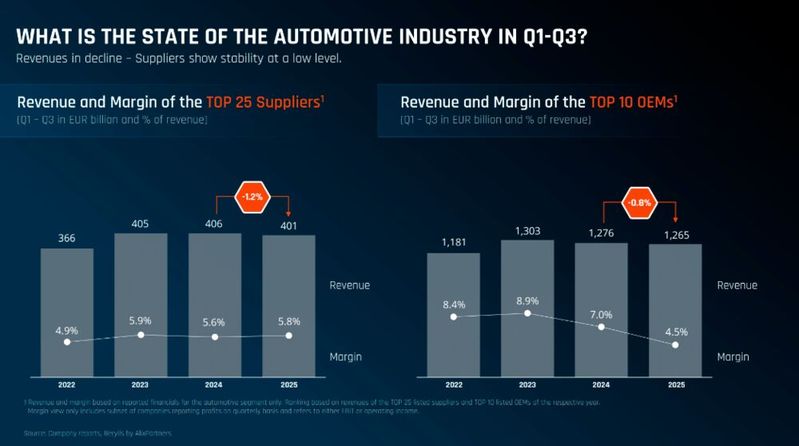
While the operating margin of OEMs drops to 4.5 percent, it slightly increases for the top 25 suppliers.
(Image: Berylls by AlixPartners)
Export bans on rare earths, supply shortages for chips, declining registration numbers in key global markets, geopolitical tensions – the automotive world is groaning under this multiple disruption. As a result, tens of thousands of jobs have been cut or are slated to be cut at major suppliers worldwide this year. Nevertheless, 2025 is not a lost year for the industry. Amid all the dark shadows, there are also bright spots.
At suppliers, the operating margin has risen from 5.5 percent to 5.8 percent compared to the previous year. Alexander Timmer, Partner at Berylls by AlixPartners, assesses the situation as follows: "The operating margin of OEMs drops from 6.3 to 4.5 percent. In contrast, it slightly increases for suppliers. We haven’t seen it exceed OEM margins since the pre-COVID era."
In fact, the OEMs have a profitability problem, but they are still robust in terms of liquidity. The situation is quite different for suppliers. Suppliers face significant difficulties with their liquidity, and their level of debt is high, both of which are real problems in times of rising interest rates.
This development is overlaid by declining revenues. Among the top 25 suppliers, revenues drop to 400 billion euros (~$464 Billion), while for the ten largest automakers, they shrink to 1,265 billion euros (~$1,47 Billion). The decline amounts to approximately 1.5 percent compared to the 2024 figures, and revenue decline was also recorded in the previous year.
The next year will prove to be challenging for the supplier industry — to put it mildly. OEMs will negotiate particularly hard on procurement. Stefan Schneeberger, supplier expert and Associate Partner at Berylls by AlixPartners, states: "The challenges faced by OEMs are leading to even tougher price negotiations and a stronger so-called pain-share demand. While the top 25 suppliers may be able to partially cushion this, the situation for mid-sized suppliers or non-listed German companies will heighten tensions further and create an urgent need for action."
Confidence Too Pronounced
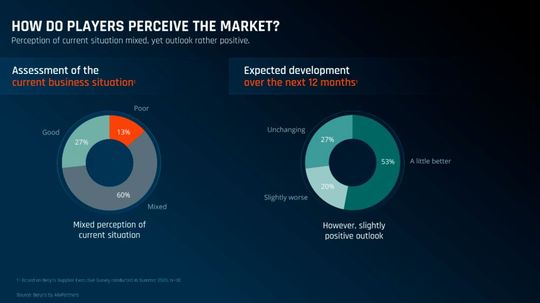
Suppliers do not expect a significant deterioration in their position, as revealed by a survey from Berylls by AlixPartners in the summer of 2025. It shows that suppliers are generally optimistic about the future. While 60 percent rate the current situation as "mixed," more than 50 percent expect a positive development over the next twelve months. However, an analysis of the results of the top 25 suppliers and top 10 OEMs suggests that this optimism may be somewhat overly pronounced. Berylls experts anticipate that 2026 will be as critical for suppliers as the pandemic crisis, with an increased risk of insolvency, especially for SMEs.
60 percent of suppliers rate the current situation as "mixed," while more than 50 percent expect a positive development in the next twelve months.
(Image: Berylls by AlixPartners)
According to Berylls, the coming year will mark a turning point for the industry. The focus on global efficiency will be replaced by increasingly regulated, regionalized, but also transparent supply chains. Localization, in particular, is an important part of a risk minimization trend fueled by U.S. policies and regulations for domestically created content (e.g., software). As a result, so-called reshoring has begun, bringing globally distributed development and production capacities back to individual countries or world regions such as the U.S. or Europe. At the same time, old alliances are losing significance while new ones are emerging, including for the procurement of raw materials, which are expected to be sourced more from Africa, Australia, or South America.
Build Trust with OEMs
Especially when it comes to the raw materials needed for e-mobility, it becomes evident how dependent Europe currently is on China and that substituting its supply of rare earths, graphite, or lithium before 2030 is not realistic. China's recent export restrictions on these raw materials highlight the necessity for supply chains to move away from rigid just-in-time or just-in-case models towards regionality, redundancy, and thus resilience.
"This resilience will develop away from being a cost factor and toward a differentiator for companies," explains Fabian Piontek, Partner and Managing Director at AlixPartners. "The industry must massively improve its resilience and thus its flexibility. This will enable it to build trust with OEMs and make long-term collaborations possible."
Date: 08.12.2025
Naturally, we always handle your personal data responsibly. Any personal data we receive from you is processed in accordance with applicable data protection legislation. For detailed information please see our privacy policy.
Consent to the use of data for promotional purposes
I hereby consent to Vogel Communications Group GmbH & Co. KG, Max-Planck-Str. 7-9, 97082 Würzburg including any affiliated companies according to §§ 15 et seq. AktG (hereafter: Vogel Communications Group) using my e-mail address to send editorial newsletters. A list of all affiliated companies can be found here
Newsletter content may include all products and services of any companies mentioned above, including for example specialist journals and books, events and fairs as well as event-related products and services, print and digital media offers and services such as additional (editorial) newsletters, raffles, lead campaigns, market research both online and offline, specialist webportals and e-learning offers. In case my personal telephone number has also been collected, it may be used for offers of aforementioned products, for services of the companies mentioned above, and market research purposes.
Additionally, my consent also includes the processing of my email address and telephone number for data matching for marketing purposes with select advertising partners such as LinkedIn, Google, and Meta. For this, Vogel Communications Group may transmit said data in hashed form to the advertising partners who then use said data to determine whether I am also a member of the mentioned advertising partner portals. Vogel Communications Group uses this feature for the purposes of re-targeting (up-selling, cross-selling, and customer loyalty), generating so-called look-alike audiences for acquisition of new customers, and as basis for exclusion for on-going advertising campaigns. Further information can be found in section “data matching for marketing purposes”.
In case I access protected data on Internet portals of Vogel Communications Group including any affiliated companies according to §§ 15 et seq. AktG, I need to provide further data in order to register for the access to such content. In return for this free access to editorial content, my data may be used in accordance with this consent for the purposes stated here. This does not apply to data matching for marketing purposes.
Right of revocation
I understand that I can revoke my consent at will. My revocation does not change the lawfulness of data processing that was conducted based on my consent leading up to my revocation. One option to declare my revocation is to use the contact form found at https://contact.vogel.de. In case I no longer wish to receive certain newsletters, I have subscribed to, I can also click on the unsubscribe link included at the end of a newsletter. Further information regarding my right of revocation and the implementation of it as well as the consequences of my revocation can be found in the data protection declaration, section editorial newsletter.
To secure a strong position in international comparison, suppliers should not only focus on operational resilience but also keep sustainability in mind, according to Piontek. Some of the new trends are indeed playing into the industry's hands: localized production, for instance, reduces transport emissions, both for raw materials and finished products. The traceability of the supply chain also shows positive effects. It supports compliance with CO₂ regulations and ethically oriented procurement policies. If sustainability and resilience improve simultaneously, companies could present a new value proposition—and thereby enhance their chances of increasing revenues and margins in the long term.
The Question is How Things Will Continue in and with China
It is not expected that global vehicle production will increase over the next twelve months—quite the opposite. Christian Grimmelt, Partner at Berylls by AlixPartners, summarizes the situation: "Supply chains and customs policies have the potential to necessitate a short-term downward revision of global vehicle production. Strong dependence on raw materials from China plays a decisive role here." In addition to the supply of raw materials from China, such as rare earths, graphite, and cobalt, access to Chinese component suppliers also has a significant impact, as demonstrated by the example of Nexperia. To strengthen the resilience of supply chains, companies should therefore focus not only on regionality but also on the qualification of new production technologies.
This Crisis Also Has Winners
No relief is expected from the U.S. either. "Import tariffs will lead to higher costs or reduced sales volumes for companies without U.S. production sites," says Fabian Piontek. However, manufacturers with their own production capacities in the U.S. will also face higher costs due to production relocations from the EU. This development, of course, also impacts suppliers. Overall, he assumes that revenues will continue to stagnate. Additionally, margins for suppliers are expected to come under pressure over the course of 2026—albeit to a lesser extent than for OEMs.
In fact, the development does not appear equally negative for all product groups. Stefan Schneeberger states: "Semiconductor manufacturers like Infineon, NXP, or ST Micro will continue to be the winners of the crisis, as they have been this year. Revenues and margins will reach record levels. Battery manufacturers also remain in the fast lane, driven by the increasing market penetration of electric vehicles. We expect a 32 percent BEV market share in new registrations worldwide by 2030." This is likely to bring significant revenue growth to battery manufacturers in 2026 and beyond.



:quality(80)/p7i.vogel.de/wcms/c2/57/c257474faf6095a24bacfd98524bc7f8/0130090188v1.jpeg "With the Coromill MR20 milling system, the cutting tool specialist Sandvik Coromant is bringing a product that should make a name for itself in tool and mold making, as well as in aerospace components, to what the manufacturer claims it can do ... (Image:Sandvik Coromant)")
:quality(80)/p7i.vogel.de/wcms/87/f8/87f88a6b4e47ea77b22b1eb88db533a8/0130110840v1.jpeg "Zenadrone, a subsidiary of Zenatec, is in the process of developing an operational low-cost drone as a disposable concept (symbolic image). The first prototype already exists. The aim is to counter the increasing number of enemy drone attacks in the future without spending a lot of money ... (Image:Cenadrone)")
:quality(80)/p7i.vogel.de/wcms/c4/8f/c48fdd4e437b1bca2b0a2d3e77ec74ad/0130015902v1.jpeg "AI will gain importance in manufacturing in 2026. (Picture: ©miss irine - stock.adobe.com / AI-generated)")
:quality(80)/p7i.vogel.de/wcms/eb/9f/eb9f3da11ab6e979c15c195ff516b2ec/0130128194v1.jpeg "Clamping force 110,000 kilonewtons! This is the largest injection molding machine in the world currently under construction. It is being built at Engel in Austria and bears the name Duo 1200 US. Eight tie bars ensure stability. Find out more about this giant of plastics processing ... (Image:Angels)")
:quality(80)/p7i.vogel.de/wcms/f0/35/f035afad8613734aaefe4d6778d21309/0129554823v1.jpeg "The Aquis Touch S multi-channel measuring, control and recording device ensures that the quality parameters of the cooling media are correct. (Image:Jumo)")
:quality(80)/p7i.vogel.de/wcms/ab/23/ab2371c186380215b8311d1aeb4e47df/0130095643v1.jpeg "Geointelligent supply chain management provides valuable information, for example, about which control unit a microchip is installed in. (Picture: ©Aleksandr Matveev - stock.adobe.com)")
:quality(80)/p7i.vogel.de/wcms/b4/01/b401c197e3591f2bec3fb84ae810ac80/0130096280v1.jpeg "Only prophecies of doom! Jensen Huang, the head of chip giant Nvidia, dismisses any concerns that the huge sums currently being invested in AI data centers will not turn a profit one day ... (Image:Nvidia)")
:quality(80)/p7i.vogel.de/wcms/53/4f/534fe0f168f6ee070ded4a48faca4cef/business-wire-main-image-1103x620v1.jpeg "The new UR AI Trainer, developed by Universal Robots and Scale AI, is the first direct lab-to-factory solution for AI model training.
(Source: Universal Robots)")
:quality(80)/p7i.vogel.de/wcms/63/21/6321beb732bf7d92640df46d7aa77573/0130125122v1.jpeg "As part of the Carbon Lab Factory Lausitz, a pilot plant for the production of sustainable, cost-effective and competitive carbon fibers will be built at the Guben site. (Image:Fraunhofer IAP / Kristin Stein)")
:quality(80)/p7i.vogel.de/wcms/08/70/087062e2e1a9b9add5777410dd746ee9/adobestock-1923991605-5607x3156v1v1.jpeg "A new type of tactile sensor, inspired by human skin, even recognizes grains of sand. (Image:Curioso.Photography - stock.adobe.com)")
:quality(80)/p7i.vogel.de/wcms/7f/08/7f087d7013424d123ab7275cd2e3fe55/adobestock-809456218--c2-a9-20degimages-20-e2-80-93-20stock-adobe-com-ki-generiert-4179x2351v1v1.jpeg "The digital upgrading of existing machines conserves resources, saves energy and reduces the need for new production. (Image:Degimages - stock.adobe.com/AI-generated)")
:quality(80)/p7i.vogel.de/wcms/24/1b/241b271e20d9171e063a4f284a748ee9/0130115596v1.jpeg "(Image:Chery)")
:quality(80)/p7i.vogel.de/wcms/5e/11/5e11044efcf1b31e6dd361b293587cbc/0130110355v1.jpeg "Lotus boss Qingfeng Feng wants to continue to offer exclusive models. (Image:Lotus)")
:quality(80)/p7i.vogel.de/wcms/95/48/954885de5a930b6770191d7f35b477c4/0130110863v1.jpeg "Honda will not be launching the two electric cars 0 Saloon and 0 SUV presented in 2025 after all (Image:Honda)")
:quality(80)/p7i.vogel.de/wcms/34/e2/34e2a9e46e59eb28f09f9a5fdf41ff9a/0130091813v1.jpeg "Electrical drive trains require a multidimensional concept of performance characterization. Rohde & Schwarz has developed the MXO 3 oscilloscope series for this purpose. (Image:Rohde & Schwarz)")
:quality(80)/p7i.vogel.de/wcms/f2/48/f24888ee4cf187dcaf569ede74cdec14/0130104146v1.jpeg "Compact AI power: The SIM8668 and SIM8666 smart modules from Simcom combine a quad-core CPU with an integrated NPU for resource-saving industrial and robotics applications in the smallest of spaces. (Image:Chip: Simcom/Background: AI-generated)")
:quality(80)/p7i.vogel.de/wcms/33/4a/334a40bdce62798bd6eb90957e222d6a/0130085649v1.jpeg "From hardware manufacturer to software provider: Neocortec is increasingly licensing its NeoMesh protocol stack directly to OEMs and third-party manufacturers instead of relying exclusively on selling its own radio modules. (Image:mc/VCG)")
:quality(80)/p7i.vogel.de/wcms/5f/4a/5f4aae3a1c19fb2b1a2df58925afeca1/0130111244v1.jpeg "Power saver for the IoT: The Npzero module takes over sensor monitoring and sends the main processor into deep sleep. (Image:Manuel Christa)")
:quality(80)/p7i.vogel.de/wcms/0c/ac/0cacda94ed641488ba0ac4b9daa2bce5/0130073615v1.jpeg "Part of the experimental set-up for a quantum physics experiment in the laboratory of the Institute of Physics at Humboldt-Universität zu Berlin, Adlershof (Germany) campus. (Image:HU Berlin/S. Klenke)")
:fill(fff,0)/images.vogel.de/vogelonline/companyimg/76800/76895/65.jpg "FAULHABER_120mm.jpg ()")
:fill(fff,0)/p7i.vogel.de/companies/69/88/69882c428938e/tmts2026-ticec-banner-en-2000px.png "tmts2026-ticec-banner-en-2000px (https://www.tmts.tw/en)")
:fill(fff,0)/p7i.vogel.de/companies/67/eb/67eba621ef6ea/logo2.png "logo2 (Wuxi InfiMotion)")
![After three years of recovery, the global supplier industry is stumbling again in 2024. There is a glimmer of hope. (Image:sizsus - stock.adobe.com / [M] / AI-generated)](https://cdn1.vogel.de/mnaXF19EY8ZzpR7o6SBlbZYZz2o=/392x392/smart/filters:format(jpg):quality(80)/p7i.vogel.de/wcms/4f/81/4f81e55dcaaa4199ecf0c08d5da86730/0125319744v1.jpeg "After three years of recovery, the global supplier industry is stumbling again in 2024. There is a glimmer of hope. (Image:sizsus - stock.adobe.com / [M] / AI-generated)")
:quality(80)/p7i.vogel.de/wcms/5a/40/5a40f9a0f2694fd5ba3fcda47c7efc60/0128999689v1.jpeg "The SOP for the electric Macan (here at the Porsche plant in Leipzig) has been postponed multiple times. This is common for new electric cars in Europe and a problem for local suppliers, according to a recent Berylls study. (Image:Porsche AG)")