The transformation to e-mobility is progressing more slowly and more volatile than expected. A survey by Berylls by AlixPartners among European suppliers reveals: The industry is stuck in a dilemma.
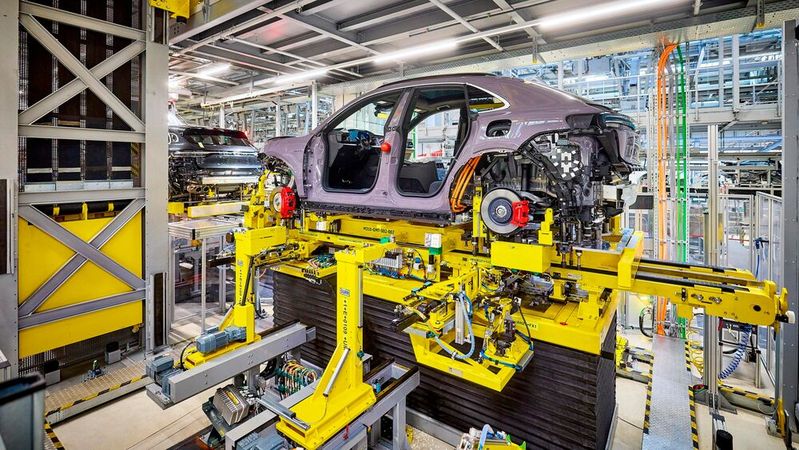
The SOP for the electric Macan (here at the Porsche plant in Leipzig) has been postponed multiple times. This is common for new electric cars in Europe and a problem for local suppliers, according to a recent Berylls study.
(Image: Porsche AG)
Automotive suppliers in the DACH region find themselves in a paradoxical situation: although the transformation to e-mobility has slowed down, margins are under pressure, and OEM platforms are delayed, 90 percent of the surveyed companies rate their preparation as good. This discrepancy between perceived readiness and market reality is one of the key findings of the "E-Mobility Supplier Survey 2025" by the consulting firm Berylls.
Dependence on Combustion Engines Unchanged
A good 70 percent of the surveyed suppliers still generate more than a quarter of their revenue from components for internal combustion engines – exactly the same figure as the previous year. By 2030, the companies expect a decline to 55 percent. This forecast is identical to the expectation from the previous year's survey. The dependency on combustion engines thus does not effectively decrease, even though the transformation has been considered a central challenge in business development for years.
At the same time, the sentiment toward e-mobility has significantly worsened. Only just under half of respondents (48 percent) see e-mobility as an opportunity – down from 69 percent last year and 77 percent in 2023. Meanwhile, the proportion of those who view e-mobility as neutral or risky has risen to 52 percent.
Expectations for revenue growth through e-mobility have further declined. While 75 percent of suppliers expected a positive revenue effect over the next five to ten years in 2023, only 50 percent do so in 2025. At the same time, 17 percent of respondents anticipate revenue declines, compared to four percent in 2024.
The margin expectations present a mixed picture: 35 percent of suppliers anticipate improvements, while 23 percent expect additional pressure. The causes are structural: many BEV programs operate below the scale necessary for profitability. At the same time, suppliers often have to manage combustion engine and electric drive portfolios in parallel, which increases fixed costs and operational complexity.
The study highlights the case of suppliers focused on e-mobility: while the Top 100 Suppliers achieve average EBIT margins between 5.2 and 5.9 percent, purely e-mobility suppliers sometimes report negative margins of up to minus 7.2 percent.
Platform Delays as a Risk
European car manufacturers delay BEV platforms by an average of 150 days (Start of Production, SOP). In contrast, electric platform plans in China are kept tighter, with delays averaging only 20 days (SOP). This discrepancy exacerbates the competitive disadvantage of European suppliers: production lines remain underutilized for longer, and investments amortize more slowly.
In addition, 92 percent of the surveyed companies expect a consolidation among e-mobility suppliers – more than half of them within the next two to three years.
Regulatory Uncertainty is Increasing
Regulation, long regarded as a reliable pace-setter for electrification, has lost stability. The recent adjustment by the EU Commission in December 2025, reducing the CO2 reduction target for new cars by 2035 from 100 to 90 percent, provides additional flexibility for suppliers of combustion and hybrid components. However, for BEV-focused suppliers, this weakens the regulatory foundation for aggressive investments.
China Sets the Pace
While Europe struggles with weaker demand, platform delays, and margin issues, China is consistently driving the transformation forward. Chinese manufacturers and suppliers benefit from higher volumes, lower cost structures, and shorter development cycles. Battery costs in China are already below 80 US dollars per kilowatt-hour, whereas in Europe they are not expected to fall below the 100-dollar mark until 2026.
The growing presence of Chinese providers in international markets increases price pressure – especially for components exposed to global competition.
Strategic Action Areas
Berylls by AlixPartners recommends five measures to suppliers in the study:
Refine portfolio: Focus on technology with a credible scaling path. Reduce or discontinue products without realistic profitability perspectives.
Increase operational flexibility: Introduce modular production systems that can adapt to fluctuating volumes. Make dual strategies for combustion engines and electric drives more efficient.
Strengthen financial discipline: Stricter capital allocation, realistic business plans, cash focus with longer payback periods.
Scenario-based planning: Develop strategies for multiple future scenarios instead of relying on a linear e-car growth curve.
Rethink China strategy pragmatically: Determine where participation is essential, where partnerships bring advantages, and where risks become unmanageable.
Transformation Without Security
E-mobility remains the central transformation of the industry this decade – but it is progressing more slowly, unevenly, and under tougher economic conditions than expected three years ago, concludes the Berylls survey. Success will belong not to those who bet on a single scenario, but to those who are prepared with a sharp portfolio, high flexibility, and financial discipline when the next wave of growth arrives.
Date: 08.12.2025
Naturally, we always handle your personal data responsibly. Any personal data we receive from you is processed in accordance with applicable data protection legislation. For detailed information please see our privacy policy.
Consent to the use of data for promotional purposes
I hereby consent to Vogel Communications Group GmbH & Co. KG, Max-Planck-Str. 7-9, 97082 Würzburg including any affiliated companies according to §§ 15 et seq. AktG (hereafter: Vogel Communications Group) using my e-mail address to send editorial newsletters. A list of all affiliated companies can be found here
Newsletter content may include all products and services of any companies mentioned above, including for example specialist journals and books, events and fairs as well as event-related products and services, print and digital media offers and services such as additional (editorial) newsletters, raffles, lead campaigns, market research both online and offline, specialist webportals and e-learning offers. In case my personal telephone number has also been collected, it may be used for offers of aforementioned products, for services of the companies mentioned above, and market research purposes.
Additionally, my consent also includes the processing of my email address and telephone number for data matching for marketing purposes with select advertising partners such as LinkedIn, Google, and Meta. For this, Vogel Communications Group may transmit said data in hashed form to the advertising partners who then use said data to determine whether I am also a member of the mentioned advertising partner portals. Vogel Communications Group uses this feature for the purposes of re-targeting (up-selling, cross-selling, and customer loyalty), generating so-called look-alike audiences for acquisition of new customers, and as basis for exclusion for on-going advertising campaigns. Further information can be found in section “data matching for marketing purposes”.
In case I access protected data on Internet portals of Vogel Communications Group including any affiliated companies according to §§ 15 et seq. AktG, I need to provide further data in order to register for the access to such content. In return for this free access to editorial content, my data may be used in accordance with this consent for the purposes stated here. This does not apply to data matching for marketing purposes.
Right of revocation
I understand that I can revoke my consent at will. My revocation does not change the lawfulness of data processing that was conducted based on my consent leading up to my revocation. One option to declare my revocation is to use the contact form found at https://contact.vogel.de. In case I no longer wish to receive certain newsletters, I have subscribed to, I can also click on the unsubscribe link included at the end of a newsletter. Further information regarding my right of revocation and the implementation of it as well as the consequences of my revocation can be found in the data protection declaration, section editorial newsletter.
The study is based on a survey of 49 European automotive suppliers from the segments of powertrain, electronics, interior, exterior, body, and software, including several top-100 suppliers.



:quality(80)/p7i.vogel.de/wcms/c2/57/c257474faf6095a24bacfd98524bc7f8/0130090188v1.jpeg "With the Coromill MR20 milling system, the cutting tool specialist Sandvik Coromant is bringing a product that should make a name for itself in tool and mold making, as well as in aerospace components, to what the manufacturer claims it can do ... (Image:Sandvik Coromant)")
:quality(80)/p7i.vogel.de/wcms/87/f8/87f88a6b4e47ea77b22b1eb88db533a8/0130110840v1.jpeg "Zenadrone, a subsidiary of Zenatec, is in the process of developing an operational low-cost drone as a disposable concept (symbolic image). The first prototype already exists. The aim is to counter the increasing number of enemy drone attacks in the future without spending a lot of money ... (Image:Cenadrone)")
:quality(80)/p7i.vogel.de/wcms/c4/8f/c48fdd4e437b1bca2b0a2d3e77ec74ad/0130015902v1.jpeg "AI will gain importance in manufacturing in 2026. (Picture: ©miss irine - stock.adobe.com / AI-generated)")
:quality(80)/p7i.vogel.de/wcms/eb/9f/eb9f3da11ab6e979c15c195ff516b2ec/0130128194v1.jpeg "Clamping force 110,000 kilonewtons! This is the largest injection molding machine in the world currently under construction. It is being built at Engel in Austria and bears the name Duo 1200 US. Eight tie bars ensure stability. Find out more about this giant of plastics processing ... (Image:Angels)")
:quality(80)/p7i.vogel.de/wcms/f0/35/f035afad8613734aaefe4d6778d21309/0129554823v1.jpeg "The Aquis Touch S multi-channel measuring, control and recording device ensures that the quality parameters of the cooling media are correct. (Image:Jumo)")
:quality(80)/p7i.vogel.de/wcms/ab/23/ab2371c186380215b8311d1aeb4e47df/0130095643v1.jpeg "Geointelligent supply chain management provides valuable information, for example, about which control unit a microchip is installed in. (Picture: ©Aleksandr Matveev - stock.adobe.com)")
:quality(80)/p7i.vogel.de/wcms/b4/01/b401c197e3591f2bec3fb84ae810ac80/0130096280v1.jpeg "Only prophecies of doom! Jensen Huang, the head of chip giant Nvidia, dismisses any concerns that the huge sums currently being invested in AI data centers will not turn a profit one day ... (Image:Nvidia)")
:quality(80)/p7i.vogel.de/wcms/53/4f/534fe0f168f6ee070ded4a48faca4cef/business-wire-main-image-1103x620v1.jpeg "The new UR AI Trainer, developed by Universal Robots and Scale AI, is the first direct lab-to-factory solution for AI model training.
(Source: Universal Robots)")
:quality(80)/p7i.vogel.de/wcms/63/21/6321beb732bf7d92640df46d7aa77573/0130125122v1.jpeg "As part of the Carbon Lab Factory Lausitz, a pilot plant for the production of sustainable, cost-effective and competitive carbon fibers will be built at the Guben site. (Image:Fraunhofer IAP / Kristin Stein)")
:quality(80)/p7i.vogel.de/wcms/08/70/087062e2e1a9b9add5777410dd746ee9/adobestock-1923991605-5607x3156v1v1.jpeg "A new type of tactile sensor, inspired by human skin, even recognizes grains of sand. (Image:Curioso.Photography - stock.adobe.com)")
:quality(80)/p7i.vogel.de/wcms/7f/08/7f087d7013424d123ab7275cd2e3fe55/adobestock-809456218--c2-a9-20degimages-20-e2-80-93-20stock-adobe-com-ki-generiert-4179x2351v1v1.jpeg "The digital upgrading of existing machines conserves resources, saves energy and reduces the need for new production. (Image:Degimages - stock.adobe.com/AI-generated)")
:quality(80)/p7i.vogel.de/wcms/24/1b/241b271e20d9171e063a4f284a748ee9/0130115596v1.jpeg "(Image:Chery)")
:quality(80)/p7i.vogel.de/wcms/5e/11/5e11044efcf1b31e6dd361b293587cbc/0130110355v1.jpeg "Lotus boss Qingfeng Feng wants to continue to offer exclusive models. (Image:Lotus)")
:quality(80)/p7i.vogel.de/wcms/95/48/954885de5a930b6770191d7f35b477c4/0130110863v1.jpeg "Honda will not be launching the two electric cars 0 Saloon and 0 SUV presented in 2025 after all (Image:Honda)")
:quality(80)/p7i.vogel.de/wcms/34/e2/34e2a9e46e59eb28f09f9a5fdf41ff9a/0130091813v1.jpeg "Electrical drive trains require a multidimensional concept of performance characterization. Rohde & Schwarz has developed the MXO 3 oscilloscope series for this purpose. (Image:Rohde & Schwarz)")
:quality(80)/p7i.vogel.de/wcms/f2/48/f24888ee4cf187dcaf569ede74cdec14/0130104146v1.jpeg "Compact AI power: The SIM8668 and SIM8666 smart modules from Simcom combine a quad-core CPU with an integrated NPU for resource-saving industrial and robotics applications in the smallest of spaces. (Image:Chip: Simcom/Background: AI-generated)")
:quality(80)/p7i.vogel.de/wcms/33/4a/334a40bdce62798bd6eb90957e222d6a/0130085649v1.jpeg "From hardware manufacturer to software provider: Neocortec is increasingly licensing its NeoMesh protocol stack directly to OEMs and third-party manufacturers instead of relying exclusively on selling its own radio modules. (Image:mc/VCG)")
:quality(80)/p7i.vogel.de/wcms/5f/4a/5f4aae3a1c19fb2b1a2df58925afeca1/0130111244v1.jpeg "Power saver for the IoT: The Npzero module takes over sensor monitoring and sends the main processor into deep sleep. (Image:Manuel Christa)")
:quality(80)/p7i.vogel.de/wcms/0c/ac/0cacda94ed641488ba0ac4b9daa2bce5/0130073615v1.jpeg "Part of the experimental set-up for a quantum physics experiment in the laboratory of the Institute of Physics at Humboldt-Universität zu Berlin, Adlershof (Germany) campus. (Image:HU Berlin/S. Klenke)")
:fill(fff,0)/images.vogel.de/vogelonline/companyimg/76800/76895/65.jpg "FAULHABER_120mm.jpg ()")
:fill(fff,0)/p7i.vogel.de/companies/67/eb/67eba621ef6ea/logo2.png "logo2 (Wuxi InfiMotion)")
:quality(80)/p7i.vogel.de/wcms/e3/47/e34727aa6eb21393fc5621d838f34a01/0128996821v1.jpeg "Attitude of the surveyed suppliers toward e-mobility.(Image: Berylls by AlixPartners)")
:quality(80)/p7i.vogel.de/wcms/24/84/248477829fb32ebd11d8d0b65ac13edc/0128996819v1.jpeg "Revenue share of the surveyed suppliers dependent on combustion engines.(Image: Berylls by AlixPartners)")
:quality(80)/p7i.vogel.de/wcms/21/8e/218e304ba65372854479aa52b4ccdbe5/0129271089v1.jpeg "Suppliers from Europe are currently facing a variety of challenges. Pictured: The Aumovio headquarters in Frankfurt am Main. (Image:Aumovio)")
![After three years of recovery, the global supplier industry is stumbling again in 2024. There is a glimmer of hope. (Image:sizsus - stock.adobe.com / [M] / AI-generated)](https://cdn1.vogel.de/mnaXF19EY8ZzpR7o6SBlbZYZz2o=/392x392/smart/filters:format(jpg):quality(80)/p7i.vogel.de/wcms/4f/81/4f81e55dcaaa4199ecf0c08d5da86730/0125319744v1.jpeg "After three years of recovery, the global supplier industry is stumbling again in 2024. There is a glimmer of hope. (Image:sizsus - stock.adobe.com / [M] / AI-generated)")