Heavy equipment plays a crucial role in global development and increasing efficiency in production and transportation. The digital transformation promotes software-defined products that are optimized by digital twins. These enable improved collaboration and fast troubleshooting.
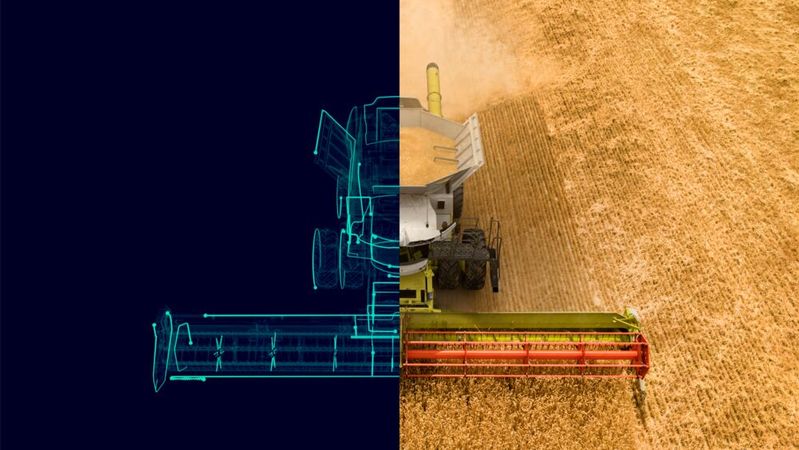
The development of mobile machines is complex - but the use of digital twins can help.
(Image: Siemens)
Heavy equipment is a driving force behind development all over the world - it enables more efficient production of food, transportation of goods around the world, development of raw materials and much more.
In the meantime, the pace has increased even more, so that the valuable machines now have to be designed for longer operating times in remote locations and sometimes also for autonomous operation.
A manufacturer that works with the digital twin from the outset can clarify system requirements more easily with operators and work more closely with suppliers.
Digital Approach Needed in Development
For manufacturers of mobile heavy machinery and equipment, software and electronics are a real boon: they create new revenue streams and cut some of the costs of developing mechanical systems that used to drive purchasing decisions. But as in other industries undergoing a similar transformation, the development of software-defined products (SDP) requires a new approach: the digital approach. A manufacturer that works with the comprehensive digital twin from the start can more easily clarify system requirements with operators and work more closely with its suppliers to get a fully integrated system faster - all in a scalable environment to produce world-class products decades from now.
Integrating Requirements in the Comprehensive Digital Twin
Even the production of heavy equipment places high demands on the manufacturer, as the quantities are small and a great deal of customization is required. In addition, the end customer expects maximum operating times from their large capital goods. Depending on the area of application, heavy equipment is used almost around the clock every day. Software plays an important role in making this possible: It enables autonomous or semi-autonomous operation and offers many other functions to increase machine capacity or for greater ease of use. However, in order to successfully provide such software functions, the developer must start by integrating the corresponding requirements into the comprehensive digital twin as early as possible.
Depending on the area of application, heavy equipment is used almost around the clock every day.
Digital Twin Makes Development Transparent
The first advantage of a properly integrated software system is the ability to detect and rectify errors much faster than with hardware. Because the digital twin makes the development of a product transparent, manufacturers can speed up their development cycles and reduce costs.
The integration of software-defined functional features into the drivetrain or other system units is attractive for manufacturers and operators because these functions can also increase profitability. Although the option to switch features on and off via software adds an additional domain and makes the product more complex, it can later simplify things for the manufacturer if a single product combines the features of several previous models with different performance characteristics.
Looking at Software and Hardware Together
The ability to increase the performance of a machine for a few weeks or even just days via the software can be much more financially attractive for operators than purchasing a more expensive product straight away. During the peak of the harvest season, for example, it can be a huge advantage to be able to harvest more crops or fruit in the same amount of time, especially if the operating costs are lower during periods of lower capacity utilization.
However, such options can only be successful if the software is intuitive to use and responds quickly so that there are no unnecessary delays given the high utilization of these costly devices. During development, software and hardware must be seen as parts of a whole. Working with the comprehensive digital twin makes it easier to establish this common view across all domains from the outset and to maintain it until the end of a machine's service life.
Use Integrated Development Environment
A good first step towards SDP is the use of an integrated development environment to make software functions available. However, the industry places high demands on reliability and it is particularly important to validate new versions of the software before they are installed. A faulty update on a cell phone is annoying, but the stakes are higher for a company's equipment: it can cause functional failures, undermine trust and violate security requirements.
Why Simulation is so Important
Simulation can bring valuable benefits for manufacturers and their supplier networks. Emulation programs such as PAVE360 are an important tool because they simulate the behavior of a new software version on a specific hardware. As an open platform, they allow the use of models with different levels of detail and the connection with specialized tools or external hardware to simulate the operating environment. This ability to virtually test the interaction of the planned electronics with the software before use in the application context is what makes digitalization so crucial for the successful development of SDP.
Date: 08.12.2025
Naturally, we always handle your personal data responsibly. Any personal data we receive from you is processed in accordance with applicable data protection legislation. For detailed information please see our privacy policy.
Consent to the use of data for promotional purposes
I hereby consent to Vogel Communications Group GmbH & Co. KG, Max-Planck-Str. 7-9, 97082 Würzburg including any affiliated companies according to §§ 15 et seq. AktG (hereafter: Vogel Communications Group) using my e-mail address to send editorial newsletters. A list of all affiliated companies can be found here
Newsletter content may include all products and services of any companies mentioned above, including for example specialist journals and books, events and fairs as well as event-related products and services, print and digital media offers and services such as additional (editorial) newsletters, raffles, lead campaigns, market research both online and offline, specialist webportals and e-learning offers. In case my personal telephone number has also been collected, it may be used for offers of aforementioned products, for services of the companies mentioned above, and market research purposes.
Additionally, my consent also includes the processing of my email address and telephone number for data matching for marketing purposes with select advertising partners such as LinkedIn, Google, and Meta. For this, Vogel Communications Group may transmit said data in hashed form to the advertising partners who then use said data to determine whether I am also a member of the mentioned advertising partner portals. Vogel Communications Group uses this feature for the purposes of re-targeting (up-selling, cross-selling, and customer loyalty), generating so-called look-alike audiences for acquisition of new customers, and as basis for exclusion for on-going advertising campaigns. Further information can be found in section “data matching for marketing purposes”.
In case I access protected data on Internet portals of Vogel Communications Group including any affiliated companies according to §§ 15 et seq. AktG, I need to provide further data in order to register for the access to such content. In return for this free access to editorial content, my data may be used in accordance with this consent for the purposes stated here. This does not apply to data matching for marketing purposes.
Right of revocation
I understand that I can revoke my consent at will. My revocation does not change the lawfulness of data processing that was conducted based on my consent leading up to my revocation. One option to declare my revocation is to use the contact form found at https://contact.vogel.de. In case I no longer wish to receive certain newsletters, I have subscribed to, I can also click on the unsubscribe link included at the end of a newsletter. Further information regarding my right of revocation and the implementation of it as well as the consequences of my revocation can be found in the data protection declaration, section editorial newsletter.
When it comes to autonomous operation, the reliable functioning of the software is probably the most important aspect. Knowing how an integrated system reacts without human intervention or supervision is already of great value in the development phase, but is also beneficial for continuous further development during the usage phase. If a new situation is recognized in the field, the comprehensive digital twin can be enriched with it to create an extended context for the models.
Digitization as the Key to Transparency
The way in which safety is prioritized differs from application to application. An interrupt-driven architecture ensures the safety of people in the vicinity of a machine and the safety of the system itself. In the event of an error in the autonomous driving system, the machine may prompt the operator to intervene manually; in the event of problems with the tool, it may retract to a safe position to prevent damage to the machine. Understanding how these software systems interact is a significant part of the complexity of developing a safe and successful SDP.
Convenience features such as pairing with a phone to play music are nice for drivers but irrelevant to the operation of the machine, so they may be given lower priority over other software systems. Regardless of the example, digitalization is the key to creating transparency about the software stack and its integration with the hardware systems.
Example of Mining: Creating Integrated Products with a Longer Service Life
Mining is the best example of an application where equipment must be designed for long periods of operation, especially software-defined machines. The equipment runs almost around the clock to get the maximum yield out of a mine. The mechanical systems must therefore be extremely robust and durable in order to withstand the tough operating conditions and heavy loads. As some of the most dangerous and monotonous activities are automated, the assemblies for the software must be correspondingly robust to prevent water or dust from short-circuiting a contact or tearing off an electrical component, for example.
Designers Need Knowledge of the System Requirements
Due to the dependence of the devices on the function of their software, manufacturers and operators must also take into account the effect of stronger cosmic radiation at high altitudes or radiation from the natural radioactive decay of the material being mined. A stray nuclear particle can change the state of a memory cell in the electronics, and if it is not corrected, this can have far-reaching consequences for operation. Simulations and tests in emulation environments before use in practice are crucial in order to take these influences into account in the design.
Designers and suppliers throughout the supply chain must have access to a comprehensive catalog of system requirements in order to build optimal products from the start. Digitization, including the digital twin, and the integration of PLM, CAD, E-CAD and other development tools make this possible. These measures accelerate the development process and the operator can concentrate on his actual work.
Designers and suppliers throughout the supply chain must have access to a comprehensive catalog of system requirements to build optimal products from the start.
Creating a Strong Product Together
Siemens can support manufacturers of heavy machinery on their path to digitalization. The company not only has a comprehensive range of tools at its disposal, but also experience in many industries that are now developing and using increasingly complex products.



:quality(80)/p7i.vogel.de/wcms/31/84/3184f9ac736d8df7c2e934593684bc74/0130024314v1.jpeg "Here, the Bavarian car manufacturer BMW looks ahead to 2025: business was sluggish due to US tariffs and weakening sales in China ... (Image:BMW)")
:quality(80)/p7i.vogel.de/wcms/49/09/49095c6192a6c46d47b567e1def31ea6/0130024626v1.jpeg "The new TUM \"RoboGym\" (powered by Neura) is Europe's largest training center for next-generation humanoid robots. It focuses on the implementation of artificial intelligence in robotic systems. At the same time, it is a forge for AI experts ... (Image:Neura Robotics)")
:quality(80)/p7i.vogel.de/wcms/fe/8a/fe8af1b829b085210fef4c1fa8abddb5/0129784389v1.jpeg "As an integral part of Koch Pac-Systeme's Predictive Pack digital service product, the gearboxes with Cynapse and Wittenstein's Smart Services make it possible to detect damage risks in the packaging specialist's machines at an early stage. (Image:Koch Pac systems)")
:quality(80)/p7i.vogel.de/wcms/9f/7b/9f7be35880605811e045acd3af8b571b/0129558586v1.jpeg "An example of the V210 processing machine, which, according to Voortman, supplements the laser cutting of the V353 with drilling, thread cutting and milling. (Image:Voortman)")
:quality(80)/p7i.vogel.de/wcms/db/68/db689490e348201603dd30447711ea2b/0129578734v1.jpeg "With three-axis vibration measurement (X, Y and Z axes) and temperature detection, the CMSVT38 condition monitoring sensor provides detailed status information that helps to detect machine damage at an early stage. (Image:Kübler)")
:quality(80)/p7i.vogel.de/wcms/92/5e/925ee98ea36ad9bd574fa1cea11d0e53/0129964352v1.jpeg "The production of hardware components for humanoid robots offers great market potential. (Image:Fraunhofer IPA)")
:quality(80)/p7i.vogel.de/wcms/08/72/0872dd2dd119a54824c41e0e580e45a8/0129576591v1.jpeg "The Rose enclosure systems can be customized on request. (Image:Rose Systemtechnik GmbH)")
:quality(80)/p7i.vogel.de/wcms/73/17/7317794432521bf911711b91287cfc28/0129961259v1.jpeg "ABB Robotics and Nvidia are enabling the widespread use of physical AI in the world of robotics. This means that systems can be created virtually and with high precision and optimized much more cost-effectively. In the large image the virtual system, next to it the real robot cell ... (Image:ABB)")
:quality(80)/p7i.vogel.de/wcms/cb/fe/cbfe2741917274bbbf93d5b93e47a4f5/contact-software-launcht-fourier-20aiv1v1.png "Fourier AI combines AI models with AI applications developed for demanding engineering tasks. (Image:Contact Software)")
:quality(80)/p7i.vogel.de/wcms/bc/f7/bcf7a56980850be13ed37d220cd514bc/elchinator-security-5042249-1280-1280x720v1v1.jpeg "The HP Wolf Security Report shows: Attackers use AI for speed, modularity and automation, while the quality of campaigns is low. (Image:Picture: Pixabay)")
:quality(80)/p7i.vogel.de/wcms/68/89/688937087188b77da95b2079399ca862/0130009534v1.jpeg "Here you can see the Dualis layout configurator in use at Montratec. (Picture: ©Gorodenkoff - stock.adobe.com)")
:quality(80)/p7i.vogel.de/wcms/9e/98/9e984afbf9c6f2bcc8963bd13465b180/26-02-pi-fraunhofer-iws-41300-ultragrain-project-closing-pic-02-1562x878v1v1.png "The process of laser wire build-up welding (DED-LB) with pulse laser-induced plasma, which contributed to the success of the Ultra Grain project, is shown at high speed. (Image:Fraunhofer IWS)")
:quality(80)/p7i.vogel.de/wcms/69/f5/69f516f07a0ba999c5ba8763891853f1/0130030553v1.jpeg "Can be reloaded in 210 seconds for a return trip on the Greenford branch line: the GWR's 230001. (Image:Jack Boskett Media | GWR)")
:quality(80)/p7i.vogel.de/wcms/f0/5e/f05e720c52f757660ddbf7c410074f64/adobestock-222131875-5616x3157v1.jpeg "(Source: © jeson - stock.adobe.com)")
:quality(80)/p7i.vogel.de/wcms/b2/64/b2641254fef5afa15645cefc37089c88/0130021093v1.jpeg "Daimler Truck and Quantum Systems are jointly developing unmanned military vehicles. (Image:Quantum Systems)")
:quality(80)/p7i.vogel.de/wcms/30/7e/307e71ec64f7c52c29458544ca29adf1/org-blobs-user-response-file-output-799034cb-2ad7-4031-859a-15013f5b78e3-plugin-output-toolu-01vwfuenhw3cadvud7pddgyq-1536x864v1v1.png "China's government is debating the contents of the 15th five-year plan. The focus will change for the automotive industry. (Image:AI-generated)")
:quality(80)/p7i.vogel.de/wcms/61/8f/618f16f8fa95ec6cc838ca9bfb5dbaf1/0130027046v1.jpeg "The Belgian Research Institute has set up a European university consortium on the subject of CMOS 2.0. It brings together 26 university groups to research chip technologies that go beyond conventional transistor scaling. (Image:Imec)")
:quality(80)/p7i.vogel.de/wcms/db/a2/dba29322d0934dea1bbc4b31df80e392/0129953760v1.jpeg "SEM image: High-density electrode array with 128 nm dots. (Image:imec)")
:quality(80)/p7i.vogel.de/wcms/c2/a8/c2a8a93f306c1475489dff074ad59731/0129967672v1.jpeg "Figure 1: Imec's logic technology roadmap showing the extension of the nanosheet era from 2nm to the A10 node with the outer-wall forksheet, before the transition to CFET for A7 and beyond. (Image:imec)")
:quality(80)/p7i.vogel.de/wcms/07/79/0779a3ba2b38d583fc9b515900be2add/0129957428v1.jpeg "If the Chinese government has its way, domestic data centers full of Nvidia hardware will be a thing of the past. (Image:Nvidia)")
:fill(fff,0)/p7i.vogel.de/companies/69/88/69882c428938e/tmts2026-ticec-banner-en-2000px.png "tmts2026-ticec-banner-en-2000px (https://www.tmts.tw/en)")
:fill(fff,0)/p7i.vogel.de/companies/67/eb/67eba621ef6ea/logo2.png "logo2 (Wuxi InfiMotion)")
:quality(80)/p7i.vogel.de/wcms/ad/da/adda2b0237d0167d79524dc8845649b8/0128720455v1.jpeg "Pepsico is digitizing selected production facilities and warehouses in the USA using Digital Twin Composer. (Image:Pepsico)")
:quality(80)/p7i.vogel.de/wcms/5e/e3/5ee329167f111885b28f2c94bf380e0d/0127110091v1.jpeg "Digitalization: Digital twins are changing the way manufacturers manage their operations, perform maintenance, and make decisions. (Image:Gerd Altmann)")