The global sensor market is well established, with hundreds of millions of sensors produced each year. Nevertheless, the market remains in flux as trends in mobility, edge computing, AI and digital healthcare continue to evolve and reshape the demands on sensor technology.
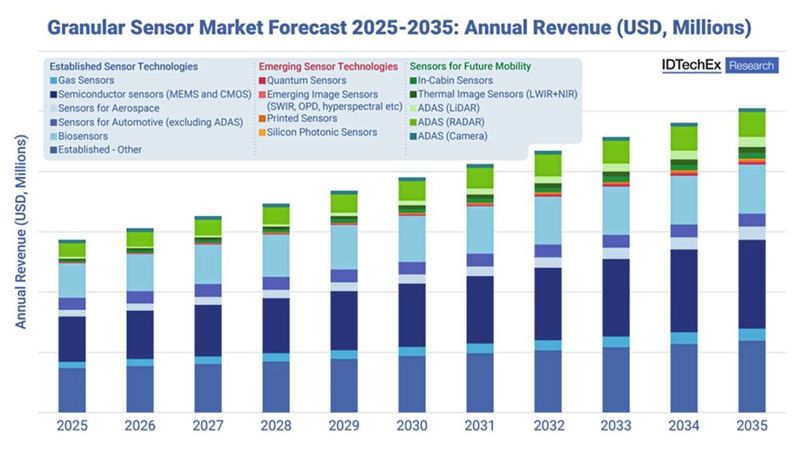
Ten-year global sensor market forecast (2025 - 2035), segmented by sensor technology.
(Image: IDTechEx)
IDTechEx projects the global sensor market to reach $253 billion by 2035, driven by rapid advancements in photonics, quantum sensing, edge sensing, and IoT technologies. These emerging innovations represent the fastest-growing segments, signaling transformative potential across industries and applications.
Sensor technology is ubiquitously used in modern electronic devices and appliances. The ability to detect physical input and convert it into an electrical signal for processing means that sensors are routinely used in communications, transportation, industrial, healthcare, energy, consumer and agricultural applications.
Although sensors account for only a fraction of the annual sales of large electronics companies, sensor technology nevertheless represents a global market with a volume of several billion dollars. In 2025, sensor technologies such as semiconductors, optical and conventional transducers (electromechanical, electrochemical) will account for the majority of the market share in terms of revenue.
Within these established sensor markets, design trends are focused on improved integration and performance in products and applications. New sensor technologies must be characterized by reduced size and power, the ability to measure more readings over a longer period of time with greater sensitivity and accuracy, and the ability to be integrated into new form factors.
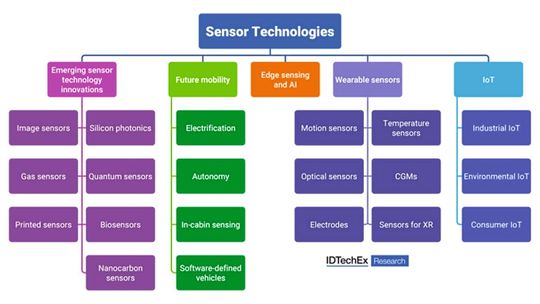
Beyond the established sensor markets, emerging global technology megatrends are changing the demands on sensor technology and offering new growth opportunities for OEMs. The mobility of the future (autonomy, electrification and driver monitoring), the expansion of the Internet of Things (IoT), increasing AI integration, the introduction of wearable technologies and the commercialization of 6G all place unique demands on sensor technology.
The most important sensor markets and technologies are covered in the IDTechEx report "Sensor Market 2025 - 2035: Technologies, Trends, Players, Forecasts".
(Image: IDTechEx)
A bright future for sensors in the mobility of the future
Trends in electrification, automation, in-vehicle monitoring and software-defined vehicles are drastically changing the requirements for sensor technology in the automotive sector. For example, temperature, current, voltage and gas sensors are needed for battery monitoring in electric vehicles, while LiDAR, radar, infrared imaging and camera technology are essential for autonomous vehicles.
The increasing autonomy of vehicles will change the interaction between vehicle and passenger, with automotive sensor technology playing a key role in ensuring safety as well as unlocking personalized passenger experiences. Infrared, time-of-flight (ToF) and radar sensors can be used in advanced driver assistance systems (ADAS) to monitor the interior to check that the driver is focused on the road. In the future, offering increased passenger-vehicle interaction and biometric authentication will create business models for functions as a service in connected, software-defined vehicles.
Future mobility will be based on sensor technology to enable the next evolution of transportation and passenger experience.
The wearable sensor market continues to evolve after a decade of growth
The wearable sensor technology landscape includes a variety of sensor types that can be integrated into a range of wearable form factors. Motion sensors, optical sensors and imaging, wearable electrodes, force, strain, temperature and chemical sensors are used in medical, consumer, AR/XR and industrial applications.
The last decade has been characterized by the success of smartwatches and fitness trackers, as well as the disruption of the glucose test strip market by continuous glucose monitors (CGMs). As a result of this disruption, large-scale opportunities in wearables are harder to find. Looking ahead, there are still many exciting innovations in wearable sensors that are now likely to attempt to penetrate niche markets as demand for refinement increases for smaller, application-specific industries.
Date: 08.12.2025
Naturally, we always handle your personal data responsibly. Any personal data we receive from you is processed in accordance with applicable data protection legislation. For detailed information please see our privacy policy.
Consent to the use of data for promotional purposes
I hereby consent to Vogel Communications Group GmbH & Co. KG, Max-Planck-Str. 7-9, 97082 Würzburg including any affiliated companies according to §§ 15 et seq. AktG (hereafter: Vogel Communications Group) using my e-mail address to send editorial newsletters. A list of all affiliated companies can be found here
Newsletter content may include all products and services of any companies mentioned above, including for example specialist journals and books, events and fairs as well as event-related products and services, print and digital media offers and services such as additional (editorial) newsletters, raffles, lead campaigns, market research both online and offline, specialist webportals and e-learning offers. In case my personal telephone number has also been collected, it may be used for offers of aforementioned products, for services of the companies mentioned above, and market research purposes.
Additionally, my consent also includes the processing of my email address and telephone number for data matching for marketing purposes with select advertising partners such as LinkedIn, Google, and Meta. For this, Vogel Communications Group may transmit said data in hashed form to the advertising partners who then use said data to determine whether I am also a member of the mentioned advertising partner portals. Vogel Communications Group uses this feature for the purposes of re-targeting (up-selling, cross-selling, and customer loyalty), generating so-called look-alike audiences for acquisition of new customers, and as basis for exclusion for on-going advertising campaigns. Further information can be found in section “data matching for marketing purposes”.
In case I access protected data on Internet portals of Vogel Communications Group including any affiliated companies according to §§ 15 et seq. AktG, I need to provide further data in order to register for the access to such content. In return for this free access to editorial content, my data may be used in accordance with this consent for the purposes stated here. This does not apply to data matching for marketing purposes.
Right of revocation
I understand that I can revoke my consent at will. My revocation does not change the lawfulness of data processing that was conducted based on my consent leading up to my revocation. One option to declare my revocation is to use the contact form found at https://contact.vogel.de. In case I no longer wish to receive certain newsletters, I have subscribed to, I can also click on the unsubscribe link included at the end of a newsletter. Further information regarding my right of revocation and the implementation of it as well as the consequences of my revocation can be found in the data protection declaration, section editorial newsletter.
Demand for IoT sensors continues, but adoption and market launch remains slow
The Internet of Things (IoT) remains a key target market for high-volume sensors, with solutions promising smart devices that are "greater than the sum of their parts". While IoT sensors are widely used in logistics, agriculture, industry and building automation, the adoption rate is consistently disappointing. Nevertheless, industrial, environmental and consumer-oriented IoT applications continue to be rapidly developed by sensor manufacturers.
The Industrial Internet of Things (IIoT) uses sensor networks to collect, monitor and analyze data from industrial processes. Key emerging applications for IIoT sensor technology include industrial robotics and automation, machine condition monitoring and predictive maintenance, occupational safety, inventory management and logistics. Data insights from IIoT solutions enable efficiency optimization, improved safety, productivity and lower operating costs.
Gas sensors are key elements in IoT solutions for the environment, with indoor air quality and outdoor air pollution monitoring taking center stage. Stricter regulations and recommendations for outdoor air quality are increasing the need for sensitive gas sensors. Key gas sensor technologies in environmental and consumer IoT include optical particle counters, metal oxide sensors, electrochemical sensors, infrared sensors, photoionization detectors and photoacoustic sensors.
The long amortization period for IoT solutions remains a key challenge. High initial investments, operational failures and the integration of existing infrastructure are barriers to the adoption of IoT technology. These challenges are largely independent of the underlying IoT sensor technology, but still have an impact on the growth rate of the sensor market.
Edge sensors combine edge computing and AI
Over the past decade, the commercialization and advancement of energy-efficient, high-performance CPUs have driven the shift of data processing to the edge. The integration of edge computing into sensors enables intelligent functions with lower latency, reduced overall energy consumption and fewer privacy concerns.
Edge sensors are increasingly being developed with AI capabilities to provide greater device intelligence. The emergence of neural processing units (NPU) enables the integration of edge AI into endpoint devices (e.g. through the local use of small and medium language models). The integration of edge AI into sensors promises predictive and prescriptive capabilities for greater device automation in most application markets.
Edge sensor technology is compelling in time-critical applications where large amounts of data are generated. The most important market applications for edge sensor technology include occupancy detection in smart buildings, predictive maintenance in the industrial Internet of Things and activity and vital sign monitoring in medical wearables.
Sensor hardware expands the possibilities of the sensor market
While global technology trends are reshaping many established sensor markets, innovations in sensor hardware will play a key role in enabling future applications.
Novel material platforms with mature sensor applications offer new form factors and cost savings over established solutions. Printed and flexible sensors, including advanced carbon sensors, can be manufactured in wide ranges for capacitive touch, force, temperature and photodetection applications.
Following the successful commercialization of quantum dots in the display industry, quantum dot image sensors are entering the market and are poised to revolutionize the industry. QD-on-CMOS short-wave infrared sensors are at least an order of magnitude cheaper than conventional InGaAs sensors, enabling high-volume applications such as ADAS systems for vehicles.
Looking to the future, the sensor market is entering uncharted territory with the commercial development of quantum sensor technology. With significant investment flowing into quantum technology, major players such as Intel, Philips and STMicroelectronics are looking to capitalize on the interest. Quantum sensors such as atomic clocks and inertial navigation sensors are initially targeting aerospace and defense applications where high sensitivity and state-of-the-art sensor performance are critical.
Market outlook
IDTechEx's latest report on "Sensor Market 2025-2035: Technologies, Trends, Players, Forecasts" provides a comprehensive overview of the global sensor technology market with insights and critical analysis from 14 related IDTechEx reports on sensor technology. The report characterizes and evaluates emerging markets for sensor applications in future mobility, IoT, wearable technology, printed electronics and edge computing. The report provides global sensor market forecasts for the next ten years from 2025 to 2035, broken down by sensor technology, including semiconductor sensors, gas sensors, automotive and aerospace sensors, biosensors, future mobility sensors, image sensors and silicon photonics sensors. (mk)



:quality(80)/p7i.vogel.de/wcms/eb/2b/eb2bd1b8487afe577b37363cd02f16ff/0113143253v1.jpeg "In our China Market Insider, we regularly provide you with relevant information straight from China. (Image:© Eisenhans - stock.adobe.com)")
:quality(80)/p7i.vogel.de/wcms/dd/b8/ddb8edc98c49b384734ab2432b297eb5/adobestock-1913662309--irene-stock-adobe-com-ki-generiertv1.jpeg "Rotary joints are used in grippers and swivel mechanisms to allow assemblies to rotate or swivel smoothly relative to one another, even under very high loads (illustrative image). (Source: Irene - stock.adobe.com / KI-generiert)")
:quality(80)/p7i.vogel.de/wcms/d1/ef/d1ef6b6f7d4543f7999980bacccaf22b/0133499261v1.jpeg "As the growing imbalance in trade relations with China continues to widen, the EU Chamber of Commerce foresees a day when trade with China will have to be seriously reevaluated ... (Image: AI-generated)")
:quality(80)/p7i.vogel.de/wcms/fe/1f/fe1fa5ee713f94deaba963dc24c3abc5/0133299273v1.jpeg "The Flexistar enables highly flexible production of laser-welded tubes thanks to its tool-free clamping system. (Image:Because Technology, LLC)")
:quality(80)/p7i.vogel.de/wcms/60/ef/60ef4f07e4829b2c2929befc0f353c58/0133511729v1.jpeg "Humanoid robots can match human performance in certain tasks. (Image:Gemini / AI-generated)")
:quality(80)/p7i.vogel.de/wcms/2e/99/2e99726b522e4b35b690e25eb6a42643/0133463991v1.jpeg "Robotics: In AMR applications, connection technology must reliably transmit power, signals, and data despite vibration and shock loads—in very confined spaces and in a way that allows for regular maintenance. (Image:Hyperever)")
:quality(80)/p7i.vogel.de/wcms/d0/18/d01801e3d5dbd7bc9d0b4f60408b630c/0133468429v1.jpeg "Quality requirements for film packaging are on the rise. At the same time, many companies are turning to recyclable film materials, which, however, have their own challenges. Fraunhofer researchers have therefore developed a fast system that detects problems in real time. (Image:Fraunhofer IKTS)")
:quality(80)/p7i.vogel.de/wcms/b1/06/b106cf44923ce39565c3264982fd20eb/0133414574v1.jpeg "Robots Build Robots: At the new Ubtech factory, automated systems even handle parts of the material supply and logistics for the production of humanoid robots. (Image:Ubtech)")
:quality(80)/p7i.vogel.de/wcms/c0/52/c052f405eb55fc3d08c4837e77206fc0/adobestock-2021845957--aucartstudio-stock-adobe-com-ki-generiertv1.jpeg "An innovation from China to combat extreme summer heat: A novel coating lowers temperatures. (Source: © AucArtStudio – stock.adobe.com_AI-generated)")
:quality(80)/p7i.vogel.de/wcms/66/a7/66a7b78159caeacce57136529688799f/0133503398v1.jpeg "Sunlight Makes Stone! These stone blocks weren't made the traditional way. Instead, they were additively manufactured from sand using a laser. In the future, however, the laser is set to be replaced by concentrated sunlight—if the startup Addisol is successful... (Image:Addisol / F. Fiedler)")
:quality(80)/p7i.vogel.de/wcms/72/b9/72b995c2c8d812c5e2115cbef31e035a/0133462727v1.jpeg "Eggl manufactures center hoods that are precisely tailored to each cooking island—whether standard size or custom shape. They are made entirely of stainless steel and are individually customized in terms of size and filter arrangement. (Image:SPI)")
:quality(80)/p7i.vogel.de/wcms/13/5d/135dfae6229ceaf5c55467a43e8f7257/adobestock-1879961393--ardi-stock-adobe-com-ki-generiertv1.jpeg "Annoying chatterboxes or awkward silences in response to questions—a moderator should specifically prepare for difficult situations in order to navigate them effectively. (Image:ardi - stock.adobe.com_AI-generated)")
:quality(80)/p7i.vogel.de/wcms/aa/a2/aaa2c6dd2daa24b485cddbf9297590c0/0133467318v1.jpeg "Battery Monitoring: Battery monitoring using electrochemical impedance spectroscopy offers several advantages. (Image:TI)")
:quality(80)/p7i.vogel.de/wcms/39/b2/39b21bf03be1683831862239a369987c/0133469638v1.jpeg "Data from autonomous vehicles and robots operating autonomously is in high demand, and Ruqi wants to capitalize on this. (Image:Ruqi Mobility)")
:quality(80)/p7i.vogel.de/wcms/8a/bb/8abbb6217220595edc1549ac9b84f307/0133429906v1.jpeg "The IAA in Hanover showcased the ambitions of Chinese commercial vehicle manufacturers in Europe. (Image:Wehner - VCG)")
:quality(80)/p7i.vogel.de/wcms/0c/53/0c5313ef91c14b6df0d0996efc33c8ad/jpg03568-bearbeitetv1.jpeg "The category winners of the 2027 German Car of the Year award. (Source: GCOTY)")
:quality(80)/p7i.vogel.de/wcms/48/15/4815da27c45973ca629a99b375ac3aef/0133509585v1.jpeg "Ventuno Q RoadTest: Designed to help the Element14 community gain practical insights from real-world tests using the Ventuno Q. (Image:Farnell/Element14)")
:quality(80)/p7i.vogel.de/wcms/17/2b/172bd132f9febdfcbcedba292ad0504d/aufmacherv1.jpeg "Micro-Epsilon offers a wide range of IO-Link-compatible sensors. (Source: Micro-Epsilon Messtechnik GmbH & Co. KG)")
:quality(80)/p7i.vogel.de/wcms/ca/b4/cab46fd26d19d6a2febca032048200b6/0133471827v1.jpeg "Photonics SDK for C and Python: Computational operations are now abstracted as standard mathematical functions. (Image:Q.ANT)")
:quality(80)/p7i.vogel.de/wcms/92/b2/92b2ed5299cde450c0764f4f64468395/0133505895v1.jpeg "The \"Iris 100\" test system for high-precision volume production of microLEDs uses a spectrometer and a high-resolution camera. (Image:Teradyne)")
:fill(fff,0)/images.vogel.de/vogelonline/companyimg/76800/76895/65.jpg "FAULHABER_120mm.jpg ()")
:fill(fff,0)/p7i.vogel.de/companies/69/de/69de1b7403b0d/simtos-logo.jpeg "simtos-logo (SIMTOS)")
:quality(80)/p7i.vogel.de/wcms/54/6d/546db0a0b349f4eaf1e78e300c69724d/0131963427v1.jpeg "Industrial networking: For AI, automation, and IoT to fully leverage their strengths, less complex and more efficient connectivity is needed. 5G RedCap connects millions of industrial devices. (Image: freely licensed)")
:quality(80)/p7i.vogel.de/wcms/2d/46/2d4652baa2a877fe8732f4446f35b406/0127093746v1.jpeg "MEMS oscillators: As a quartz-free alternative, MEMS oscillators offer several advantages that make them ideal for future miniaturized applications. (Image:SiTime)")