As conventional approaches are reaching the limits of physics, alternatives to silicon-based chips are needed for the flood of data of the future. Borrowing from the code of life gives hope for a breakthrough. DNA has been making a name for itself as a promising computing memory for some time now.
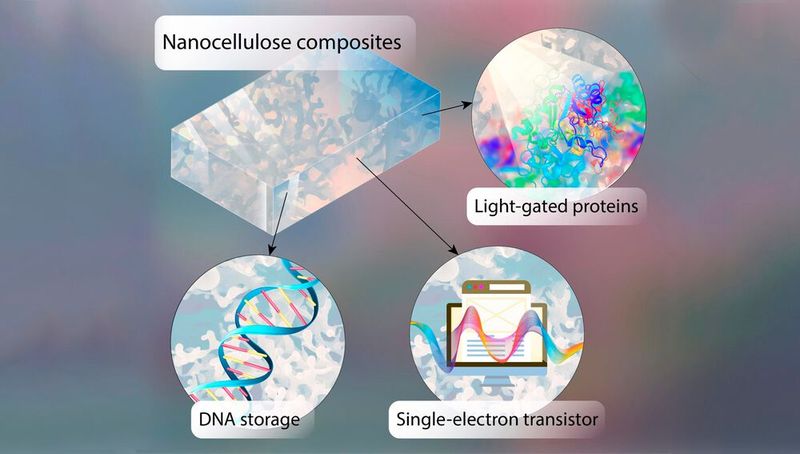
A team at Julius-Maximilians-Universität (JMU) Würzburg is developing DNA chips made from semiconducting, bacteria-produced nanocellulose.
(Image: Chair of Bioinformatics at the University of Würzburg)
The solution to limited storage and energy-intensive computing capacities could lie in the building blocks of life: DNA. The quaternary coding of DNA should create the necessary storage density and robustness for the upcoming data explosion.
Hyper-tight and mega-compact
One gram of DNA could theoretically store up to one billion gigabytes of information. This corresponds to a possible data storage capacity of several exabytes per cubic millimeter.
"A single coffee cup full of DNA would be enough to store all of humanity's digital data," says Mark Bathe, Professor of Biological Engineering at MIT and associate member of the Broad Institute of MIT and Harvard. This is because DNA is "around a thousand times denser than even [the most modern] flash memory", the researcher reveals.
In his view, another property of DNA as a storage medium is at least as important. As soon as the DNA polymer has been produced, the memory no longer consumes any energy. You can write the DNA and then store it forever, says Prof. Bathe.
So far, the costs have been prohibitively high.
DNA data storage is based on a chemical reaction known as DNA synthesis. Reading requires sequencing, a process to determine the exact order of nucleotides in an existing DNA strand. Both are lengthy laboratory processes. Practical application is also limited by very slow read and write times. To speed up the procedure, researchers are experimenting with modified approaches (see section "NAM-like nucleic acid memory").
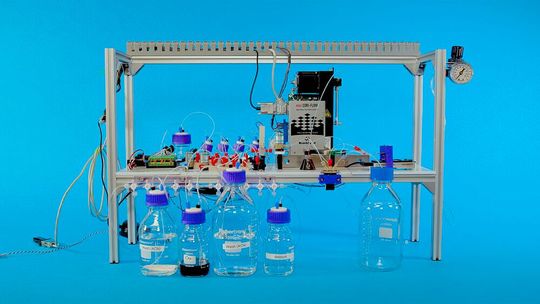
Microsoft and the University of Washington demonstrated the process of data archiving in DNA around six years ago with this automatic - and already historic - system.
(Image: Microsoft)
The molecular form of DNA resembles a double helix consisting of two antiparallel, complementary strands. The two strands have a phosphate-sugar skeleton. Within these strands are nitrogenous bases that are shaped like horizontal rungs and stacked on top of each other: Adenine (A), Thymine (T), Guanine (G) and Cytosine. With these bases (ATCG instead of zeros and ones), the number pairs 00, 01, 10 and 11 could be coded as A, T, C and G.
Conventional computers that make use of binary data coding work with a sequence of zeros and ones. These two values are represented by different states of electrons in a storage medium (either "on" or "off"), for example by the alignment of magnetic particles on a hard disk or by charged and uncharged states in a semiconductor. These states are known to be sensitive to interference, susceptible to physical defects, electromagnetic fields and the normal aging process. The approach has no inherent error correction - unlike DNA code.
The base pairs of DNA are complementary: adenine pairs with thymine; guanine with cytosine. Each of the two DNA strands is therefore a complete data replica of the other. This molecular construction of DNA is extremely resistant and has low energy requirements, even during writing and reading processes. It can regenerate itself. It can replicate itself and is also completely recyclable.
However, binary coding, which is used in information technology, is easier to handle as it is derived directly from the way electronic circuits work. Under optimal conditions, the integrity of the DNA code remains intact for thousands of years.
In DNA of all things
DNA computing aims to master information processing with synthetic DNA molecules. This emerging field of research has also recently made considerable progress, albeit primarily in medical applications.
In conventional silicon-based integrated circuits, binary-coded information flows through controlled electron movements along metallized conductor paths. The signals pass through logic gates consisting of pairs of CMOS transistors, which combine to form complex logic networks, consume a lot of energy and dissipate heat. Photonic chips (see the report "Under the hood of Q.ANT's photonic AI accelerator"), a promising alternative, replace electrons with photons; they handle light signals and make use of effects such as wavelength division multiplexing for native parallelism. What makes DNA computing different?
DNA-based information systems are based on biomolecular data processing - in other words, on biochemical reactions. The highlight is the massive parallelism of these emerging solutions with an unsurpassed storage density. One milliliter of DNA solution can perform ≈10¹⁸ parallel DNA operations; one gram of DNA theoretically records 455 exabytes of data.
DNA solutions (now in the double sense) can supplement or replace conventional silicon-based circuits in niche applications - namely where extreme parallelism, unsurpassed energy efficiency of the memory and top-class power density are required.
Date: 08.12.2025
Naturally, we always handle your personal data responsibly. Any personal data we receive from you is processed in accordance with applicable data protection legislation. For detailed information please see our privacy policy.
Consent to the use of data for promotional purposes
I hereby consent to Vogel Communications Group GmbH & Co. KG, Max-Planck-Str. 7-9, 97082 Würzburg including any affiliated companies according to §§ 15 et seq. AktG (hereafter: Vogel Communications Group) using my e-mail address to send editorial newsletters. A list of all affiliated companies can be found here
Newsletter content may include all products and services of any companies mentioned above, including for example specialist journals and books, events and fairs as well as event-related products and services, print and digital media offers and services such as additional (editorial) newsletters, raffles, lead campaigns, market research both online and offline, specialist webportals and e-learning offers. In case my personal telephone number has also been collected, it may be used for offers of aforementioned products, for services of the companies mentioned above, and market research purposes.
Additionally, my consent also includes the processing of my email address and telephone number for data matching for marketing purposes with select advertising partners such as LinkedIn, Google, and Meta. For this, Vogel Communications Group may transmit said data in hashed form to the advertising partners who then use said data to determine whether I am also a member of the mentioned advertising partner portals. Vogel Communications Group uses this feature for the purposes of re-targeting (up-selling, cross-selling, and customer loyalty), generating so-called look-alike audiences for acquisition of new customers, and as basis for exclusion for on-going advertising campaigns. Further information can be found in section “data matching for marketing purposes”.
In case I access protected data on Internet portals of Vogel Communications Group including any affiliated companies according to §§ 15 et seq. AktG, I need to provide further data in order to register for the access to such content. In return for this free access to editorial content, my data may be used in accordance with this consent for the purposes stated here. This does not apply to data matching for marketing purposes.
Right of revocation
I understand that I can revoke my consent at will. My revocation does not change the lawfulness of data processing that was conducted based on my consent leading up to my revocation. One option to declare my revocation is to use the contact form found at https://contact.vogel.de. In case I no longer wish to receive certain newsletters, I have subscribed to, I can also click on the unsubscribe link included at the end of a newsletter. Further information regarding my right of revocation and the implementation of it as well as the consequences of my revocation can be found in the data protection declaration, section editorial newsletter.
Applications of DNA computing range from molecular circuits for computational problems with NP-hard complexity to network flow algorithms with linear time complexity. Limitations lie in the slow execution speed of biochemical processes and in the special requirements of handling DNA.
DNA computers take advantage of the binding ability of base pairs (adenine pairs with thymine, and cytosine with guanine.) A short strand consisting of ATCG would bind to TAGC and not to other sequences.
If DNA molecules are mixed with specially designed sequences of bases, logic gates can be derived from this behavior. In this way, DNA can function as a biological logic gate through the clever combination of base pairs. For example:
Adenine (A) and thymine: an AND gate,
Cytosine (C) and guanine (G): an OR gate,
the **NOT function** could be implemented by the absence of a specific base pair.
The development of programmable arrays of logic gates represents a decisive obstacle on the way to widespread adoption (see the section "D(NA)PGAs").
"NAM-like" nucleic acid memory
"Nature does data compression on an amazing scale and in ways we still don't fully understand," observes Gurtej Sandhu, Principal Fellow and Vice President at memory specialist Micron Technology in Boise, Idaho.
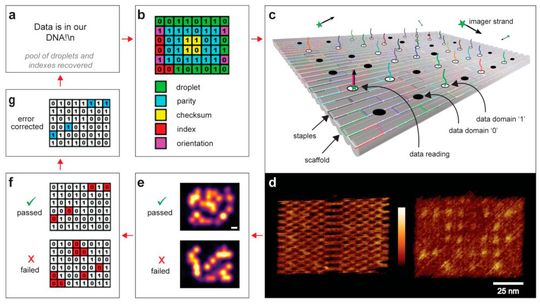
A promising candidate for DNA-based data storage is an approach called dNAM (digital nucleic acid memory), which makes use of an artificial nucleobase. The method encodes digital information in specific combinations of single-stranded DNA (so-called "staple strands") with (1) or without (0) docking site domains on DNA origami plug-in boards. These staple strands can assemble independently with a carrier DNA strand to form DNA origami structures - and are reusable.
The first dNAM prototype with DNA origami and DNA PAINT super-resolution microscopy was created at the University of Boise in the otherwise sleepy U.S. state of Idaho in collaboration with Micron Technology.
One of many approaches to data storage in DNA
(Image: Boise State University)
A working dNAM prototype successfully encoded the message "Data is in our DNA!\n" using DNA origami and reconstructed it using DNA PAINT super-resolution microscopy.
To do this, the data was first converted into a binary string and then coded into localization points on the matrix. The matrix designs are then assembled on DNA origami platforms. These platforms consist of stacking strands that self-assemble with the help of carrier DNA.
To read the information encoded in Origami, a device examines the binding of fluorescent imaging samples using DNA PAINT super-resolution microscopy. This procedure makes it possible to identify the individual "pins" (staple threads) in each matrix cell as 0 or 1. The data density is currently around 330 Gbit/cm².
The images of the patterns are post-processed by an error correction algorithm to enable 100% recovery of the original message. If individual docking sites or entire origami are missing, the data can be completely restored using an error correction algorithm. In contrast to other approaches to DNA-based data storage, DNA sequencing is not required here.
DNA memory chips from Würzburg
The research of Professor Thomas Dandekar's team at Julius-Maximilians-Universität (JMU) Würzburg focuses on DNA-based data storage using chips made of semiconducting, bacterially produced nanocellulose. It is not only reusable, it is also biodegradable. The researchers use fluorescence-based methods (DNA-PAINT microscopy) and light-controlled proteins to read out the data.
DNA chips from Würzburg achieve a storage density of up to one billion gigabytes per gram of DNA and are robust against electromagnetic pulses. The DNA does not require a continuous supply of energy. The researchers assume that the information archived on a DNA chip in this way is likely to be preserved for several thousand years.
D(NA)PGAs
Research groups have also already developed the first DNA-based programmable gate arrays for general DNA computation.
The concept borrows from classic FPGAs (Field Programmable Gate Arrays), but implements processing units with DNA building blocks at molecular level. Classic FPGAs consist of reconfigurable silicon-based logic blocks. DPGAs instead make use of DNA structures that rely on hybridization, polymerase reactions or enzyme-controlled cuts and connections.
A superchip with over 100 billion unique circuits? Sure, it's possible in DNA and the most normal thing in the world in nature.
DNA molecules can essentially flow in any direction. This makes it difficult to merge logic gates for calculations in programmed sequences and represents a major obstacle to DNA computing.
To overcome this problem, researchers are using DNA origami. This approach uses the ability of a DNA sequence to adhere to itself and bend into almost any desired 2D or 3D shape.
In the DNA computers, oligonucleotides (short DNA segments) move in test tubes in a similar way to electrons in conventional computers. As each DNA base binds to its specific counterpart, a loose DNA strand can fold in on itself and hold together - hence the term DNA origami.
In molecular information technology, DNA origami plays a key role as a structuring method to organize nanoscale computational elements - similar to the way registers are used in conventional silicon processors. But while registers store bits, the DNA strands (or conjugated molecules) represent logical states. They are accessed via a molecular address, for example on the basis of sequence complementarity.
DNA origami structures can integrate several DNA gates (logical gates) and switching logic. They switch under enzyme or temperature control. In these systems, the DNA origami not only takes over the physical arrangement, but also the logical coupling of the "register cells" - i.e. the molecules that carry the memory state.
A project at ETH Zurich and the University of Oxford combined DNA origami with fluorescent markers to make binary states (0/1) optically readable. The targeted addition of DNA key sequences made it possible to actively change the state of individual register cells - comparable to setting or resetting a bit.
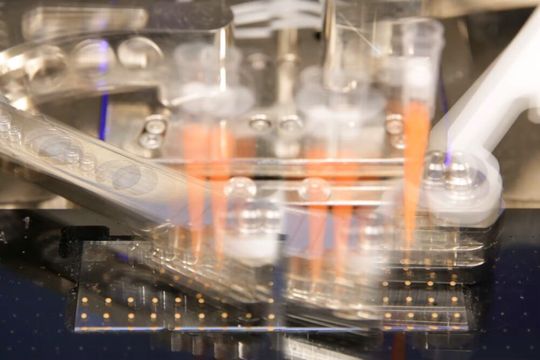
Getting down to business: researchers at Harvard University have developed a DNA storage method based on enzymatic DNA synthesis.
(Image: Wyss Institute at Harvard University)
Integration of electronics and photonics on DNA chips
Researchers at ETH Zurich have combined electronic and photonic components on a single chip. By using plasmonics, they forced light waves into extremely small structures, which significantly increases the miniaturization and speed of DNA chips. This technology enables faster and more efficient data transmission and processing. This promises advantages for the analysis of large genomic data sets, possibly in vivo.
First DNA computer memory
Researchers at North Carolina State University and Johns Hopkins University have developed a DNA technology that combines a whole range of data storage and processing functions, including repeated storage, retrieval, computation, deletion and overwriting of data.
Earlier DNA-based storage and computing technologies could only perform some of these tasks, but not all of them in combination.
"Until now, the assumption has been that while DNA holds promise for long-term data storage, it would be difficult or even impossible to develop a DNA-based technology that could replicate the full functionality of conventional electronic systems (...) and do it all in a programmable and repeatable way," comments Albert Keung, an associate professor of chemical and biomolecular engineering and Goodnight Distinguished Scholar at NC State University. This hurdle has now been overcome.
Conclusion
Liquid DNA computers and memories are approaching market maturity. DNA molecules can not only serve as carriers of genetic information, but can also form lines, transmit control commands and, like electrons, transmit signals within the circuits of a biological computer.
With DNA as a storage medium and computing engine, the boundaries of computer technology are being redrawn. A volumetric density that exceeds conventional flash memory by a factor of 1000 and a factor of 100 million(!) lower energy consumption compared to conventional technologies positions DNA memory as a serious technology that hopefully will not create bigger problems than it solves. We shall see. (mbf)
Anna Kobylinska and Filipe Pereia Martins work for McKinley Denali, Inc, USA.



:quality(80)/p7i.vogel.de/wcms/dd/08/dd086510d9ae7b50181f6070e4463b44/0129363730v1.jpeg "Typical application for ionizing devices: Wrapping films. (Picture: ©Adobe Stock/SMC)")
:quality(80)/p7i.vogel.de/wcms/35/57/3557c819943c53acec41a0ccba87da4f/0130049064v1.jpeg "Researchers at the Fraunhofer IWU in Chemnitz have long known that many typical sheet metal parts can be manufactured more cost-effectively using hollow embossing rollers. Now there is news to report ... (Image:Fraunhofer IWU)")
:quality(80)/p7i.vogel.de/wcms/59/02/590246e3b3f415c65edbee377c14ca77/26-06-pi-fraunhofer-iws-41450-direktplattieren-pic-01-7771x4369v1v1.jpeg "The Fraunhofer IWS has developed the new \"direct laser cladding\" process, which creates a functional layer directly on the base body by applying a strip-shaped metal to rotationally symmetrical components in a spiral and bonding it locally by laser. (Image:Christoph Wilsnack/Fraunhofer IWS)")
:quality(80)/p7i.vogel.de/wcms/73/60/73608418789b1d9c393f5e2fa974eda2/0130209906v1.jpeg "The robots of the X6 generation from b+m enable very high painting quality and are also particularly compact and easy to maintain. (Image:Beckhoff)")
:quality(80)/p7i.vogel.de/wcms/78/e9/78e9188c25a8a94e67c34c9bf8ffe495/visual-agile-20robots-20and-20google-20deepmind-20partner-20to-20bring-20intelligence-20to-20robotics-2500x1406v1v1.jpeg "Together, the partners are developing adaptable, intelligent robots for a wide range of applications (Image:Agile Robots SE)")
:quality(80)/p7i.vogel.de/wcms/e7/66/e7669ecf0260ae8fc54c214e34e4902a/0130316817v1.jpeg "Siemens and Palo Alto Networks offer tested cybersecurity solution for industrial 5G. (Image:Siemens)")
:quality(80)/p7i.vogel.de/wcms/9f/55/9f55324832c4f426958031375124d9de/siemens-20ubtech-20hmnd-1920x1079v1v1.png "Ready for the factory floor: While Ubtech is planning mass production, Siemens is already testing humanoids in real factory applications in Erlangen. (Image:Siemens)")
:quality(80)/p7i.vogel.de/wcms/11/36/113695ed260e29c8c2d9d39dc5f9d869/0130213768v1.jpeg "AI can work cheaply in China and deliver the results rapidly all over the world. (Image:Dall-E / AI-generated)")
:quality(80)/p7i.vogel.de/wcms/62/5f/625f41e87ebfef156a98c8e6393e32fd/0130211654v1.jpeg "Axial flux motors have some advantages over radial flux motor—but their production is currently still expensive. (Image:RWTH Aachen University)")
:quality(80)/p7i.vogel.de/wcms/77/9b/779b0685d010dfe45c9c2cb1cfecd467/0128886425v1.jpeg "The BlueEye is the first \"real\" hyperspectral camera for the UV range and covers the wavelength range from 220 to 380nm. (Image:Inno-spec GmbH)")
:quality(80)/p7i.vogel.de/wcms/e4/51/e451d52ce0182fb0aaa46a5774f832ef/26-04-pi-fraunhofer-iws-21160-bioslide-pic-01-4128x2321v1v1.jpeg "With the BioSlide research project, the Fraunhofer IWS is investigating how sliding systems can be designed to be more sustainable and energy-efficient. New materials can be tested in a particularly application-oriented manner on this plain bearing test stand. (Image:Fraunhofer IWS)")
![Thanks to advanced 3D printing technology, a more efficient use of resources should contribute to lower-emission aviation—this is the goal of ['skai]-lab. (Image:Oleksandr Pashchenko - stock.adobe.com / AI-generated)](https://cdn1.vogel.de/nghHNSbySccfOjG3n1qCA-FVOjQ=/288x162/smart/filters:format(jpg):quality(80)/p7i.vogel.de/wcms/62/64/626424c97a16e69f871bf216c9629c2a/adobestock-1927043193--c2-a9-20oleksandr-20pashchenko-20-e2-80-93-20stock-adobe-com-ki-generiertv1v1.jpeg "Thanks to advanced 3D printing technology, a more efficient use of resources should contribute to lower-emission aviation—this is the goal of ['skai]-lab. (Image:Oleksandr Pashchenko - stock.adobe.com / AI-generated)")
:quality(80)/p7i.vogel.de/wcms/b6/62/b662adc2cec8227d8172509bbfb6ee42/25c0207-107-4961x2789v1v1.jpeg "The GLB is the second model based on Mercedes' new MMA platform. Apparently, Geely's platform is better and cheaper, which is why the two companies are negotiating a partnership. (Image:Mercedes-Benz)")
:quality(80)/p7i.vogel.de/wcms/c1/79/c179ce9acd000e7cf48318e03e3fe4da/0130333964v1.jpeg "Magna is expanding its hybrid portfolio with the DHD REX, a dedicated hybrid drive for REEVs. (Image:Magna)")
:quality(80)/p7i.vogel.de/wcms/80/c2/80c2ea3fbe2df808a263d99adad93f66/0130160344v1.jpeg "Francois Provost has been CEO of Renault since summer 2025. (Image:Renault)")
:quality(80)/p7i.vogel.de/wcms/8d/f8/8df87aa10e28419e1869acb641b4c4dd/0130324805v1.jpeg "With the Affela 1 in the Signature Edition, the Sony Honda Mobility joint project was to be launched in a few months' time. (Image:SHM)")
:quality(80)/p7i.vogel.de/wcms/4d/dd/4dddf438e91f394c04a095dbfd109d1c/0130236430v1.jpeg "Measurement modules: The 720301 module in combination with the SL2000 enables RMS and power calculations, among other things. (Image:Yokogawa)")
:quality(80)/p7i.vogel.de/wcms/61/fc/61fcf95f5cca15494ad18343901ae585/0130317237v1.jpeg "With the AGI CPU, Arm says it is taking a \"historic step\": With the processor aimed at AI in data centers, the company is presenting itself for the first time as a provider of its own chips, not just as a pure IP licensor. (Image:Arm)")
:quality(80)/p7i.vogel.de/wcms/82/90/8290dfe3595b6c6b33726ae8b76172c7/0130319587v1.jpeg "The concept image illustrates how the pattern of tiny protrusions and depressions created on the substrate (MgO, bottom) controls the arrangement of atoms in the superconducting material (YBCO, top). At the interface between the two layers, an electronic structure enables superconductivity to occur at higher temperatures than previously possible. (Image:Chalmers University of Technology / Riccardo Arpaia)")
:fill(fff,0)/p7i.vogel.de/companies/67/eb/67eba621ef6ea/logo2.png "logo2 (Wuxi InfiMotion)")
:quality(80)/p7i.vogel.de/wcms/2e/be/2ebe7a3fd5bc91773110a9b66e3e95cf/86592347v1.jpeg "Quantum computers exploit quantum mechanical effects such as superposition and entanglement to deliver enormous computing power. (Image:public domain)")
:quality(80)/p7i.vogel.de/wcms/cb/8a/cb8ae7f5205365efce3e7285154fc3cf/0130132198v1.jpeg "Markus Huber (left) and Nicolai Friis from TU Wien know how to make quantum computers multidimensional in order to perform computing operations even better. (Image:TU Vienna / A. Rommel)")