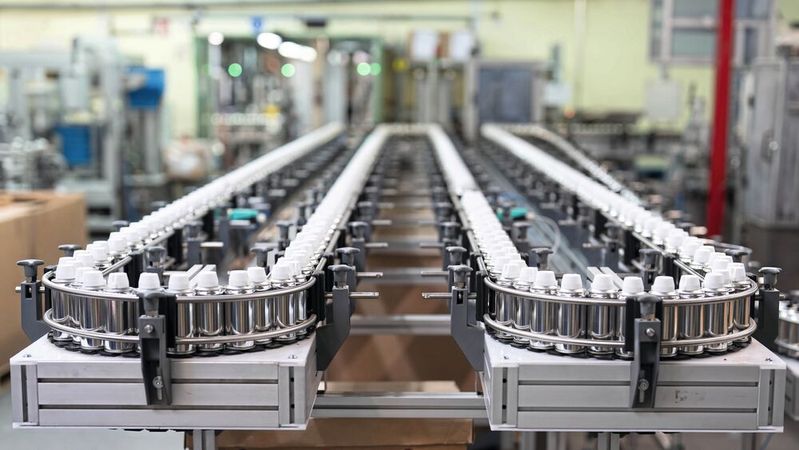
At a leading manufacturer of spray paints, link chain conveyors from Minitec ensure that the spray cans are reliably transported on their way through production and buffered if necessary.
An advantage of Minitec's link chain conveyors: They allow for very small curve radii, enabling a high buffer volume of the spray cans.
(Image: Minitec)
Professional paint aerosol systems are the domain of Peter Kwasny GmbH. The family-run company with 450 employees produces paint sprays, touch-up pens, and preparatory products for various requirements and markets. Around 35 million spray paint cans leave the factory each year. Customers include the international automotive and paint industries, specialist retailers, manufacturing industries, and DIY stores. In addition to the headquarters in Gundelsheim near Heilbronn, there is a logistics center in Sinsheim and several foreign branches.
From Mixing the Paints to Packaging the Cans
The production features a very high level of vertical integration, ranging from mixing the paints to the final labeled can. After manufacturing and refining, the paints are first placed in containers of various sizes, from IBCs (Intermediate Bulk Containers) to five-liter buckets. Next, they proceed to aerosol filling. After filling the spray cans, they are sealed with valves and gassed. In the next area, packaging occurs, which involves attaching the spray cap and applying the label and coding. Finally, the finished products are palletized in an automatic carton sealing machine.
The collaboration with Minitec GmbH has been ongoing for quite some time. Michael Seidler, senior plant engineer at Kwasny, recalls: "We began in 2016 with a project where we equipped inline scales and spray head machines with chain conveyors. Behind the machines, we set up accumulation routes where the cans are buffered for the next assembly step. Two years later, we expanded this configuration with larger conveyor lines across multiple lines. All four inline scales and all four spray head machines were equipped with them. In 2020, a new machine was added, our 2K special production, where we equip a spray can with a hardener cartridge. This entire plant, including the complete transport and rotation process of cans, was again fully linked by Minitec."
Quality Assurance According to the Production Sequence
Kwasny has an inline production where the spray cans are manufactured "first in, first out." They must be evaluated by quality assurance according to the production sequence and coded with date and time. Here, the Minitec chain conveyors have proven to be the best solution because they ensure that the cans are smoothly transported in line.
Previously, Kwasny used conveyor paths based on steel frames, which are increasingly being replaced by Minitec systems. The reasons for this are diverse, says Michael Seidler: "One advantage of Minitec chain conveyors is that they allow very small curve radii, which enables tighter buffering. Additionally, the path can easily be redirected and continued in another direction. And since we are very cramped, we can easily install a step or deviate a bit to the left or right, and not just run in a straight line. Another advantage is the flexibility of the Minitec system. Since we frequently reconfigure details in the production processes, the machines can be easily connected to the profile system, allowing us to integrate small additional solutions like stoppers very easily. With the stainless steel sheets, changes always required drilling holes, which sometimes look like Swiss cheese. Last but not least, the Minitec conveyors are easy to clean. With paints, a small accident can happen quickly, like a spill somewhere. Such contaminations can be easily removed from the aluminum profiles, and that is also why we are very satisfied with this system."
Further Increase Productivity
To meet the increased demand for its spray cans, Kwasny needed to further boost its productivity. Therefore, the company aimed to further automate the existing line. As the latest project, in early 2024, a buffering line for the last remaining assembly line was initiated. The packaging of the cartons is currently still done manually but will soon also be automated. For this, the buffering line from Minitec was necessary to buffer the spray cans during format changes.
In the latest system, in addition to a regular GKF route, a unit with an inclined conveyor is also used. Michael Seidler explains: "The reason we went vertical for the first time was due to the lack of space. There simply wasn't enough room to buffer the cans. By implementing the concept of conveying the workpieces up and then down again, we gain a tremendous amount of capacity in a very confined space." Another measure for space saving and optimal space utilization in the new system was raising the preceding normal conveyor line to allow large cartons of material to be stored beneath the conveyor.
Space-Saving Vertical Buffering
The buffer capacity has increased enormously with the new system. Up to 400 cans can be buffered on the route before packaging—depending on their diameter. On the route with the vertical buffer, which runs between the packaging and the planned packaging system, up to 600 cans can even be parked.
The entire project was completed within a few months. Michael Seidler praises the good cooperation: "It went very smoothly, Minitec is always easy to reach. The exchange of drawings and agreements worked very well. The on-site assembly was also completely seamless, everything fit perfectly."
Date: 08.12.2025
Naturally, we always handle your personal data responsibly. Any personal data we receive from you is processed in accordance with applicable data protection legislation. For detailed information please see our privacy policy.
Consent to the use of data for promotional purposes
I hereby consent to Vogel Communications Group GmbH & Co. KG, Max-Planck-Str. 7-9, 97082 Würzburg including any affiliated companies according to §§ 15 et seq. AktG (hereafter: Vogel Communications Group) using my e-mail address to send editorial newsletters. A list of all affiliated companies can be found here
Newsletter content may include all products and services of any companies mentioned above, including for example specialist journals and books, events and fairs as well as event-related products and services, print and digital media offers and services such as additional (editorial) newsletters, raffles, lead campaigns, market research both online and offline, specialist webportals and e-learning offers. In case my personal telephone number has also been collected, it may be used for offers of aforementioned products, for services of the companies mentioned above, and market research purposes.
Additionally, my consent also includes the processing of my email address and telephone number for data matching for marketing purposes with select advertising partners such as LinkedIn, Google, and Meta. For this, Vogel Communications Group may transmit said data in hashed form to the advertising partners who then use said data to determine whether I am also a member of the mentioned advertising partner portals. Vogel Communications Group uses this feature for the purposes of re-targeting (up-selling, cross-selling, and customer loyalty), generating so-called look-alike audiences for acquisition of new customers, and as basis for exclusion for on-going advertising campaigns. Further information can be found in section “data matching for marketing purposes”.
In case I access protected data on Internet portals of Vogel Communications Group including any affiliated companies according to §§ 15 et seq. AktG, I need to provide further data in order to register for the access to such content. In return for this free access to editorial content, my data may be used in accordance with this consent for the purposes stated here. This does not apply to data matching for marketing purposes.
Right of revocation
I understand that I can revoke my consent at will. My revocation does not change the lawfulness of data processing that was conducted based on my consent leading up to my revocation. One option to declare my revocation is to use the contact form found at https://contact.vogel.de. In case I no longer wish to receive certain newsletters, I have subscribed to, I can also click on the unsubscribe link included at the end of a newsletter. Further information regarding my right of revocation and the implementation of it as well as the consequences of my revocation can be found in the data protection declaration, section editorial newsletter.
System Brings Noticeable improvement
After three months of practical operation, the senior plant engineer notes that the system is running very well so far: "Of course, the system will only be complete once the new automatic packaging line is implemented. But even now, the Minitec system brings a noticeable improvement. We can buffer more. The hustle and bustle of the employees have subsided. Since there are larger buffer areas, they can now approach a disturbance without stress because the entire system doesn't come to a halt immediately. That's what the buffers were intended for, and it works very well."
In general, with Minitec projects, the design of the respective conveyor solution and the division of tasks vary from case to case, says Seidler: "Sometimes we have just a conveyor system with a drive motor, and in other cases, control is also associated with it. Everything happens hand in hand in close coordination and collaboration. In the latest system, the control cabinets also came from Minitec. Kwasny created and integrated a few interfaces for this. Where another stopper needs to be set, etc., so that the pressure accumulation on the can isn't too high. This was slightly reconfigured by our electricians because it's only when the machines are installed in the production process that you really see where something additional might be needed."
Further Projects Planned
Due to the consistently successful collaboration in recent years, the next projects with Minitec are already in planning, says Seidler: "On one hand, we will convert several more conveyor lines from steel belts to the Minitec system. Additionally, we are currently planning an automatic depalletizer that places empty cans on an assembly table. And since, as mentioned, we are very cramped in the hall, an 'Omega conveyor' is also being coordinated, which elevates and lowers the cans, creating a passageway. So, there is still plenty to do."



:quality(80)/p7i.vogel.de/wcms/dd/08/dd086510d9ae7b50181f6070e4463b44/0129363730v1.jpeg "Typical application for ionizing devices: Wrapping films. (Picture: ©Adobe Stock/SMC)")
:quality(80)/p7i.vogel.de/wcms/35/57/3557c819943c53acec41a0ccba87da4f/0130049064v1.jpeg "Researchers at the Fraunhofer IWU in Chemnitz have long known that many typical sheet metal parts can be manufactured more cost-effectively using hollow embossing rollers. Now there is news to report ... (Image:Fraunhofer IWU)")
:quality(80)/p7i.vogel.de/wcms/59/02/590246e3b3f415c65edbee377c14ca77/26-06-pi-fraunhofer-iws-41450-direktplattieren-pic-01-7771x4369v1v1.jpeg "The Fraunhofer IWS has developed the new \"direct laser cladding\" process, which creates a functional layer directly on the base body by applying a strip-shaped metal to rotationally symmetrical components in a spiral and bonding it locally by laser. (Image:Christoph Wilsnack/Fraunhofer IWS)")
:quality(80)/p7i.vogel.de/wcms/73/60/73608418789b1d9c393f5e2fa974eda2/0130209906v1.jpeg "The robots of the X6 generation from b+m enable very high painting quality and are also particularly compact and easy to maintain. (Image:Beckhoff)")
:quality(80)/p7i.vogel.de/wcms/78/e9/78e9188c25a8a94e67c34c9bf8ffe495/visual-agile-20robots-20and-20google-20deepmind-20partner-20to-20bring-20intelligence-20to-20robotics-2500x1406v1v1.jpeg "Together, the partners are developing adaptable, intelligent robots for a wide range of applications (Image:Agile Robots SE)")
:quality(80)/p7i.vogel.de/wcms/e7/66/e7669ecf0260ae8fc54c214e34e4902a/0130316817v1.jpeg "Siemens and Palo Alto Networks offer tested cybersecurity solution for industrial 5G. (Image:Siemens)")
:quality(80)/p7i.vogel.de/wcms/9f/55/9f55324832c4f426958031375124d9de/siemens-20ubtech-20hmnd-1920x1079v1v1.png "Ready for the factory floor: While Ubtech is planning mass production, Siemens is already testing humanoids in real factory applications in Erlangen. (Image:Siemens)")
:quality(80)/p7i.vogel.de/wcms/11/36/113695ed260e29c8c2d9d39dc5f9d869/0130213768v1.jpeg "AI can work cheaply in China and deliver the results rapidly all over the world. (Image:Dall-E / AI-generated)")
:quality(80)/p7i.vogel.de/wcms/62/5f/625f41e87ebfef156a98c8e6393e32fd/0130211654v1.jpeg "Axial flux motors have some advantages over radial flux motor—but their production is currently still expensive. (Image:RWTH Aachen University)")
:quality(80)/p7i.vogel.de/wcms/77/9b/779b0685d010dfe45c9c2cb1cfecd467/0128886425v1.jpeg "The BlueEye is the first \"real\" hyperspectral camera for the UV range and covers the wavelength range from 220 to 380nm. (Image:Inno-spec GmbH)")
:quality(80)/p7i.vogel.de/wcms/e4/51/e451d52ce0182fb0aaa46a5774f832ef/26-04-pi-fraunhofer-iws-21160-bioslide-pic-01-4128x2321v1v1.jpeg "With the BioSlide research project, the Fraunhofer IWS is investigating how sliding systems can be designed to be more sustainable and energy-efficient. New materials can be tested in a particularly application-oriented manner on this plain bearing test stand. (Image:Fraunhofer IWS)")
![Thanks to advanced 3D printing technology, a more efficient use of resources should contribute to lower-emission aviation—this is the goal of ['skai]-lab. (Image:Oleksandr Pashchenko - stock.adobe.com / AI-generated)](https://cdn1.vogel.de/nghHNSbySccfOjG3n1qCA-FVOjQ=/288x162/smart/filters:format(jpg):quality(80)/p7i.vogel.de/wcms/62/64/626424c97a16e69f871bf216c9629c2a/adobestock-1927043193--c2-a9-20oleksandr-20pashchenko-20-e2-80-93-20stock-adobe-com-ki-generiertv1v1.jpeg "Thanks to advanced 3D printing technology, a more efficient use of resources should contribute to lower-emission aviation—this is the goal of ['skai]-lab. (Image:Oleksandr Pashchenko - stock.adobe.com / AI-generated)")
:quality(80)/p7i.vogel.de/wcms/c3/c4/c3c4ce270b083eeac55654148611f064/0130237945v1.jpeg "China is not giving up on hydrogen, but is intensifying its efforts. (Image:freely licensed from Pixabay)")
:quality(80)/p7i.vogel.de/wcms/4e/c0/4ec0bd19390b169edfa23677373dcdf1/0130260089v1.jpeg "Renewable fuels can supply European road traffic, according to a study. (Image:Aral)")
:quality(80)/p7i.vogel.de/wcms/6f/c9/6fc9050301d745cad25585c6780f8f51/0130197341v1.jpeg "Production facilities are a worthwhile target and are therefore at risk. (Image:ABB Robotics)")
:quality(80)/p7i.vogel.de/wcms/b6/62/b662adc2cec8227d8172509bbfb6ee42/25c0207-107-4961x2789v1v1.jpeg "The GLB is the second model based on Mercedes' new MMA platform. Apparently, Geely's platform is better and cheaper, which is why the two companies are negotiating a partnership. (Image:Mercedes-Benz)")
:quality(80)/p7i.vogel.de/wcms/4d/dd/4dddf438e91f394c04a095dbfd109d1c/0130236430v1.jpeg "Measurement modules: The 720301 module in combination with the SL2000 enables RMS and power calculations, among other things. (Image:Yokogawa)")
:quality(80)/p7i.vogel.de/wcms/61/fc/61fcf95f5cca15494ad18343901ae585/0130317237v1.jpeg "With the AGI CPU, Arm says it is taking a \"historic step\": With the processor aimed at AI in data centers, the company is presenting itself for the first time as a provider of its own chips, not just as a pure IP licensor. (Image:Arm)")
:quality(80)/p7i.vogel.de/wcms/82/90/8290dfe3595b6c6b33726ae8b76172c7/0130319587v1.jpeg "The concept image illustrates how the pattern of tiny protrusions and depressions created on the substrate (MgO, bottom) controls the arrangement of atoms in the superconducting material (YBCO, top). At the interface between the two layers, an electronic structure enables superconductivity to occur at higher temperatures than previously possible. (Image:Chalmers University of Technology / Riccardo Arpaia)")
:fill(fff,0)/images.vogel.de/vogelonline/companyimg/76800/76895/65.jpg "FAULHABER_120mm.jpg ()")
:fill(fff,0)/p7i.vogel.de/companies/69/88/69882c428938e/tmts2026-ticec-banner-en-2000px.png "tmts2026-ticec-banner-en-2000px (https://www.tmts.tw/en)")
:fill(fff,0)/p7i.vogel.de/companies/67/eb/67eba621ef6ea/logo2.png "logo2 (Wuxi InfiMotion)")
:quality(80)/p7i.vogel.de/wcms/e9/4b/e94b8b024c1cdd10568277bdf9e60828/0124665600v1.jpeg "In the latest system, in addition to a standard GKF line, a unit with an incline conveyor is also used.(Image: Minitec)")
:quality(80)/p7i.vogel.de/wcms/42/77/4277a2dbdcd8f93123d5c60b33d5da76/0124665597v1.jpeg "Michael Seidler is convinced of the advantages of the Minitec solution.(Image: Minitec)")
:quality(80)/p7i.vogel.de/wcms/ea/7b/ea7b89ea46485c079d24e32a66955ee0/0124666215v1.jpeg "Solution in a confined space: By conveying upwards, the buffer capacity has increased enormously.(Image: +++ Various Values +++ GKF)")
:quality(80)/p7i.vogel.de/wcms/62/53/6253a533adc23d0db235434f9d7c8766/0124665573v1.jpeg "The upstream, standard conveyor line was elevated to allow for the storage of large boxes of material underneath the conveyor line.(Image: Minitec)")
:quality(80):fill(efefef,0)/p7i.vogel.de/wcms/67/ad/67adf92d254d2/elatec-wp-smart-factory.png "Elatec WP Smart Factory")
:quality(80)/p7i.vogel.de/wcms/5e/47/5e47efbcf1fcb05112b89b96157fb024/0123946657v1.jpeg "With its 75 meters in length and a production volume of 122,000 tons per year, the preservation line KON 47/3-HD is a powerhouse. (Image:Rösler)")
:quality(80)/p7i.vogel.de/wcms/d4/ba/d4bab9481e66f8570f40eb8ef2a90198/0129795613v1.jpeg "A camera inspection during removal ensures that the components are placed correctly in the KLTs. (Image:Yaskawa Europe)")